
Learn Pronunciation Features in IELTS Speaking
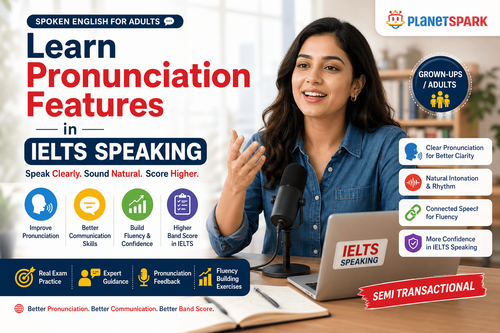

Table of Contents
- Master IELTS Speaking with Advanced Pronunciation Features
- Build Natural IELTS Speaking Confidence with PlanetSpark Pra
- Why Pronunciation Matters in IELTS Speaking
- Fluency Building Exercises IELTS Candidates Should Practice
- Build Exam-Ready IELTS Speaking Habits with PlanetSpark Guid
- Why Strong Pronunciation is the Key to a Higher IELTS Speaki
- Enhance IELTS Communication Skills with PlanetSpark Today
- Master IELTS Speaking with Consistent Practice
Struggling to speak clearly and confidently in IELTS speaking is one of the biggest challenges for adult learners, even when they know English well. Poor pronunciation, hesitation, and lack of fluency often reduce band scores and confidence.
This blog focuses on improving IELTS speaking through pronunciation features, spoken English for adults, and practical communication skills for IELTS. You will also learn effective fluency building exercises IELTS and strategies to boost confidence in IELTS speaking test. For structured learning and guided practice, platforms like PlanetSpark also help learners build strong speaking skills through expert-led training. Let’s start with why pronunciation matters in IELTS success.
Master IELTS Speaking with Advanced Pronunciation Features
Strong pronunciation is one of the most important factors in scoring well in IELTS speaking. Many adult learners know grammar and vocabulary, but still lose marks because their speech lacks clarity, natural rhythm, and confidence. Good pronunciation is not about having a British or American accent, it is about being easily understood without effort from the listener.
In IELTS speaking, examiners listen closely to how naturally you speak, how clearly you pronounce words, and how well your ideas flow. Even small improvements in pronunciation can significantly improve your band score and overall impression.
To truly master pronunciation, you need to focus on the key features that shape natural spoken English:
1. Word Stress and Syllable Emphasis
Every word has a stressed syllable, and placing stress correctly makes speech clearer. For example, saying “PHO-to-graph” instead of flat pronunciation improves understanding instantly. Incorrect stress can confuse listeners even if vocabulary is correct.
2. Sentence Stress for Meaning
In natural speech, not all words are spoken equally. Important words like nouns and verbs are stressed, while smaller words are softer. This helps highlight meaning and makes answers sound more natural in IELTS speaking.
Want to improve your English speaking skills?
Join PlanetSpark Spoken English Classes.
Book your free trial today.
3. Intonation and Voice Movement
Intonation refers to the rise and fall of your voice. A flat tone sounds robotic, while natural variation shows confidence. Practicing intonation helps express emotions, opinions, and clarity in answers.
4. Connected Speech for Fluency
Native speakers link words together instead of speaking slowly word by word. For example, “going to” becomes “gonna” in natural speech. Practicing connected speech improves flow and boosts fluency in spoken English for adults.
5. Clear Individual Sounds
Mispronounced vowels and consonants can change meaning completely. Focus on difficult sounds like “th”, “v”, and short vs long vowels to improve clarity and reduce errors.
6. Rhythm and Natural Flow
English has a natural rhythm that comes from stressed and unstressed words. Practicing rhythm helps your speech sound smoother and more confident, which is essential for communication skills for IELTS.
When you consistently work on these pronunciation features, your speech becomes clearer, more natural, and easier to follow. This directly improves your ability to answer confidently in real exam situations. It also strengthens confidence in IELTS speaking test, especially when speaking under pressure.
With regular practice and guided support, learners can train their mouth, ears, and mind to speak English naturally. Over time, this leads to better fluency, stronger communication, and higher IELTS speaking band scores.
Build Natural IELTS Speaking Confidence with PlanetSpark Practice Sessions
Many learners preparing for IELTS speaking know what to say, but struggle with how to say it naturally under time pressure. Pronunciation breaks, hesitation, and lack of fluency often reduce performance even when ideas are strong. This gap between knowledge and real speaking ability is where most candidates lose marks and confidence.
PlanetSpark helps learners overcome this challenge through structured, real-time speaking practice designed specifically for IELTS improvement. Instead of memorizing answers, learners practice speaking in guided sessions that focus on fluency, clarity, and natural expression.
With consistent practice at PlanetSpark, learners develop:
- Strong spoken English for adults through regular speaking exposure
- Improved communication skills for IELTS using real-life topics and discussions
- Better fluency through interactive speaking drills and corrections
- Higher confidence in IELTS speaking test by simulating exam-like conditions
- Natural pronunciation habits through repeated guided practice
This practical learning approach ensures that learners don’t just understand English, but actually use it confidently in real situations. Over time, speaking becomes more natural, structured, and effortless, leading to better IELTS performance and stronger overall communication ability.
Want to speak English fluently and confidently?
Join PlanetSpark Communication Skills Program.
Start your free demo class now.
Why Pronunciation Matters in IELTS Speaking
Pronunciation plays a major role in determining your IELTS speaking band score because examiners are not only evaluating what you say, but also how easily they can understand you. Even if your grammar is correct and your vocabulary is strong, unclear pronunciation can reduce your overall performance. Many learners underestimate this and focus only on memorizing answers, which often leads to low fluency and hesitation during the test.
Good pronunciation ensures that your ideas are delivered clearly without the need for repetition or explanation. It improves the natural flow of speech, making your answers sound more confident, structured, and easy to follow. When pronunciation is strong, your speech feels more effortless and professional, which directly improves your impression on the examiner.
For adults working on spoken English for adults, pronunciation acts as a bridge between what you know and how effectively you express it. It helps convert thoughts into clear spoken communication, especially in high-pressure situations like the IELTS exam.
- Improves clarity and reduces miscommunication during responses
- Enhances fluency and creates a natural speech rhythm
- Helps you sound more confident and organized while speaking
- Supports stronger communication skills for IELTS in all speaking parts
- Reduces hesitation by making speech more automatic and natural
- Increases overall band score by improving listening ease for examiners
Strong pronunciation also helps in Part 1, Part 2, and Part 3 of the IELTS speaking test, where quick thinking and clear expression are essential. When you pronounce words correctly, your brain focuses less on struggling with sounds and more on forming better ideas.
Overall, understanding and improving pronunciation features is one of the fastest ways to boost your IELTS speaking performance. It builds confidence, improves clarity, and creates a strong foundation for achieving higher band scores consistently.
Fluency Building Exercises IELTS Candidates Should Practice
Fluency is one of the most important scoring criteria in IELTS speaking, and it cannot be improved through theory alone. It requires consistent practice that helps you think directly in English, respond quickly, and speak without unnatural pauses. Many learners know the answers but lose marks because they hesitate, translate from their native language, or stop frequently while speaking.
Effective fluency building exercises IELTS help you overcome these issues by training your brain and speech muscles to respond faster and more naturally. With regular practice, your speech becomes smoother, more confident, and easier to understand, which directly improves your overall band score.
Here are some highly effective exercises you should practice daily:
1. Timed Speaking Practice on Random Topics
Pick any IELTS topic like education, travel, or technology and speak for 1–2 minutes without preparation. This builds spontaneity and helps you think quickly in real exam conditions.
2. Shadowing Native Speakers
Listen to native English speakers and repeat exactly after them, copying their rhythm, stress, and intonation. This improves pronunciation, flow, and natural speaking style, which is essential for spoken English for adults.
3. Daily Storytelling Practice
Choose simple daily experiences or imaginary situations and narrate them in English. This improves sentence formation, creativity, and helps you build strong communication skills for IELTS.
4. Non-Stop Speaking Drill
Speak on any topic continuously for at least 2 minutes without stopping. Even if you make mistakes, keep going. This builds confidence and reduces hesitation in IELTS speaking.
5. Question-Answer Simulation
Practice answering common IELTS questions quickly without overthinking. This improves reaction time and prepares you for real exam pressure.
These exercises train your brain to stop translating from your native language and start thinking directly in English. Over time, this improves speech flow, reduces pauses, and makes your answers sound more natural and confident.
Consistent practice not only enhances fluency but also builds strong confidence in IELTS speaking test, helping you perform better in all parts of the exam.
Want to improve pronunciation and clarity in English?
Join PlanetSpark English Speaking Classes.
Book your free trial session today!
Build Exam-Ready IELTS Speaking Habits with PlanetSpark Guidance
Improving IELTS speaking is not only about learning pronunciation rules or doing exercises, but also about building the right speaking habits under exam pressure. Many learners perform well in practice but lose confidence during the actual test because they are not trained for real-time thinking and structured responses.
PlanetSpark focuses on developing these exam-ready habits through guided speaking practice that mirrors real IELTS conditions. Learners are encouraged to think, speak, and respond in English naturally without over-reliance on memorized answers. This helps them become more spontaneous and fluent in real conversations.
Through consistent practice, learners improve:
- Natural response formation for IELTS speaking questions
- Real-time thinking skills for faster answer delivery
- Clear expression using strong communication skills for IELTS
- Smooth speaking flow that reduces hesitation and pauses
- Overall spoken English for adults through practical usage
This approach helps learners shift from “prepared answers” to “confident speaking,” which is essential for achieving higher band scores. Over time, they develop the ability to speak clearly, stay calm, and handle any IELTS question with ease.

Why Strong Pronunciation is the Key to a Higher IELTS Speaking Band Score
Pronunciation is one of the most important factors in your IELTS speaking performance because examiners focus not just on what you say, but on how clearly and naturally you are understood. Even if your grammar is accurate and vocabulary is strong, unclear pronunciation can lower your score and make your answers harder to follow. Many learners ignore this and focus only on memorizing answers, which often leads to hesitation and broken fluency during the test.
Good pronunciation ensures that your ideas are delivered smoothly without repetition or confusion. It improves the natural flow of speech, making your answers sound more confident, structured, and easy to understand. When your pronunciation is strong, your speech feels effortless, which creates a positive impression on the examiner and improves overall scoring potential.
For adults improving spoken English for adults, pronunciation becomes the link between knowledge and expression. It helps transform thoughts into clear spoken communication, especially in pressure situations like the IELTS exam where quick thinking is required.
Why pronunciation directly impacts your IELTS score:
- Improves clarity and reduces chances of miscommunication
- Enhances fluency and creates a natural speaking rhythm
- Makes you sound more confident and organized during responses
- Strengthens overall communication skills for IELTS across all parts
- Reduces hesitation by improving speech flow and automatic response
- Helps examiners understand answers easily, improving band score potential
Strong pronunciation is essential in all parts of IELTS speaking—whether it is Part 1 introductions, Part 2 cue cards, or Part 3 discussions. When pronunciation is accurate, your mind focuses less on sounding correct and more on expressing ideas clearly and logically.
Ultimately, mastering pronunciation features is one of the fastest and most effective ways to improve your IELTS speaking performance. It builds confidence, improves fluency, and creates a strong foundation for achieving higher band scores consistently.
Want to build confidence in real-life English conversations?
Join PlanetSpark Fluency Building Program.
Reserve your free class now.
Enhance IELTS Communication Skills with PlanetSpark Today
Improving IELTS speaking requires more than self-study and practice exercises. Many adult learners struggle with hesitation, lack of structure, and unclear pronunciation, which directly impacts their band score. To overcome these challenges, a guided and practical learning approach becomes essential.
PlanetSpark IELTS programs are designed to help learners build real speaking ability through structured training and continuous practice. The focus is not just on learning English, but on developing the confidence to speak clearly, naturally, and effectively in exam conditions.
The program specifically addresses common challenges faced by learners such as hesitation while speaking, limited fluency, and difficulty in expressing ideas under pressure. With expert guidance and consistent practice, learners gradually improve their ability to think in English and respond with confidence.
- Live interactive speaking sessions that build real-time response skills
- Expert IELTS trainers who provide targeted guidance and corrections
- Real exam-style practice to simulate actual IELTS speaking conditions
- Personalized pronunciation feedback to improve clarity and accuracy
- Confidence-building speaking exercises to reduce fear and hesitation
- Structured IELTS-focused curriculum designed for measurable improvement
- Practical fluency activities that enhance natural speaking flow
Through this structured approach, learners develop strong communication skills for IELTS, improve spoken English for adults, and build the confidence in IELTS speaking test needed to achieve higher band scores consistently.

Master IELTS Speaking with Consistent Practice
Improving IELTS speaking requires patience, daily practice, and the right strategies. By focusing on pronunciation, fluency, and communication skills, learners can significantly improve their performance. Consistent effort helps build natural speaking ability and reduces exam pressure.
With the right practice methods and mindset, adults can transform their speaking skills and achieve higher confidence in real-life and exam situations. The key is to keep practicing and stay consistent in your learning journey.
Also read- Spoken English: Ways to Improve Your Speaking Skills
Frequently Asked Questions
Key skills include pronunciation, fluency, vocabulary, and strong communication skills for IELTS. These help improve clarity and confidence.
Regular practice, reading aloud, and speaking daily are effective ways to improve spoken English for adults.
Timed speaking, storytelling, and shadowing native speakers are effective fluency building exercises IELTS candidates can use.
PlanetSpark provides structured training, real speaking practice, and expert feedback to improve IELTS speaking performance effectively.
Yes. PlanetSpark is designed for all levels—from beginners who struggle with basic spoken English to advanced learners aiming for higher IELTS band scores. The sessions are personalized, so each learner receives targeted feedback on pronunciation, fluency, and confidence based on their current level.