
Master Accent Modification: Speak Clearly, Shine Bright


Table of Contents
- What is Accent Modification
- Why Students Consider Accent Modification
- Where Students Struggle During Accent Modification
- How to Improve Accent Modification
- How Accent Modification Helps Students
- Techniques Used in Accent Modification
- Accent Modification for Different Learners
- Role of Accent Modification Classes for Students
- Helpful Tools for Accent Training
- Time Required for Accent Modification
- Why Real-World Speaking Practice Matters
- Why PlanetSpark Is the Best Choice for Accent & Communicatio
- Final Thoughts: Stepping Toward Fluent Communication
Accent modification assists the students to speak better, sound clearer, and be more confident in school and in the real world. It is here that you will find out what accent training is, the usefulness of accent training, and the most effective methods of practicing clear speech. You will also see that learning with appropriate guidance can make a huge difference. In the accent modification classes led by experts at PlanetSpark, students will develop their speaking skills and become skillful communicators who are ready to succeed in the global arena.
What is Accent Modification
Accent Modification is the process of coming up with more understandable pronunciation, rhythmic speech, and proper production of sounds without losing your natural accent or identity. It is concerned with the art of perfecting speech so that the listeners can grasp you easily.
This is a process that is prevalent among international students, regional English, and everybody who desires to improve his or her communication to achieve academic or career success.
It does not target the elimination of cultural identity. Rather, it enhances your skill in communicating ideas in a confident and clear way.

Why Students Consider Accent Modification
Students interact with peers, educators, and viewers who may have divergent backgrounds. Speech that is clear and confident makes communication easy and successful. Students interested in learn how to speak calmly and confidently can click this link.
Many students want to change their accent to:
- Showcase confident ideas in classrooms and discussions.
- Clarity throughout academic tasks and competitions.
- Be ready to study abroad and globally.
- Enhance daily English speaking fluency.
- Develop confidence in interviews and campus activities.
Accent modification is also known to reduce hesitation, increase fluency, and assist social confidence.
Where Students Struggle During Accent Modification
Accent training is not in vain, although there are some difficulties that students can encounter along the way. These are the pitfalls that are involved in the learning process and are easily defeated through consistent practices and guidance.
Common Challenges:
- Having a hard time distinguishing minor differences in pronunciation.
- Relapse into old speaking habits.
- Nervous or unsure about speaking in front of people.
- Irregular practice with respect to improvement.
- Misunderstanding of English sounds, stress, and intonation patterns.
Encouraging Note
Through organized coaching, practice, and real-life speaking activities, students will progressively develop clarity, confidence, and fluency in their speech.
Turn Hesitation into Powerful Communication!
With phonetics, confidence training, and practice, they’ll speak like leaders.
How to Improve Accent Modification
You can learn to fix your accent over time, but once you understand how to do it, it gets much easier. The following are the ways through which students can achieve gradual improvements:
- Listen Mindfully: Get yourself exposed to native English by listening to podcasts, watching movies, and learning videos. Pay attention to sound patterns, emphasis, and rhythm.
- Practice Consistently: Even ten to fifteen minutes per day makes good speaking habits. Brief, frequent practice is better compared to long and infrequent practice.
- Record and Review: Voice recording will assist you in comparing your progress, identifying your mistakes, and developing self-knowledge.
- Focus on Mouth Movements: Lip shape, tongue placement, and airflow are to be paid attention to to pronounce the sounds correctly.
- Shadow Native Speakers: Repeat sentences immediately after listening to them to be of the same tone, pace, and pronunciation.
- Learn Stress & Intonation: Practice what syllables to stress and which words to stress — it is not just the correct sounds.
- Use Pronunciation Tools: Apps, audio dictionaries, and phonetic charts assist in working with words and sounds that are hard to get used to.
- Get Guided Support: A trained instructor guarantees feedback, correction, and systematic learning - hastens progress.
Through patience, daily practice, and good guidance, the students gradually develop a clear and confident, and natural speaking voice.
How Accent Modification Helps Students
There is no need to make big adjustments on how to improve your accent, you can do it with little, daily habits that will make you a good speaker in the long run. The following are just some of the things that students can do in their day to come out sounder and more assured:
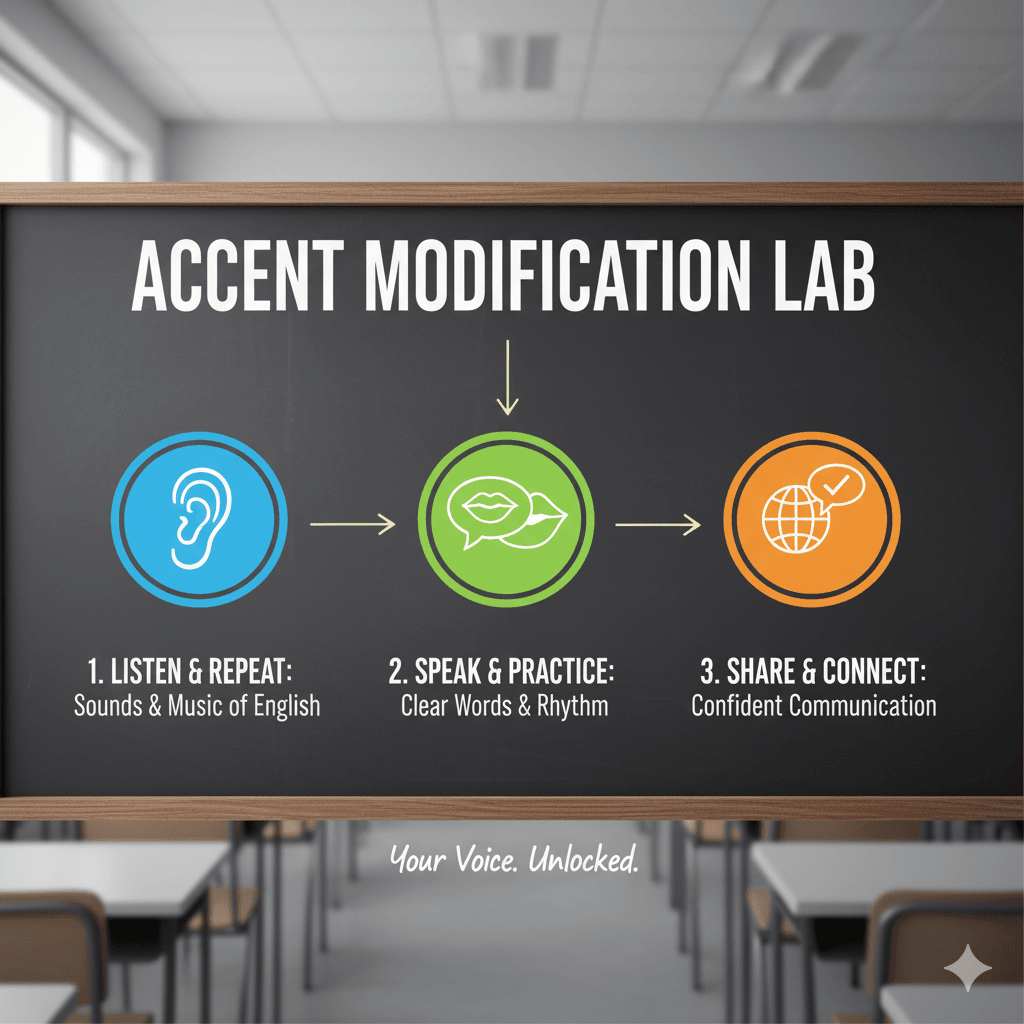
- Active listening to English podcasts, videos, or audiobooks and paying attention to pronunciation.
- Practice vocal learning by reading a page of a book or summarizing what you have learnt in a classroom.
- Record your voice for a few minutes a day to identify errors in pronunciation and monitor improvement.
- Shadow native speakers saying sentences directly after hearing them.
- Learn new sounds and practice difficult words using phonetics applications or pronunciation tools.
- See how the mouth moves in videos, as this would help you to know how the sounds are produced.
- Slow speech should be practiced initially to establish accuracy and then slowly get faster.
- Study the patterns of stress and intonation to sound natural and expressive.
Hard work goes a long way. Students who have only 10-15 minutes a day can build a clearer speech, greater confidence, and a more improved accent with time.
Make Your Child a Clear and Confident Speaker!
With structured accent training and speaking practice, growth becomes natural.
Techniques Used in Accent Modification
Accent modification involves organized speech programs to develop coherent and assertive speech. These techniques assist in perfecting the mastery of pronunciation, rhythm, and tone without sounding unnatural and false.
- Phonetic Training: Understanding the sound production process and training the uneasy consonants, vowels, and combinations.
- Sound Drills & Minimal Pairs: Correcting the sound of words by saying them with their similar sounds (such as ship/sheep, bat/bad).
- Mouth and Tongue Positioning: Exercising physical speech in the way of correct pronunciation of sounds.
- Shadowing Exercises: Repeating and listening to sentences of the native speakers to adjust to the rhythm and clarity.
- Intonation and Stress Training: Mastering how to stress natural, conversational words or syllables.
- Pace and Rhythm Adjustment: Having a fluent, unbroken speech.
- Listening and Imitation Work: Watching the native speaker's accentation on video, podcasts, and in conversation to develop ear training.
- Recording and Self-Review: Recording your speech to determine how far you have gone and what needs to be revised.
Students can have better pronunciation, natural flow of speech, and greater confidence in communication, step by step, with the right techniques and regular practice.
Accent Modification for Different Learners
There is no one-size-fits-all accent training. Accent modification is personalized to meet the needs and learning styles of every learner, because each of them has different goals, backgrounds, and speaking difficulties.
1. School Students: Learn proper pronunciation early, enhance reading-aloud abilities, enhance fluency, and be confident in making presentations, attending interviews, and communicating with others around the globe. While giving speeches, students make various mistakes. Click here to know the mistakes and how to improve them.
2. College Students: Practice creating clarity, minimizing the use of mother-tongue, academic and professional communication, and competitive exams or studying in other countries.
3. Working Professionals: Improve communication skills, interactions with clients, delivering presentations, and cross-cultural communication to sound confident and professional in any international location.
4. Non-Native English Speakers: Practice pronunciation, vocabulary, rhythm, intonation, and everyday communication to become more comfortable and fluent when speaking English.
5. Public Speakers & Performers: Voice projection, tone, expression, and clarity to capture audiences and make impressions through strong speeches or performances.
Accent modification changes according to the needs of the different learners so they can communicate effectively, confidently, and clearly in any environment.
Build Global-Standard Speaking Confidence!
Prepare your young learner for future academic and career opportunities.
Role of Accent Modification Classes for Students
Accent modulation classes assist students to speak effectively, assertively, and normally in both academic and daily life. These classes are aimed at enhancing pronunciation, stress, rhythm, and intonation by using guided practice.
Through professional support, students will be taught to correct speech patterns, develop effective communication strategies, and increase self-esteem. There are also classes with real speaking activities, such as reading aloud and conversations, and learners can practice techniques in real life.
Accent training provides students with an opportunity to articulate themselves, engage in school discussions, and get ready to act in the global arena by providing personalized support and regular practice.
Helpful Tools for Accent Training
Proper tools can streamline the accent practice process, make it more interesting, and effective. These materials assist learners to listen to proper pronunciation, practice every day, and monitor progress without any doubts.
- Audio-based Dictionaries Online
- Cambridge Dictionary
- Merriam-Webster
- Accent & Speech Training Apps
- ELSA Speak
- Speechling
- YouGlish
- Recording Tools
- Phone voice recorder
- Audacity
- Listening Platforms
- YouTube
- Podcasts
- Audiobooks
- Pronunciation Resources
- IPA (International Phonetic Alphabet) charts
- Forvo
- Interactive Learning Sites
- Duolingo speaking.
- BBC Learning English
- Accent Training Channels
- Rachel’s English
- English with Lucy
Pro Tip: The combination of listening, speaking, recording, and feedback-based practice is the most effective. Through consistent practice with these tools, students will be able to gradually develop clearer, stronger, and more confident English speech.
Transform Your Child’s Accent and Expression!
From pronunciation to public speaking, help them master communication effortlessly.
Time Required for Accent Modification
Accent modification is not an immediate process and is reliant on regularity, habits of practice, and the personal pace of learning. The average student reports clarity and pronunciation change in 8-12 weeks of regular practice, and more profound accent adjustment might require 6-12 months of training. Practice in speaking every day, feedback provided by trainers, and the use of conversation in real-life accelerate the process. Through patience and gradual practice, students are capable of having clear, natural, and confident speech in the long run.
Why Real-World Speaking Practice Matters
Accent improvement goes beyond classroom learning — real-world practice brings the biggest change. When students apply what they learn in daily conversations, school activities, and presentations, they begin to sound more natural and confident. Simple habits like speaking English with friends, participating in group discussions, watching English content without subtitles, and practicing voice notes help strengthen pronunciation and rhythm. The more students use English in everyday situations, the faster their accent improves and feels effortless.

Why PlanetSpark Is the Best Choice for Accent & Communication Skills
PlanetSpark helps students refine pronunciation, neutralize strong accents, and communicate confidently in school and real‑world situations. With structured learning, practice‑based training, and expert guidance, students speak more clearly, fluently, and naturally.
What Students Get
- 1:1 Expert Coaches for personalised guidance and speech clarity
- Accent Training Modules focusing on phonetics, articulation, and MTI reduction
- AI‑Powered Feedback Tools to practise and instantly correct mistakes
- Speaking Labs, Debates & Clubs to boost fluency through fun practice
- Creative Writing, Reading & Listening Activities to strengthen language foundation
- Performance Feedback & Reports to track progress and growth
- Daily Speaking Drills to build natural fluency
- Role-Play & Real-Life Scenarios for Practical Speaking Confidence
- Gamified Learning & Rewards to keep practice exciting and fun
- Parent-Teacher Review Sessions for aligned learning support
PlanetSpark blends expert coaching with modern technology, ensuring students develop strong English communication, improved accent clarity, and the confidence to speak in classrooms, speeches, interviews, and global spaces.
Final Thoughts: Stepping Toward Fluent Communication
Accent modification equips students with the power to speak in a clear, confident, and professional voice. It does not mean transforming who you are, but it means giving it more power and ensuring that what you have to say is heard just the way you mean.
As students spend time on building pronunciation, rhythm, and speech clarity, they open the door to academic confidence and global opportunities. A small step of accent modification is on the way to effective communication, personal expression, and success in the future.
No matter self-practice or accent modification classes, all the students can make a good impression by speaking confidently and clearly to create a positive impression.
Frequently Asked Questions
Accent modification helps students improve pronunciation, stress, and rhythm in speech. It doesn't remove your accent but trains you to speak clearly so teachers, classmates, and audiences understand you easily.
Students benefit from accent modification to communicate confidently in school, presentations, competitions, and global environments. It improves pronunciation, fluency, and confidence, helping them express ideas clearly and stand out academically.
No. Accent modification does not erase your accent or culture. It simply enhances clarity and reduces confusion, helping you sound confident while maintaining your original linguistic identity.
Accent improvement varies by practice level, age, and exposure. With consistent training, students begin seeing noticeable clarity and pronunciation improvement within 6–12 weeks of structured learning and practice.
PlanetSpark offers live 1:1 classes, AI-based speech coaching, and phonetics training that help students reduce mother-tongue influence, speak clearly, and gain confidence in real-life communication.
Yes! PlanetSpark builds confidence through personalized coaching, fun speaking activities, and safe practice environments, helping shy students speak clearly, participate confidently, and enjoy public speaking.