
Improve AI fluency for professional communication to Lead Better at Work


Table of Contents
- What Is AI Fluency for Professional Communication
- AI as a Communication Co-Pilot in Daily Work
- Master Prompting for Business Clarity
- Verifying AI Bias in Corporate Communication
- Building Human-Centered AI Leadership
- Developing Critical Thinking as Your AI Advantage
- Integrating AI into Daily Workflows
- Practical Daily Habits to Improve AI Fluency
- How PlanetSpark Communication Skills Classes Help Profession
- Build Confidence Through Smarter Communication
What if your next AI-generated email could influence decisions, build trust, and position you as a confident leader instantly?
In today’s workplace, professionals are using AI daily, yet many struggle to communicate clearly, guide AI effectively, or trust its outputs. Poor prompts, unchecked bias, and generic responses often weaken communication instead of improving it.
AI fluency for professional communication is the skill that bridges this gap. It helps you think strategically, guide AI tools, and refine outputs with clarity and purpose.
In this blog, you will learn how to master prompting for business clarity, verify AI bias in corporate comms, use AI as a communication co-pilot, and build human-centered AI leadership. Let us begin with understanding what AI fluency really means.
What Is AI Fluency for Professional Communication
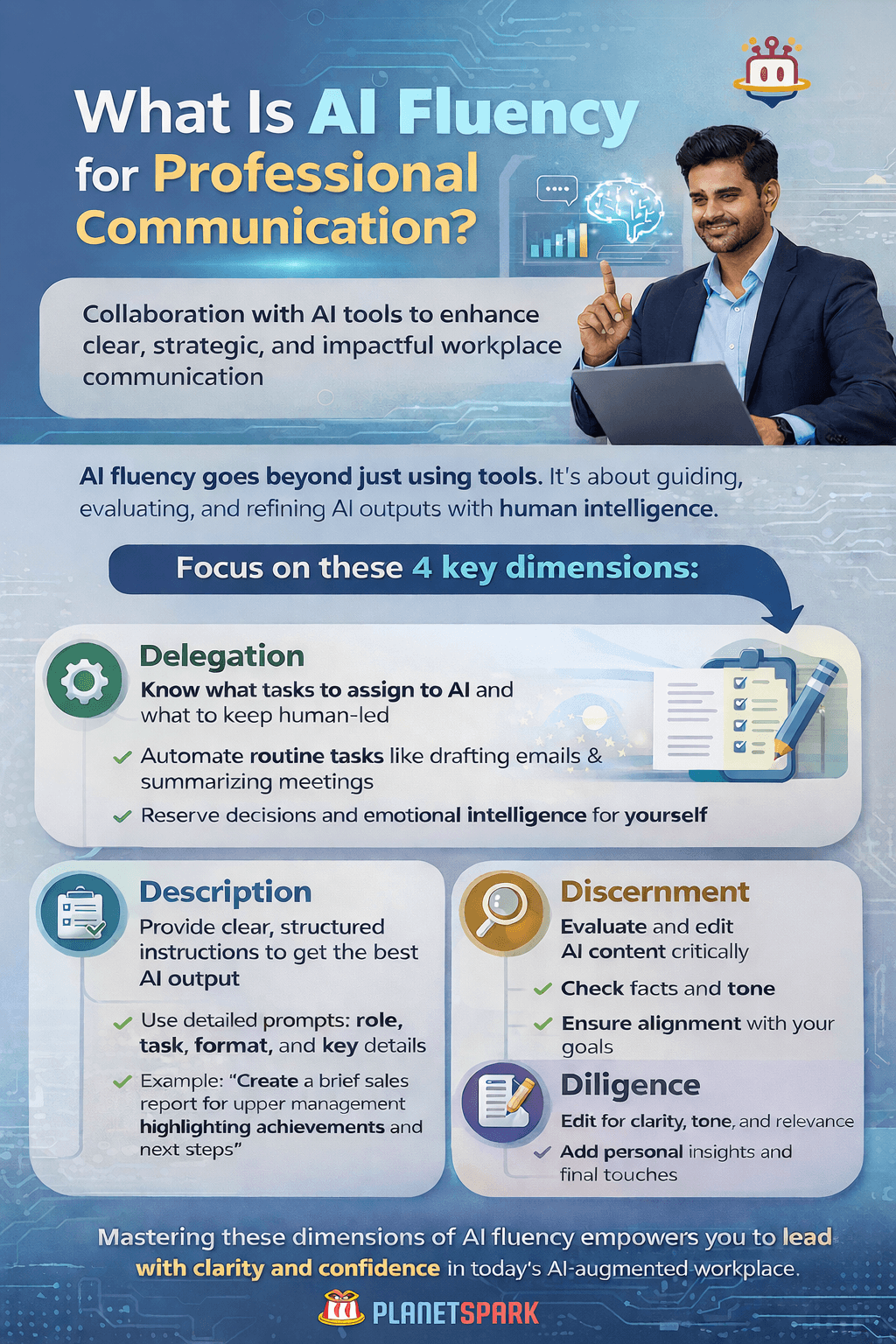
AI fluency for professional communication is the ability to collaborate with AI tools effectively, ethically, and strategically to enhance how you communicate at work. It is not just about knowing how to use tools like ChatGPT or Grammarly. It is about integrating AI into your thinking process so that your communication becomes clearer, faster, and more impactful.
Many professionals assume AI will automatically generate perfect emails, reports, or presentations. However, AI does not think independently. It responds based on the instructions you provide. This means the quality of output depends heavily on your clarity, context, and intent. In fact, AI fluency makes human intelligence more important, not less.
At its core, AI fluency is built on four essential dimensions:
1. Delegation
Delegation means understanding which tasks you should assign to AI and which require human judgment.
For example:
- You can delegate drafting emails, summarizing meetings, or structuring reports to AI
- But decisions, emotional communication, and strategic thinking should remain human-led
A fluent professional knows that AI handles repetitive and structured tasks, while they focus on creativity and decision-making.
2. Description
Description refers to how clearly you communicate instructions to AI.
Instead of giving vague prompts like:
"Write a report"
A fluent professional would say:
"Create a one-page project update for senior stakeholders, including progress, key risks, and next steps in a professional tone."
This clarity ensures that AI understands your expectations and delivers more relevant output.

3. Discernment
Discernment is your ability to evaluate AI-generated content critically.
AI can produce confident but incorrect or incomplete information. A professional must:
- Check facts and accuracy
- Identify missing context
- Adjust tone for the audience
- Ensure alignment with business goals
For example, if AI drafts a client email, you should review whether the tone is appropriate and whether the message reflects your company’s values.
4. Diligence
Diligence means refining and improving AI outputs before using them.
Fluent professionals do not copy and paste AI responses. Instead, they:
- Edit for clarity and tone
- Add personal insights
- Customize content for specific situations
- Ensure consistency with their communication style
This step transforms generic AI output into meaningful professional communication.
Want your AI outputs to sound sharper and more professional? Join a FREE trial session and master prompting techniques used by top professionals. Spots filling fast.
The Power of Iterative Collaboration
AI fluency is not about getting the perfect answer in one attempt. It is about working with AI in multiple steps.
For example:
- Ask AI to draft an email
- Refine tone and structure
- Add specific details
- Adjust for audience
This iterative process ensures your communication becomes sharper and more aligned with your intent.
Why AI Fluency Matters for Modern Professionals
In today’s fast-paced workplace, communication speed and clarity directly impact productivity and leadership. Professionals who can guide AI effectively:
- Communicate ideas more clearly
- Make faster decisions
- Reduce misunderstandings
- Present themselves as confident leaders
As workplaces become more AI-driven, this skill is no longer optional. It is becoming a core leadership capability for 2026 and beyond.
AI as a Communication Co-Pilot in Daily Work
AI as a communication co-pilot is changing how professionals approach their daily tasks. Instead of replacing communication skills, AI enhances them by helping you structure thoughts, refine language, and save time.
Think of AI as a smart assistant that supports your communication process. It helps you organize ideas, but you remain responsible for the final message and its impact.
Where AI Works Best as a Co-Pilot
AI can support several everyday communication tasks:
- Drafting emails: Helps you structure messages clearly and maintain a professional tone
- Summarizing meetings: Converts long discussions into key takeaways and action points
- Structuring reports: Organizes complex information into clear sections
- Generating outlines: Helps overcome the blank page problem when starting documents
- Preparing talking points: Assists in planning conversations and presentations
For instance, before an important client meeting, you can ask AI to simulate possible questions or objections. This allows you to prepare thoughtful responses in advance, improving your confidence and performance.
Benefits of Using AI as a Communication Co-Pilot
Using AI effectively can significantly improve your work efficiency and communication quality:
- Saves time: Automates repetitive writing tasks
- Improves consistency: Maintains a uniform tone across emails and reports
- Enhances clarity: Structures ideas logically and concisely
- Reduces cognitive load: Helps you focus on strategy instead of formatting
- Supports preparation: Enables better planning for meetings and presentations
However, these benefits only appear when AI is used thoughtfully.
The Risk of Over-Reliance
One common mistake professionals make is relying too heavily on AI without reviewing or refining outputs. This can lead to:
- Generic or impersonal communication
- Inaccurate information
- Misaligned tone
- Reduced authenticity
To avoid this, always treat AI as a co-pilot, not an autopilot. You guide the process, make decisions, and take responsibility for the final output.
Struggling to sound confident and clear in important meetings? Book your FREE demo class now and learn structured communication before others get ahead. Limited slots available.
Master Prompting for Business Clarity
Prompting is the foundation of AI fluency. Without clear prompts, even the most advanced AI tools cannot deliver meaningful or accurate results. In a professional setting, vague instructions lead to vague communication, which can create confusion, delays, and poor decision-making.
Prompting for business clarity means expressing your intent in a structured and precise way so that AI can generate outputs aligned with your goals, audience, and context. In many ways, better prompting improves not only AI output but also your own thinking process.
Use the RTFD Framework
To create effective prompts, professionals can rely on the RTFD framework. This structure ensures that your instructions are complete and actionable.
- Role: Define the perspective AI should take
Example: Act as a senior project manager or HR leader - Task: Clearly state what needs to be done
Example: Draft an email, summarize a report, or create a presentation outline - Format: Specify how the output should look
Example: Bullet points, short paragraphs, formal email, or executive summary - Details: Add context, tone, audience, and constraints
Example: Include risks, keep tone professional, limit to 150 words
When all four elements are present, AI understands your expectations better and produces more relevant results.
Why Structured Prompting Matters
Let us compare two approaches:
- Weak prompt: Write a report
- Strong prompt: Act as a business analyst. Create a concise project update for senior stakeholders in bullet format. Include progress, risks, and next steps.
The second prompt provides clarity, direction, and purpose. This leads to sharper, more actionable communication that is ready to use with minimal edits.
Advanced Prompting Techniques
Once you understand the basics, you can improve your results further with advanced techniques:
- Step-by-step prompting: Ask AI to break down its reasoning. This improves accuracy in complex tasks
- Iterative prompting: Refine outputs in multiple rounds instead of expecting perfection in one attempt
- Meta-prompting: Ask AI to improve your prompt itself. This is useful when you are unsure how to phrase a request
- Example-based prompting: Provide a sample output to guide tone, structure, and expectations
These techniques allow you to move from basic usage to strategic AI collaboration.
Common Prompting Mistakes
Many professionals struggle with prompting because of avoidable mistakes:
- Being too vague or unclear
- Ignoring the audience or context
- Accepting the first output without review
- Adding unnecessary or confusing details
Avoiding these mistakes helps you communicate more effectively and ensures that AI outputs are aligned with your goals.
Verifying AI Bias in Corporate Communication
AI-generated content is not always neutral, accurate, or inclusive. Verifying AI bias in corporate comms is essential to maintain professionalism, credibility, and trust in workplace communication.
Bias can appear subtly and may not be immediately obvious. However, even small issues in tone or language can negatively impact relationships, brand image, and decision-making.
Understanding Bias in AI Communication
AI systems learn from large datasets, which may include biases. As a result, AI-generated communication can reflect:
- Cultural assumptions that may not apply globally
- Gender bias in roles or examples
- Overgeneralizations that simplify complex situations
- Outdated or incorrect data
- Language that may unintentionally exclude certain groups
For example, an AI-generated hiring email might use language that subtly favors one group over another, affecting inclusivity and employer branding.
How to Detect and Fix Bias
Professionals must actively review AI outputs before using them. This involves:
- Checking whether the tone is inclusive and respectful
- Identifying hidden assumptions or stereotypes
- Verifying facts and data accuracy
- Aligning content with company values and policies
- Rewriting sections to ensure neutrality and clarity
This process ensures that communication remains professional and responsible.
The Professional Review Checklist
Before sending any AI-generated communication, ask yourself:
- Is this message inclusive and appropriate for all audiences
- Does the tone match the situation and recipient
- Is the information accurate and verified
- Does it reflect my organization’s values and standards
This checklist acts as a safeguard against potential communication risks.
Worried your communication may sound robotic or biased? Book a FREE trial session today and learn how to refine your tone like a leader. Limited availability.
Building Human-Centered AI Leadership
Human-centered AI leadership focuses on balancing technology with empathy, clarity, and ethical decision-making. As AI becomes more integrated into workplaces, leaders must ensure that human connection remains at the core of communication.
Technology can enhance efficiency, but trust, motivation, and collaboration are built through human interaction.
What Defines Human-Centered AI Leadership
Effective leaders who use AI successfully demonstrate:
- Clear and empathetic communication
- Ethical and responsible use of AI tools
- Transparency about how AI is used in decisions
- Strong emotional intelligence
- Adaptability in fast-changing environments
These qualities help leaders maintain credibility while leveraging AI for efficiency.
Practical Leadership Applications
Leaders can use AI in meaningful ways without losing authenticity:
- Drafting structured feedback using AI, then adding personal insights
- Communicating organizational changes with clarity and empathy
- Using AI-generated insights to support data-driven decisions
- Preparing for meetings while maintaining a human tone
For example, a leader may use AI to draft feedback but personalize it to reflect genuine appreciation and understanding.
Leadership Mistakes to Avoid
Some common pitfalls include:
- Relying on AI for emotionally sensitive communication
- Sending AI-generated messages without editing
- Ignoring feedback from team members
- Using AI without transparency, which can reduce trust
Leaders must remember that AI is a support tool, not a replacement for human judgment.
Developing Critical Thinking as Your AI Advantage
AI fluency is not just about using tools effectively. It is about thinking critically and acting as a filter for AI-generated content.
AI can produce outputs that sound confident but may be incorrect, incomplete, or misleading. Professionals must evaluate and refine these outputs before using them.
Key Critical Thinking Skills
To use AI responsibly, professionals must develop:
- Fact-checking ability
- Awareness of inconsistencies
- Relevance evaluation
- Contextual judgment
- Ability to question assumptions
These skills ensure that AI outputs are reliable and meaningful.
How to Apply Critical Thinking
You can strengthen your critical thinking by:
- Verifying information using trusted sources
- Comparing multiple AI responses for accuracy
- Adjusting content based on audience and context
- Validating insights before making decisions
Real-World Example
If AI generates a market analysis, do not rely on it blindly. Instead:
- Check whether the data sources are credible
- Confirm whether trends are current
- Ensure the insights are relevant to your specific business
This approach reduces risk and improves decision-making quality.

Integrating AI into Daily Workflows
AI fluency grows through consistent use and practical application. The more you integrate AI into your daily workflow, the more confident and effective you become.
Start with the First 30 Minutes
Begin by identifying repetitive tasks in your daily routine, such as:
- Drafting emails
- Summarizing meetings
- Interpreting data
- Structuring reports
Create simple prompts to automate these tasks. Over time, refine these prompts for better results.
Build a Safe Practice System
To build confidence gradually:
- Use company-approved AI tools
- Start with non-sensitive tasks
- Experiment with different prompts
- Learn from mistakes and refine your approach
This reduces risk while improving your skills.
Collaborate and Learn
AI fluency improves faster when you learn with others:
- Share effective prompts with colleagues
- Build a shared library of use cases
- Learn from team experiences and feedback
This collaborative approach accelerates learning across teams.
Top AI Tools for Professionals
Some commonly used tools include:
- ChatGPT, Claude, Gemini for general tasks
- Grammarly and Wordtune for writing improvement
- Perplexity AI for research
- Otter.ai and Fireflies.ai for meetings
- Zapier AI Agents for automation
Each tool serves a specific purpose, and choosing the right one improves efficiency.
Still figuring out how to use AI effectively at work? Book your FREE demo class and start building real-world communication skills today. Seats are filling fast.
Practical Daily Habits to Improve AI Fluency
Improving AI fluency for professional communication requires consistent practice and reflection.
Daily Habits
- Rewrite AI outputs in your own words to build clarity
- Practice structured prompting regularly
- Analyze tone and communication style
- Reflect on how effective your communication was
These small habits build strong long-term skills.
Weekly Growth Strategies
- Review past emails and communication
- Experiment with new prompting techniques
- Identify where AI outputs fall short
- Practice leadership communication scenarios
This helps you continuously improve.
Long-Term Benefits
Developing AI fluency leads to:
- Higher productivity
- Better decision-making
- Stronger leadership presence
- More confident communication
Over time, this skill becomes a major competitive advantage in the workplace.
Consistency and intentional practice transform AI fluency from a technical skill into a powerful communication strength that supports long-term professional growth.
How PlanetSpark Communication Skills Classes Help Professionals
PlanetSpark communication skills classes are designed for working professionals who want to improve clarity, confidence, and leadership communication in an AI-driven workplace.
These programs go beyond theory and focus on real-world communication challenges such as meetings, presentations, structured thinking, and AI-assisted communication. Structured learning ensures professionals build skills step by step instead of relying on trial and error.
What makes PlanetSpark stand out:
- Live 1:1 sessions with expert communication trainers
- Personalized learning roadmap based on your communication gaps
- AI-powered feedback tools for speech and presentation analysis
- Practice through real workplace scenarios and role plays
- Focus on clarity, persuasion, and leadership presence
- Continuous performance tracking and improvement plans
This combination of human coaching and AI-powered feedback helps professionals build confidence, clarity, and executive presence faster.

Build Confidence Through Smarter Communication
AI is transforming how professionals communicate, but your ability to think clearly and express ideas effectively will always define your success.
When you develop AI fluency for professional communication, you move from simply using tools to leading with clarity, confidence, and purpose. Consistent practice, thoughtful refinement, and a focus on human connection will help you stand out in any workplace.
Over time, this skill becomes more than just a professional advantage. It becomes a foundation for leadership, growth, and long-term success.
Also Read: Top 10 Professional Communication Tips Every Employee Should Know
Frequently Asked Questions
At PlanetSpark, we define it as the ability to use AI tools effectively while maintaining clarity, accuracy, and human connection in communication.
Start with structured frameworks like RTFD and practice giving clear instructions with context, audience, and tone.
It ensures your communication remains inclusive, accurate, and aligned with professional standards.
It is the ability to use AI responsibly while prioritizing empathy, clarity, and team engagement.
AI helps draft, structure, and refine communication while you guide and finalize the message.
No. AI enhances communication but cannot replace human judgment, empathy, and leadership presence.
With consistent practice and structured learning, noticeable improvement can be seen within weeks.
Personalized Communication Roadmaps
Record a video to get a AI generated personalized communication reports