
Assertive Communication Phrases: Speak Clearly and Confidently
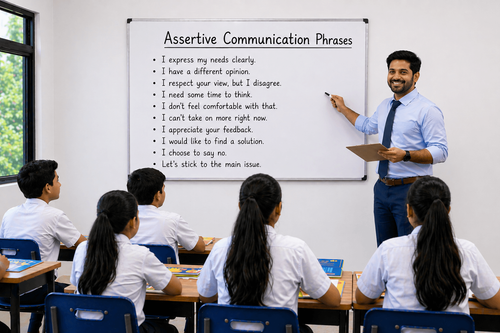

Table of Contents
- What Is Assertive Communication?
- Top Assertive Communication Phrases for Everyday Life
- Assertive Communication Examples in Real Situations
- Assertive Communication Examples at Home
- Assertive Communication Examples for Students
- Communication Phrases at Work
- Confident Communication Skills You Need
- Voice Control
- Body Language
- Listening Skills
- Emotional Control
- How to Become More Assertive Daily
- Start Small
- Replace Weak Language
- Use “I” Statements
- Practice Scripts
- Common Mistakes to Avoid
- Assertive Communication for Leadership
- Assertive Communication for Kids and Teens
- Daily Practice Exercises for Assertive Speaking
- Mirror Practice
- Voice Notes
- Role Play
- Journal Reflection
- One Brave Conversation Rule
- Why Many People Struggle With Assertiveness
- How PlanetSpark Builds Communication Confidence
- Speak Clearly, Speak Confidently
Assertive communication phrases help you express your thoughts, needs, and boundaries in a clear, respectful, and confident way. Whether you are a student, working professional, parent, or entrepreneur, the right words can improve conversations, reduce misunderstandings, and build stronger relationships. In this blog, you will learn practical assertive communication examples, communication phrases at work, and techniques to strengthen confident communication skills for daily life and career growth.
What Is Assertive Communication?
Assertive communication means expressing your opinions, feelings, and needs honestly while respecting others. It sits between two unhealthy extremes:
- Passive communication - staying silent, avoiding conflict, ignoring your needs
- Aggressive communication - dominating, blaming, or disrespecting others
- Assertive communication - clear, calm, respectful, and confident expression
An assertive communicator knows how to speak up without being rude and listen without feeling weak.
Why Assertive Communication Matters
Strong communication is one of the most valuable life skills today. It helps in:
- Building confidence
- Managing conflict peacefully
- Improving workplace relationships
- Speaking in meetings effectively
- Saying no without guilt
- Expressing ideas clearly
- Strengthening leadership presence
- Reducing stress caused by misunderstandings
Signs of an Assertive Speaker
You may be communicating assertively if you:
- Maintain calm body language
- Use direct but polite words
- Respect time and boundaries
- Listen actively
- State expectations clearly
- Ask questions confidently
- Handle disagreements maturely
- Speak with confidence, not fear
Top Assertive Communication Phrases for Everyday Life
Using the right phrases makes communication easier. Here are powerful assertive communication phrases you can use daily.
Phrases to Express Opinions
- I believe this is the best option because...
- In my view, we should consider...
- I see it differently, and here is why...
- My perspective is...
- I would like to add another idea...
Phrases to Set Boundaries
- I am not comfortable with that.
- I cannot commit to that right now.
- I need some time before deciding.
- That does not work for me.
- I would prefer a different approach.
Phrases to Ask for Respect
- Please let me finish my point.
- I would appreciate being heard.
- Let us speak one at a time.
- I want this conversation to remain respectful.
- I am happy to discuss this calmly.
Phrases to Say No Politely
- Thank you for asking, but I will pass.
- I appreciate the opportunity, but I cannot take this on.
- I am unable to help this time.
- That is not something I can commit to.
- I need to decline for now.
Phrases to Request Help
- Could you please guide me on this?
- I would appreciate your support here.
- Can we work on this together?
- I need assistance with this task.
- Would you mind explaining that again?
Assertive Communication Examples in Real Situations
Understanding examples helps you apply these phrases naturally.
Assertive Communication Examples at Home
Situation: Too Many Interruptions
Instead of: "You never let me talk!"
Say: "I would like to finish what I am saying, then I will listen to you."
Situation: Need Personal Space
Instead of: staying silent
Say: "I need some quiet time right now. Let us talk later."
Situation: Unfair Expectations
Instead of: doing everything resentfully
Say: "I can help with this, but I need support with the rest."
Assertive Communication Examples for Students
Situation: Asking a Teacher for Clarification
- I did not fully understand the concept. Could you explain it once more?
Situation: Group Project Imbalance
- I feel the workload is uneven. Can we divide tasks fairly?
Situation: Classroom Participation
- I have an idea I would like to share.
Communication Phrases at Work
Workplaces value professionals who communicate clearly. Here are useful workplace communication phrases.
In Meetings
- I would like to contribute an idea.
- Can we revisit the main objective?
- I have a different suggestion.
- Let us focus on the priority first.
- Could you clarify the next steps?
With Colleagues
- I need your input on this project.
- Let us align expectations.
- I appreciate your effort.
- Can we discuss a better process?
- I would like to understand your viewpoint.
With Managers
- I would like feedback on my performance.
- Here is an update on progress.
- I need support to meet this deadline.
- Can we discuss priorities for this week?
- I am interested in taking more responsibility.
During Conflict
- Let us focus on the issue, not blame.
- I understand your concern. Here is my perspective.
- How can we solve this together?
- I want to find a fair solution.
- Let us reset and discuss calmly.
Build workplace-ready speaking skills with PlanetSpark, designed for kids, students, and adults who want to speak with clarity and confidence.
Confident Communication Skills You Need
Assertive phrases work best when paired with strong communication habits.
Voice Control
Speak at a steady pace. Avoid mumbling or rushing.
Improve It By:
- Reading aloud daily
- Recording your voice
- Practicing pauses
- Breathing deeply before speaking
Body Language
Your posture often speaks before your words.
Best Practices
- Stand straight
- Maintain comfortable eye contact
- Keep shoulders relaxed
- Use natural gestures
- Avoid crossing arms defensively
Listening Skills
Confidence is not only speaking, it is listening well.
Use These Habits
- Let others finish
- Ask follow-up questions
- Repeat key points for clarity
- Avoid interrupting
- Show attention through posture
Emotional Control
Assertive people stay calm even in difficult moments.
Helpful Techniques
- Pause before responding
- Count to five mentally
- Focus on solutions
- Avoid reacting in anger
- Use neutral language
How to Become More Assertive Daily
Confidence grows through repetition and awareness.
Start Small
Use assertive communication phrases in low-pressure situations first.
Examples:
- Asking for help in a store
- Sharing an opinion with friends
- Clarifying instructions in class
- Speaking first in small meetings
Replace Weak Language
Avoid phrases like:
- Maybe this is wrong but...
- Sorry to bother you...
- It is probably not important...
Use instead:
- I would like to share an idea.
- I have a question.
- This point is important because...
Use “I” Statements
These reduce blame and increase clarity.
Examples:
- I feel overlooked when I am interrupted.
- I need more time to finish this properly.
- I would prefer earlier notice next time.
Practice Scripts
Prepare phrases before important conversations.
Examples:
- Salary discussion
- Presentation meeting
- Parent-teacher meeting
- Academic interview
- Difficult family talk
Common Mistakes to Avoid
Even confident people make communication mistakes. Watch out for these:
Overexplaining
Long explanations reduce clarity. Be concise.
Apologizing Excessively
Use sorry only when needed.
Avoiding Eye Contact
It may appear unsure or disengaged.
Speaking Too Softly
Low volume can hide strong ideas.
Being Defensive
Respond with curiosity, not ego.
Assertive Communication for Leadership
Leaders need clarity, empathy, and confidence. Assertive communication helps leaders:
- Give feedback respectfully
- Set expectations clearly
- Motivate teams
- Solve conflicts quickly
- Build trust
- Inspire action
- Present ideas powerfully
Leadership Phrase Examples
- Here is our goal for this week.
- I value your effort and want to improve this area.
- What support do you need to succeed?
- Let us decide based on facts.
- Thank you for raising that concern.
Assertive Communication for Kids and Teens
Children also benefit from learning confident communication early.
Helpful Phrases for Kids
- Please do not interrupt me.
- I need help with this.
- I do not like that.
- Can we take turns?
- I have something to say.
Benefits for Children
- Better classroom participation
- Stronger friendships
- Reduced bullying vulnerability
- Improved self-esteem
- Better public speaking skills
- Emotional awareness
Help your child become a fearless speaker or improve your own confidence with PlanetSpark Communication Skills Course and live expert coaching.
Daily Practice Exercises for Assertive Speaking
Mirror Practice
Speak phrases while observing posture and facial expressions.
Voice Notes
Record yourself answering common questions confidently.
Role Play
Practice workplace or school conversations with a friend.
Journal Reflection
Write situations where you stayed silent. Rewrite what you could say assertively next time.
One Brave Conversation Rule
Have one clear, honest conversation each day.
Why Many People Struggle With Assertiveness
People often hesitate because of:
- Fear of rejection
- Fear of conflict
- Low confidence
- Past criticism
- Lack of practice
- Not knowing the right words
The good news is that assertiveness is a skill, not a personality trait. It can be learned.
How PlanetSpark Builds Communication Confidence
PlanetSpark helps children and adults develop real-world communication skills through structured learning, technology, and expert guidance. Every learner gets 1:1 personal trainers who adapt sessions to learning style, pace, and goals. A personalised curriculum targets fluency, grammar, confidence, storytelling, and public speaking step by step.
With SparkX AI video analysis, learners receive feedback on voice clarity, body language, grammar, confidence, and idea flow. AI-led practice sessions allow independent speaking practice with instant feedback. Spark Diary builds writing habits through stories, speeches, and daily reflections.
Gamified modules make learning enjoyable through vocabulary, grammar, spelling, and listening activities. Regular PTMs and progress reports keep parents informed with measurable growth insights. Learners also join clubs like debate, podcasting, writing, comedy, and storytelling for social confidence.
Safe expression matters too, so Sparkline gives kids a moderated platform to share their work. Frequent contests and showcases create motivation and recognition.
Want visible improvement in speaking confidence? Join PlanetSpark today and start learning with expert mentors and AI-powered practice.
Speak Clearly, Speak Confidently
Assertive communication phrases can transform the way you speak, work, study, and build relationships. They help you express ideas without fear, set boundaries respectfully, and handle conflict with maturity. Whether you are a student raising your hand in class, a professional leading meetings, or a parent guiding your child, confidence grows when communication becomes intentional.
The best part is that assertiveness is learnable. Start with small phrases, practice daily, improve body language, and stay calm under pressure. Over time, clear communication becomes natural.
If you want faster progress, structured mentorship can make a major difference. PlanetSpark offers expert coaching, AI tools, and personalised learning paths to help kids and adults become powerful communicators.
Ready to speak with confidence in every situation? Explore PlanetSpark Communication Skills Course today.
Frequently Asked Questions
Assertive communication phrases are respectful and direct statements used to express thoughts, needs, boundaries, or opinions clearly. Examples include, “I would like to share my view,” “That does not work for me,” and “Can we discuss this calmly?” These phrases help avoid passive silence and aggressive reactions while building healthier communication.
A good workplace example is saying, “I need clarification on the deadline so I can plan this properly.” This shows professionalism, ownership, and clear intent. Other workplace communication phrases include requesting feedback, setting priorities, and resolving disagreements respectfully.
You can improve by:
Practicing daily conversations
Speaking slowly and clearly
Maintaining eye contact
Using prepared phrases
Listening actively
Recording and reviewing your voice
Managing nervousness through breathing exercises
Consistency matters more than perfection.
Students need assertiveness to ask questions, participate in class, work in teams, express discomfort, and build self-confidence. It supports academic growth, leadership development, and stronger peer relationships. It also helps children handle social situations more effectively.
A structured learning program with live coaching and practical speaking practice is ideal. PlanetSpark offers 1:1 trainers, AI feedback tools, storytelling, public speaking, writing practice, and confidence-building activities designed for both kids and adults.