

Communication is not about speaking flawless English; it is about expressing thoughts clearly, confidently, and with purpose. When learners truly understand the elements of communication and apply them in everyday situations, their ability to connect with others improves naturally. Regular practice helps build fluency, while structured feedback highlights strengths and corrects gaps before they become habits. Over time, hesitation turns into confidence, and confusion turns into clarity. With the right guidance and consistent speaking opportunities, communication transforms from a challenge into a powerful skill that supports academic success, social interactions, and long-term personal growth.
Elements of Communication Explained with Practical Examples
Last Updated At: 25 Feb 2026
9 min read
Communication shapes every part of our lives, at home, in classrooms, workplaces, and daily interactions, yet many people struggle to express ideas clearly or respond effectively. This gap exists not due to lack of intelligence, but limited awareness of the elements of communication and how they work together in real life.
This blog goes beyond textbook definitions to explain the elements of the communication process using practical examples. You’ll learn how sender, message, encoding, channel, receiver, decoding, feedback, and noise function in real conversations, and what makes communication truly effective. Designed for students, parents, and professionals, this guide shows how practice-based learning builds natural spoken English
Understanding the Elements of Communication
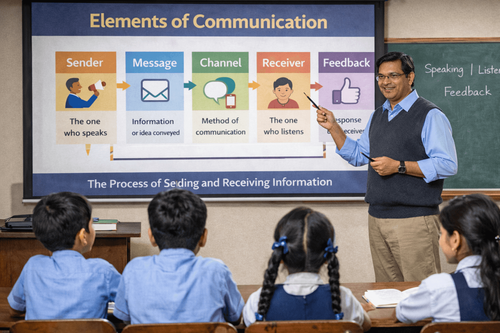
To truly understand communication, we must first answer a fundamental question: what are the elements of communication? Communication is not a single action; it is a process made up of interconnected parts. Each part plays a vital role in ensuring that a message is sent, received, understood, and responded to correctly.
The elements of communication process include the sender, message, encoding, channel, receiver, decoding, feedback, and noise. When these elements work in harmony, communication becomes clear and effective. When even one element breaks down, confusion arises.
Sender: The Origin of Communication
The sender is the person who initiates the communication. In school, this could be a teacher explaining a concept. At home, it could be a child expressing a need. The sender’s clarity of thought, confidence, and language skills directly influence the quality of communication.
A sender who lacks vocabulary, struggles with sentence formation, or feels nervous may not express ideas clearly,even if the idea itself is strong. This is why spoken English training focuses heavily on helping learners become confident senders.
Message: The Information Being Shared
The message is the actual content,ideas, feelings, instructions, or opinions,that the sender wants to convey. Messages can be informative, emotional, persuasive, or instructional.
In real-life communication, unclear messages are a major cause of misunderstanding. For example, vague instructions or poorly structured sentences often confuse listeners. Understanding the elements of effective communication means learning how to structure messages logically and purposefully.
Encoding: Turning Thoughts into Words
Encoding is the process of converting thoughts into spoken or written language. This step is often overlooked but is crucial in the elements of communication cycle.
Encoding involves choosing the right words, grammar, tone, and structure. A child may understand a concept internally but struggle to encode it into clear English sentences. This is where guided speaking practice becomes essential.
Channel: The Medium of Communication
The channel is how the message is delivered,spoken conversation, phone calls, video meetings, presentations, or written text. Each channel requires different skills.
For example, spoken communication demands clarity, pronunciation, and confidence, while presentations require structure and voice modulation. Effective communication training ensures learners can adapt their message across multiple channels.
Receiver: The Listener or Audience
The receiver is the person who receives the message. Their background knowledge, language ability, attention level, and emotional state influence how the message is understood.
A skilled communicator learns to adapt language based on the receiver,simplifying explanations for children or using formal language in interviews.
Decoding: Interpreting the Message
Decoding is how the receiver interprets the message. Miscommunication often happens here due to unfamiliar vocabulary, unclear pronunciation, or cultural differences.
Strong communication skills help ensure that messages are decoded as intended, not misinterpreted.
Feedback: Completing the Communication Cycle
Feedback confirms whether communication was successful. A nod, question, response, or action all count as feedback.
The elements of communication cycle are incomplete without feedback. Two-way communication builds clarity, trust, and engagement.
Noise: Barriers to Communication
Noise includes physical distractions, emotional stress, language gaps, or lack of confidence. Even fear of speaking English can act as noise, preventing effective communication.
Understanding noise helps learners overcome barriers consciously and improve communication outcomes.
Elements of Effective Communication in Real Life
Knowing the elements of communication process is only the foundation. Real mastery comes from applying these elements consciously in day-to-day interactions,whether in classrooms, homes, social settings, interviews, or professional environments. Effective communication is not accidental; it is a skill built through awareness, intention, and consistent practice. Let’s break this down in a more practical and detailed way.
Clarity and Structure
Effective communication always starts with clear thinking. If thoughts are scattered, the message will be confusing,no matter how good the language is. Clarity means knowing what you want to say and why you want to say it before you speak.
In real life, this involves:
Organising ideas in a logical sequence (beginning, middle, and end)
Avoiding unnecessary details that distract from the core message
Using simple and precise words instead of complicated sentences
For example, when explaining an idea in class or answering an interview question, a structured response helps the listener follow your reasoning easily. Clear structure strengthens the message and improves decoding for the receiver, making communication smoother and more impactful.
Confidence and Fluency
Confidence plays a powerful role in how a message is perceived. Even a well-structured message can lose its impact if delivered with hesitation, long pauses, or fear of making mistakes.
In real-life communication:
Fluency allows ideas to flow naturally without excessive pauses
Clear pronunciation ensures the message is understood correctly
A steady tone builds trust and credibility with the listener
Lack of confidence often introduces noise into the communication process,self-doubt, fear of judgement, or anxiety,which weakens message delivery. Confidence grows when speakers practise speaking regularly in supportive environments, helping them focus on meaning rather than mistakes.
Active Listening
Communication is never one-sided. Active listening is a critical yet often ignored element of effective communication. It ensures that communication becomes a two-way process rather than a one-directional exchange.
Active listening involves:
Paying full attention without interrupting
Understanding the speaker’s intent, not just their words
Responding thoughtfully through questions or feedback
When listeners actively listen, decoding improves, feedback becomes meaningful, and misunderstandings reduce significantly. In conversations, classrooms, and interviews, strong listening skills enhance clarity and strengthen relationships.
Adaptability
One of the most practical elements of effective communication is adaptability. The way we communicate should change based on:
Who the audience is (child, peer, teacher, interviewer)
The situation (formal, informal, emotional, instructional)
The purpose of communication (informing, persuading, explaining)
Adaptability ensures that the channel, language, tone, and examples align with the receiver’s needs. For instance, explaining a concept to a friend differs greatly from presenting the same idea to a teacher or panel. Flexible communicators adjust naturally, ensuring the message is received as intended.
Practice Over Theory
Understanding theory alone does not make someone a good communicator. Communication is a performative skill, much like sports or music,it improves only with regular practice.
Real-life improvement comes from:
Speaking daily in real situations
Practising role plays and conversations
Receiving feedback and applying corrections
Reflecting on what worked and what didn’t
Consistent practice strengthens every element of the communication cycle,from encoding thoughts clearly to receiving and responding to feedback confidently. Over time, communication becomes natural, fluent, and effective rather than forced or memorised.
In real life, effective communication is the result of clarity, confidence, listening, adaptability, and practice working together. When these elements are developed together, communication transforms from a challenge into a powerful life skill.
Learning Communication Practically with PlanetSpark Spoken English
Understanding what are the elements of communication becomes truly powerful when learners practise them in real situations. This is where PlanetSpark Spoken English Course stands apart.
Live, Interactive English Conversations Daily
Unlike passive video lessons, learners engage in live conversations based on real-life situations,school discussions, travel conversations, interviews, and presentations.
Accent Neutralisation and Clear Articulation
Focused modules help reduce mother tongue influence, improve phonetics, and build accurate pronunciation,essential for clear encoding and decoding.
Lexical Resource Enhancement
Vocabulary is taught contextually through collocations, phrases, and dialogues, strengthening message quality.
Situational Dialogues and Role Plays
Learners practise ordering food, delivering speeches, asking questions, and explaining concepts,directly applying the elements of communication cycle.
Instant Feedback and AI Fluency Reports
AI tools and expert trainers provide instant corrections on grammar, fluency, and pronunciation, with detailed reports shared with parents.
Speaking Confidence Trackers
Regular feedback tracks strengths, gaps, and progress, building confidence steadily.
1:1 Personal Trainers
Each child is paired with a certified communication expert who delivers personalised guidance, immediate feedback, and motivation.
Personalised Curriculum
Custom learning roadmaps adapt continuously to each learner’s pace, ensuring meaningful progress.
SparkX AI Video Analysis
AI evaluates voice modulation, body language, structure, and confidence through recorded speeches.
AI-Led Practice Sessions
Learners practise independently with AI coaches, reinforcing skills beyond live classes.
Spark Diary
A digital journal that builds writing habits, creativity, and thought clarity.
Gamified Learning
Interactive quizzes and challenges make learning engaging and fun.
Parent-Teacher Meetings and Progress Reports
Transparent communication ensures parents stay informed and involved.
Learning Clubs and Communities
Debate clubs, storytelling circles, podcasting, and comedy clubs build real-world communication skills.
Sparkline Safe Platform
A moderated space for kids to share content confidently and safely.
Contests and Showcases
Competitions and open mics build stage confidence and motivation.
Mastering Communication: Your Confidence-Building Journey Starts Here
PlanetSpark’s spoken English approach ensures learners don’t just know the theory but live it through real conversations, personalised mentoring, and AI-powered insights.
Master communication confidently with PlanetSpark’s expert programs.
You may also read :
Frequently Asked Questions
The elements of communication include sender, message, encoding, channel, receiver, decoding, feedback, and noise. Together, they form the communication process.
They help identify where communication breaks down and how to improve clarity, understanding, and effectiveness.
Clarity, confidence, listening, adaptability, structured messages, and feedback are key elements of effective communication.
Through live conversations, role plays, feedback, and consistent practice rather than passive learning.
PlanetSpark integrates live classes, AI feedback, personalised trainers, and real-life speaking practice to help learners apply communication elements confidently.