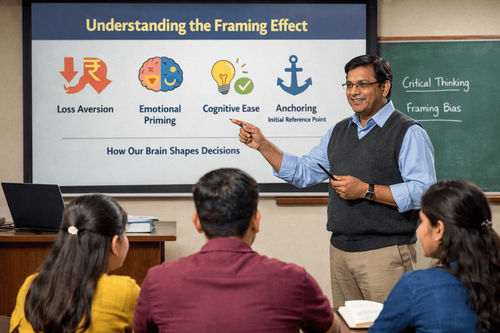
The Framing Effect explains how the presentation of information shapes decisions, judgments, and thought processes. While individuals often assume their choices are rational and evidence-based, research consistently shows that subtle shifts in wording, tone, emphasis, and context can dramatically alter outcomes. The same fact, when framed differently, can lead to entirely different conclusions.
This blog addresses the search intent behind understanding the Framing Effect, how it operates in everyday and professional settings, practical framing effect examples, and how conscious awareness combined with strong communication skills can help individuals build better decision-making and critical thinking abilities.
What Is the Framing Effect?
The Framing Effect is a cognitive bias where people respond differently to the same information based on how it is presented rather than what is presented. When information is framed as a gain, individuals tend to act cautiously. When the same information is framed as a loss, individuals are more likely to take risks.
At its core, the Framing Effect reveals that decision-making is not purely logical. Instead, it is deeply influenced by emotional cues, linguistic structure, and contextual emphasis.
Key Characteristics of the Framing Effect
The facts remain constant, only the presentation changes
Emotional reactions precede analytical reasoning
People rarely recognize when framing is influencing them
This makes framing one of the most powerful and subtle forces shaping human behavior.
Why Framing Matters in Everyday Life
Decisions are rarely made in isolation or under perfectly neutral conditions. Most choices occur within contexts shaped by language, expectations, and emotional undertones.
How Framing Influences Daily Decisions
Language shapes perception before logic engages, setting the emotional direction of thought
Context determines interpretation, influencing whether information feels safe or risky
Emotions often override rational evaluation, especially under time pressure
From news headlines and advertisements to classroom instructions and workplace conversations, framing quietly guides how individuals interpret reality, often without conscious awareness.
Understanding the psychological foundation of framing is essential for developing resistance to biased decision-making.
Prospect Theory and Framing
The Framing Effect is closely linked to Prospect Theory, which explains how people evaluate gains and losses asymmetrically. According to this theory, losses feel significantly more painful than gains of the same size feel rewarding.
This imbalance causes individuals to:
Avoid losses more aggressively than they pursue gains
Make inconsistent decisions when outcomes are framed differently
Prioritize emotional comfort over objective analysis
Key Psychological Drivers of the Framing Effect
Loss Aversion
Individuals fear losses more than they value equivalent gains
Loss-framed messages trigger urgency and risk-taking
Cognitive Shortcuts
The brain prefers efficiency over accuracy
Framing allows the mind to reach conclusions quickly without deep analysis
Emotional Anchoring
The first frame encountered often becomes the reference point
Subsequent information is interpreted relative to this anchor
Understanding these mechanisms is critical for building awareness, improving judgment, and resisting manipulation.
Framing Effect Examples in Real Life
Framing Effect Examples in Decision Making
One of the most cited framing effect examples appears in health communication:
A treatment described as having a 90% survival rate feels reassuring
The same treatment described as having a 10% mortality rate feels dangerous
Critical thinking is the ability to evaluate information objectively, identify assumptions, and consider multiple perspectives. The Framing Effect weakens critical thinking when individuals accept presented narratives without scrutiny.
How Framing Disrupts Critical Thinking
Limits alternative viewpoints by narrowing interpretation
Encourages emotional reactions instead of analytical reasoning
Creates false urgency, fear, or optimism
When framing goes unnoticed, decisions become reactive rather than deliberate.
How Awareness Strengthens Thinking
Developing awareness of framing significantly enhances critical thinking.
Key practices include:
Identifying emotionally charged or biased language
Reframing information in neutral terms
Asking reflective questions such as “What is missing?” or “How else could this be presented?”
Strong communicators are trained to pause, analyze, and question framing before responding.
Framing Effect in Communication
The Role of Language in Framing
Words such as “must,” “failure,” “risk,” “opportunity,” and “urgent” carry emotional weight. Skilled communicators understand that language does not merely convey information, it shapes interpretation.
Effective communication requires conscious word selection rather than instinctive phrasing.
Effective Communication Practices to Reduce Bias
Replace extreme or absolute terms with neutral language
Separate objective facts from subjective interpretation
Present balanced viewpoints instead of single narratives
These practices help listeners and readers engage their critical faculties rather than emotional reflexes.
Ethical vs Manipulative Framing
Not all framing is harmful. The distinction lies in intent.
Ethical framing informs, clarifies, and empowers decision-makers
Manipulative framing pressures, misleads, or restricts choice
Communication skills training emphasizes responsible framing that builds trust and transparency rather than control.
Framing Effect in Leadership and Workplace Decisions
How Leaders Frame Reality
Leaders influence decisions through:
Performance feedback
Change announcements
Goal setting and evaluation
A leader framing challenges as “learning opportunities” promotes innovation, while framing them as “failures” discourages experimentation.
Ask how the same information would sound if framed in the opposite way.
2. Slow Down Decision Making
Fast decisions rely heavily on framing, slower decisions allow reasoning to intervene.
3. Seek Multiple Perspectives
Exposure to diverse viewpoints weakens the influence of a single frame.
4. Improve Language Awareness
Recognize emotionally loaded or persuasive words.
5. Build Structured Thinking
Frameworks and decision models reduce reliance on instinctive judgment.
Teaching the Framing Effect to Students and Professionals
Why Early Awareness Matters
Builds independent and analytical thinking
Reduces susceptibility to persuasion and misinformation
Enhances academic, career, and leadership outcomes
Communication training helps learners recognize framing patterns early and respond thoughtfully rather than reactively.
How Communication Skills Strengthen Decision Making
Strong communication skills enable individuals to:
Express ideas clearly and logically
Interpret information accurately
Question assumptions with confidence
When communication improves, decision quality improves naturally because thinking becomes structured, reflective, and intentional.
PlanetSpark and Communication Skills Development
Why Choose PlanetSpark for Communication Skills Training
PlanetSpark focuses on developing structured thinking, ethical communication, and confident expression. Its programs help learners recognize cognitive biases like the Framing Effect and apply practical communication strategies in real-world situations.
What Learners Gain
Clear reasoning and articulation skills
Critical thinking frameworks
Effective speaking and writing abilities
Ethical persuasion and influence techniques
Building Awareness for Better Decisions
The Framing Effect influences nearly every decision we make, from everyday choices to high-stakes professional judgments. Without awareness, individuals become vulnerable to biased communication, emotional manipulation, and flawed reasoning. Understanding how framing works, recognizing framing effect examples, and consciously developing communication skills allows individuals to regain control over their thinking process.
Strong decision-making is not about eliminating influence altogether, but about recognizing it, evaluating it, and responding intentionally. Communication skills play a foundational role in this journey by enabling individuals to analyze information, challenge narratives, and think critically under pressure. With structured training and consistent practice, anyone can build decision-making and critical thinking skills that lead to clarity, confidence, and better outcomes across personal, academic, and professional life.
The framing effect is a cognitive bias where people make different decisions based on how information is presented, even when the facts are the same. Positive or negative wording changes perception and judgement.
Professionals make high-impact decisions daily. Framing can influence risk-taking, leadership choices, negotiations, and strategy. Understanding it helps reduce biased decisions and improves judgement quality.
Yes. Critical thinking encourages professionals to question how information is framed, rephrase options neutrally, and evaluate data objectively instead of emotionally.
Very common. From performance reviews to financial proposals and strategy presentations, framing effect examples appear whenever language highlights gains, losses, or risks selectively.
PlanetSpark’s communication skills course trains professionals to analyse language, recognise cognitive bias, and structure communication logically. This strengthens critical thinking, ethical persuasion, and decision-making confidence.