
GROW Model: Feedback & Conflict Resolution | PlanetSpark
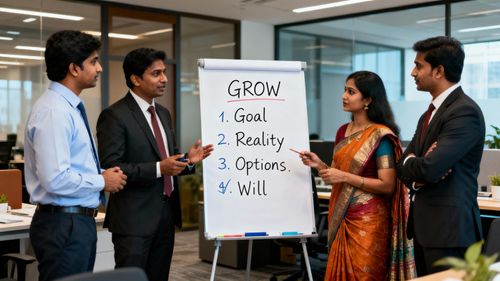

Table of Contents
- Understanding the GROW Model Framework for Professional Exce
- Breaking Down the GROW Model Step by Step
- How the GROW Model Enhances Constructive Feedback in Profess
- Using the GROW Model for Conflict Resolution at Work
- Advanced Professional Applications of the GROW Model
- PlanetSpark Communication Skills Course for Working Professi
- Your Growth Begins With Better Conversations
In today’s professional environment,where hybrid teams, high-stakes communication, and cross-functional collaboration define everyday workflows,mastering constructive feedback and conflict resolution is no longer optional. It is a core leadership competency. And at the heart of these competencies lies an internationally trusted coaching framework: the GROW Model.
If you’re searching What is GROW Model, how it works in real-world scenarios, or how to use the GROW Model example set for feedback discussions, performance reviews, team conflicts, or coaching sessions,this blog will give you the deepest, most actionable breakdown crafted especially for professionals.
Whether you're a manager giving performance reviews, a team leader navigating conflict, or a working professional trying to improve your influence, the GROW Model gives you clarity, structure, and outcomes.
Understanding the GROW Model Framework for Professional Excellence
What is GROW Model and Why It Works in the Workplace
The GROW Model is a four-step coaching and communication framework:
Goal – Define what the person wants
Reality – Understand the current situation
Options – Explore possible solutions
Will – Commit to action
It was developed by Sir John Whitmore and has become the world’s most relied-upon framework for coaching, performance improvement, behavioural change, and communication alignment.
Professionals love the GROW Model because:
It reduces emotional friction in conversations
It helps people articulate their own solutions
It encourages accountability instead of dependency
It keeps discussions structured and forward-moving
It works across industries and job roles
By the end of this section, you’ll understand why Fortune 500 companies, leadership coaches, HR teams, and project managers consistently rely on the GROW Model to build clarity and alignment.
Elevate your leadership and communication journey with PlanetSpark’s intensive professional courses.
Breaking Down the GROW Model Step by Step
Goal – Establishing Clarity and Direction
Every powerful conversation begins with a shared Goal. A goal defines why the discussion is happening and what the desired outcome looks like.
Professional applications of the Goal stage:
Setting expectations in feedback discussions
Establishing what team members want to improve
Clarifying objectives during a conflict situation
Aligning performance improvement strategies
Defining success metrics in behaviour change
A strong GROW Model example (Goal stage) may look like:
“I want to improve how I delegate tasks to reduce project bottlenecks.”
Or for conflict situations:
“We want to rebuild trust and collaborate efficiently moving forward.”
Reality – Understanding What Is Actually Happening
The Reality stage focuses on diagnosing the present situation without assumptions, blame, or defensiveness. This is where emotional intelligence plays a huge role.
Professionals use this stage to explore:
Current obstacles
Performance gaps
Different perspectives from involved parties
Skill limitations
Workflow challenges
Patterns that lead to conflict
A manager might ask questions like:
“What steps have you taken so far?”
“What are the main challenges you’re facing?”
“How is this impacting the team?”
“What evidence do we have about the issue?”
This stage ensures the conversation is grounded in facts, not perceptions.
Options – Generating Solutions and Alternatives
After uncovering the reality, the conversation moves toward solution generation. The aim is to explore multiple Options, not dictate decisions.
This stage helps professionals:
Encourage creativity in problem solving
Consider risks and benefits
Evaluate various approaches
Build ownership in the solution
Identify skills or resources needed
Example options generated in a feedback context:
Taking a communication skills course
Using tools like Notion or Asana for workload planning
Seeking peer feedback regularly
Blocking deep-work hours
Delegating tasks strategically
Will – Creating an Accountability Roadmap
The Will phase commits the individual to take action. Without this step, conversations become theoretical and do not drive behaviour change.
Professionals finalize:
What exactly will be done
By when
What support is required
How progress will be reviewed
What success will look like
A strong commitment example:
“Starting next Monday, I will send weekly task updates every morning and review deadlines with the team.”
How the GROW Model Enhances Constructive Feedback in Professional Settings
Feedback is essential but often mishandled due to emotional resistance or miscommunication. The GROW Model fixes this by shifting the conversation from criticism to clarity.
Why GROW Works Perfectly for Feedback
It reduces defensive reactions
It focuses on goals, not mistakes
It makes feedback neutral and solution-oriented
It builds collaboration in improvement
It empowers the receiver to think and act independently
Professional GROW Model Example for Constructive Feedback
Goal: Improve cross-team communication to avoid project delays.
Reality: Missed updates and unstructured messages led to misunderstandings.
Options: Create clarity scripts, use a shared dashboard, schedule sync meetings.
Will: Implement a weekly 15-minute check-in and update dashboards daily.
Anyone,from team leads to senior managers,can use this structure to give feedback without sounding harsh or critical.
Using the GROW Model for Conflict Resolution at Work
Conflict is inevitable in professional environments, but unmanaged conflict damages performance, morale, timelines, and collaboration. With the GROW framework, conflict becomes an opportunity for alignment and growth.
How GROW Reduces Conflict Intensity
It focuses on shared goals instead of personal differences
It allows both sides to express their reality
It fosters mutual empathy
It encourages solutions rather than blame
It builds commitments that prevent future conflicts
Workplace GROW Model Example for Conflict Management
Two project leads are experiencing tension regarding responsibilities.
Goal: Improve collaboration and ensure clear role ownership.
Reality: Overlapping tasks causing confusion and frustration.
Options: Redefine responsibilities, create a shared roadmap, weekly sync-ups.
Will: Establish a documented responsibility chart and review weekly.
This structure makes the discussion objective, not emotional.
Advanced Professional Applications of the GROW Model
This is where the framework becomes truly powerful for leaders and senior professionals. Let’s dive deep into how strategic communicators apply GROW in complex, high-stakes environments.
Using the GROW Model in Leadership Development
Leaders use GROW to:
Coach emerging talent
Improve decision-making clarity
Strengthen accountability
Enhance team morale
Build long-term capability
A leadership GROW conversation might include topics like:
Strategic thinking
Delegation skills
Client communication
Team motivation
Change management
GROW Model for Performance Improvement Plans (PIPs)
Human Resource professionals often use GROW as the backbone of constructive PIPs because it avoids confrontation and supports improvement.
A PIP using the GROW structure ensures:
Clear behavioural expectations
Documented realities
Detailed improvement strategies
Weekly accountability checkpoints
It makes PIPs feel collaborative, not punitive.
Coaching Employees with Skill Gaps
When a professional lacks a skill,communication, negotiation, time management, leadership, presentation—the GROW Model becomes a transformation tool.
Example skills that improve via GROW-based coaching:
Public speaking
Conflict management
Email writing
Team engagement
Critical thinking
Client handling
This is why many corporate trainers rely on PlanetSpark-inspired methods to coach working professionals.
GROW Model for Remote and Hybrid Teams
Remote work exposes communication gaps. GROW becomes essential because it:
Aligns expectations clearly
Establishes accountability
Reduces misunderstandings
Improves asynchronous communication
Nurters psychological safety
In distributed teams, GROW helps structure conversations that otherwise get lost in chat messages or emails.
GROW in Management and People Development
Managers use GROW for:
1:1 meetings
Quarterly performance conversations
Mentoring
Delegation discussions
Corrective feedback
Goal setting
Example questions include:
“What outcome do you want from this quarter?”
“What challenges are slowing you down?”
“What support do you need to move forward?”
“What will you commit to in the next two weeks?”
GROW Model for Client and Stakeholder Management
When clients express dissatisfaction or misalignment, professionals use GROW to structure the conversation and maintain trust.
Example:
Goal: Align on delivery expectations
Reality: Client expectations were unclear
Options: Detailed weekly reports, early-stage prototypes
Will: Adopt a revised communication and delivery plan
PlanetSpark Communication Skills Course for Working Professionals
Now let’s look at how PlanetSpark’s course structure aligns perfectly with the GROW Model and the modern working professional’s needs. Though PlanetSpark is widely known for its impact on younger learners, the same research-backed, practice-heavy, and feedback-driven approach translates powerfully for adults in corporate roles.
PlanetSpark’s Public Speaking & Communication Course: Designed for Real-World Professionals
PlanetSpark’s Public Speaking and Communication Skills Course for Working Professionals is not a passive, theory-heavy program. It’s a live, interactive, and personalised coaching experience that helps you transform how you speak, present, negotiate, and resolve conflicts, using models like GROW as a backbone.
1. 1:1 Public Speaking Coaching by Communication Experts
Every professional is paired with a dedicated communication expert. Instead of generic group coaching, you get 1:1 personalised sessions tailored to:
Your industry (tech, consulting, HR, marketing, sales, etc.)
Your role (individual contributor, team lead, manager, founder)
Your specific goals (boardroom presentations, client pitches, conflict resolution, performance reviews)
Your trainer:
Understands your learning style, pace, and temperament
Observes your natural communication patterns in real time
Offers targeted feedback on clarity, confidence, structure, and listening skills
This is GROW in action: each session aligns on a Goal, reviews your current Reality, explores Options, and agrees on a Way Forward for your next step as a communicator.
2. Step-by-Step Skill Building for Professionals
The curriculum is structured to help you grow from hesitant speaker to confident communicator in a systematic way. It covers:
Body Language: Posture, eye contact, gestures, and presence in physical and virtual meetings
Voice Modulation: Tone, pace, pauses, emphasis, and clarity for impactful delivery
Speech Structuring: Opening, body, and conclusion; signposting; transitions; logical flow
Storytelling: Using personal and professional stories to make points memorable
Persuasive Techniques: Ethos, pathos, logos; handling objections; influencing without authority
Extempore Skills: Thinking on your feet in Q&A, unplanned meetings, or sudden opportunities
Debating & Argumentation: Presenting your viewpoint convincingly, yet respectfully
You learn how to:
Use facial expressions and body language to appear confident and trustworthy
Use gestures that reinforce your message instead of distracting from it
Use intonation and emphasis to hold attention during long presentations
Structure content so that stakeholders always know “why this matters”
In workplace debates, whether in strategy meetings or cross-functional discussions, you practice:
Counterarguments and rebuttals without getting personal
Agreeing and disagreeing respectfully
Building logical arguments using data and clear reasoning
Applying ethos (credibility), pathos (emotion), and logos (logic) strategically
3. TED-Style Training Modules for Impactful Presentations
You are trained to deliver speeches and presentations using a TED-style model:
Hook – Capture attention in the first 30 seconds
Message – Clarify the key takeaway for your audience
Story – Use examples, anecdotes, or case studies to bring the message alive
Call-to-Action (CTA) – Tell your audience what you want them to do next
This aligns beautifully with the GROW Model, both focus on clarity, structure, and meaningful action. You learn to make your communication:
Crisp yet powerful
Emotionally engaging yet logically sound
Relevant to your audience’s context and needs
4. Real-Time Practice with Diverse Professionals
Instead of only learning with colleagues from your own organisation, PlanetSpark puts you in group activities with professionals from different sectors and backgrounds.
You participate in:
Panel discussions
Mock client meetings
Storytelling circles
Debates on business or workplace topics
These sessions:
Mirror real-world pressure and unpredictability
Help you apply the GROW Model when responding to disagreement or pushback
Let you observe and learn from others’ strengths and strategies
5. Video Feedback Loop for Deep Reflection
Every serious communicator knows this secret: watching yourself on video is uncomfortable, but transformational.
With PlanetSpark, you:
Record your presentations, pitches, or conflict-resolution role-plays
Review them with your coach to analyse body language, tone, and clarity
Receive detailed feedback on strengths and improvement areas
In addition, AI tools analyse:
Pauses and pacing
Keyword emphasis
Sentence construction and clarity
This mirrors the Reality phase of the GROW Model, helping you see your current state clearly before deciding new Options and Way Forward.
Your Growth Begins With Better Conversations
Constructive conversations are the foundation of exceptional leadership, and the GROW Model transforms these conversations into powerful catalysts for real change. When you apply the GROW framework with intention, every discussion,whether it’s a performance review, a conflict resolution meeting, or a coaching session,becomes purposeful, calm, and forward-focused. Instead of approaching feedback with hesitation or confronting conflict with anxiety, you begin to navigate these moments with clarity, empathy, and strategic direction.
Professionals who master the GROW Model consistently experience measurable shifts in their leadership presence:
Leading with greater confidence because they have a reliable structure to guide even the toughest conversations.
Resolving conflicts before they escalate, using thoughtful questioning to identify root causes rather than reacting to symptoms.
Coaching peers and teams effectively, enabling others to find their own solutions rather than dictating decisions.
Strengthening workplace relationships through transparent communication, active listening, and genuine understanding.
Making sharper decisions, grounded in clear goals, real-world context, and thoroughly explored options.
Demonstrating leadership readiness, as their communication reflects maturity, emotional intelligence, and strategic thinking.
Growth as a communicator is never accidental,it is the outcome of consistent reflection, structured conversation, and intentional practice. When you refine how you speak, you transform how you lead. The GROW Model gives you the structure to drive meaningful dialogue, develop people, and dissolve friction. PlanetSpark gives you the skill, coaching, and real-world application to elevate those conversations into lasting leadership impact.
You may also read:
Frequently Asked Questions
The GROW Model is a coaching framework that stands for Goal, Reality, Options, and Way Forward. It’s used by managers, leaders, and professionals to structure conversations around performance, feedback, problem-solving, and conflict resolution. Instead of giving advice, you guide yourself or others through clarifying goals, understanding the current situation, exploring possible solutions, and agreeing on concrete actions.
For conflict resolution, start by setting a shared Goal (e.g., smoother collaboration), then discuss the Reality from both sides without blame. Next, brainstorm Options together—new processes, communication norms, or support mechanisms. Finally, create a Way Forward with specific actions, deadlines, and accountability. This approach keeps conversations future-focused and solution-oriented.
Yes. You can use the Steps of GROW Model on your own by journaling or reflecting:
What is my Goal?
What is my current Reality?
What Options do I have?
What will be my Way Forward?
This self-coaching style is especially useful for career planning, preparing for tough conversations, or reflecting on performance.
PlanetSpark doesn’t just explain what is GROW Model; it helps you apply it. In live 1:1 sessions and group activities, you practise coaching-style conversations, feedback delivery, and conflict resolution using GROW. Coaches give you structured feedback on your questioning, listening, and framing skills so you can confidently run GROW-based conversations at work.
The course is ideal for working professionals who:
Want to become more confident in meetings, presentations, and negotiations
Need to give or receive feedback frequently
Are stepping into or already in leadership roles
Want to handle conflict, performance discussions, or client conversations more effectively
If you’re ready to upgrade how you speak, listen, and lead, PlanetSpark’s communication skills and public speaking course is built for you.