



Together, these listening styles form the foundation of strong workplace communication. When professionals learn when and how to use each type, they become clearer thinkers, stronger collaborators, and more effective leaders.
Powerful Tips to Help You Actively and Effectively Listen
Here are eight concise, comprehensive, and polished tips that cover everything you need for strong workplace listening:
1. Be Fully Present
Give your complete attention by putting away distractions, maintaining eye contact, and focusing on the speaker instead of your surroundings.
2. Listen to Understand, Not to React
Pause your internal responses and absorb the message first. Aim to grasp the speaker’s intent before forming your opinion.
3. Ask Thoughtful Clarifying Questions
Use simple, respectful questions to clear doubts and deepen understanding. It shows engagement and prevents miscommunication.
4. Use Supportive Verbal and Non-Verbal Cues
Nod, maintain an open posture, and use brief cues like “I follow” or “Got it” to show active participation.
5. Paraphrase Key Points
Summarise or restate crucial parts of the conversation to confirm that you understood correctly and to strengthen clarity.
6. Avoid Interrupting
Let the speaker complete their thoughts. Interruptions break trust and signal impatience, especially in professional environments.
7. Pay Attention to Tone and Emotion
Observe body language, tone, and pacing. These cues reveal concerns, confidence levels, and hidden sentiments behind the words.
8. Reflect Before Responding
Take a moment to process the entire message. A composed, well-thought-out response makes communication clearer and more respectful.
Develop listening skills that elevate your influence and workplace relationships.
Book a Free Demo Now!
Why Listening Matters in the Workplace
Enhances Collaboration and Team Performance
When professionals listen attentively, teamwork becomes smoother and more efficient. Shared tasks run without confusion, and everyone stays aligned on objectives.
Fewer misunderstandings: Team members clearly understand roles, timelines, and expectations.
Better alignment in meetings: People stay on the same page, which leads to faster decisions and more productive discussions.
Builds Trust Among Colleagues
Trust grows naturally when people feel genuinely heard. Listening shows respect, empathy, and openness.
People feel valued when heard: It makes colleagues more willing to share ideas and concerns.
Creates a healthier work culture: Teams become more cooperative and supportive, reducing tension and improving morale.
Improves Decision-Making
Strong decisions require complete information. When leaders and team members listen actively, they capture insights that shape better outcomes.
Leaders who listen gather complete context before acting: This reduces risks, encourages diverse perspectives, and leads to more thoughtful strategies.
Reduces Workplace Conflict
Many conflicts stem from miscommunication or assumptions. Listening helps resolve issues before they escalate.
Listening diffuses emotional tension: When people feel understood, they become less defensive and more open to solutions.
Examples of conflict avoided through good listening: A project delay resolved calmly after understanding workload concerns, or a disagreement between departments settled once both sides’ priorities were heard.
Strengthens Client and Stakeholder Relationships
Clients and stakeholders want to feel understood, not rushed. Effective listening helps uncover the real message behind their words.
Listening uncovers needs, pain points, and expectations: This leads to tailored solutions, better negotiation outcomes, and long-term trust.
Common Barriers to Effective Listening
| Barrier | What It Means | How It Affects Workplace Communication |
|---|---|---|
| Distractions | External noise, notifications, or multitasking | Breaks focus and leads to missed details |
| Preconceived Notions | Entering conversations with assumptions | Blocks open-minded understanding |
| Emotional Triggers | Strong feelings influencing perception | Causes reactive listening instead of objective listening |
| Interrupting | Cutting people off mid-sentence | Reduces trust and disrupts the speaker’s flow |
| Information Overload | Too much data at once | Makes it difficult to retain key points |
| Lack of Interest | Low engagement or boredom | Leads to selective hearing and poor recall |
| Language or Communication Gaps | Complex jargon or unclear messaging | Increases confusion and misinterpretation |
| Judgmental Attitude | Evaluating or criticising while listening | Creates defensiveness and shuts down dialogue |
How Better Listening Strengthens Leadership
Strong leadership is built on clarity, trust, and genuine connection. While many professionals focus on speaking persuasively, the most effective leaders know that listening is the true foundation of influence. When leaders listen with intention, they create environments where people feel respected, supported, and motivated to perform at their best.
1. It Builds Trust and Psychological Safety
Teams are more open when they know their leader is willing to hear concerns, ideas, and challenges without judgment. This trust encourages honest communication and faster problem-solving.
2. It Helps Leaders Make Informed Decisions
Listening allows leaders to gather complete context from all stakeholders. They understand the implications, risks, and opportunities more clearly, which leads to stronger, well-rounded decisions.
3. It Encourages Innovation and New Ideas
Employees are more likely to share creative solutions when they feel heard. Leaders who listen create a culture where diverse perspectives are welcomed, leading to better innovation and continuous improvement.
4. It Reduces Conflict and Misalignment
Leaders who listen can sense tension early, understand underlying issues, and address concerns before they escalate. This strengthens team harmony and keeps projects on track.
5. It Improves Coaching and Mentoring
Effective leaders guide their teams not by talking the most, but by listening deeply. They understand individual strengths, development areas, and motivations, enabling more personalised support.
6. It Boosts Employee Engagement and Morale
When leaders listen, employees feel valued. This improves job satisfaction, loyalty, and overall team morale, creating a more positive and productive work environment.
7. It Strengthens Communication Across Departments
Cross-functional collaboration improves when leaders listen carefully to different teams’ needs and challenges. This leads to smoother workflows and stronger interdepartmental relationships.
Better listening is not just a communication skill. It is a leadership strategy that elevates team performance, strengthens relationships, and shapes a healthier, more resilient workplace culture.
See How Active Listening Can Transform Your Career
Schedule a Demo Now!
Active Listening Techniques
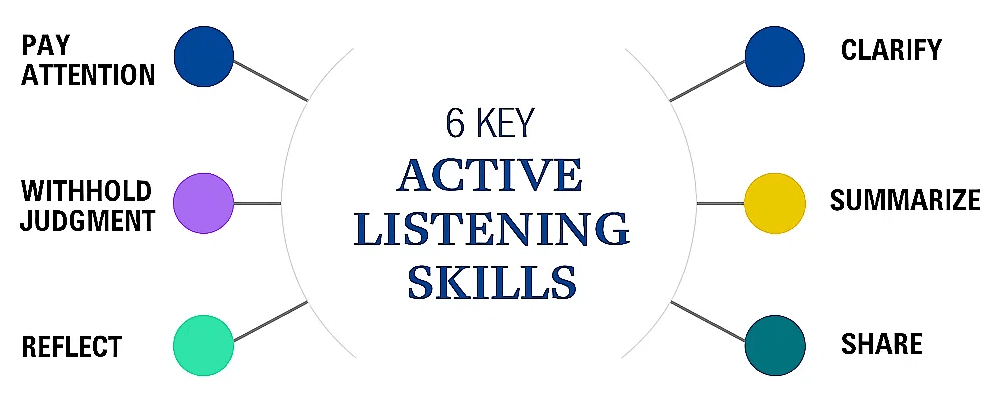
Enhancing your active listening skillset involves more than simply hearing someone speak. It requires presence, intention, and thoughtful response. These six techniques help working professionals communicate with clarity, trust, and efficiency:
1. Pay Attention
Focus fully on the speaker. Maintain eye contact, silence notifications, and avoid multitasking.
Example: In a project meeting, you close your laptop and listen attentively as a teammate explains a roadblock. Because you’re fully present, you catch a detail that prevents a scheduling mistake.
2. Withhold Judgment
Listen without interrupting or forming conclusions before the speaker finishes.
Example: A colleague shares concerns about the workflow. Instead of dismissing it as “overthinking,” you listen openly and discover a genuine bottleneck that needs fixing.
3. Reflect
Mirror what the speaker is expressing to show understanding and empathy.
Example: When an employee says, “I’m overwhelmed with these deadlines,” you respond with, “It sounds like the workload has been heavy lately.” This helps them feel heard and supported.
4. Clarify
Ask thoughtful questions to remove ambiguity and deepen understanding.
Example: During a client call, instead of assuming what “ASAP” means, you ask, “Can you clarify the exact timeline you’re expecting?” This prevents delays and rework.
5. Summarize
Restate the main points to confirm alignment and avoid misunderstandings.
Example: After a discussion with your manager, you say, “So the priority is updating the pitch deck by Friday, and the next review is on Monday, correct?” This ensures both sides are on the same page.
6. Share
Once you’ve listened fully, contribute your perspective, suggestions, or solutions.
Example: A teammate explains a recurring issue with cross-team communication. After listening and summarising, you share, “Here’s a possible solution: we can set up a weekly sync to keep everyone aligned.”
Connection Between Leader Listening, Taking Action, and Employee Voice
In modern workplaces, employees do not just want to be heard; they want to see that what they say leads to meaningful change. This is where the relationship between leader listening, leader action, and employee voice becomes critical.
1. Listening Creates Psychological Safety
When leaders listen without interrupting or dismissing ideas, employees feel safe to express their thoughts openly.
Example: A team member highlights a recurring customer complaint. A listening-focused leader acknowledges it and encourages more insights instead of shutting it down.
2. Action Shows That Listening Is Not Performative
Employees quickly notice when leaders hear them but fail to act. Taking visible, timely steps shows that their input matters.
Example: If employees report confusing processes, and the leader introduces a clearer workflow within a week, trust grows immediately.
3. Employee Voice Increases When Action Follows Listening
When people see their feedback influencing decisions, they speak up more often and with better ideas.
Example: After a leader acts on suggestions about improving internal communication, more team members voluntarily contribute ideas for other improvements.
4. Better Listening Leads to Better Engagement
Employees feel valued when leaders understand their challenges and respond empathetically. This strengthens engagement, morale, and loyalty.
Example: When a leader listens to workload concerns and redistributes tasks, the team becomes more motivated and productive.
5. Closing the Loop Builds a Culture of Transparency
Announcing what changes were made because of employee feedback creates transparency and boosts organizational trust.
Example: A manager says, “Based on your feedback, we’ve updated the client escalation process.” This simple acknowledgment reinforces that employee voice drives real outcomes.
6. Leadership Listening Predicts Team Performance
Leaders who listen well identify risks sooner, reduce friction, and create an environment where innovation thrives.
Example: When a leader listens to early warnings about a potential project delay, they can intervene faster, helping the team deliver on time.
What Characterizes a Poor Listener vs a Good Listener?
| Aspect | Poor Listener | Good Listener |
|---|---|---|
| Attention | Gets distracted easily, checks phone or laptop while others speak | Stays fully present, maintains focus throughout the conversation |
| Body Language | Avoids eye contact, closed posture, impatient expressions | Uses open posture, nods naturally, maintains calm and encouraging expressions |
| Interruptions | Frequently interrupts, finishes others’ sentences, rushes conversations | Lets others finish their thoughts, waits before responding |
| Judgment | Forms quick opinions, dismisses ideas, gets defensive | Keeps an open mind, evaluates information thoughtfully |
| Understanding | Assumes meaning without clarifying, often misinterprets information | Asks clarifying questions, confirms understanding before responding |
| Empathy | Focuses only on their own perspective, ignores emotional cues | Recognizes emotions, responds with sensitivity and understanding |
| Response Style | Reactive, argumentative, or dismissive | Thoughtful, calm, and solution focused |
| Engagement | Appears uninterested, provides minimal verbal or nonverbal feedback | Actively engages through questions, reflections, and summaries |
| Follow-Through | Forgets details, takes no action on what was discussed | Remembers key points and takes appropriate follow-up actions |
| Effect on Others | Makes people feel unheard, undervalued, or frustrated | Makes people feel respected, understood, and encouraged to share |
Enhance your communication and leadership skills with expert guidance.
Book a PlanetSpark Demo Today!
How Strong Listening Skills Drive Business Success
Effective listening is not just a soft skill; it is a strategic advantage that directly impacts business performance, employee experience, and long-term organisational health. When professionals and leaders listen deeply and intentionally, companies experience measurable improvements across collaboration, productivity, innovation, and customer satisfaction.
1. Enhances Team Productivity and Efficiency
When team members listen carefully during discussions, requirements, and handovers, work moves faster and cleaner.
Fewer mistakes occur because instructions are understood correctly.
Teams avoid repeated clarifications, rework, and misaligned expectations.
Projects run smoothly because everyone is on the same page.
2. Improves Employee Engagement and Retention
Employees feel valued when leaders listen to their concerns, ideas, and challenges.
This builds psychological safety, a key driver of high-performing teams.
Engaged employees stay longer, reducing turnover costs.
A listening culture boosts morale and creates a supportive work environment.
3. Strengthens Customer and Client Relationships
Listening uncovers customer pain points, desires, and long-term expectations.
Sales teams can tailor solutions more accurately.
Support teams can resolve issues faster and with empathy.
Strong listening leads to higher customer satisfaction and loyalty.
4. Fuels Innovation and Better Decision-Making
When professionals listen without bias, they gather richer data and diverse perspectives.
New ideas emerge because people feel safe sharing unconventional thoughts.
Leaders make decisions that are better informed and more effective.
Innovation becomes a natural outcome of open communication.
5. Reduces Conflict and Improves Workplace Harmony
Most workplace conflicts start with miscommunication or assumptions.
Stronger listening skills help:
Reduce misunderstandings
De-escalate emotional tension
Encourage collaborative problem-solving
Maintain positive working relationships
6. Enhances Leadership Influence and Credibility
A leader who listens earns trust faster than one who speaks the most.
Employees naturally follow leaders who demonstrate empathy and respect.
Listening helps leaders spot early warning signs of burnout, conflicts, or process gaps.
It enhances executive presence and strengthens leadership impact across teams.
7. Improves Sales, Negotiation, and Client Conversions
Listening is at the core of effective persuasion.
Professionals who listen well can:
Identify hidden objections during sales conversations
Understand client motivations
Negotiate deals that benefit both parties
Build long-term business partnerships
8. Builds a Culture of Continuous Improvement
When companies listen to feedback from employees, customers, and stakeholders:
Processes improve continuously
Products become more customer aligned
Teams adopt a growth mindset
Organisations stay competitive and adaptable

How PlanetSpark Helps Working Professionals Build Exceptional Listening Skills
In a fast-paced corporate world, strong listening is not optional, it is a career accelerator. PlanetSpark’s communication and leadership programs for working professionals are designed to strengthen listening as a foundational soft skill through guided practice, feedback, and real-world simulations.
Expert-Led Coaching on Workplace Scenarios
Learn active listening strategies for meetings, client calls, and team discussions with personalised guidance from industry-trained coaches.Structured Techniques for Effective Listening
Master practical skills like reflective listening, clarifying, summarising, and reading emotional cues for better communication.Interactive Practice with Real-Time Feedback
Engage in simulations and receive AI-powered feedback on tone, responses, and comprehension to improve quickly and measurably.Leadership and Team Communication Development
Strengthen leadership presence by learning to listen intentionally, build trust, and make informed decisions.Practical Application for Client and Stakeholder Relations
Enhance client interactions, negotiation outcomes, and stakeholder engagement through improved listening and understanding.
Conclusion
Listening is more than a passive act, it is a powerful tool that drives collaboration, trust, innovation, and business success. For working professionals, mastering listening skills can transform team dynamics, strengthen client relationships, and elevate leadership effectiveness. By practicing active listening, being present, and applying emotional intelligence, professionals can navigate complex workplace scenarios with confidence and clarity.