
Importance of Reading Skills for Confident Communication


Table of Contents
- What Are Reading Skills?
- Why Are Reading Skills Important?
- How Reading Skills Help in Talking and Sharing Ideas
- How to Make Your Child Fall in Love with Reading
- Different Types of Reading Skills
- Fun Ways to Practice Reading Every Day
- How to Encourage Regular Reading Habits
- How Planetspark Helps in Improving Reading Skills
- Conclusion: Strengthening Reading Skills for a Confident Fut
Reading is one of the most important skills a person can develop. It is not just about recognizing letters or understanding words; it is about unlocking the power to explore ideas, learn new things, and express oneself confidently. Strong reading skills help children and adults grasp knowledge from books, stories, newspapers, and even digital content. For kids, these skills build the foundation for success in school, communication, and social interactions. For working professionals, reading skills improve comprehension, decision-making, and effective communication.
When someone has strong reading skills, they can understand instructions, interpret information, and explain ideas clearly. This ability creates confidence in both personal and professional life. Reading also develops critical thinking. For instance, a child reading a story learns to predict what might happen next, understand character emotions, and think about solutions to problems. Adults reading reports, emails, or guides develop analytical thinking, making their communication sharper and more impactful.
In today’s fast-paced world, reading is essential to stay informed and make smart decisions. Reading not only helps in acquiring knowledge but also improves attention span, memory, and focus. Additionally, it encourages curiosity. Children and adults who read regularly are more likely to ask questions, explore new topics, and develop a lifelong love for learning. In short, the importance of reading skills goes beyond academics; it shapes a person’s ability to communicate, understand the world, and grow intellectually.
What Are Reading Skills?
Reading skills refer to the abilities that allow a person to understand, interpret, and enjoy written content. These skills form the backbone of learning and communication. Without reading skills, even simple instructions or stories can seem confusing, and conveying thoughts effectively becomes a challenge.
Key components of reading skills include:
Understanding words: Recognizing and understanding the meaning of words.
Comprehension: Grasping the ideas, emotions, and messages in a text.
Fluency: Reading smoothly and confidently without stumbling.
Vocabulary building: Learning new words and knowing how to use them in context.
Critical thinking: Evaluating what is read and connecting it with prior knowledge.
Pronunciation and expression: Saying words correctly and expressing ideas clearly.
Why reading skills are important for kids and adults:
Helps with homework, learning, and academic progress.
Builds attention, focus, and memory.
Prepares individuals for real-life tasks like reading instructions, messages, or emails.
Enhances communication by improving speaking and writing.
Example Table: Components of Reading Skills
| Skill Component | What It Means | How It Helps |
|---|---|---|
| Vocabulary | Understanding words and their meanings | Easier comprehension |
| Comprehension | Grasping the message or story | Clear communication |
| Fluency | Reading smoothly without pauses | Enjoy reading more |
| Critical Thinking | Thinking about what you read | Better problem-solving |
| Pronunciation | Saying words correctly | Stronger speaking skills |
Developing reading skills is not only crucial for learning but also enhances confidence in communication. Kids who read regularly can tell stories, explain ideas, and ask questions more confidently. Adults with strong reading skills can interpret reports, emails, and information efficiently, which strengthens both personal and professional communication. The ability to read effectively is the first step toward becoming a confident and knowledgeable communicator.
Why Are Reading Skills Important?
Understanding what is the importance of reading skills helps us realize their value in every aspect of life. Reading skills form the foundation for learning, communication, and personal growth. They allow individuals to understand content, remember information, and communicate ideas effectively.
Benefits of strong reading skills:
Better communication: Reading improves vocabulary, sentence structure, and understanding, which helps in speaking and writing.
Boosts confidence: When a person understands what they read, they feel confident sharing ideas with others.
Improves focus and attention: Reading requires concentration, which sharpens the mind and strengthens memory.
Supports learning across subjects: Reading comprehension is essential for subjects like math, science, history, and languages.
Encourages creativity and imagination: Reading stories and information stimulates curiosity and problem-solving skills.
Importance of reading skills in communication:
Clear expression: Understanding words and sentence structures allows for better communication.
Understanding others: Strong readers can comprehend instructions, emails, messages, and stories quickly.
Persuasive speaking: Reading helps in learning how to explain ideas in an organized way, which is useful for discussions and presentations.
Conflict resolution: Comprehending different viewpoints through reading can help in solving misunderstandings.
Daily Life Examples:
Following recipes, instructions, or user manuals accurately.
Writing emails, reports, or messages clearly and effectively.
Learning new skills through books or online articles.
Enjoying stories, comics, or blogs while understanding the content fully.
"Speak confidently, shine brightly!"
Boost your child’s communication with PlanetSpark’s expert-guided Communication Skills course.
How Reading Skills Help in Talking and Sharing Ideas
Reading is not just about understanding words on a page - it directly improves how we talk, share ideas, and communicate effectively. Strong reading skills help children express themselves confidently in class and adults communicate clearly at work or in everyday life.
Ways reading skills improve communication:
Better vocabulary: Reading introduces new words, which can be used in conversations or writing.
Clear expression: Understanding sentence structure helps explain ideas logically.
Improved listening: Reading develops attention to detail, which helps in understanding others during discussions.
Confidence in speaking: When kids or adults know what they read, they feel more comfortable sharing their thoughts.
Critical thinking: Reading helps analyze information, ask questions, and provide meaningful answers.
Example Table: Reading Skills and Communication Benefits
| Reading Skill | Communication Benefit | Real-Life Example |
|---|---|---|
| Vocabulary | Use more words to express ideas | Explaining a science concept clearly |
| Comprehension | Understand messages better | Following instructions or guidelines |
| Fluency | Speak confidently and smoothly | Storytelling or giving presentations |
| Critical Thinking | Make informed opinions | Debating a topic or discussing a book |
Activities that improve reading for better communication:
Reading aloud: Helps in pronunciation, fluency, and confidence.
Storytelling from books: Encourages children to summarize and explain ideas.
Discussion and reflection: Talk about what was read to develop comprehension and expression.
Interactive reading apps: Games and exercises improve both reading and speaking skills.
Strong reading skills make expressing ideas easier. A child who reads regularly can narrate stories, describe experiences, and answer questions without hesitation. Adults with strong reading skills can write better emails, reports, and presentations, making them confident in professional communication.
By practicing reading every day, learners strengthen their ability to understand information, think critically, and communicate clearly - skills essential for school, work, and life.
How to Make Your Child Fall in Love with Reading
Developing strong reading skills starts with making reading fun and enjoyable. Children learn best when they are curious and excited about stories, books, and learning new words.
Tips to make reading fun:
Create a reading-friendly space: A cozy corner with books, good lighting, and comfy seating encourages children to read.
Let them choose books: Allow kids to pick stories or topics they enjoy - fantasy, science, comics, or animals.
Read together: Shared reading sessions help develop vocabulary, comprehension, and bonding.
Use engaging visuals: Books with illustrations, charts, and colorful layouts make reading interesting.
Set small goals: Reading a page a day or a chapter a week makes the habit less overwhelming.
Incorporate technology: Educational apps, audiobooks, and interactive stories can motivate reluctant readers.
Discuss stories: Ask questions about characters, plot, or lessons, encouraging critical thinking.
Fun Ways to Track Progress:
| Activity | How It Helps | Frequency |
|---|---|---|
| Reading chart | Visual progress tracking | Daily |
| Story summaries | Improves comprehension and expression | Weekly |
| Word games | Builds vocabulary | 2–3 times a week |
| Reading aloud sessions | Enhances fluency and confidence | Daily or alternate days |
Reading should never feel like a chore. When children enjoy reading, they naturally develop stronger reading skills, which in turn improves communication, imagination, and learning. Professionals can also adopt similar techniques - choosing interesting books, reading daily, and discussing ideas with peers to maintain and enhance their reading skills.
Falling in love with reading is the first step toward building a lifelong habit that strengthens vocabulary, comprehension, critical thinking, and communication - skills that benefit both kids and adults in school, work, and life.
"Every word you speak matters!"
Enroll now in PlanetSpark’s Communication Skills course to enhance clarity and confidence.
Different Types of Reading Skills
Reading is not just one single skill - it involves multiple abilities that work together to help a person understand and enjoy text. Knowing the types of reading skills can help parents, teachers, and learners focus on areas that need improvement.
Main types of reading skills include:
1. Phonemic Awareness
Understanding the sounds that letters and words make.
Helps children decode new words and read accurately.
Example: Recognizing that “cat” and “bat” rhyme.
2. Decoding Skills
The ability to read words by breaking them into sounds.
Essential for beginners to read fluently.
Example: Sounding out “reading” as /r-ee-d-ing/.
3. Vocabulary Skills
Knowing the meaning of words and how to use them.
Improves comprehension and communication.
Example: Learning that “gigantic” means very large.
4. Comprehension Skills
Understanding and interpreting what is read.
Critical for answering questions, summarizing, and applying knowledge.
Example: Explaining the moral of a story.
5. Fluency Skills
Reading smoothly with correct speed, pronunciation, and expression.
Makes reading enjoyable and improves understanding.
Example: Reading a story aloud without pausing unnecessarily.
6. Critical Thinking and Analytical Skills
Evaluating text, identifying main ideas, and making inferences.
Helps children and adults think deeply and communicate clearly.
Example: Predicting what might happen next in a story.
Table: Summary of Types of Reading Skills
| Type of Reading Skill | Description | Why It Matters |
|---|---|---|
| Phonemic Awareness | Understanding letter sounds | Builds foundation for reading |
| Decoding Skills | Breaking words into sounds | Helps in reading new words |
| Vocabulary Skills | Knowing meanings of words | Improves comprehension & speech |
| Comprehension Skills | Understanding meaning of text | Enhances learning & communication |
| Fluency Skills | Reading smoothly & confidently | Makes reading enjoyable |
| Critical Thinking Skills | Analyzing and thinking about text | Strengthens problem-solving |
Developing all these types of reading skills ensures learners are not just reading words but truly understanding, enjoying, and using information. Strong reading skills also enhance confidence in speaking, writing, and interacting with others.
"Let your voice be heard!"
Develop strong communication skills through PlanetSpark’s fun and interactive program.
Fun Ways to Practice Reading Every Day
Practicing reading skills doesn’t have to feel like homework. Making reading enjoyable helps kids develop a habit while adults can improve comprehension and communication naturally.
Daily Reading Activities:
Storytime Sessions: Read a short story daily, discuss the characters and events.
Word Games: Play Scrabble, crosswords, or word search puzzles to build vocabulary.
Read Aloud: Take turns reading aloud in a fun, expressive way to improve fluency.
Interactive Apps: Use educational apps or audiobooks to combine fun and learning.
Journaling: Encourage writing a daily summary of what was read to strengthen comprehension.
Role Play: Act out parts of a story to make reading imaginative and engaging.
Library Visits: Explore different genres to keep curiosity alive.
Visual Table: Daily Reading Practice Ideas
| Activity | Skill Developed | Suggested Frequency |
|---|---|---|
| Storytime | Comprehension, vocabulary | Daily |
| Word Games | Vocabulary, spelling | 2–3 times a week |
| Read Aloud | Fluency, pronunciation | Daily or alternate days |
| Educational Apps | Interactive learning, comprehension | 3–4 times a week |
| Journaling | Writing & comprehension | Daily |
| Role Play | Imagination & expression | Weekly |
| Library Exploration | Curiosity & critical thinking | Weekly |
Consistent reading practice improves not just understanding but also confidence in communication. Kids who read daily can tell stories, explain ideas, and express emotions clearly. Adults who practice reading regularly become better at learning new skills, understanding information quickly, and communicating professionally.
Tips to keep reading fun:
Reward small milestones, like finishing a book or mastering new words.
Make reading interactive with questions and discussions.
Mix fiction and non-fiction to balance creativity and knowledge.
Fun daily reading habits strengthen all types of reading skills, making learners confident in comprehension, vocabulary, fluency, and communication. Over time, this habit can lead to academic success, career growth, and lifelong learning.
How to Encourage Regular Reading Habits
Building strong reading skills requires consistent practice and encouragement. Encouraging regular reading habits helps children and adults improve comprehension, vocabulary, and communication.
Strategies to Encourage Reading:
Set a Routine: Dedicate a specific time each day for reading, like before bed or after school/work.
Create a Reading-Friendly Environment: A quiet, cozy space with books or digital content encourages focus.
Offer a Variety of Materials: Include storybooks, comics, magazines, articles, and online stories.
Be a Reading Role Model: Adults who read regularly inspire kids to enjoy reading.
Reward Milestones: Celebrate completing a book or mastering new words to motivate learners.
Discuss What Was Read: Ask questions about the story, ideas, or new vocabulary to reinforce learning.
Combine Technology: Use educational apps or audiobooks to make reading interactive and enjoyable.
Bullet Points: Benefits of Regular Reading Habits
Enhances vocabulary and comprehension.
Improves confidence in speaking and writing.
Stimulates imagination and critical thinking.
Strengthens attention span and focus.
Develops a lifelong love for learning.
Regular reading habits help learners strengthen all types of reading skills, ensuring that children become confident in school, and adults improve professional communication and learning efficiency. The habit of reading daily transforms knowledge into practical skills, making learning a joyful and lifelong journey.
How Planetspark Helps in Improving Reading Skills
Learning reading skills can be fun and effective when supported with the right guidance. Planetspark offers a structured and interactive way to improve reading skills, making the process enjoyable for kids and effective for all learners.
How Planetspark Supports Reading Development:
1. Interactive Learning Approach
Uses stories, games, and activities to make reading engaging.
Helps learners focus on comprehension and vocabulary through interactive exercises.
Example: Children can read a story and answer fun quizzes about characters, plot, and moral lessons.
2. Skill-Based Progress Tracking
Monitors development of different types of reading skills like comprehension, fluency, and vocabulary.
Personalized feedback helps learners improve gradually.
Example: After reading a story, the system tracks how well a child understood the content and provides suggestions.
3. Daily Practice and Exercises
Short, daily reading exercises encourage consistent practice.
Includes word games, story summaries, and reading aloud sessions.
Helps build strong habits for lifelong reading and communication improvement.
4. Focus on Communication Skills
Reading exercises are paired with speaking activities to enhance importance of reading skills in communication.
Children learn to explain ideas, narrate stories, and express emotions confidently.
Example: After a story, children can record themselves summarizing or discussing the plot, improving both reading and speaking skills.
5. Fun and Engaging Content
Includes illustrated stories, interactive apps, and creative prompts.
Makes learning enjoyable and encourages curiosity, helping learners develop a love for reading naturally.
With Planetspark, learners not only improve reading but also develop critical thinking, imagination, and communication skills. Regular guided practice ensures that children and adults alike are confident in reading and sharing their ideas.
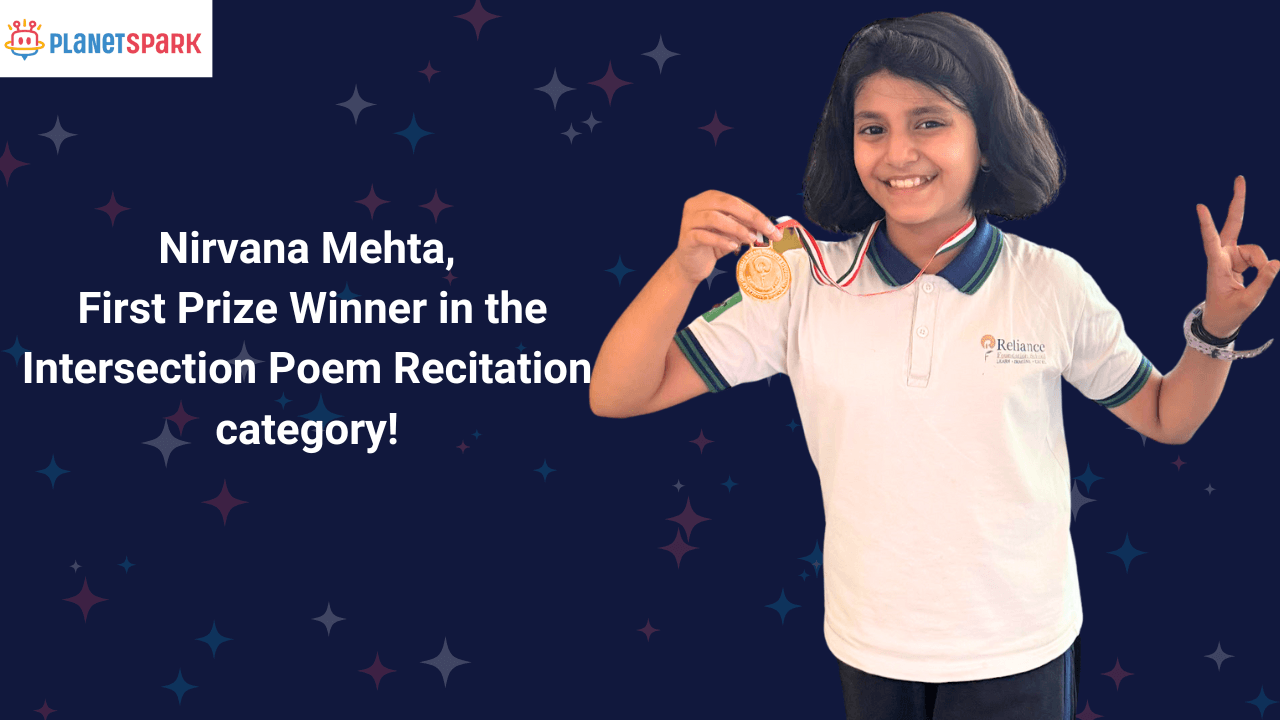
Nirvana Mehta Triumphs in Intersection Poem Recitation
Nirvana Mehta has been awarded First Prize in the Intersection Poem Recitation category, demonstrating exceptional confidence, expressive storytelling, and impressive voice control. Her achievement highlights the impact of strong communication and public speaking skills, cultivated through consistent practice and expert guidance at PlanetSpark.
Conclusion: Strengthening Reading Skills for a Confident Future
The importance of reading skills cannot be overstated. From children learning their first stories to adults navigating work or personal growth, strong reading skills form the foundation of confident communication, critical thinking, and lifelong learning. Reading skills allow learners to understand new ideas, express themselves clearly, and make sense of the world around them.
By developing different types of reading skills - including comprehension, vocabulary, fluency, and critical thinking - learners become confident in both speaking and writing. These skills not only help in academic performance but also improve daily communication, problem-solving, and decision-making. Whether it’s narrating a story, summarizing an article, or interpreting information at work, reading skills enhance clarity and expression.
Regular practice and engaging methods, such as interactive storybooks, word games, and discussion activities, make reading enjoyable and effective. Platforms like Planetspark make learning structured and fun, combining reading with speaking exercises to improve communication while nurturing curiosity and imagination.
"Confidence starts with good communication!"
Join PlanetSpark’s Communication Skills course and watch your child express ideas fearlessly.
Frequently Asked Questions
Reading skills are the abilities that help a person understand, interpret, and enjoy written text. They include comprehension, vocabulary, fluency, and critical thinking.
Strong reading skills help children learn in school, express ideas clearly, build confidence, and develop critical thinking from an early age.
Reading enhances vocabulary, comprehension, and sentence formation, which makes it easier to speak, write, and express ideas clearly.
Reading skills are useful for following instructions, understanding emails, learning new topics, and enjoying stories, making everyday tasks easier and more enjoyable.
Key types include comprehension, fluency, vocabulary, phonemic awareness, decoding, and critical thinking skills.
Use interactive methods like reading aloud, asking questions, drawing story scenes, acting out stories, and using colorful printable materials.