
Leader Member Exchange Theory Guide for Professionals
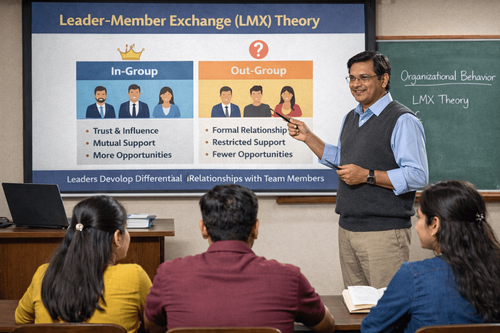

Table of Contents
- What Is Leader Member Exchange Theory?
- Evolution of Leader Member Exchange Theory
- Core Principles of Leader Member Exchange Theory
- In-Groups and Out-Groups in LMX Theory
- Stages of Leader Member Exchange Development
- Why Leader Member Exchange Theory Matters in Modern Organisa
- Role of Communication Skills in Leader Member Exchange Theor
- Leader Member Exchange Theory and Leadership Effectiveness
- Leader Member Exchange Theory PPT: Why It Is Widely Used
- Leader Member Exchange Theory in Team Management
- Challenges and Criticism of Leader Member Exchange Theory
- Applying Leader Member Exchange Theory in Real-Life Scenario
- Developing LMX Skills Through Communication Practice
- Why PlanetSpark for Communication Skills and Leadership Deve
- Detailed Exploration of Constructs
- Leadership Is Built Through Relationships
The Leader Member Exchange Theory explains why leadership effectiveness is shaped not only by authority or position, but by the quality of relationships leaders build with individual team members. In modern organisations, success depends on trust, communication, and mutual respect rather than hierarchy alone. This blog explores the Leader Member Exchange Theory in depth, explains how leader-member relationships influence performance and motivation, and shows how strong communication skills help leaders create inclusive, high-performing teams.

What Is Leader Member Exchange Theory?
The Leader Member Exchange Theory, often referred to as the Leader member exchange theory of leadership, focuses on the dyadic, one-to-one relationship between a leader and each team member. Unlike traditional leadership theories that treat teams as uniform groups, LMX theory recognises that leaders naturally develop different relationships with different individuals.
These relationships vary in quality and directly influence:
Job satisfaction
Commitment and loyalty
Performance and engagement
At its core, the theory argues that leadership effectiveness depends on communication quality, trust, and mutual influence.
Evolution of Leader Member Exchange Theory
From Role-Based Leadership to Relationship-Based Leadership
Earlier leadership models assumed leaders used the same style with all employees. The Leader Member Exchange Theory of leadership challenged this assumption by showing that leaders form distinct exchanges with individuals over time.
This shift highlighted:
Leadership as a social process
Communication as a core leadership tool
Relationships as performance drivers
The theory evolved from “Vertical Dyad Linkage” research into the modern LMX framework used today in organisational psychology and management studies.
Core Principles of Leader Member Exchange Theory
1. Dyadic Relationships
Leadership occurs through individual leader-member relationships, not just group dynamics.
2. Exchange-Based Interactions
Relationships develop through exchanges of trust, support, information, and responsibility.
3. Relationship Quality Matters
High-quality exchanges lead to better outcomes for both leaders and team members.
4. Communication Is Central
Open, consistent, and respectful communication strengthens exchanges over time.
In-Groups and Out-Groups in LMX Theory
One of the most discussed aspects of the Leader Member Exchange Theory is the formation of in-groups and out-groups.
In-Group Members
Experience high trust and mutual respect
Receive more responsibility and autonomy
Have open communication with leaders
Out-Group Members
Experience formal, transactional relationships
Have limited communication access
Perform only role-defined tasks
This distinction does not arise intentionally but develops through early interactions and communication patterns.
Stages of Leader Member Exchange Development
Stage 1: Role Taking
Leader evaluates new members’ skills and attitudes
Communication is formal and task-focused
Stage 2: Role Making
Trust begins to develop
Members show initiative and reliability
Communication becomes more open
Stage 3: Role Routinization
Relationships stabilise
Expectations are clear
Communication becomes predictable and efficient
Leaders who invest in communication at each stage are more likely to build high-quality exchanges across the team.
Why Leader Member Exchange Theory Matters in Modern Organisations
Impact on Employee Performance
High-quality leader-member relationships lead to:
Higher productivity
Greater discretionary effort
Improved problem-solving
Impact on Motivation and Engagement
Employees who feel heard and valued are more engaged and loyal.
Impact on Team Culture
LMX theory explains why inclusive leadership cultures outperform rigid hierarchical models.
Master communication confidently with PlanetSpark’s expert programs.
Role of Communication Skills in Leader Member Exchange Theory
Communication is the foundation of every leader-member exchange.
How Communication Shapes LMX Quality
Clarity reduces misunderstandings
Listening builds trust
Feedback strengthens alignment
Leaders who communicate effectively create psychological safety and encourage open dialogue.
Key Communication Behaviours in High-Quality LMX
Active listening without interruption
Transparent sharing of expectations
Constructive feedback rather than criticism
Consistent follow-ups
These behaviours transform transactional relationships into collaborative partnerships.
Leader Member Exchange Theory and Leadership Effectiveness
Why Equal Treatment Is Not the Same as Fair Treatment
LMX theory highlights that fairness does not always mean sameness. Leaders must tailor communication and support while maintaining ethical boundaries.
Balancing Individual Attention and Team Equity
Effective leaders:
Avoid favoritism
Offer development opportunities to all
Use communication to manage perceptions
Strong communication skills ensure differentiation does not become division.
Leader Member Exchange Theory PPT: Why It Is Widely Used
The Leader member exchange theory PPT format is commonly used in:
Management training programs
MBA and HR curricula
Leadership workshops
This is because the model:
Is easy to visualise
Explains real workplace behavior
Connects theory with practical leadership challenges
Professionals often search for LMX theory PPTs to understand relationship dynamics and leadership impact.
Leader Member Exchange Theory in Team Management
Building High-Quality Exchanges Across the Team
Leaders should aim to gradually improve relationship quality with every member.
Practical Actions for Leaders
Schedule regular one-on-one conversations
Encourage open feedback
Recognise contributions publicly and privately
Communication consistency is key to avoiding in-group and out-group divides.
Challenges and Criticism of Leader Member Exchange Theory
Potential Risks
Perceived favoritism
Unequal access to opportunities
Team resentment
How Communication Reduces These Risks
Transparency in decisions
Clear role expectations
Inclusive dialogue
Effective communication mitigates the limitations of the model.
Applying Leader Member Exchange Theory in Real-Life Scenarios
In Corporate Leadership
Managing diverse teams
Delegating responsibilities
Handling performance reviews
In Education and Training
Teacher-student relationships
Mentorship programs
Group project leadership
In Remote and Hybrid Workplaces
Maintaining trust without physical presence
Using communication tools effectively
Preventing disengagement
LMX theory remains relevant across all modern work environments.
Developing LMX Skills Through Communication Practice
Understanding the theory is not enough. Skill development requires practice.
Key Areas to Focus On
Emotional intelligence
Assertive communication
Empathy-driven listening
Feedback delivery
Leaders who practice these skills consistently improve relationship quality over time.

Why PlanetSpark for Communication Skills and Leadership Development
PlanetSpark focuses on building structured communication, critical thinking, and interpersonal effectiveness. Its Communication Skills programs help learners understand leadership frameworks like the Leader Member Exchange Theory and apply them confidently in real-world interactions.
What Learners Gain
Strong interpersonal communication
Leadership presence and clarity
Relationship-building skills
Confidence in team interactions
Detailed Exploration of Constructs
Mutual Respect
How Respect Is Built in Leader–Member Exchanges
Leader Member Exchange Theory explains that mutual respect develops when leaders value how professionals think, communicate, and simplify complexity.
Translating technical or strategic ideas into relatable narratives, often supported by a Leader member exchange theory PPT—signals recognition of expertise and cognitive effort.
Respect strengthens when leaders acknowledge competence publicly and employees recognize guidance, creating a balanced, high-quality exchange.
Loyalty
Loyalty as a Result of Fair Exchange
Loyalty in the leader member exchange theory of leadership is not emotional dependence but a response to fair treatment and consistent communication.
When leaders reframe language from command to collaboration, loyalty deepens.
The PlanetSpark communication skills course trains professionals to use inclusive language, feedback framing, and clarity techniques that reinforce trust and long-term commitment.
Obligation
Discretionary Effort and Performance Impact
Obligation reflects a shared sense of responsibility beyond formal job roles.
High-LMX relationships motivate discretionary effort, extra initiative that directly improves productivity, revenue impact, and team reliability.
This construct shows how exchange quality converts communication into measurable business outcomes.
HR Perspective
Reducing Bias Through Standardised Communication
HR teams use Leader member exchange theory PPT frameworks to highlight how appraisal language (“confident” vs “aggressive”) can introduce bias.
Standardising feedback, evaluation criteria, and messaging reduces subjective influence and ensures fair development pathways across teams.
Motivating Workplace Culture
Scaling Trust Across the Organisation
To Build effective leadership and team relationships, organisations must embed bias-free communication skills at scale, not rely on one-off workshops.
Applying Leader Member Exchange Theory systematically creates a culture of trust, fairness, and sustained engagement across all levels.
Leadership Is Built Through Relationships
The Leader Member Exchange Theory highlights a fundamental truth about leadership, effective leadership is rooted in relationships, not titles. Leaders who invest in communication, trust-building, and individual understanding create high-quality exchanges that drive performance, engagement, and long-term success.
By understanding the Leader member exchange theory of leadership and strengthening communication skills, leaders can move from transactional management to relational leadership. In today’s dynamic workplaces, the ability to communicate clearly, listen actively, and build trust is what transforms leaders into role models and teams into high-performing units.
You may also read:
Frequently Asked Questions
Leader Member Exchange Theory explains that leaders develop different quality relationships with each team member based on communication, trust, and competence. The leader member exchange theory of leadership describes stages of role taking, role making, and routinization and guides professionals to build effective leadership and team relationships ethically.
High quality LMX leads to discretionary effort, better ratings, innovation, and lower turnover. Managers searching leader member exchange theory PPT often present these benefits to supervisors to show how Build effective leadership and team relationships improves organizational outcomes.
Yes. By demonstrating initiative, reliability, and clear communication, employees can gradually increase exchange quality. Many professionals prepare a Leader member exchange theory PPT to make their ideas visible and request mentoring conversations with leaders.
Leaders must avoid stereotyping, tone policing, and unfair task distribution. Standardized communication norms in meetings and emails reduce subjective influence. Corporate trainers using a Leader member exchange theory PPT include slides on these risks for HR and L&D teams.
PlanetSpark business communication learning provides 1:1 coaching and structured workshops where adults practice feedback scripts, delegation talks, and create a Leader member exchange theory PPT for internal sessions. The PlanetSpark communication skills course helps professionals build trust-led relationships exactly as proposed in Leader Member Exchange Theory and supports fair exchanges across all business channels.