
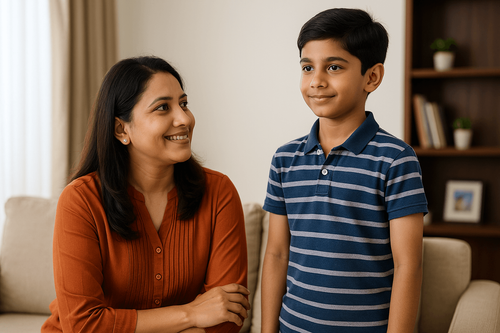

When children speak, parents usually focus on the words they choose. But more than half of communication happens through non-verbal cues. These silent signals include posture, eye contact, facial expressions, hand gestures and the way a child uses space.
As a parent, understanding non-verbal cues for kids helps you guide them in becoming stronger communicators. You do not need technical knowledge. You only need simple awareness, observation and a few at-home practices. This blog is a complete parent-friendly guide that explains how children use non-verbal cues in communication, why these skills matter and how you can help your child use body language and posture with confidence.
What Are Non-Verbal Cues for Kids
Non-verbal cues are the silent signals children use while speaking or interacting. These include:
posture
facial expressions
gestures
hand movements
eye contact
head movements
use of space
body orientation
For kids, these signals are especially important because they help others understand intention, emotion and confidence. A child’s non-verbal communication often speaks before their words do.
Non-verbal cues are not fixed. Children learn them through imitation, practice and environment. A child who sees confident communication at home usually develops stronger non-verbal skills. That is why parents play a powerful role in shaping how children communicate without words.
Why Non-Verbal Communication Is Important for Children
Children use non-verbal cues in communication long before they learn complete sentences. Even as toddlers, they point, nod, shake their head or raise their arms when they want to express something. As they grow older, these cues continue to influence how clearly they express themselves.
Here is why non-verbal communication matters:
It helps children express emotions.
It makes speech clearer and more natural.
It improves social interaction and empathy.
It builds confidence during conversations.
It strengthens public speaking and classroom participation.
It reduces misunderstandings in day-to-day communication.
Children who master non-verbal cues feel more in control of their communication. They look confident even when using few words. This leads to better friendships, stronger school participation and more comfort when speaking to new people.
How Children Use Non-Verbal Cues in Everyday Communication
Children constantly use non-verbal cues, often without realizing it. Here are some examples of how non-verbal communication appears in their daily routine.
1. Eye Contact
When children make eye contact, it shows they are listening, confident and present in the conversation. Good eye contact does not mean staring. It means looking gently at the speaker and occasionally shifting the gaze naturally.
2. Posture
A child who stands straight with relaxed shoulders appears confident and ready to communicate. A slouched posture can give the impression of disinterest or nervousness, even if the child is simply tired.
3. Facial Expressions
Smiles, raised eyebrows, frowns and wide eyes help children express emotions. A child’s face often gives more information than their words.
4. Gestures
Hand movements help kids add clarity to what they are saying. For example, pointing, illustrating size, or showing direction supports verbal communication.
5. Body Orientation
When a child faces the person they are talking to, it shows interest. If they turn away, it may signal discomfort or distraction.
6. Personal Space and Movement
Children learn how close or far they should stand from someone. This varies for family, friends and strangers.
Recognizing these patterns helps parents understand how their child communicates without using words.
The Connection Between Body Language and Confidence
One of the strongest non-verbal cues for kids is posture. Confident posture can change how a child feels inside. When children stand tall, keep their chin up and relax their shoulders, their voice naturally becomes clearer and more expressive.
Studies show that body posture is strongly linked to emotional state. Kids who practice confident posture often feel more confident. This is why posture training is a major part of communication and public speaking programs for children.
Here is what confident posture looks like:
straight back
chin slightly raised
relaxed shoulders
open chest
balanced feet
hands relaxed by the side or used for gestures
When you teach your child posture, you are not teaching them to look rigid. You are teaching them to appear open, comfortable and expressive.
Help your child develop communication confidence beyond words.
Explore PlanetSpark’s Communication Skills Program today.
How Parents Can Help Kids Improve Non-Verbal Communication at Home
Teaching children non-verbal cues does not require special tools. Parents can help through simple daily habits, observation and gentle correction.
Here are the most effective parent strategies.
Step 1: Model Non-Verbal Communication Yourself
Children learn through imitation. When you maintain good eye contact, healthy posture and clear hand gestures, your child naturally mirrors these habits.
Step 2: Practice Eye Contact Through Simple Games
Try activities like:
looking into each other’s eyes while counting to five
practicing storytelling while making eye contact
maintaining eye contact during daily conversations
These exercises make eye contact natural instead of forced.
Step 3: Use Posture Reminders That Feel Fun, Not Strict
Instead of saying “Sit properly”, use child-friendly cues like:
“Let’s sit like superheroes.”
“Show me your strong posture.”
“Sit tall like a mountain.”
Children respond better to imagery than instructions.
Step 4: Encourage Hand Gestures During Storytelling
Ask your child to use:
hands to show size
pointing to show direction
gestures to describe actions
Gestures make communication lively and expressive.
Step 5: Teach Facial Expressions Through Mirror Play
Stand with your child in front of a mirror and practice:
happy expression
curious expression
surprised expression
determined expression
This helps children understand how expressions communicate emotion.
Step 6: Correct Non-Verbal Mistakes Gently
If your child looks down or slouches, do not scold. Use soft reminders:
“Eyes up, sweetheart. I’m right here.”
“Let’s stand straight like we are ready for adventure.”
Positive correction builds confidence.
Daily Routines That Build Strong Non-Verbal Communication in Kids
Non-verbal communication becomes natural when children practice it every day. Parents do not need dedicated lessons. Small routines built into normal life help children understand how to use posture, facial expressions and eye contact with ease. These habits slowly teach non-verbal cues for kids in a warm and consistent way.
1. Start the Day With a Posture Check
Every morning, remind your child to stand tall for a few seconds. You can simply say:
Stand like a superhero
Lift your chest softly
Stretch your shoulders back
This takes less than ten seconds but signals the child’s brain to notice posture. Over time, it becomes part of their natural behavior.
2. Encourage Eye Contact During Simple Conversations
Choose low-pressure moments:
Asking how their day was
Talking during breakfast
Sharing something funny
Gently say, “Look at me when you talk to me.” Over days, eye contact becomes easier and more comfortable. This is the simplest way to teach how children use non-verbal cues in communication through everyday life.
3. Use Gesture-Friendly Activities
Activities such as describing objects, storytelling games or guessing games encourage children to use their hands naturally. Gestures bring clarity and excitement to communication.
4. Practice Walk-and-Talk Conversations
Take short evening walks. Encourage your child to talk while walking upright with relaxed arms. This builds confident movement, body awareness and natural posture.
5. Include a Night-Time Reflection
Ask your child:
What expression did you use most today
Did you make eye contact with your teacher or friends
Did you stand tall while speaking
Reflection develops self-awareness, a key part of communication.
Build everyday communication habits that stick.
Help your child grow with PlanetSpark’s Communication Skills Program.
Activities and Games to Teach Non-Verbal Communication at Home
Kids learn best through fun. These parent-child activities help children practice non-verbal communication without feeling like they are being taught.
Activity 1: The Mirror Game
Stand in front of the mirror with your child. Ask them to copy your expressions:
joy
surprise
confusion
curiosity
determination
This helps your child understand how expressions change meaning without any words.
Activity 2: Freeze Posture Challenge
Play music. When the music stops, both of you freeze.
Tell your child to freeze in a confident posture:
straight spine
chin up
open arms or relaxed gesture
This playful method improves body awareness quickly.
Activity 3: Expression Guessing Game
Take turns making expressions while the other guesses:
I am thinking
I am worried
I am excited
I am unsure
This strengthens emotional recognition and communication clarity.
Give your child a safe space to practice real communication skills.
Join PlanetSpark’s expert-led Communication Skills classes.
Activity 4: Eye Contact Counting
Sit across from each other and maintain eye contact while counting slowly to ten. This develops comfort with eye contact, which is a central part of non-verbal cues for kids.
Activity 5: Gesture-Based Storytelling
Ask your child to tell a story using hands:
showing size
showing shape
showing direction
showing movement
Kids become more expressive when they learn how gestures add meaning
Activity 6: Walk With Confidence Game
Ask your child to walk across the room in two ways:
with a slouched posture
with a confident posture
Then ask which one felt better. This helps children understand how posture affects communication.
Activity 7: The Emotion-to-Posture Match
Say an emotion and ask your child to show posture for it:
brave
shy
surprised
calm
This blends emotional intelligence with body language skills.
Common Mistakes Children Make With Non-Verbal Cues
Kids practice communication daily, but not all habits help them communicate clearly. Here are common mistakes children make and how parents can guide them.
Mistake 1: Avoiding Eye Contact
Some children look down, look away or glance too quickly. This makes them appear unsure or distracted. Gently remind them to hold eye contact for short moments. Avoid forcing it.
Mistake 2: Slouched Posture
Slouching is common because it feels comfortable. However, it lowers the child’s energy and makes speech sound dull. Encourage simple posture cues:
stand tall like a tree
lift your chin slightly
relax your shoulders
Mistake 3: Overusing Gestures
Some kids move their hands too quickly or too much. This can distract the listener. Teach them to use slow, clear gestures that match their message.
Mistake 4: Blank Facial Expressions
Children sometimes forget to smile or show emotion, especially when nervous. Practicing expressions in front of a mirror improves awareness.
Mistake 5: Turning Away While Speaking
Kids may turn their bodies sideways or walk around while speaking. Teach them to face the person they are communicating with.
Mistake 6: Copying Adult Stress Cues
Children sometimes imitate adults without realizing it. If they see tense shoulders or rushed conversations, they may copy those patterns. Modelling calm non-verbal cues helps reset the child’s behavior.
How to Correct These Mistakes Without Hurting Confidence
Children improve faster with gentle guidance. Avoid harsh corrections like “Stop slouching” or “Why are you not looking at me”. Instead, use supportive cues:
Let us try that sentence again with strong posture
Look at me for one second while you speak
Try using your hands slowly to explain this
Give me an expression that matches your story
Correction should feel like practice, not pressure. This is the parent-friendly way of supporting non-verbal development.
Confidence grows when children learn through encouragement.
PlanetSpark creates a positive environment for communication improvement.
Why Non-Verbal Skills Are Essential in Public Speaking
Public speaking is not about memorizing lines. It is about expressing ideas with clarity and confidence. Non-verbal communication shapes how confidently a child presents on stage.
Here is how posture, expressions and gestures help:
Eye contact connects speakers with their audience.
Strong posture boosts voice clarity and breathing.
Gestures highlight important points.
Expressions make storytelling more interesting.
Open body language reduces nervous energy.
Children with strong non-verbal skills naturally become better public speakers, storytellers and classroom performers.
The Role of Non-Verbal Cues in Friendships and Social Interactions
Children rely on non-verbal cues for more than communication with adults. These cues shape how well they connect with friends, classmates and peers. When children understand body language, they communicate warmth, confidence and interest. This helps them form friendships and maintain positive relationships.
Non-verbal cues for kids play an important role during school interactions, birthday parties, playground time and group activities. When children use open posture, kind expressions and attentive eye contact, others feel more comfortable approaching them. This reduces misunderstandings and builds stronger friendships.
Social interactions improve when children know how to:
nod to show listening
smile genuinely
face the person they are speaking with
avoid crossing arms too tightly
use gentle gestures while explaining something
These small habits make communication friendlier and more effective.
Stronger friendships start with confident communication.
PlanetSpark helps children build social confidence with structured learning.
Advanced Body Language Techniques for Older Kids
As children grow, you can introduce more advanced non-verbal communication techniques. These skills help them handle school presentations, group discussions and real-world communication challenges with confidence.
Technique 1: Controlled Breathing for Confident Posture
Teach your child to take slow breaths before speaking. This helps relax the shoulders, straighten the spine and support a stable voice. Breathing is a foundational tool for calm body language.
Technique 2: Purposeful Gestures
Older kids can learn to move their hands purposefully instead of randomly. Teach them to:
gesture only when emphasizing an idea
keep hands above the waistline
avoid overly fast movements
Purposeful gestures make communication sharper and clearer.
Technique 3: Eye Contact Triangle
Instead of staring at one spot, children can learn the eye contact triangle technique: shift their gaze between the listener’s left eye, right eye and mouth. This creates natural rhythm and reduces pressure.
Technique 4: Spatial Awareness
Teach your child to maintain appropriate distance in different settings:
closer with family
arm’s length with classmates
respectful distance with teachers or adults
Understanding personal space shows maturity.
Technique 5: Open and Relaxed Stance
Older kids can practice keeping feet shoulder-width apart, knees relaxed and shoulders soft. This stance helps them stay grounded while speaking.
How Parents Can Strengthen Non-Verbal Communication Through Daily Reinforcement
Advanced skills require gentle reinforcement. Here are simple ways parents can help:
Reinforcement 1: Use Verbal Labels
Whenever your child displays a good posture or friendly gesture, label it aloud:
That was great eye contact
Your posture looked strong while speaking
Your smile made the conversation warm
Positive labelling builds awareness.
Reinforcement 2: Ask Reflection Questions
End the day with simple reflective questions:
Did you feel confident while speaking
Did you look at your teacher when answering
Did your posture help you feel calmer
Reflection builds emotional intelligence.
Reinforcement 3: Practice Real-Life Scenarios
Role-play common situations:
introducing themselves
asking a question in class
participating in group work
greeting visitors at home
Role-play prepares kids for real-world communication challenges.
How PlanetSpark Helps Kids Develop Non-Verbal Communication Skills
PlanetSpark’s communication and public speaking programs are built around child-friendly engagement. Instead of memorization, children learn by practicing. Here is how PlanetSpark supports non-verbal communication growth:
AI tools guide children through personalized communication exercises
Gamified learning keeps kids motivated and curious
Personalized curriculums ensure progresAs in posture, gestures, clarity and expression
Progress reports help parents see visible improvement
Club-based learning modules give children real opportunities to practice.
PlanetSpark creates a structured, fun and supportive environment for children to master non-verbal cues without feeling pressured or judged.
Communication confidence is built through practice, guidance and support.
PlanetSpark teaches children all three. Enroll today.
Teach Non-Verbal Cues to Kids with Confidence
Non-verbal communication shapes how children feel, express and connect. When kids learn posture, gestures, expressions and eye contact, they become clearer communicators in school, at home and in friendships. With parent guidance and consistent practice, children can develop strong non-verbal skills that stay with them for life.