
Poem Comprehension Skills Training for Better Understanding


Table of Contents
- What is Poem Comprehension
- Why Poem Comprehension is Important
- How Kids Can Understand Poems Easily
- Poem Comprehension for Class 3
- Poem Comprehension for Class 4
- Poem Comprehension for Class 7
- Fun Tips to Practice Poem Comprehension
- How Poem Comprehension Skills Help in School
- How Planetspark Helps
- Conclusion
Poems are magical - they rhyme, dance with words, and take readers to a world of imagination. But reading a poem isn’t just about saying words aloud. Many kids often wonder, “What does this poem really mean?” That’s where poem comprehension comes in.
Poem comprehension is the skill to understand the meaning, feelings, and ideas hidden in a poem. It’s about listening, thinking, imagining, and connecting with the poet’s message. For children, poem comprehension doesn’t just improve reading - it builds thinking skills, vocabulary, creativity, and confidence.
With the right guidance, poem comprehension can become fun, engaging, and easy. Kids can learn to enjoy reading, understand emotions, and explore the beauty of words. In this blog, we will explore what poem comprehension is and why it is important for young learners.
What is Poem Comprehension
Poem comprehension is the ability to understand a poem deeply. Unlike stories, poems often use fewer words but express bigger ideas and emotions. Children practicing poem comprehension learn to focus on the meaning, rhythm, and feelings of the poem instead of just memorizing it.
Key Skills in Poem Comprehension
Even young learners can practice these skills:
Understanding the main idea – figuring out what the poem is about.
Recognizing emotions – identifying feelings like joy, sadness, or excitement.
Noticing rhymes and rhythm – how words sound together.
Visualizing scenes – imagining pictures from the words.
Finding the message or lesson – understanding what the poet wants to say.
These skills work together to make poem comprehension fun and meaningful.
Story vs. Poem Comprehension
| Story Reading | Poem Comprehension |
|---|---|
| Longer sentences | Short, meaningful lines |
| Clear events | Hidden meanings |
| Simple language | Creative and expressive language |
Poem comprehension helps kids think creatively and notice details that they might miss in stories.
Why Kids Should Start Early
Introducing poem comprehension early makes reading enjoyable. Kids start asking:
“What is this poem about?”
“How does it make me feel?”
“Which line do I like the most?”
These questions improve understanding naturally, without making it feel like a school task.
“Speak your mind, shine your voice!”
Unlock your child’s confidence with PlanetSpark’s Communication Skills Course.
Why Poem Comprehension is Important
Poem comprehension is more than just a reading skill - it is a learning skill that benefits kids in many ways.
Enhances Reading and Understanding
When children practice poem comprehension:
They understand words in context instead of memorizing meanings.
They learn how words work together to convey ideas.
Reading becomes faster, smoother, and more meaningful.
Even a simple poem can teach word usage, sentence structure, and meaning.
Builds Emotional Awareness
Poems express feelings in special ways. By understanding them, kids can:
Identify emotions like happiness, fear, or kindness.
Learn to express their own emotions confidently.
Develop empathy for others through imagination and reflection.
Supports School Learning
Poem comprehension improves overall learning. Kids who practice comprehension:
Perform better in reading, writing, and speaking activities.
Think critically about words, phrases, and ideas.
Connect poems to real-life experiences and lessons.
For example, a simple poem can teach concepts like nature, friendship, or honesty in ways stories sometimes cannot.
Boosts Creativity and Language Skills
Poem comprehension encourages kids to:
Imagine scenes, characters, and emotions.
Try their own words and create mini-poems.
Learn new vocabulary and sentence patterns.
These skills improve overall language development and confidence in reading aloud.
Long-Term Benefits
Kids with strong poem comprehension skills:
Become thoughtful readers.
Enjoy literature and creative writing.
Develop a solid foundation for school and life.
Poem comprehension is a life skill. It goes beyond reading - it teaches children to observe, imagine, and express themselves.
“Every word matters, every voice counts.”
Help kids express clearly through PlanetSpark’s guided learning.
How Kids Can Understand Poems Easily
Understanding poems can seem tricky at first. But with the right approach, poem comprehension becomes fun and simple for children. Kids don’t just read poems - they explore them, feel them, and connect with their meaning.
Step-by-Step Approach to Poem Comprehension
Here’s how kids can start understanding any poem, even the tricky ones:
Read the Poem Slowly
Take time to read each line carefully.
Don’t worry about understanding everything on the first read.
Read it aloud to notice the rhythm and rhyme.
Identify Difficult Words
Circle or underline words you don’t know.
Look up meanings or ask an adult.
Understanding new words helps in grasping the overall meaning.
Think About the Poem’s Feelings
Poems often express emotions like happiness, sadness, fear, or excitement.Ask questions:
How does this line make me feel?
What mood is the poet trying to create?
Notice repeated words - they usually show important feelings.
Visualize the Poem
Kids should try to imagine pictures in their mind. For example, in a poem about rain:Picture raindrops falling, children playing in puddles, or clouds in the sky.
Drawing small sketches while reading can also help remember ideas.
Break the Poem into Parts
Most poems have stanzas (small sections).
Understand each stanza separately and then connect them together.
Ask: “What is this stanza telling me?”
Find the Main Idea or Message
Every poem has a message, lesson, or story.
Summarize it in your own words: “This poem is about…”
Try explaining it to someone else - this reinforces understanding.
Practical Tips for Kids
Highlight Keywords – Words repeated or emphasized often reveal meaning.
Act It Out – Pretend you are part of the poem. Acting helps remember feelings and actions.
Ask Questions – “Why did the poet use this word?” “What is the poet feeling here?”
Use Rhymes – Rhyming words often give clues to the main idea.
Interactive Table Example
| Poem Line | Feeling | Main Idea |
|---|---|---|
| “The sun smiles in the sky” | Happy, bright | Nature is cheerful |
| “Raindrops fall softly at night” | Calm, peaceful | Rain brings calmness |
| “The wind whispers through the trees” | Mysterious | Nature is alive and talking |
By breaking down poems this way, children practice poem comprehension naturally, making it a habit and not a chore.
Why This Approach Works
Makes learning active instead of passive.
Helps kids remember poems longer.
Improves vocabulary and imagination.
Builds confidence in reading aloud and discussing poems.
“Confident kids, brighter futures.”
Boost speaking and communication skills with PlanetSpark’s expert-led course.
Poem Comprehension for Class 3
At an early stage, children start exploring poems more deeply. Poem comprehension for Class 3 focuses on simple understanding, recognizing emotions, and expressing thoughts in their own words.
Key Focus Areas
Understanding Simple Words and Sentences
Class 3 poems use simple, easy-to-read words.
Kids practice reading slowly, identifying meanings, and connecting words to the message.
Recognizing Feelings in Poems
Kids are taught to notice happiness, sadness, excitement, or surprise in poems.
They learn to answer questions like:
How does this poem make me feel?
What is the poet happy or sad about?
Connecting Poems to Life
Poems often reflect daily life, nature, animals, or school experiences.
Kids are encouraged to relate poems to their own experiences:
“This reminds me of the park where I played yesterday.”
“The poem about rain feels like the time I danced in puddles.”
Activities for Better Comprehension
Draw and Label: Draw pictures of the poem and label important objects.
Retell in Own Words: Ask kids to explain what they read in simple sentences.
Highlight Key Words: Circle important words that show emotions or ideas.
Poem Maps: Create a small map connecting lines, feelings, and main ideas.
Example Table for Class 3 Poem Comprehension
| Line from Poem | Feeling | Child’s Interpretation |
|---|---|---|
| “The little bird sings in the tree” | Joyful | Birds are happy in the morning |
| “The night sky is dark and deep” | Calm, sleepy | Night is quiet and peaceful |
| “Raindrops tap on the roof” | Calm, playful | Rain makes a fun sound |
Why Class 3 Focus Matters
At this stage, children are building the foundation for higher-level poem comprehension. Skills like understanding emotions, connecting lines to life, and summarizing the poem in their own words help them in later grades.
Tips for Parents and Teachers
Encourage children to read poems aloud.
Ask them questions about the poem after reading.
Give small rewards or praise when they interpret a poem correctly.
Use interactive games like matching emotions to lines.
By practicing these techniques, kids enjoy poems more, understand them better, and naturally improve their reading, thinking, and expression skills.
“Your voice is your superpower!”
PlanetSpark helps children communicate with clarity and confidence.
Poem Comprehension for Class 4
As children grow, poem comprehension for Class 4 focuses on understanding poems in more depth. The poems become slightly longer, the vocabulary is richer, and the themes are more expressive. Kids are encouraged not only to identify feelings but also to explore poet’s purpose, hidden meanings, and imagery.
Key Areas of Focus
Understanding Complex Words and Phrases
Class 4 poems include phrases and metaphors.
Children are taught to guess meanings using context.
Example: “The golden sun whispers to the flowers”
Students understand that it means the sun is bright and warm, making flowers grow happily.
Identifying Main Ideas and Themes
Each poem has a theme such as nature, friendship, courage, or kindness.
Kids are guided to find the theme by looking at repeated ideas, important words, and overall feeling.
Analyzing Feelings and Emotions
Class 4 comprehension teaches children to look beyond literal meaning.
Example questions for a poem:
How does the poet feel about nature?
What emotion is shown in the poem?
How do the words help you feel the poem’s mood?
Practical Activities for Class 4
Highlighting and Annotation
Kids underline words or phrases showing emotions or important ideas.
Color coding works well: red for emotions, blue for main ideas.
Drawing Connections
Children connect the poem’s ideas to their own life.
Example: “The river flows endlessly” → “The river near my house is always moving.”
Group Discussions
Students share what they understood.
Different interpretations are encouraged, teaching creative thinking.
Poem Mapping
Create a visual map of the poem: lines, emotions, keywords, and themes.
Example Table:
| Poem Line | Feeling | Theme | Child’s Interpretation |
|---|---|---|---|
| “The stars twinkle like tiny lamps” | Wonder, joy | Nature | Stars look magical in the sky |
| “The forest hums with life” | Excitement | Nature | Forest is full of animals and sounds |
| “Brave hearts rise to face the storm” | Courage | Bravery | We should be brave in difficult times |
Why Class 4 Comprehension is Important
Helps children think critically.
Improves writing skills, as they can describe feelings and themes.
Enhances oral communication, because kids can explain poems clearly.
Builds creative imagination, which supports storytelling and creative writing.
Tips for Parents and Teachers
Encourage children to read aloud with expression.
Ask open-ended questions like: “Why do you think the poet wrote this?”
Practice summarizing the poem in 2–3 sentences.
Use interactive exercises, like matching lines with emotions or drawing pictures for stanzas.
By practicing poem comprehension for Class 4, kids gain confidence in understanding deeper ideas, themes, and feelings, preparing them for higher-grade poems with more advanced structures and messages.
“From shy to shining!”
Let kids overcome stage fear with PlanetSpark’s Communication Skills Program.
Poem Comprehension for Class 7
At the upper primary level, poem comprehension for Class 7 focuses on advanced understanding. Poems are longer, use literary devices like similes, metaphors, and personification, and explore abstract ideas, social messages, and deeper emotions.
Key Focus Areas for Class 7
Understanding Figurative Language
Students learn to interpret metaphors, similes, personification, and symbolism.
Example: “Time is a thief that steals our moments” → understanding that time passes quickly and we should value it.
Exploring Themes and Messages
Poems often carry lessons about life, nature, society, or emotions.
Students are encouraged to identify central themes and supporting ideas.
Analyzing Tone and Mood
Class 7 comprehension teaches kids to notice the poet’s tone: happy, sad, angry, reflective.
Understanding tone helps in grasping the emotional depth of a poem.
Advanced Activities for Class 7
Highlighting Literary Devices
Students mark examples of similes, metaphors, personification, and alliteration.
Helps them understand how poets create meaning through words.
Comparative Analysis
Compare two poems on the same theme.
Example: Comparing a poem about friendship vs. a poem about courage.
Discussion and Debate
Students discuss why a poet chose certain words or ideas.
Debates on interpretation encourage critical thinking.
Creative Expression
Students rewrite a poem in their own words or add a stanza.
This encourages imagination and deeper understanding.
Example Table for Class 7 Poem Analysis
| Poem Line | Literary Device | Theme | Interpretation |
|---|---|---|---|
| “The moonlight danced on the river” | Personification | Nature, Calm | Moonlight makes the river look alive and magical |
| “Hope is the anchor in a stormy sea” | Metaphor | Hope, Resilience | Hope keeps us steady during difficult times |
| “The city sleeps while dreams awake” | Contrast | Life & Imagination | Night shows rest, but imagination continues |
Why Class 7 Comprehension Matters
Develops critical thinking and analytical skills.
Enhances writing, vocabulary, and creative expression.
Prepares students for higher studies, literature, and exams.
Builds confidence in interpreting complex texts and expressing ideas.
Tips for Parents and Teachers
Encourage independent reading of poems from books and online sources.
Ask thought-provoking questions: “What could the poet mean by this line?”
Discuss multiple interpretations and guide students to think critically.
Encourage writing reflections on poems to enhance understanding.
By mastering poem comprehension for Class 7, children can enjoy poetry fully, understand deeper emotions and messages, and develop strong language and thinking skills for school and beyond.
“Express, inspire, and impress.”
Enhance kids’ public speaking skills with PlanetSpark’s interactive learning.
Fun Tips to Practice Poem Comprehension
Learning to understand poems doesn’t have to be boring. Poem comprehension can be turned into a fun activity, making kids excited about reading, thinking, and imagining. Practicing poems regularly helps children improve their vocabulary, reading skills, and creativity while having fun.
1. Read Aloud with Expression
Reading aloud brings poems to life. Kids can:
Use different voices for different characters or animals.
Pause at commas and full stops to show rhythm.
Emphasize rhyming words to notice patterns.
For example, in the line, “The cat sleeps softly under the moon,” kids can whisper “softly” and stretch “moon” to feel the rhythm.
2. Act Out the Poem
Kids love role-play. Acting out poems helps them understand emotions and actions.
Pretend to be a character or an animal in the poem.
Move around as the poem describes actions.
Use gestures to show feelings.
This technique helps children remember the poem better and connect with its meaning.
3. Draw Pictures and Diagrams
Visualizing poems is a powerful comprehension tool. Children can:
Draw the scene described in the poem.
Use colors for emotions: red for excitement, blue for calm.
Create diagrams to connect ideas in different stanzas.
| Poem Line | Emotion | Drawing Idea |
|---|---|---|
| “Raindrops tap on the roof” | Calm, playful | Draw raindrops and a child watching from window |
| “The sun smiles in the sky” | Happy | Draw a bright sun over a garden |
| “The wind whispers through the trees” | Mysterious | Draw trees moving in the wind with little lines for sound |
Drawing strengthens visual thinking, making poem comprehension easier.
4. Highlight Keywords and Phrases
Kids should underline important words and phrases in a poem:
Words repeated often are usually important.
Words showing emotions, actions, or main ideas help in understanding the poem.
Color coding can be fun: red for feelings, green for main ideas, blue for new words.
Highlighting makes it easy to summarize the poem later.
5. Discuss and Share Ideas
Sharing thoughts about poems makes learning interactive:
Ask children:
“What do you like in this poem?”
“Which line is your favorite?”
“Why do you think the poet wrote this?”
Encourage different interpretations - no wrong answers.
Discussions improve critical thinking and confidence in expressing ideas.
6. Play Poem Games
Turn learning into a game:
Rhyme Match: Match words that rhyme in the poem.
Emotion Hunt: Find words showing emotions.
Story Retell: Retell the poem in your own words.
Games make poem comprehension interactive and exciting, ensuring kids practice regularly.
Why Fun Tips Work
Engages multiple senses: reading, seeing, acting, and speaking.
Improves memory: kids remember better when they interact with the poem.
Builds creativity: drawing, acting, and re-writing poems encourages imagination.
Boosts confidence: kids feel proud when they understand and share poems.
By following these fun tips, children learn poem comprehension naturally, without feeling pressured, while also enjoying the magical world of poetry.
“Speak up, stand out.”
PlanetSpark teaches children to communicate ideas with confidence.
How Poem Comprehension Skills Help in School
Poem comprehension is not just about enjoying poetry - it has a direct impact on school performance. Children who practice comprehension skills become better readers, writers, thinkers, and communicators.
1. Enhances Reading Skills
Kids who practice poem comprehension read faster and understand more.
They can identify key words, main ideas, and emotions quickly.
Helps in reading textbooks, stories, and instructions in exams.
Example: A child who reads a poem about nature can easily understand a story about forests in their science class.
2. Improves Vocabulary and Language
Poem comprehension exposes children to new words and phrases.
They learn different sentence structures and ways to express ideas.
Vocabulary gained from poems helps in writing essays, answers, and creative tasks.
3. Develops Critical Thinking
Understanding poems requires analyzing lines, comparing stanzas, and finding hidden meanings.
Children learn to ask questions like:
“Why did the poet use this word?”
“What is the message of this stanza?”
These skills are transferable to other subjects, such as reading comprehension and social studies.
4. Supports Writing Skills
Poem comprehension improves writing clarity.
Children can express ideas more effectively in their own words.
They learn to organize thoughts and use descriptive language.
Example Table: Connection Between Poem Comprehension and Writing
| Skill Learned | School Benefit | Example |
|---|---|---|
| Recognizing emotions | Better essay writing | Describe feelings in a story |
| Understanding main ideas | Summarize paragraphs | Write short answers clearly |
| Vocabulary building | Creative writing | Use new words in stories |
5. Builds Confidence in Speaking
Children who understand poems read aloud confidently.
They learn voice modulation, pauses, and expression.
Public speaking and class participation improve.
6. Encourages Imagination and Creativity
Poems encourage kids to visualize and imagine beyond textbooks.
Imagination helps in problem-solving, creative writing, and art projects.
7. Long-Term Academic Benefits
Strong poem comprehension skills lead to better reading comprehension across subjects.
Helps in exams, projects, storytelling competitions, and creative assignments.
Students develop a love for reading and learning, which benefits them throughout school and beyond.
By practicing poem comprehension regularly, children gain a strong foundation for learning, enhance their language and thinking skills, and enjoy academic success while having fun with poetry.
How Planetspark Helps
Planetspark makes learning poem comprehension easy, fun, and effective for kids. With guided lessons, interactive activities, and experienced teachers, children can practice and improve their skills step by step.
Structured Learning for Kids
Step-by-step lessons help kids understand poems from simple to advanced levels.
Interactive exercises like drawing, acting, and highlighting keywords make learning engaging.
Personalized guidance ensures each child learns at their own pace.
Activities That Make Comprehension Fun
Read Aloud Sessions – Teachers encourage reading with expression.
Poem Discussions – Kids share interpretations and ideas, boosting confidence.
Creative Exercises – Drawing scenes, mapping stanzas, and rewriting lines.
| Activity | Benefit |
|---|---|
| Acting out poems | Improves emotional understanding |
| Highlighting keywords | Enhances focus and vocabulary |
| Group discussions | Encourages critical thinking |
Why Planetspark Works
Engaging Learning – Poems come alive with games, visuals, and stories.
Confidence Building – Kids speak, read, and interpret poems confidently.
Skill Development – Reading, comprehension, writing, and creative thinking improve naturally.
Planetspark’s approach makes poem comprehension fun, interactive, and effective, helping children develop a lifelong love for reading and learning.
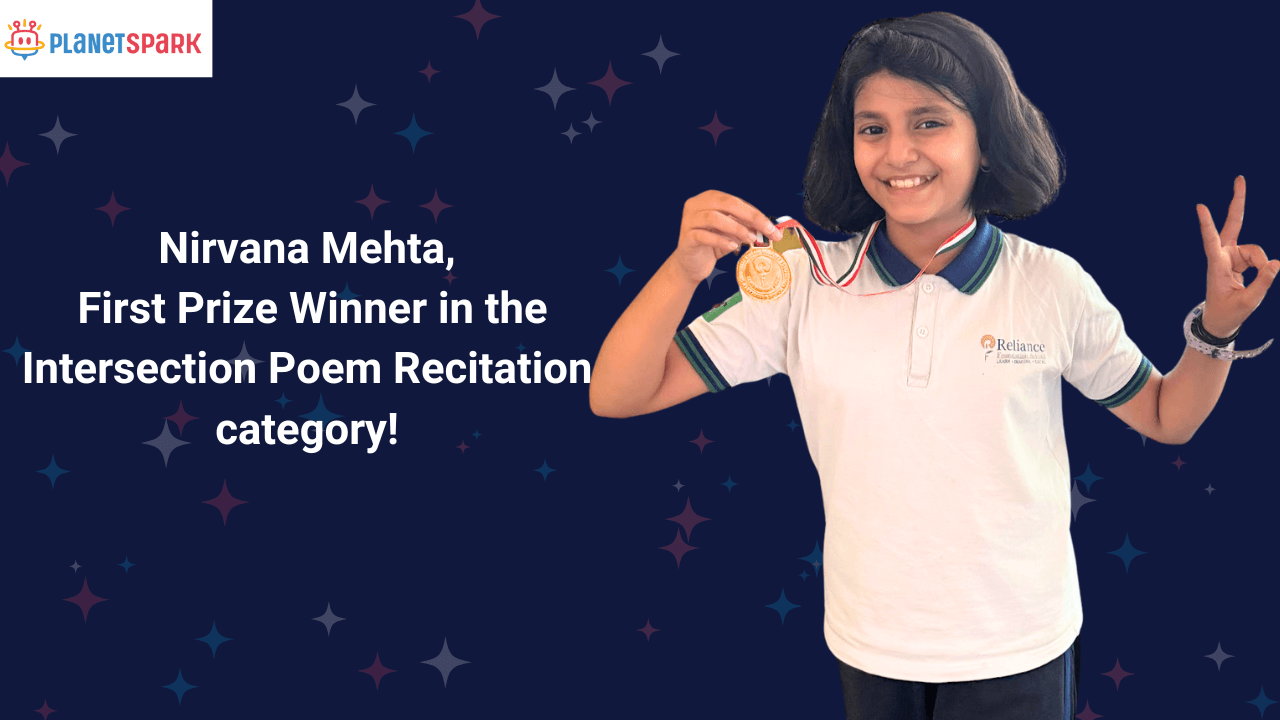
Nirvana Mehta: First Prize Winner in Poem Recitation
Nirvana Mehta, aged 10, has emerged as the First Prize Winner in the Intersection Poem Recitation category. She impressed the judges with her remarkable confidence, expressive delivery, and excellent voice control.
Her achievement reflects the impact of consistent practice and guided learning at PlanetSpark, highlighting how strong communication and public speaking skills can be nurtured from an early age.
Conclusion
Poem comprehension is an essential skill that helps kids read, understand, and enjoy poems while building vocabulary, creativity, and critical thinking.
Key Takeaways
Poem comprehension is more than reading - it’s understanding feelings, ideas, and messages.
Practicing poems helps children connect lessons to life, express emotions, and improve school performance.
Fun activities like reading aloud, acting, drawing, and discussions make comprehension engaging and memorable.
Structured guidance, like that provided by Planetspark, ensures kids practice effectively and gain confidence in all areas of learning.
By learning poem comprehension, children not only enjoy reading poetry but also develop important language and thinking skills that will help them in school and everyday life.
“Words can change the world.”
Empower kids with effective communication through PlanetSpark’s course.
Frequently Asked Questions
Poem comprehension is the ability to understand the meaning, emotions, and ideas in a poem, not just reading the words aloud.
It improves reading skills, vocabulary, creativity, critical thinking, and helps children express emotions clearly.
Kids can read poems aloud, highlight key words, visualize scenes, draw pictures, act out poems, and discuss their interpretations.
Reading fluency, vocabulary, emotional awareness, creative thinking, and confidence in speaking and writing.
Parents can read poems together, ask questions, encourage drawing or role-play, and make learning interactive and fun.
Yes! It enhances reading, writing, and speaking skills, improves understanding of lessons, and boosts performance in exams and creative activities.