
Schwa Sound in English: Improve Pronunciation & Clarity
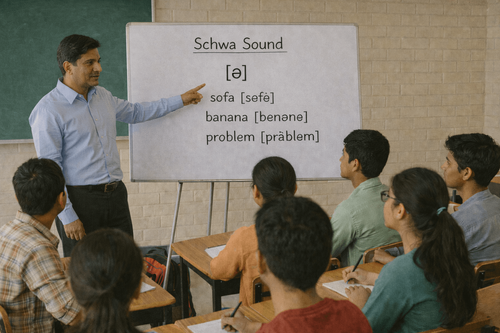

Table of Contents
- What Is the Schwa Sound and Why Is It Everywhere in English?
- How the Schwa Sound Works in Spoken English
- Schwa Sound Examples You Hear Every Day
- Why These Schwa Sound Examples Matter
- Schwa Sound in Sentences
- Schwa in Connected Speech (Natural Flow)
- 20 Words with Schwa Sounds (Must-Know List)
- Common Mistakes Students Make with the Schwa Sound
- How to Practice Schwa Sound Effectively as a Student
- PlanetSpark Communication Course: Detailed USPs for Students
- A Small Sound That Creates Big Confidence
If you’ve ever wondered why English sounds natural when fluent speakers talk,but feels choppy or unclear when learners speak,,the answer often lies in one tiny sound: the Schwa Sound. Students frequently search what is the schwa sound, schwa sound in English, or schwa sound examples because they want clearer pronunciation, better listening skills, and confident speech. That’s exactly what this guide delivers.
In simple terms, the schwa sound is the most common vowel sound in English, yet it’s also the most misunderstood. It appears in unstressed syllables, turning full vowels into a soft, neutral sound (ə). This single concept explains why banana isn’t pronounced ba-na-na evenly, or why about starts with a relaxed “uh” sound. Mastering the schwa sound helps students sound natural, reduce mother tongue influence, and improve fluency across reading, speaking, and listening.
This blog is designed specifically for students who want practical clarity,not just theory. You’ll learn:
What the schwa sound is and why it matters
How the schwa sound works in English words and sentences
Real schwa sound examples you hear every day
A curated list of 20 words with schwa sounds
Common mistakes students make with schwa pronunciation
How structured speaking practice accelerates improvement
By the end, you’ll understand why fluent speakers don’t pronounce every vowel clearly,and how you can adopt the same rhythm and clarity.

What Is the Schwa Sound and Why Is It Everywhere in English?
The most common question students ask is simple: what is the schwa sound? The schwa sound is a neutral vowel sound represented by the phonetic symbol /ə/. It occurs in unstressed syllables, meaning the syllable is spoken quickly and lightly.
Unlike strong vowels such as /a/, /e/, /i/, /o/, or /u/, the schwa sound doesn’t have a fixed pronunciation. Instead, it adapts,sounding like a soft “uh.”
Why English Depends on the Schwa Sound
English is a stress-timed language. This means:
Some syllables are stressed (spoken clearly and strongly)
Others are unstressed (spoken quickly and softly)
The schwa sound appears in these unstressed parts, helping English maintain its natural rhythm.
Without schwa:
Speech sounds robotic
Pronunciation feels forced
Fluency drops
With schwa:
Speech flows naturally
Sentences sound conversational
Listening comprehension improves
Schwa Sound in English: A Simple Example
Consider this word:
banana
Not: ba-NA-na
Correct: buh-NA-nuh
The first and last syllables use the schwa sound.
This pattern repeats across thousands of English words, making schwa sound mastery essential for students.
How the Schwa Sound Works in Spoken English
Understanding the schwa sound in English requires noticing stress patterns. English speakers naturally reduce vowels in unstressed syllables.
Stress vs Unstress: The Core Rule
Stressed syllables → clear vowel sounds
Unstressed syllables → schwa sound
Example:
teacher
Pronounced: TEE-chər
Not: TEE-cher
That final “er” becomes a schwa sound.
Why Students Struggle with Schwa Sound Words
Students often:
Pronounce every vowel clearly
Read English exactly as it’s written
Apply mother tongue rhythm to English
This leads to unnatural pronunciation.
Learning schwa is not about memorizing rules,it’s about training the ear and mouth to relax unstressed sounds.
Schwa Sound Examples You Hear Every Day
The schwa sound appears so often in spoken English that we use it without realizing. Most everyday English words contain unstressed syllables, and those syllables naturally change into the schwa sound when spoken fluently. This is why English sounds smooth and fast when native or fluent speakers talk.
Let’s break down some common schwa sound examples students already know.
Common Schwa Sound Words Explained
about → uh-BOUT
The first syllable is unstressed, so “a” becomes a soft uh.problem → PROB-ləm
The second syllable loses its clear vowel sound and turns into schwa.family → FAM-uh-lee
The middle syllable is unstressed and reduced, not pronounced clearly.support → suh-PORT
The first syllable is unstressed and softened into a schwa sound.teacher → TEE-chər
The ending “-er” is never pronounced as a strong vowel,it’s always a schwa.
In each of these words, the stressed syllable stays strong, while the others relax into schwa. This contrast is what creates natural English rhythm.
Why These Schwa Sound Examples Matter
When students pronounce every syllable clearly, speech sounds:
Slow
Robotic
Over-pronounced
Using schwa correctly helps you:
Speak faster without rushing
Sound natural and fluent
Improve listening comprehension
Schwa Sound in Sentences
Schwa isn’t limited to long words. It appears constantly in short, common words, especially when speaking in full sentences.
Articles and Function Words
Words like a, an, the, to, of, for usually become schwa in connected speech.
Examples:
I need uh pen.
She is uh doctor.
He went tə school.
A cup uh tea, please.
Notice how these words lose stress and become soft and quick.
Schwa in Connected Speech (Natural Flow)
When we speak naturally:
Content words (nouns, main verbs) are stressed
Grammar words (articles, prepositions) are reduced
Example sentence:
She bought uh book tə read.
Only bought, book, and read are stressed. The rest turn into schwa sounds.
20 Words with Schwa Sounds (Must-Know List)
Here are 20 words with schwa sounds that students encounter daily:
About
Banana
Teacher
Problem
Family
Support
Taken
Pencil
Open
Celebrate
Memory
Ago
Today
Animal
Doctor
Lemon
Camera
Possible
Supply
Condition
Practice tip: Say each word slowly, identify the stressed syllable, then soften the rest.
Common Mistakes Students Make with the Schwa Sound
Mistake 1: Over-Pronouncing Every Vowel
English isn’t phonetic. Reading every vowel clearly leads to unnatural speech.
Mistake 2: Ignoring Sentence Stress
Schwa works at word and sentence level. Function words often reduce to schwa.
Mistake 3: Practicing Without Feedback
Students may practice wrong pronunciation repeatedly.How to Practice Schwa Sound Effectively as a Student
Mastering the schwa sound isn’t about memorizing rules,it’s about training your ear, voice, and rhythm together. Follow these step-by-step techniques to make your pronunciation sound natural and confident.
How to Practice Schwa Sound Effectively as a Student
Mastering the schwa sound isn’t about memorizing rules,it’s about training your ear, voice, and rhythm together. Follow these step-by-step techniques to make your pronunciation sound natural and confident.
Step 1: Learn Stress Patterns
Every English word has one main stressed syllable. This stressed part is spoken louder, longer, and more clearly. Start by identifying it.
How to practice:
Clap or tap while saying the word. The loudest clap marks the stress.
Use a dictionary or pronunciation tool to check the stressed syllable.
Say the word slowly first, then at normal speed.
Example:
RE-cord (noun) vs re-CORD (verb)
BA-na-na → stress on the middle syllable
Once you know where the stress lies, the rest becomes easier.
Step 2: Reduce the Rest
All unstressed syllables naturally weaken in English. This is where the schwa sound appears.
How to practice:
Stop trying to pronounce every vowel clearly.
Relax your jaw and tongue for unstressed vowels.
Let the sound become a soft “uh” instead of a strong vowel.
Example:
about → uh-BOUT
teacher → TEE-chər
problem → PROB-ləm
This reduction makes your speech smoother and more native-like.
Step 3: Speak in Context
Practicing individual words is useful,but real fluency comes from sentences. Schwa sound in English changes with sentence flow and stress.
How to practice:
Read short sentences aloud instead of isolated words.
Notice how small words (a, the, to, of) lose stress.
Practice linking words together naturally.
Example:
I need uh pen.
She went tə school today.
Speaking in context trains your brain to apply schwa automatically.
Step 4: Get Live Correction
Self-practice helps, but feedback is the real accelerator. Without correction, students often repeat the same mistakes.
Why live correction matters:
Someone tells you exactly where stress is missing
Incorrect vowel sounds are corrected instantly
You build confidence by speaking, not guessing
Best practice:
Practice with a teacher, language coach, or live speaking platform that focuses on pronunciation and real-time feedback.
Final Tip for Students
Think of the schwa sound as the pause between strong beats in music. When you learn where to relax, your English stops sounding forced,and starts flowing naturally.
Consistent daily speaking + stress awareness + correction = clear, confident English.

PlanetSpark Communication Course: Detailed USPs for Students
PlanetSpark’s communication skills course is designed for students who want real speaking confidence, not rote learning.
Live, Interactive English Conversations Daily
Students participate in daily live sessions based on real-life scenarios—school discussions, travel conversations, interviews, and presentations.
Accent Neutralization & Clear Articulation
Dedicated phonetics modules focus on schwa sound in English, reducing MTI and improving clarity.
Lexical Resource Enhancement
Vocabulary is taught contextually using collocations and phrases, reinforcing natural stress and schwa usage.
Situational Dialogues & Role Plays
Students practice ordering food, giving speeches, explaining ideas, and asking questions,applying schwa sounds naturally.
Instant Feedback & AI Fluency Reports
AI tools and expert trainers provide instant correction on pronunciation, grammar, and sentence flow.
Speaking Confidence Trackers
Parents receive detailed progress reports highlighting pronunciation improvement, fluency growth, and next steps.
A Small Sound That Creates Big Confidence
The schwa sound may be the smallest and softest sound in English, but for students, it often becomes the biggest breakthrough in spoken communication. Many learners spend years memorizing vocabulary and grammar, yet still feel hesitant while speaking. The reason is simple: without the schwa sound, English feels stiff, forced, and unnatural.
When students master schwa, something changes. Words begin to flow. Sentences sound smoother. Speaking feels easier and less tiring. Instead of thinking about every vowel, students focus on meaning, expression, and confidence.
This tiny sound plays a powerful role in:
Pronunciation clarity – stressed words stand out clearly
Listening skills – students understand native speakers faster
Natural rhythm – speech sounds conversational, not mechanical
These skills matter everywhere: answering in class, giving presentations, participating in group discussions, clearing interviews, and even casual daily conversations.
English fluency is not about speaking louder, faster, or more. It’s about speaking smarter. Fluent speakers know where to emphasize and where to relax. They reduce unstressed syllables, use the schwa sound naturally, and let their speech breathe.
When students learn where to soften and where to stress, they stop sounding like someone who is translating in their head. They start sounding like someone who thinks in English. That shift,from effort to ease,is what builds real confidence.
Mastering the schwa sound teaches students an important lesson: clarity doesn’t come from saying everything strongly; it comes from knowing what matters most. And once that lesson is learned, English stops being a subject,and becomes a skill they own.
PlanetSpark bridges this gap with live practice, expert correction, and structured pronunciation training designed specifically for students.
You may also read:
Frequently Asked Questions
The schwa sound is a soft, neutral vowel sound (/ə/) used in unstressed syllables, making English sound natural.
It improves pronunciation clarity, listening skills, and fluency by teaching students natural English rhythm.
Find the stressed syllable first—unstressed vowels usually become schwa sounds.
No. Even short words like a, the, of, and to often use the schwa sound in sentences.
PlanetSpark combines live speaking sessions, phonetics training, AI feedback, and confidence tracking to ensure students apply schwa sounds correctly in real communication.