
Social Communication Skills for Confidence and Effective Interaction
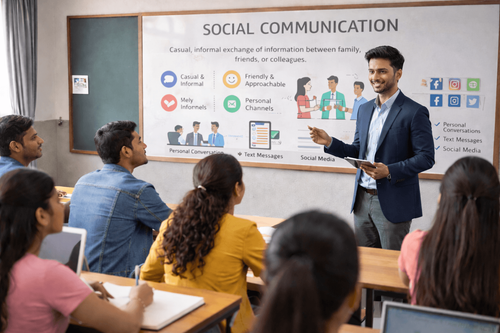

Table of Contents
- Understanding Social Communication in a Business Context
- The Role of Social Communication in Confidence and Clarity
- Social Media Communication and Its Impact on Professional Id
- Social and Behavior Change Communication in Organizations
- How to Improve Social Communication Skills Practically
- Key Areas to Focus On
- Why Structured Communication Training Matters
- PlanetSpark’s Communication Skill Course for Professionals
Understanding Social Communication in a Business Context
Social communication refers to how individuals exchange information, emotions, intentions, and meaning within social environments. In business settings, social communication determines how effectively teams collaborate, leaders inspire, and organizations build trust.
What Is Social Communication?
At its core, what is social communication? It is the process through which people use verbal language, non-verbal cues, tone, expressions, and context to interact meaningfully with others. Unlike transactional communication, social communication focuses on relationship-building, emotional intelligence, and mutual understanding.
In the workplace, social communication includes:
How you present ideas in meetings
How you listen and respond to feedback
How you negotiate, persuade, and resolve conflicts
How you adapt communication styles across cultures and hierarchies
Strong social communication enables professionals to articulate thoughts confidently while remaining empathetic and respectful.
Describe the Social Function of Communication
To describe the social function of communication, we must look beyond words. Communication serves multiple social purposes:
Building relationships: Trust is formed through consistent, clear interaction
Establishing identity: How we speak shapes how others perceive us
Creating shared understanding: Teams align goals through discussion
Influencing behaviour: Communication drives action and decision-making
In business, communication is not just about information transfer, it is about shaping perception, motivating teams, and creating alignment.
The Role of Social Communication in Confidence and Clarity
Confidence in communication is not about speaking louder or dominating conversations, it is about expressing thoughts clearly, respectfully, and with purpose. Social communication plays a critical role in bridging the gap between what we intend to say and how others actually perceive our message. When individuals understand the social context of communication, they are better equipped to adjust their tone, language, and delivery to suit different situations.
Strong social communication helps individuals navigate conversations with self-assurance. It allows them to respond thoughtfully rather than react emotionally, creating interactions that feel natural, composed, and impactful. Over time, this ability builds inner confidence, as individuals trust their communication skills and feel prepared to handle diverse social and professional scenarios.
Communication and Self-Confidence
Professionals with strong social communication skills demonstrate confidence through clarity, emotional intelligence, and adaptability. They are able to:
Express ideas clearly and without hesitation, even in high-pressure situations
Handle objections, disagreements, and differing opinions calmly and respectfully
Speak assertively without appearing aggressive or dismissive
Adapt their message based on the audience, cultural context, and communication setting
When individuals know what they want to say and how to say it appropriately, communication becomes effortless. This clarity reduces anxiety, minimizes self-doubt, and allows confidence to emerge naturally rather than being forced.
Clarity in Professional Interactions
Clarity is one of the most valuable outcomes of effective social communication. Clear communication reduces misunderstandings, improves productivity, and strengthens trust in both personal and professional relationships. When messages are communicated with intention and structure, people are more likely to understand expectations and respond positively.
Social communication ensures that:
Messages are well-organized, purposeful, and easy to understand
Emotional cues such as tone, body language, and facial expressions are interpreted accurately
Feedback is delivered constructively, encouraging growth rather than defensiveness
Clear communication is especially critical in leadership roles, client interactions, teamwork, and cross-functional collaboration, where even small misunderstandings can lead to larger challenges.
Social Media Communication and Its Impact on Professional Identity
In the digital era, social media communication has become a defining element of professional identity. Emails, LinkedIn updates, virtual meetings, messaging platforms, and online presentations are now extensions of how individuals communicate, collaborate, and present themselves to the world.
Unlike in-person interactions, digital communication often lacks immediate feedback such as facial expressions or tone of voice. This makes clarity, word choice, and intent even more important. Every written message contributes to how professionalism, credibility, and confidence are perceived.
How Social Media Communication Differs
Compared to face-to-face conversations, social media communication:
Lacks real-time emotional cues, increasing the risk of misinterpretation
Requires concise, intentional, and well-structured language
Can amplify both positive impressions and negative misunderstandings instantly
Professionals must develop the ability to convey tone, respect, and clarity through written communication while remaining mindful of their digital footprint.
Social Media Communication for Professional Growth
When used strategically, social media communication can significantly enhance professional growth and visibility. It helps individuals:
Build strong personal and corporate brands
Establish thought leadership and credibility in their field
Strengthen professional networks and relationships
Influence audience perception through consistent, authentic messaging
Mastering social communication across digital platforms is no longer optional. It is a core communication skill that shapes reputation, career opportunities, and long-term professional success.
Social and Behavior Change Communication in Organizations
Social and behavior change communication is a structured approach that uses communication to influence attitudes, beliefs, and actions over time.
What Is Social Behaviour Change Communication?
Social behaviour change communication focuses on:
Understanding audience psychology
Addressing barriers to change
Reinforcing positive behaviors through messaging
In businesses, this approach is used to:
Encourage ethical practices
Improve workplace culture
Drive adoption of new processes
Strengthen employee engagement
Communication becomes a tool not just for sharing information, but for transforming behaviour.
Why It Matters in Business Leadership
Leaders who understand behaviour change communication:
Inspire teams during change
Reduce resistance
Build alignment and motivation
This makes communication a strategic leadership tool rather than a soft skill.
How to Improve Social Communication Skills Practically
Improving social communication is not about memorizing scripts or speaking more, it is about developing awareness, adaptability, and consistency through intentional practice. Strong communication skills are built over time by observing interactions, receiving feedback, and consciously refining how messages are delivered and received. With the right approach, anyone can improve their ability to communicate confidently and effectively in both personal and professional settings.
Practical improvement begins with understanding that communication is a two-way process. It involves not only what you say, but how you listen, respond, and adjust based on the social context. Structured practice helps individuals identify gaps in their communication style and work on them systematically.
Key Areas to Focus On
Active Listening and Empathy: Builds trust by understanding perspectives and emotions.
Non-Verbal Communication Awareness: Aligns body language, tone, and expressions with words.
Articulation and Vocabulary Building: Ensures clarity and precise expression.
Emotional Intelligence: Helps manage emotions and handle conflicts calmly.
Audience-Specific Messaging: Adapts communication to context and people.
Together, these social communication skills strengthen relationships, improve teamwork, and create confident, impactful interactions that support long-term personal and professional success.
Why Structured Communication Training Matters
Self-learning has limits. Structured training provides:
Expert feedback
Real-life simulations
Personalized improvement plans
Measurable progress
This is where focused programs make a difference.
PlanetSpark’s Communication Skill Course for Professionals
PlanetSpark’s communication skill course is designed for individuals who want to upgrade their social communication in real-world business scenarios.
What Makes PlanetSpark Different
The program focuses on:
Practical communication frameworks
Business-focused scenarios
Confidence-building exercises
Behavioral communication strategies
Learners gain hands-on experience in:
Presentations and public speaking
Workplace conversations
Leadership communication
Social media communication for professionals
Who Should Enroll
This course is ideal for:
Working professionals
Entrepreneurs and founders
Students preparing for careers
Managers and team leaders
The emphasis is on applicable communication, not theoretical concepts.
Communication Is the Skill That Shapes Every Relationship
Social communication is more than just speaking, it is the ability to connect, understand, influence, and build trust. From learning what social communication truly means to applying social and behavior change communication in real-life situations, strong communication skills shape how we grow personally and professionally.
Whether through face-to-face conversations or social media communication, every interaction reflects confidence, clarity, and emotional intelligence. When communication improves, relationships strengthen, misunderstandings reduce, and opportunities expand.
Developing communication skills is a lifelong investment. With consistent practice and the right guidance, anyone can become a confident and effective communicator. Structured learning accelerates this journey by providing feedback, real-world practice, and measurable growth.
Frequently Asked Questions
Social communication is the ability to interact effectively using verbal and non-verbal cues. It is important because it builds relationships, improves clarity, and enhances professional confidence.
It influences teamwork, leadership effectiveness, customer relationships, and workplace culture. Strong communication leads to better decision-making and collaboration.
The social function of communication includes relationship building, trust creation, emotional understanding, and influencing behaviour within teams and organizations.
It is a strategic approach that uses communication to influence attitudes and behaviors, helping organizations manage change, improve culture, and drive engagement.
PlanetSpark offers structured, practice-based communication skill courses that focus on real-world business communication, confidence building, and professional growth.