
Speech Act Theory for Adults: Clear Professional Communication
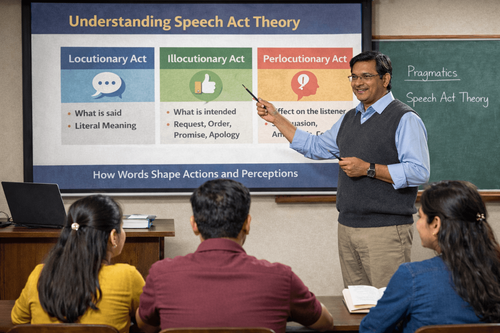

Table of Contents
- What Is Speech Act Theory?
- Origins of Speech Act Theory
- Why Speech Act Theory Matters in Professional Communication
- Core Components of Speech Act Theory
- Speech Act Theory and Meaning in Context
- Types of Speech Acts in Professional Settings
- Speech Act Theory and Workplace Miscommunication
- Improving Clarity Using Speech Act Theory
- Speech Act Theory and Leadership Communication
- Speech Act Theory in Written Professional Communication
- Speech Act Theory and Cross-Cultural Communication
- Developing Speech Act Awareness Through Communication Skills
- Why PlanetSpark for Communication Skills Development
- Language as Action, Not Just Words
The Speech Act Theory explains that communication is not just about sharing information, it is about performing actions through language. In professional settings, words are used to request, promise, instruct, warn, approve, or negotiate. This blog explores Speech Act Theory in detail, explains how meaning is created through spoken and written communication, and shows how mastering speech acts improves clarity, intent, and impact in professional interactions.

What Is Speech Act Theory?
Speech Act Theory is a linguistic and philosophical framework that explains how utterances perform actions rather than merely convey information. When people speak, they are often doing something, such as making a promise, giving an order, offering an apology, or asking a question.
For example:
Saying “I will submit the report by Friday” is not just information, it is a commitment
Saying “Please revise this section” performs the act of requesting
Speech Act Theory helps professionals understand how intent, context, and wording shape outcomes.
Origins of Speech Act Theory
Austin Speech Act Theory
The foundation of Speech Act Theory was laid by philosopher J.L. Austin through the Austin speech act theory. Austin challenged the idea that language is only used to describe facts. He proposed that many utterances are performative, meaning they perform an action simply by being spoken.
Austin’s work introduced a shift in understanding language as action rather than description, which has had a lasting impact on communication studies, linguistics, and professional discourse.
Why Speech Act Theory Matters in Professional Communication
In workplaces, clarity is not optional, it is essential. Misunderstood instructions, vague commitments, and poorly framed feedback often lead to conflict, delays, and inefficiency.
Professional Communication Depends On
Clear intent
Correct interpretation
Shared understanding
Speech Act Theory provides a structured way to analyze how messages function beyond their literal meaning.
Enroll in PlanetSpark’s Communication Skills Course and speak with confidence.
Core Components of Speech Act Theory
Austin identified three levels at which every utterance operates. Understanding these levels is crucial for improving communication impact.
1. Locutionary Act – What Is Said
This is the literal meaning of the words spoken.
Example:
“The meeting starts at 10 AM.”
This level focuses purely on vocabulary and sentence structure.
2. Illocutionary Act – What Is Intended
This is the speaker’s intention behind the words.
Example:
Informing team members
Reminding late attendees
Emphasising punctuality
The same sentence can carry different intentions depending on context.
3. Perlocutionary Act – What Effect Is Achieved
This refers to the effect the utterance has on the listener.
Example:
Team members arrive on time
Someone feels pressured or reassured
Effective communication ensures alignment between intention and outcome.
Speech Act Theory and Meaning in Context
Speech acts do not exist in isolation. Their meaning depends heavily on context.
Key Contextual Factors
Relationship between speaker and listener
Power dynamics
Cultural norms
Situational expectations
For instance, a request from a manager carries a different force than the same words spoken by a peer. Speech Act Theory helps professionals adjust communication based on context to avoid misinterpretation.
Types of Speech Acts in Professional Settings
Assertives
Statements that convey information or belief.
Examples:
Reporting progress
Presenting facts
Sharing opinions
Directives
Attempts to get someone to do something.
Examples:
Requests
Instructions
Advice
Clarity and tone are critical to avoid sounding aggressive or vague.
Commissives
Commitments to future action.
Examples:
Promises
Guarantees
Agreements
Poorly framed commissives often lead to trust issues in teams.
Expressives
Statements that express emotions or attitudes.
Examples:
Apologies
Appreciation
Feedback
These acts shape workplace relationships and morale.
Declaratives
Utterances that change status or reality when spoken.
Examples:
Approving a proposal
Announcing a promotion
Declaring a decision
These acts require authority and clear communication.
Speech Act Theory and Workplace Miscommunication
Many workplace issues arise when:
Illocutionary intent is unclear
Perlocutionary effect differs from intention
Context is ignored
Common Communication Breakdowns
Instructions interpreted as suggestions
Feedback perceived as criticism
Requests mistaken for commands
Understanding Speech Act Theory allows professionals to diagnose and correct such issues.
Improving Clarity Using Speech Act Theory
1. Make Intent Explicit
State whether you are requesting, advising, or instructing.
2. Match Language to Authority Level
Align tone with role and responsibility.
3. Anticipate Listener Interpretation
Consider how words may be perceived emotionally.
4. Confirm Understanding
Encourage clarification and feedback.
These practices reduce ambiguity and improve outcomes.
Speech Act Theory and Leadership Communication
Leaders perform speech acts constantly.
Leadership Through Language
Setting expectations
Giving feedback
Making decisions
Motivating teams
Leaders who understand speech acts communicate with authority without intimidation and empathy without ambiguity.
Speech Act Theory in Written Professional Communication
Speech acts are not limited to spoken language. Emails, reports, and messages also perform actions.
Examples
“Please find attached” as a directive
“We recommend proceeding” as advice
“Approved” as a declarative
Written communication often lacks tone cues, making speech act awareness even more important.
Speech Act Theory and Cross-Cultural Communication
Different cultures interpret speech acts differently.
Cross-Cultural Challenges
Indirect requests misunderstood
Politeness levels misread
Authority signals overlooked
Speech Act Theory helps professionals adapt communication across cultural contexts by focusing on intent and effect rather than literal wording.
Developing Speech Act Awareness Through Communication Skills Training
Understanding theory alone is insufficient. Practical application builds mastery.
Skills That Support Effective Speech Acts
Active listening
Emotional intelligence
Assertive communication
Context awareness
Communication skills training integrates these abilities into real-world scenarios.

Why PlanetSpark for Communication Skills Development
PlanetSpark focuses on building structured communication, clarity of intent, and confident expression. Its Communication Skills programs help learners understand frameworks like Speech Act Theory and apply them effectively in academic, professional, and leadership contexts.
What Learners Gain
Clear and purposeful communication
Improved interpretation of intent
Confidence in professional interactions
Ethical and effective language use
Language as Action, Not Just Words
Speech Act Theory reminds us that communication is not just about what we say, but what we do through what we say. In professional environments, clarity of intent and accuracy of interpretation determine success, trust, and efficiency. Misaligned speech acts lead to confusion, while well-executed ones drive action and alignment.
By understanding Speech Act Theory and strengthening communication skills, professionals can ensure their words create the intended impact. Whether leading teams, managing clients, or collaborating across cultures, the ability to use language consciously transforms communication from a routine task into a powerful professional skill.
You may also read :
Frequently Asked Questions
Speech Act Theory explains that statements perform functions such as requests, promises, orders, or feedback. Austin speech act theory showed that meaning depends on illocutionary force and context. For adults, Speech Act Theory becomes tool to analyse meetings and emails so that every message achieves felicity under Speech Act Theory and produces intended perlocutionary outcomes.
Austin speech act theory introduced performatives and three layers—locution, illocution, perlocution. Speech Act Theory preserved Austin speech act theory as foundation. Austin speech act theory examples continue to guide adults in organisational pragmatics. Without Austin speech act theory, Speech Act Theory for adults would not exist in its present practical form.
Felicity in Speech Act Theory requires authority, conventional procedure, and uptake. Austin speech act theory examples like unauthorised orders illustrate Speech Act Theory misfires. Adults must confirm role and timing. Speech Act Theory for adults recommends explicit markers in virtual work so felicity under Speech Act Theory remains strong.
Yes. Conflict often emerges from misunderstood illocutionary acts. Austin speech act theory proved that apology repairs perlocutionary acts. Speech Act Theory for adults helps mediators redesign directives echoing Austin speech act theory. Adults practising these principles maintain decorum and rational negotiation under Speech Act Theory.
PlanetSpark communication skills course for professionals turns Speech Act Theory into lived practice. Mentors use Austin speech act theory examples in labs—client calls, leadership emails, feedback role plays. Adults who join PlanetSpark programmes gain structured clarity so Speech Act Theory improves impact, and that is why PlanetSpark blends perfectly with Austin speech act theory for adult workplace growth.