
Simple Turn Taking Communicative Strategy Guide for Students


Table of Contents
- What Is a Turn-Taking Communicative Strategy?
- Why Is Turn-Taking Important for Students?
- Understanding Communication Strategies
- How Turn-Taking Works in Communication
- Types of Turn-Taking Communicative Strategy
- Common Signals Used in Turn-Taking
- Examples of Turn-Taking Communicative Strategy
- How Students Can Improve Turn-Taking
- Turn-Taking in Different Situations
- Turn-Taking Mistakes Students Should Avoid
- Why Turn-Taking Is a Key Communication Strategy
- Practice Activities for Students
- How Teachers Can Help Students Improve Turn-Taking
- PlanetSpark: The Ultimate Platform for Confident Speaking
- Empower Your Voice, Empower Your Future with PlanetSpark
Turn taking communicative strategy means knowing when to speak, when to pause, and how to share a conversation without interrupting others. This guidance will help students understand what turn-taking is, why it matters, and how to use it confidently in daily interactions. With fun classes and expert coaching, PlanetSpark helps students speak clearly, listen better, and enjoy smoother, more meaningful conversations in school and beyond.
What Is a Turn-Taking Communicative Strategy?
Turn-taking is a communication strategy where speakers take turns talking in a conversation in an organized and meaningful way. It ensures that communication is balanced, respectful, and productive.
In simple words:
Turn-taking means knowing when to speak, when to wait, when to listen, and how to share the conversation space.
It prevents interruptions, reduces confusion, and builds better interpersonal relationships.Teachers often praise students who show good turn-taking because it shows discipline and strong social skills.
Why Is Turn-Taking Important for Students?
For students, turn-taking is not just a skill but a life tool. Here is why it matters:
1. Improves Classroom Discussions
When everyone takes turns, discussions become richer and more meaningful. Ideas flow smoothly, and everyone stays engaged.
2. Encourages Active Listening
Turn-taking helps students focus on what others are saying rather than preparing answers prematurely.
3. Builds Respect and Empathy
Giving others time to speak shows respect; listening to them builds empathy.
4. Enhances Group Project Success
Smooth communication means fewer conflicts and better teamwork.
5. Strengthens Speaking Skills
Knowing when and how to speak helps students build confidence.
6. Prepares Students for Real-World Communication
Interviews, group meetings, presentations, and social interactions all require good turn-taking.
Understanding Communication Strategies
Before understanding turn-taking deeply, you must know what communication strategies are.
Communication strategies are techniques or methods that individuals use to express ideas clearly, handle conversations effectively, and avoid communication breakdowns.
Some common communication strategies include:
Turn-taking
Clarification (asking questions to understand better)
Repairing (fixing misunderstandings)
Topic control
Topic shifting
Pausing
Paralinguistic cues (tone, pitch, gestures)
Turn-taking is one of the core communication strategies because it influences all other strategies.
How Turn-Taking Works in Communication
Turn-taking may look simple where one person talks and another listens but it is actually a well-organized process involving:
1. Taking the Floor: Deciding when to start speaking.
2. Holding the Floor: Continuing your turn without being interrupted.
3. Yielding the Floor: Ending your turn and allowing someone else to speak.
4. Recognizing Cues: Noticing when someone wants to speak, pause, or continue.
5. Managing Interruptions: Politely preventing or handling interruptions.
These skills make a conversation structured and respectful.
Types of Turn-Taking Communicative Strategy
Students commonly use several strategies, sometimes unconsciously. Understanding them helps you communicate better.
1. Verbal Cues
These are spoken signals that indicate turn transitions.
Examples:
“Can I add something?”
“What do you think?”
“Let me finish this point.”
Verbal cues help both speakers and listeners know when a turn is shifting.
2. Non-Verbal Cues
Body language plays a huge role in turn-taking.
Examples:
Eye contact
Facial expressions
Nodding
Hand gestures
Leaning forward to speak
Even silence can signal a turn.
Prepare your child for real-world communication with PlanetSpark’s coaching.
3. Overlapping Talk
This happens when two people speak at the same time. Sometimes it’s natural, but students must learn when to stop or continue based on cues.
Example:
Two students say “Exactly!” at the same time while agreeing with a teacher.
4. Interruptions (Positive and Negative)
Interruptions are of two types which are explained below:
Positive interruption: Encourages the speaker
Example: “Oh yes, that makes sense!”Negative interruption: Cuts someone off
Example: Talking over someone intentionally
Students should avoid negative interruptions.
5. Back channeling
This means giving feedback without taking the floor completely.
Examples:
“Hmm…”
“I see.”
“Right.”
It shows attentiveness without interrupting.
Common Signals Used in Turn-Taking
Turn-taking relies on subtle verbal and non-verbal cues that help speakers manage conversations smoothly. These signals guide when to speak, continue, or step back, ensuring clear, respectful communication for everyone involved.
A. Signals for Taking the Turn
Raising your hand (in class)
Leaning forward
Starting with “I’d like to say…”
Making eye contact with the speaker
B. Signals for Holding the Turn
Using fillers like “umm,” “so…”
Slight hand gestures
Avoiding long pauses
C. Signals for Yielding the Turn
Pausing intentionally
Looking at someone to invite them
Asking, “What do you think?”
These cues help everyone participate smoothly. Students interested to learn the articulation skills can click this link.
Let your child shine with PlanetSpark’s fun and effective speaking lessons.
Examples of Turn-Taking Communicative Strategy
Below are simple, student-friendly examples.
1. Classroom Discussion Example (Group Activity)
Student A: “I believe pollution can be reduced by using public transport. What do you think, Ravi?”
Student B: “That’s a good point. I’d like to add that cycling can also help.”
This is a perfect example of turn-taking communicative strategy where the speaker invites another speaker politely.
2. Presentation Example
Presenter: “That’s all for my introduction. Now Mary will explain the second part.”
Showing an organized shift of speakers.
3. Debate Example
Moderator: “Your time is up. Now Team B, please continue.”
Team B Speaker: “Thank you. I’d like to start by addressing your point….”
Controlled, respectful turn-taking.
4. Conversation with a Friend
Friend 1: “I watched that new series yesterday.”
Friend 2: “Oh! I did too. What did you like most about it?”
Smooth exchange of turns using questions.
5. Online Classroom Example
Students raise digital hands and take turns answering.
Turn-taking can happen virtually as well.
These points make it easier to understand turn-taking communicative strategy example for school assignments or exams.
Support your child’s growth with PlanetSpark’s personalised speaking training.
How Students Can Improve Turn-Taking
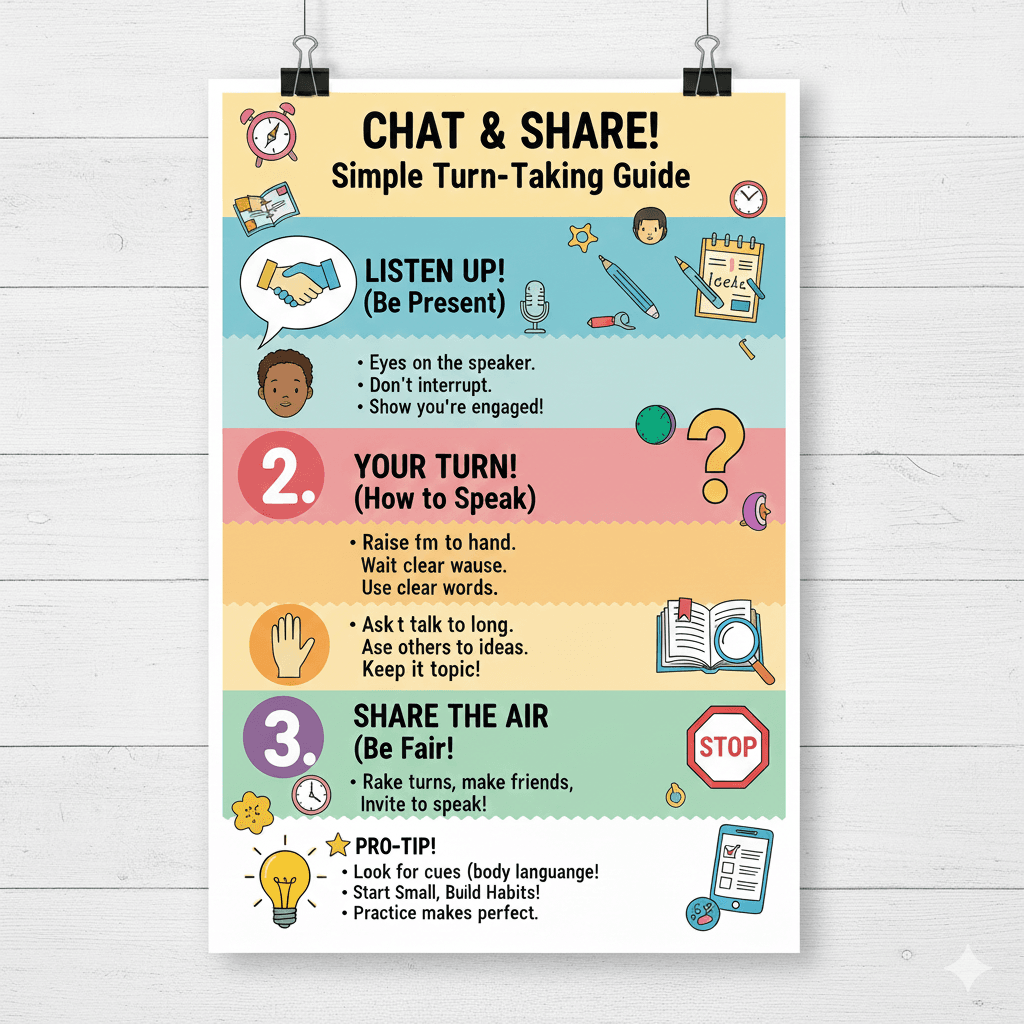
Here are 12 practical tips that students can apply immediately:
1. Avoid Interrupting
Let the speaker finish their thought unless it’s a positive interruption.
2. Use Polite Expressions
“May I speak next?”
“Can I respond to that point?”
3. Pay Attention to Non-Verbal Signals
Body language helps you judge when to speak.
4. Ask Questions
Questions naturally shift turns.
5. Maintain Eye Contact
This signals readiness to speak or listen.
6. Don’t Dominate Conversations
Give others time, too.
7. Use Pauses Wisely
A short pause means you are thinking; a long pause invites others to speak.
8. Practice Active Listening
Turn-taking requires careful listening, not just waiting for your turn.
9. Encourage Others
Invite quieter classmates:
“Would you like to share your thoughts?”
10. Be Clear and Concise
Taking long turns can discourage others from speaking.
11. Use Backchanneling
Show that you’re engaged without interrupting.
12. Learn Cultural Differences
Some cultures prefer long pauses; others prefer quick exchanges.
Give your child powerful communication skills through PlanetSpark’s programs.
Turn-Taking in Different Situations
Turn-taking varies depending on the context. Here’s how it works in various student environments:
Group Projects: Students must divide speaking time equally to avoid domination and ensure collaboration.
Class Debates: Turn-taking is usually rule-based and timed. Interruptions are not allowed.
Presentations: Turn-taking happens among team members as they transition through sections.
Classroom Participation: Raising hands is a formal turn-taking method used worldwide.
Social Conversations: Turn-taking is more relaxed but still essential for respectful communication.
Turn-Taking Mistakes Students Should Avoid
Students often struggle with managing turns effectively during discussions. Avoiding these common mistakes helps create smoother, respectful, and more productive communication in classrooms, group activities, and everyday conversations.
Talking Too Much: It frustrates others and weakens group communication.
Interrupting Frequently: Shows disrespect and breaks the conversation flow.
Not Listening: Turn-taking fails if you are only waiting to speak.
Ignoring Cues: Missing signals leads to confusion and awkward pauses.
Using Aggressive Language: Overpowering others is unhealthy in both academic and personal communication.
Why Turn-Taking Is a Key Communication Strategy
Turn-taking is not just polite behaviour but a structured communication strategy that promotes:
Balance
Fairness
Clarity
Cooperation
Mutual respect
When students understand and practice turn-taking, they automatically improve their overall communication strategies and become better speakers and listeners. Students can also click this link to know the tips to develop effective communication in classroom
Give your child powerful communication skills through PlanetSpark’s programs.
Practice Activities for Students
Practical activities help students build confidence and gradually master turn-taking skills. These exercises encourage patience, active listening, and balanced participation, making classroom communication smoother and more interactive for everyone.
Role-Play Exercises: Students can practice turn-taking in mock conversations, debates, or interviews.
Queue-Based Response: Create a response list in group discussions so everyone gets a turn.
“Pass the Talk” Activity: Use a soft ball; whoever holds it speaks.
Conversation Circles: Students exchange ideas one by one in a circular pattern.
Pause and Reflect: Students learn to pause before replying which is great for improving listening.
How Teachers Can Help Students Improve Turn-Taking
Teachers play an important role in shaping students’ communication habits. By using clear guidance, supportive strategies, and consistent modelling, they can help students participate confidently and respectfully in conversations and group activities.
Model Good Turn-Taking: Teachers should show proper cues and polite transitions.
Set Discussion Rules: Define how students should take turns in group settings.
Encourage Shy Students: Some students need an invitation to speak.
Use Visual Cues: Cards like “My Turn,” “Your Turn” help younger students.
Provide Feedback: Students should know what they are doing well and what to improve.
PlanetSpark: The Ultimate Platform for Confident Speaking
PlanetSpark helps children become strong, expressive, and fearless speakers through personalized coaching and innovative learning tools. With expert mentors and real-world practice, students develop clarity, fluency, confidence, and stage presence that stays with them for life.
Why PlanetSpark Is the Best Choice for Communication Training
1:1 personalised public speaking coaching to build confidence and clear expression.
Certified communication trainers guiding children through structured, interactive learning sessions.
TED-style speech training modules helping students deliver powerful, engaging presentations.
Live debates and group activities improve quick thinking and stage presence.
SparkX AI video analysis offers detailed performance insights for continuous improvement.
Gamified learning through SparkBee to strengthen vocabulary, grammar, and language skills.
AI-led practice sessions enabling independent speech and storytelling improvement anytime.
Creative clubs and showcases providing real platforms to practise and perform confidently.
Empower Your Voice, Empower Your Future with PlanetSpark
Turn-taking is one of the most important communication strategies every student must learn. It helps express ideas clearly, listen actively, respect others, and participate confidently in both academic and personal settings. Whether you’re in a group discussion, debate, classroom recitation, or a friendly chat, turn-taking keeps the conversation meaningful and organized.
From verbal and non-verbal cues to backchanneling, yielding, and holding the floor, turn-taking involves many simple yet powerful techniques. By understanding its principles and practicing the skills outlined in this blog, students can significantly improve their speaking and listening abilities.
Communication is not only about what you say but also how and when you say it and turn-taking ensures that every voice is heard.
Frequently Asked Questions
Turn Taking Communicative Strategy is the method of sharing speaking time in a conversation. It ensures clear communication, prevents interruptions, and helps students listen, respond, and express ideas respectfully and confidently in any discussion.
Turn-taking helps students speak confidently, listen better, and participate effectively in class discussions, group work, and presentations. It builds respectful communication habits, improves understanding, and strengthens overall interaction skills in academic and social environments.
Turn-taking strategies examples include waiting for pauses, asking questions, using gestures, inviting others to speak, and giving feedback through nodding. These techniques help maintain smooth conversation flow and ensure everyone gets a fair chance to share ideas.
Students can improve by practising active listening, avoiding interruptions, using polite cues to speak, paying attention to body language, and participating in group activities. Regular practice helps them speak confidently while respecting others’ contributions.
Yes. PlanetSpark’s 1:1 coaching, speaking clubs, AI analysis tools, and structured curriculum help children build confidence, fluency, clarity, and better conversation habits. Kids learn real-life speaking skills that enhance academic performance and everyday communication.
PlanetSpark’s personalised public speaking and communication classes teach children turn-taking through live practice, interactive activities, AI tools, and expert feedback. Students learn to speak confidently, listen actively, and engage smoothly in conversations and group discussions.