
What Is Digital Communication | Simple Guide for Students


Table of Contents
- What is Digital Communication ?
- What Is Sampling in Digital Communication?
- What Is Quantization in Digital Communication?
- What Is a Digital Communication System?
- What Is Intersymbol Interference (ISI) in Digital Communicat
- What Is ASK in Digital Communication?
- What Is Entropy in Digital Communication?
- What Is PCM in Digital Communication?
- Let’s Learn and Play! — Fun Basics & Brainstorming for Young
- Quick Summary — Digital Communication
- How PlanetSpark Helps Students Learn Concepts Like These
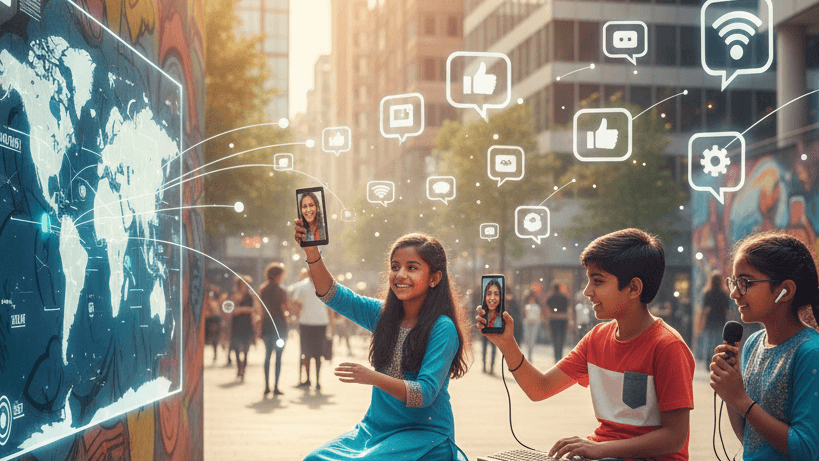
Have you ever sent a WhatsApp message, watched a YouTube video, or made a video call to your friends? If yes, then you’ve already used digital communication! It’s the way we connect, share ideas, and express ourselves using electronic devices like phones, computers, and tablets. From chatting with friends to attending online classes, digital communication is now a big part of our daily lives.
At PlanetSpark, children learn much more than just using digital tools. They learn to speak, write, and express their thoughts clearly and confidently in this fast-changing digital world. Through fun activities, guided lessons, and real-life practice, PlanetSpark helps every child become a smart and confident communicator ready to shine both online and offline!
What is Digital Communication ?
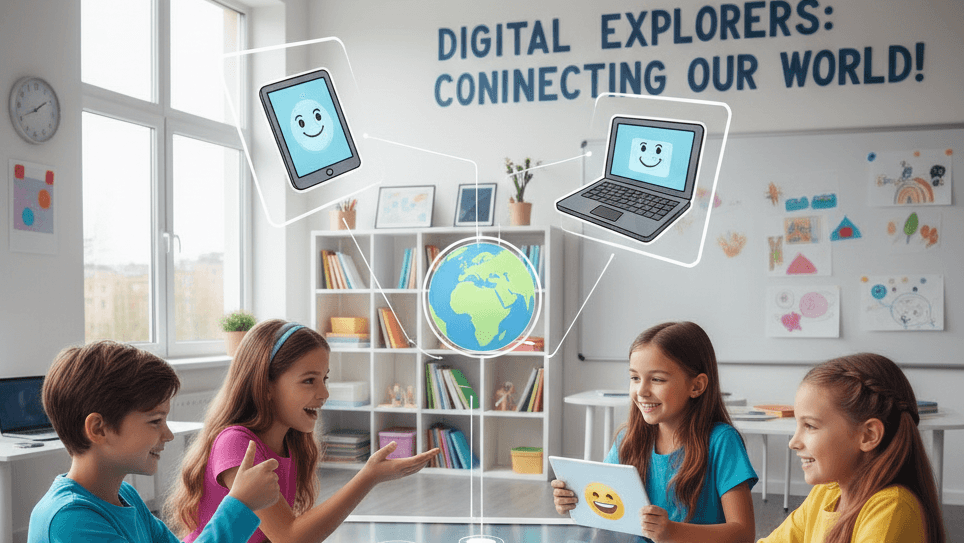
Digital communication means sharing information through electronic devices like phones, computers, or tablets. For example, when you send a WhatsApp message, watch a YouTube video, or talk to your friends on a video call you’re using digital communication. It helps us stay connected, learn new things, and share ideas quickly and easily.
Turn your child’s tech curiosity into strong communication skills.
With PlanetSpark’s fun learning programs, they’ll not just learn they’ll shine!
Book a FREE demo class today and see their confidence glow!
What Does “Digital” Mean?
The word digital means “using numbers.”
So, digital communication means talking or sending information using numbers mostly 0 and 1.
Example:
When you send a voice note to your friend:
- Your voice becomes an electrical signal.
- That signal is turned into digital code (0s and 1s).
- The code travels through the internet.
- Your friend’s phone changes it back into your real voice.
Table: Digital vs. Non-Digital Communication
| Type | Example | How It Works |
| Digital Communication | WhatsApp, Email, Online Classes | Uses 0s and 1s (binary code) |
| Non-Digital Communication | Talking face-to-face, writing a letter | Uses real voice or handwriting |
Checklist: Can You Spot Digital Communication Around You?
Sending a message on WhatsApp
Watching a cartoon on YouTube
Playing an online game
Attending a PlanetSpark class online
Using Google Meet or Zoom
If you ticked any of these, you’re already using digital communication daily!
What Is Sampling in Digital Communication?
Let’s imagine you’re recording your voice on a phone.
Your voice is a continuous sound it keeps changing smoothly.
But computers don’t understand that smooth sound directly.
So, they take small samples of your voice at very fast intervals thousands of times per second!
Each tiny piece is called a sample.
Example:
If you clap your hands, the sound moves like a wave.
The computer picks many points from that wave that’s sampling.
Fun Activity: Try Sampling at Home!
- Say your name slowly.
- Record it on your phone.
- Zoom into the voice recording you’ll see tiny parts (samples) of your voice wave!
What Is Quantization in Digital Communication?
After sampling, we have lots of points with different values.
But computers can’t store every tiny difference so they round them into neat levels.
That’s called quantization.
Ready for better clarity?
Click to read more and master the communication skills today!
Simple Analogy:
Think of your exam marks.
If your score is 89.5, your teacher might round it to 90 that’s quantization!
Table: Real Numbers vs Quantized Values
| Real Sound Value | Quantized Value |
| 1.22 | 1 |
| 1.78 | 2 |
| 2.41 | 2 |
| 2.95 | 3 |
Quantization makes it easier for computers to store and send data faster.
What Is a Digital Communication System?
A Digital Communication System is like a mail delivery chain it takes information from one place and safely delivers it to another.
The 5 Main Parts:
| Step | Part Name | What It Does |
| 1 | Information Source | Where the message starts (like your voice) |
| 2 | Transmitter | Changes it into digital form |
| 3 | Channel | The path the message travels (air, wires, etc.) |
| 4 | Receiver | Gets the digital message |
| 5 | Destination | Converts it back into voice or text |
Example:
You send “Hi!” on WhatsApp:
- Your phone → converts it into 0s and 1s.
- Signal → travels through the internet (channel).
- Your friend’s phone → receives and shows “Hi!”.
That’s how a digital communication system works super fast and reliable!
What Is Intersymbol Interference (ISI) in Digital Communication?
Sounds like a tough word? Don’t worry! Let’s make it simple.
When you speak too fast, your words mix up — right?
In digital communication, something similar happens when one signal overlaps with another.
This mix-up is called Intersymbol Interference (ISI).
Example:
Imagine sending “HELLO” — but your signals for “E” and “L” get mixed, so the receiver hears something weird like “HEELO.”
That’s ISI!
How Do Engineers Fix It?
- They use filters and equalizers that separate mixed signals.
- It makes sure every message is clear and easy to read.
What Is ASK in Digital Communication?
ASK stands for Amplitude Shift Keying — it’s a fancy way of saying we send data using “on” and “off” signals.
Simple Example:
Think of a light bulb :
- Light ON → means “1”
- Light OFF → means “0”
By turning the light on and off in a pattern, we can send messages in binary form.
Analogy:
Like Morse code, but with electricity instead of beeps!
if your child loves exploring new ideas — from science to stories , Join PlanetSpark’s Creative Learning Program and watch them turn thoughts into powerful words.
Book a FREE demo class Today and let their confidence take flight!
What Is Entropy in Digital Communication?
Entropy tells us how much information is in a message — or how surprising it is.
Simple Example:
- If you say, “The sun rises in the east,” → low entropy (everyone knows that).
- If you say, “Today it snowed in Jaipur!” → high entropy (wow, that’s rare!).
Table: Examples of Entropy
| Message | Entropy Level |
| “I like ice cream.” | Low |
| “The school gave free pizza today!” | High |
So, entropy = surprise or new information in a message.
What Is PCM in Digital Communication?
PCM stands for Pulse Code Modulation.
It’s the main method used to turn your voice or sound into digital form.
Steps of PCM:
- Sampling – Taking small parts of the sound.
- Quantization – Rounding those samples.
- Encoding – Changing them into 0s and 1s.
Example:
When you send a voice note:
- Your voice → becomes samples.
- Samples → get quantized.
- Computer → changes them into 0s and 1s.
- Sent to your friend → turned back into your voice!
That’s PCM at work every time you use your phone!
Don’t just teach your child facts help them share them with confidence!
Join PlanetSpark’s Creative Learning Programs where curiosity meets communication.
Book a FREE demo class Today and see your child shine — one word at a time!
Let’s Learn and Play! — Fun Basics & Brainstorming for Young Minds
Brainstorming Time (Think & Imagine!)
Let’s think creatively! Parents can ask these questions to help children express their ideas:
- If you could make your own chatting app, what would it look like?
- Why should we be careful while using the internet?
- How does digital communication help you learn new things?
- What if animals could send messages — how would they talk digitally?
Discuss these at dinner time or before bed — it builds curiosity and creative thinking!
Fun Family Activities
| Activity | What You Need | What You’ll Learn |
| 1. Secret Code Message | Paper and pencil | Make your own code (A=1, B=2, C=3) and write a message. Learn how data turns into numbers. |
| 2. Message Relay Game | 3–4 family members | Whisper a sentence down the line. Notice how it changes — this shows why clear communication matters! |
| 3. Sound Explorer | A mobile phone | Record a clap or word and zoom in to see the sound wave — that’s what sampling looks like! |
| 4. Fact Fun Challenge | Two interesting facts | Share one common fact and one surprising one — which one do others find more exciting? (That’s entropy!) |
| 5. Make a Mini Poster | Chart paper or Canva app | Draw or design a small poster titled “Digital Communication Around Me.” Decorate it with gadgets and emojis! |
Quick Summary — Digital Communication
| Topic | What It Means |
| Digital Communication | Sharing messages using 0s and 1s |
| Sampling | Taking small parts of a signal |
| Quantization | Rounding signal values |
| Digital System | The chain from sender to receiver |
| ISI | Mixing of signals |
| ASK | Sending 0s and 1s using signal strength |
| Entropy | Amount of surprise/information |
| PCM | Turning sound into digital code |
How PlanetSpark Helps Students Learn Concepts Like These
PlanetSpark helps children build powerful communication and public speaking skills through engaging, personalised, and tech-driven learning. From storytelling to debating, kids learn to express clearly, think confidently, and speak with impact.
1. 1:1 Public Speaking Coaching
Personalised sessions with certified trainers ensure focused attention, instant feedback, and faster confidence-building.
2. Step-by-Step Skill Development
Covers all communication aspects — body language, voice modulation, storytelling, and persuasive speech — for holistic growth.
3. TED-Style Training Approach
Students learn to deliver engaging, structured speeches using the “Hook–Message–Story–Call to Action” model.
4. Global Peer Interaction
Kids join live debates and storytelling circles with learners from 13+ countries, boosting global exposure and confidence.
5. Continuous Feedback & Progress
Video reviews and AI-led assessments track growth in clarity, articulation, and stage presence.
6. Competitions & Recognition
Frequent public speaking contests and leagues help children showcase talent and celebrate achievements.
Frequently Asked Questions
Digital communication means sending and receiving information through electronic devices using digital signals (0s and 1s). It’s important because it makes sharing ideas faster, easier, and possible from anywhere in the world.
Faster and clearer transmission
Easy storage and sharing
Less noise or signal loss
Can be used for text, video, or audio
Saves time and effort
Email, WhatsApp, video calls, online classes, social media, and even digital news — all are forms of digital communication.
Analog communication uses continuous signals (like FM radio) and may include noise.
Digital communication uses 0s and 1s (like WhatsApp calls) and offers clearer, more reliable quality.
Learners can explore it through simple experiments, videos, and interactive learning programs like PlanetSpark, where fun lessons turn technology and communication concepts into exciting real-life learning.