
Future Indefinite Tense: Learn Structure, Rules, and Usage Easily
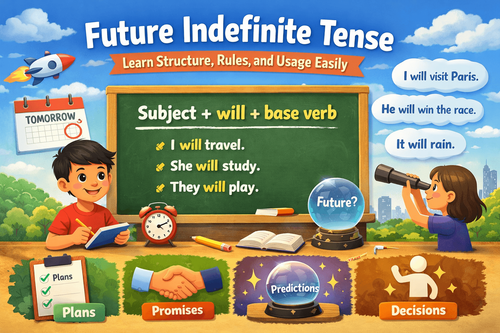

Will you speak better English tomorrow? This guide on Future Indefinite Tense: Learn Structure, Rules, and Usage Easily will help you form sentences confidently.
What Is Future Indefinite Tense?
The future indefinite tense is used to talk about actions that will happen in the future.
In simple words, it tells us about things that are yet to happen.
For example:
I will go to school tomorrow.
She will finish her homework later.
Here, the action has not happened yet. It will happen in the future.
Why Is It Important?
We use the future indefinite tense every day when we:
- Talk about plans
- Make promises
- Predict something
- Decide something instantly
Think about this:
What will you do after reading this blog?
That answer will use the future indefinite tense.
Future Indefinite Tense Structure
Understanding the future indefinite tense structure is very easy.
Basic Formula
Subject + will + base form of verb
Examples:
- I will eat
- She will play
- They will study
That’s it. No complicated rules.
Negative Sentences
To make negative sentences, add “not”.
Structure:
Subject + will not + base verb
Examples:
- I will not go
- She will not call
- They will not play
Short Form
You can also use short forms:
- will not = won’t
Example:
I won’t go to the park.
Question Form
To ask questions:
Will + subject + base verb?
Examples:
- Will you come?
- Will she help?
- Will they join us?
Try this yourself:
Make a question using “you” and “study”.
Future Indefinite Tense Rules
Let’s understand the simple rules.
Rule 1: Use “will” for all subjects
Unlike some tenses, you don’t need to change the verb for different subjects.
- I will go
- He will go
- They will go
Easy and same for all.
Rule 2: Use base form of the verb
Always use the base form (V1).
Correct: She will eat
Wrong: She will eats
Rule 3: Use for instant decisions
When you decide something quickly, use future indefinite tense.
Example:
“I am thirsty. I will drink water.”
Rule 4: Use for promises
Example:
“I will help you.”
Rule 5: Use for predictions
Example:
“It will rain tomorrow.”
Think about this:
What do you think will happen tomorrow?
Future Indefinite Tense Examples
Let’s look at more future indefinite tense examples.
Daily Life Examples
- I will wake up early tomorrow.
- She will complete her project tonight.
- We will visit our grandparents.
- They will watch a movie.
School Examples
- I will finish my homework.
- The teacher will check notebooks.
- We will learn a new chapter.
Fun Examples
- I will eat pizza tonight.
- We will play games after school.
- She will win the competition.
Mini Scenario
Rahul has a test tomorrow. He says:
“I will study hard tonight.”
This shows a future action.
Ask yourself:
What will you do this evening?
Future Indefinite Tense Exercises
Let’s practice with some future indefinite tense exercises.
Fill in the blanks
- I ____ (go) to the market tomorrow.
- She ____ (call) you later.
- They ____ (play) football in the evening.
Make negative sentences
- I will eat junk food.
- She will miss the class.
Make questions
- You will help me.
- She will come to school.
Try this yourself
Write 3 sentences about what you will do tomorrow.
When to Use Future Indefinite Tense
You should use this tense in different situations.
1. For Plans
Example:
“I will visit my friend.”
2. For Promises
Example:
“I will always support you.”
3. For Predictions
Example:
“The match will be exciting.”
4. For Offers
Example:
“I will carry your bag.”
5. For Decisions at the Moment
Example:
“I will answer the question.”
Observe this in real life
Listen to people around you. How often do they say “will”?
Common Mistakes to Avoid
Let’s avoid some common mistakes.
Mistake 1: Using wrong verb form
Wrong: She will goes
Correct: She will go
Mistake 2: Forgetting “will”
Wrong: I go tomorrow
Correct: I will go tomorrow
Mistake 3: Using extra words
Wrong: I will going
Correct: I will go
Mistake 4: Confusing with present tense
Wrong: I go tomorrow
Correct: I will go tomorrow
Remember:
Keep it simple—Subject + will + base verb.
Tips to Learn Future Indefinite Tense Easily
Here are some easy tips.
Practice Daily
- Speak small sentences
- Write simple lines
Use Real-Life Situations
- Talk about your plans
- Describe your future actions
Play Games
- Make sentences with friends
- Ask questions using “will”
Revise Regularly
- Repeat rules
- Practice exercises
Ask your teacher or parent
Check if your sentences are correct.
Fun Activities to Master Future Indefinite Tense
Learning grammar can be fun.
Activity 1: Future Diary
Write what you will do tomorrow.
Example:
“I will wake up early. I will go to school.”
Activity 2: Guess the Future
Ask your friend:
“What will you do this weekend?”
Activity 3: Story Time
Create a short story using “will”.
Example:
“I will go on an adventure. I will find treasure.”
Think about this
What story will you create?
Why Learning Future Indefinite Tense Is Important
This tense helps you:
- Speak clearly
- Express future plans
- Build confidence
- Improve communication
Without it, talking about the future becomes difficult.
Mini Scenario
A student says:
“I go tomorrow interview.”
It sounds confusing.
Correct sentence:
“I will go for the interview tomorrow.”
Now it sounds clear and correct.
Conclusion
The future indefinite tense is simple and useful.
Let’s quickly revise:
- It talks about future actions
- Structure is Subject + will + base verb
- It is used for plans, promises, and predictions
- Practice makes it easy
When you learn this tense, you can talk about your future with confidence.
So here’s a final thought:
What will you learn next in English grammar?