
Top Activities to Improve Writing Skills for Kids


Writing is more than just putting words on paper; it’s a life skill that helps children express their thoughts, organize ideas, and communicate confidently. In school and beyond, strong writing skills make a child stand out. But here’s the good news: improving writing doesn’t have to feel like homework. When children explore creative activities, storytelling prompts, and playful writing challenges, the learning process becomes both fun and deeply effective.
Today’s digital generation learns differently. They need activities that are engaging, interactive, and aligned with their natural curiosity. Whether your child is shy, expressive, imaginative, or analytical, the right creative writing exercises can help them grow into confident, articulate communicators.
This blog explores practical ways to improve your child’s writing, plus a collection of fun, creative activities you can try at home, no teaching background required!
How to Improve Your Child’s Writing Skills
1. Create a Reading Routine at Home
Every strong writer is a strong reader. Exposing children to books, stories, poems, and articles shapes their vocabulary, imagination, and sentence flow. Let your child explore a mix of genres, fantasy stories, science facts, adventure books, and even comic strips. Reading helps them understand how ideas connect and how writers build meaning.
Tip: Try reading together for 15 minutes daily. Ask questions like, “What do you think happens next?” or “Why did the character do that?”
This boosts critical thinking and makes the learning experience more memorable.
2. Encourage Daily Writing Without Pressure
Writing improves when it becomes a habit. Instead of strict assignments, let your child write freely, a diary entry, a short story, a poem, or even a silly list about their favourite things.
Give them colourful notebooks, fun pens, stickers, or digital tools such as kid-friendly writing apps.
The goal is to keep writing consistently, enjoyably, and pressure-free.
3. Introduce Structured Writing Activities
Parents often wonder how to teach children writing skills at home. The secret is structure. Guided frameworks like the 5W1H method, story arcs, or mind-mapping help children organise thoughts. Even simple templates, beginning, middle, and end, give young writers clarity and confidence.
When children learn to break down ideas, their writing automatically becomes more thoughtful and expressive. PlanetSpark’s Creative Writing program uses proven frameworks that help kids master storytelling, idea-building, and logical expression step by step.
4. Give Feedback That Motivates, Not Discourages
Instead of correcting every mistake, highlight what your child did well. Appreciation builds confidence, which is essential for improving writing skills.
Then give one or two simple suggestions like:
“Let’s try adding more describing words.”
“Can you make the ending more exciting?”
“What if we add a dialogue here?”
Positive reinforcement keeps children eager to write again.
Help your child master Creative Writing with structured lessons designed by experts.
Fun Writing Activities
Writing activities should feel playful, not like extra homework. Here are creative ways to build writing skills while keeping your child excited.
1. Try Online ELA Games Like Prodigy English
Children love games, and that makes Prodigy English a perfect way to build writing and language skills. Through interactive tasks, vocabulary challenges, and story-driven gameplay, children learn sentence structure, word usage, and problem-solving without even realising they’re learning.
Why it works:
Kids stay motivated because it’s game-based
They get instant feedback
It strengthens both reading and writing skills
It removes the fear of making mistakes
Parents can treat this activity like a “fun learning break” between homework sessions. Even 10–15 minutes a day can create a noticeable improvement in vocabulary and creativity.
2. Poetry Scavenger Hunt (Perfect for Creative Thinking)
This activity turns poetry into a lively treasure hunt. Create a list of poetic elements your child must “find” in books, songs, or even around the house. Examples include:
A rhyme (cat/hat)
A simile (“brave as a lion”)
An alliteration (“Silly Sally sang softly”)
A line that describes a feeling
Once they “collect” these, encourage them to write their own tiny poem using the elements they found.
This builds descriptive writing, clarity, and imagination, key parts of strong writing skills.
You can also make it competitive by timing the scavenger hunt or giving a reward for the most creative poem.
3. Create Your Own Comic Strip
Comics are a brilliant way to help children break down writing into simple scenes. Ask your child to:
Choose characters
Create a short problem
Write simple dialogues in speech bubbles
Draw 3–6 panels to show how the story unfolds
This activity strengthens:
Sequencing
Dialogue writing
Creativity
Story structure
Even children who don’t enjoy long writing tasks love this exercise because it feels like art + storytelling combined.
4. Create Your Own Madlib (Boost Vocabulary & Grammar)
Madlibs are fill-in-the-blank stories that spark laughter and surprise, perfect for building vocabulary and grammar skills.
Here’s how it works:
Create a short story with missing nouns, verbs, adjectives, etc.
Ask your child to fill in the blanks with random words
Read the final hilarious story together
Madlibs encourage children to think about parts of speech, sentence flow, and word choice, all while having fun.
This activity is especially useful for spoken English and creative writing development.
Give your child an edge in Creative Writing with personalised coaching.
Why Choose PlanetSpark Creative Writing
Parents often struggle to find the right balance between creativity and structure in their child’s writing journey. PlanetSpark bridges this gap beautifully. Our Creative Writing program is designed to build writing skills step by step, from basic sentence formation to advanced storytelling techniques.
Children don’t just learn to write; they learn to think, imagine, and express meaningfully.
Our curriculum combines:
Genre-Focused Curriculum: Covers diverse forms like stories, poems, essays, reviews, and persuasive letters to build versatile writing skills.
Framework-Based Learning: Students master story arcs, the S.T.O.R.Y structure, the 5W1H method, and the PEEL technique for structured writing.
Writing and Speaking Integration: Learners present their written pieces to strengthen expression and storytelling confidence.
Real-Time Editing: Classes emphasise rewriting and refinement through peer reviews and teacher feedback.
Publishing Opportunities: Students can feature their work on PlanetSpark’s blog, e-magazine, or co-authored anthologies for recognition.
Creativity Boosters: Writing prompts, imagination games, and story dice activities nurture originality and creative thinking.
Pranav: A Grade 3 Champion in Public Speaking & Creative Writing
A Young Talent Who Turned His Ideas Into Powerful Stories
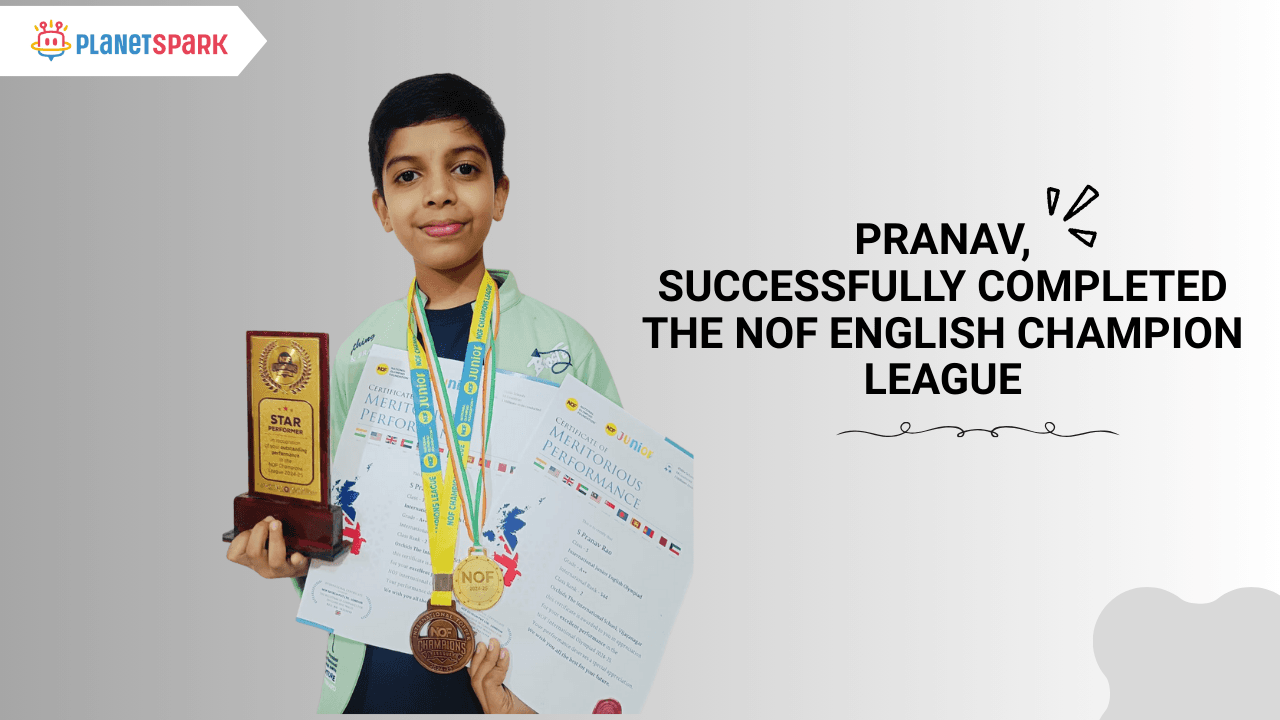
Pranav, a bright Grade 3 learner, recently completed the prestigious NOF English Champion League, earning recognition for his remarkable abilities in Public Speaking and Creative Writing. What made his achievement stand out was not just his performance, but how beautifully he expressed his ideas with clarity, imagination, and confidence.
At the beginning, Pranav loved stories but struggled to structure his ideas. Through regular guidance, engaging writing frameworks, and expressive activities, he began shaping thoughtful stories, vivid descriptions, and well-developed dialogues.
What makes Pranav’s achievement inspiring is his dedication. He embraced every activity, comic strips, poetry hunts, story arc exercises, and writing prompts, with curiosity and enthusiasm. Slowly, his writing transformed from short sentences into expressive, creative paragraphs filled with imagination.
Today, Pranav stands as an example of how young children can thrive when they receive the right support, encouragement, and structured learning.
Give your child the confidence to write creatively and clearly.
Limited slots available, Book a Free Demo Class before this batch closes!
The Right Writing Support Can Transform Your Child’s Future
Writing is not just a school subject; it’s a lifelong skill. When children learn to express themselves clearly, they gain the confidence to participate, present, and explore new opportunities. Strengthening your child’s writing skills early gives them a powerful head start in academics, communication, and creative thinking.
The activities we explored, from poetry hunts to Madlibs and comic strips, are simple yet transformative. They build creativity, vocabulary, structure, and imagination. But pairing these home activities with expert guidance creates a complete learning ecosystem.
PlanetSpark makes this journey smoother, more engaging, and much more effective through structured Creative Writing programs that nurture every child’s unique voice.
If you want your child to write better stories, richer sentences, and more expressive ideas, now is the perfect time to take the next step.
Readers Also Loved These Sections:
Frequently Asked Questions
Start with simple daily activities like reading together, writing short stories, and encouraging journals. Add fun tasks like comic strips, Madlibs, or poetry hunts. These make writing enjoyable and strengthen creativity.
Children can begin as early as age 6. At this age, they understand basic words and sentences, allowing them to explore imagination through short stories and descriptive lines. Regular practice builds confidence.
Absolutely. The right online program offers structure, expert guidance, interactive activities, and personalised feedback, all from the comfort of home. Children learn frameworks, vocabulary, and writing flow in a fun way.
Activities like comic strips, diary writing, word games, Prodigy-style ELA games, and scavenger hunts help children develop writing skills while staying motivated. These activities mix creativity with learning.
With consistent practice and proper guidance, children begin showing noticeable improvement within 4–6 weeks. Their vocabulary expands, sentence clarity improves, and they start expressing ideas more confidently.