
Analogy Meaning for Kids: Boost Creative Writing Skills


Table of Contents
- Analogy Meaning Explained for Kids
- Understanding Analogy
- Why Is Understanding Analogy Important for Kids?
- Types of Analogies Explained in Detail for Kids
- How Analogies Improve Creative Writing
- Real-Life Example: Analogy in a Short Story
- Sample Creative Writing Texts Using Analogies
- Success Story: How Aryaman Used Analogies to Become a Publis
- How Guided Writing Practice Helps Children Master Analogies
- How PlanetSpark Helps Children Master Creative Writing with
- Final Thoughts: Why Analogy Meaning Matters in Writing
When children start writing stories, one common challenge parents notice is this: the ideas are there, but the writing feels plain. Sentences sound repetitive. Descriptions feel flat. This is where understanding analogy meaning can make a big difference. Analogies help children explain ideas creatively, compare emotions, and make their writing more vivid and engaging.
In this guide, we will explain the analogy meaning in simple terms, share clear examples, and show how children can use analogies to improve storytelling and creative writing skills.
Analogy Meaning Explained for Kids
When we explain analogy meaning to kids, it is best to keep it simple, visual, and relatable.
An analogy is like saying:
This thing is similar to that thing in one special way.
Kids already use analogies in daily life without realising it.
Easy explanation for kids:
An analogy helps you explain an idea by comparing it to something you already know.
Kid-friendly examples:
- A teacher is like a lighthouse. They guide students in the right direction.
- Homework is like exercise for the brain.
- A library is like a treasure chest full of knowledge.
These comparisons help children understand ideas faster and remember them better.
Analogy Examples with Everyday Situations
Here are some easy analogy examples with situations that children can relate to and use in their own writing:
Situation: Feeling scared before an exam
- Fear felt like a knot tightening in my stomach.
Situation: A kind friend helping you
- My friend was like an umbrella, protecting me on a bad day.
Situation: A strict but caring teacher
- Our teacher was like a coach, pushing us to do better every day.
Situation: A noisy classroom
- The classroom sounded like a buzzing beehive.
Situation: Feeling very happy
- Happiness spread through me like warm sunlight.
Situation: Working hard for a goal
- Preparing for the competition was like climbing a steep hill, step by step.
These situational analogies show children how to connect feelings and actions with clear images, making their writing more interesting and expressive.
Boost Your Child’s Creative Writing Today!
Book a PlanetSpark demo now and help them master analogies.
Understanding Analogy
To understand analogy meaning, think of it as a comparison between two things that may be different but share a similar relationship or idea.
An analogy explains something unfamiliar by linking it to something familiar.
Simple definition: An analogy compares one thing to another to explain an idea clearly or creatively.
Example:
- A classroom without discipline is like a garden without a fence.
Here, the comparison helps the reader understand the importance of discipline using an everyday image.
Why Is Understanding Analogy Important for Kids?
Understanding analogy meaning plays an important role in a child’s language, thinking, and creative development. Analogies are not just writing tools. They shape how children understand ideas and express their thoughts clearly.
1. Builds Strong Thinking and Reasoning Skills
When children create or understand analogies, they learn how to find connections between ideas.
Example:
If a child understands that a teacher is like a guide, they learn to think about relationships, not just objects.
This improves logical thinking and problem-solving skills.
2. Improves Creative Writing and Storytelling
Children who understand analogy meaning can move beyond plain sentences.
Instead of writing:
- The day was good.
They learn to write:
- The day felt like a smooth ride with no bumps.
This makes stories more interesting and expressive.
3. Helps Children Express Emotions Clearly
Many children struggle to explain how they feel. Analogies give them a safe and creative way to express emotions.
Example:
- Anger felt like a volcano ready to erupt.
This is helpful in personal writing, journaling, and storytelling.
4. Strengthens Vocabulary and Language Skills
Learning analogies exposes children to new words and sentence patterns.
As children practise analogies, they naturally improve:
- Word choice
- Sentence variety
- Descriptive language
This leads to more confident communication.
5. Supports Academic Performance
Analogies are often used in school exams, comprehension passages, and essays.
Children who understand analogy meaning can:
- Answer comparison-based questions easily
- Write better essays and speeches
- Stand out with creative responses
6. Encourages Imagination and Original Thinking
Analogies push children to think creatively instead of memorising phrases.
Example:
- Hope is like a small candle in the dark.
This develops originality and confidence in self-expression.
7. Improves Speaking and Communication Skills
Analogies are not limited to writing. They improve spoken communication too.
Children who use analogies while speaking sound:
- Clear
- Confident
- Engaging
This is especially useful in speeches, debates, and classroom discussions.
8. Prepares Children for Advanced Writing Skills
Understanding analogy meaning prepares children for similes, metaphors, and deeper literary techniques they will learn later.
It builds a strong foundation for higher-level writing and reading comprehension.
In simple terms, analogies help children think better, write better, and express themselves with confidence.
Transform Ideas into Stories!
Sign up for a free session to learn how analogies can make writing vivid.
Types of Analogies Explained in Detail for Kids
Understanding different types of analogies helps children use them correctly in stories, essays, and creative writing. Each type serves a different purpose and uniquely improves writing.
1. Simple Comparison Analogies
These are the easiest type of analogies for kids to understand. They directly compare one thing to another based on a shared quality.
When kids use it:
To explain an idea clearly and quickly.
Examples:
- Books are like windows because they help us see the world.
- A good friend is like a pillow because you can lean on them.
This type is perfect for beginners who are just learning analogy meaning.
2. Emotional Analogies
Emotional analogies help children describe feelings in a vivid way instead of using plain words like happy, sad, or scared.
When kids use it:
To show emotions in stories and personal writing.
Examples:
- Nervousness felt like butterflies flying in my stomach.
- Sadness hung over her like a dark cloud.
These analogies make readers feel the emotion instead of just reading about it.
3. Functional Analogies
Functional analogies explain how something works by comparing it to something familiar.
When kids use it:
To explain ideas in essays, science answers, or informative writing.
Examples:
- The brain works like a computer that stores information.
- The heart is like a pump that keeps blood moving.
This type improves clarity and understanding in academic writing.
4. Nature-Based Analogies
These analogies compare ideas or feelings to elements from nature, such as the sun, rain, rivers, or animals.
When kids use it:
To add beauty and imagery to creative writing.
Examples:
- Her smile was like sunshine on a rainy day.
- Time flowed like a river, never stopping.
Nature-based analogies make writing more descriptive and imaginative.
5. Story-Based Analogies
Story-based analogies are used within stories to improve description and mood.
When kids use it:
To make stories more engaging and expressive.
Examples:
- The night wrapped the city like a soft black blanket.
- Fear chased him like a shadow down the street.
These analogies help set the scene and keep readers interested.
6. Problem–Solution Analogies
These analogies compare challenges to obstacles and solutions to actions that overcome them.
When kids use it:
To explain effort, learning, and growth.
Examples:
- Learning math was like solving a puzzle, one piece at a time.
- Practising every day was like sharpening a pencil to make it work better.
This type is very useful in motivational writing and essays.
By learning these different types of analogies, children can choose the right comparison for the right situation, making their writing clearer, more creative, and more powerful.
How Analogies Improve Creative Writing
Once children clearly understand analogy meaning, they can use analogies as powerful tools to improve creative writing. Analogies help young writers move from simple sentences to expressive, imaginative storytelling.
1. Analogies Make Descriptions More Vivid
Many children describe scenes in a basic way because they do not know how to paint pictures with words.
Simple sentence:
- The playground was crowded.
With an analogy:
- The playground was like a busy ant hill, full of movement and noise.
Analogies help readers visualise scenes clearly, making the story more engaging.
2. Analogies Help Show Emotions Instead of Telling Them
Creative writing becomes stronger when emotions are shown, not just told.
Telling emotion:
- She was very nervous.
Showing emotion with an analogy:
- Her nervousness felt like tiny drums beating inside her chest.
This technique helps readers feel the emotion along with the character.
3. Analogies Improve Character Development
Analogies can reveal a character’s personality, mood, or behaviour.
Example:
- He stood firm like a rock when others gave up.
This single analogy tells readers that the character is strong and determined without long explanations.
4. Analogies Add Creativity and Originality
Stories without analogies often sound repetitive. Analogies encourage children to think creatively and use their imagination.
Example:
- Ideas burst in her mind like fireworks.
Such comparisons make writing unique and interesting.
5. Analogies Improve Story Flow and Transitions
Analogies help connect ideas smoothly, making writing easier to read.
Example:
- The day ended like a chapter closing in a book.
This helps stories feel complete and well-structured.
6. Analogies Strengthen Vocabulary and Sentence Structure
When children practise analogies, they naturally learn new words and sentence patterns.
Instead of repeating common words, they explore expressive language, which improves overall writing quality.
7. Analogies Help Children Express Complex Ideas Simply
Some ideas are difficult for children to explain directly. Analogies make them easier to understand.
Example:
- Learning patience was like waiting for a seed to grow into a plant.
This is especially helpful in essays, reflections, and moral stories.
By using analogies thoughtfully, children can turn ordinary writing into powerful creative pieces that connect strongly with readers.
Real-Life Example: Analogy in a Short Story
Without analogy:
The boy ran fast because he was scared.
With analogy:
The boy ran fast, his feet moving like lightning as fear chased him down the street.
This shows how understanding analogy meaning can instantly improve storytelling.
Sample Creative Writing Texts Using Analogies
Below are three short creative writing samples with analogies to help children clearly see how analogies can be used in different situations.
Sample 1: Facing a Challenge
The morning of the school competition felt heavy, like a bag filled with unseen stones. As I walked into the hall, my heart beat like a fast drum calling me to the stage. Fear tried to hold me back like sticky mud around my feet, but hope whispered softly like a friend standing beside me. When I finally spoke, my words flowed like a clear river, and confidence rose inside me like the sun climbing into the sky.
Sample 2: Describing a Happy Moment
Laughter filled the room like bubbles rising in a glass of soda. My friends’ smiles shone like tiny lamps, lighting up the afternoon. Happiness wrapped around me like a warm blanket, and every moment felt as light as a feather floating in the air.
Sample 3: Showing Fear and Courage
The dark corridor looked endless, like a tunnel with no light at the end. Fear crept behind me like a silent shadow, but courage stood firm like a wall inside my heart. With each step forward, my fear grew smaller, like a candle slowly melting away.
These examples show how analogies can bring emotions, settings, and actions to life, helping children write more expressive and engaging creative pieces.
Success Story: How Aryaman Used Analogies to Become a Published Author
Aryaman joined PlanetSpark at the age of 9 with a strong imagination but struggled to turn his ideas into expressive writing. His stories had good plots, but they lacked depth in emotions and description.
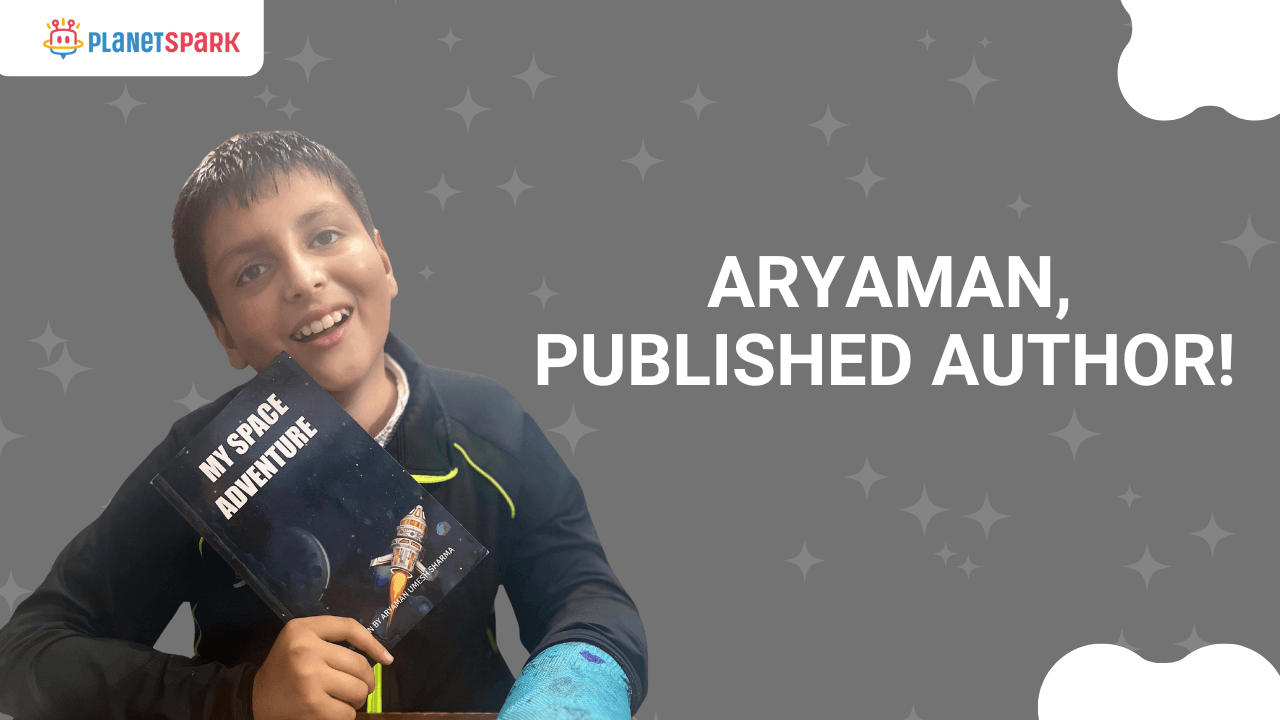
Through guided creative writing sessions, Aryaman learned the true analogy meaning and how to use analogies naturally in his stories. He began comparing emotions, settings, and actions with familiar images, making his writing more vivid and engaging.
Instead of writing simple lines, Aryaman started crafting sentences like:
- Fear crept in like a quiet shadow.
- Hope shone like a small lamp in the dark.
With regular feedback, personalised guidance, and focused practice, Aryaman’s confidence grew. His storytelling improved, his communication became clearer, and his creative voice became stronger.
At just 9 years old, Aryaman went on to become a published author, showcasing how mastering analogies can transform creative writing. His journey reflects how the right support can nurture creativity, communication skills, and confidence in young writers.
From Ideas to Published Stories!
Book a free demo to nurture creative writing and communication skills.
How Guided Writing Practice Helps Children Master Analogies
Many children understand the analogy meaning in theory, but find it difficult to use analogies naturally in their writing. Guided writing practice plays a key role in helping children bridge this gap between understanding and application.
Turns Ideas into Clear Expressions
Children often have strong ideas but struggle to express them clearly. With guided practice, they learn how to choose the right comparison that matches the emotion or situation in their story.
Example:
Instead of forcing an analogy, children learn to ask, What does this feeling or scene remind me of?
Helps Children Use Analogies Naturally
Without guidance, children may overuse analogies or place them awkwardly in sentences. Structured feedback teaches them:
- When an analogy adds value
- When simple sentences work better
- How to keep comparisons clear and meaningful
This results in smoother, more natural writing.
Improves Confidence Through Practice and Feedback
Regular guided practice allows children to experiment with analogies without fear of making mistakes. Supportive feedback helps them refine their writing and build confidence in their creative voice.
Over time, children begin using analogies instinctively.
Builds Strong Writing Habits
Guided writing helps children develop habits such as:
- Thinking before comparing
- Revising sentences for clarity
- Matching analogies to tone and mood
These habits improve overall creative writing skills, not just analogy usage.
Strengthens Communication Skills Beyond Writing
The ability to use analogies also improves spoken communication. Children learn how to explain ideas clearly during discussions, presentations, and storytelling.
With consistent guidance and practice, children move from basic comparisons to confident, expressive writing that uses analogies effectively and creatively.
How PlanetSpark Helps Children Master Creative Writing with Analogies
Creative writing is not just about imagination. Children need the right guidance to turn ideas into well-structured, expressive stories. At PlanetSpark, creative writing is taught as a skill that develops step by step, with special focus on tools like analogies.
Through personalised creative writing sessions, children learn the true analogy meaning and how to apply it naturally in stories, essays, and descriptive writing.
What Makes PlanetSpark’s Creative Writing Approach Effective
- Personalised Writing Guidance
Each child receives one-to-one feedback that helps them understand where and how to use analogies without overdoing them. - Structured Creative Writing Frameworks
Children are taught how to build scenes, describe emotions, and develop characters using analogies in a clear and age-appropriate way. - Practice-Based Learning
Regular writing exercises encourage children to experiment with analogies in real situations, such as describing fear, happiness, challenges, and success. - Confidence-Building Feedback
Supportive feedback helps children refine their comparisons, improve sentence flow, and gain confidence in their creative voice. - Strong Communication Skills
By learning to use analogies effectively, children improve not only their writing but also their speaking and storytelling abilities.
PlanetSpark’s creative writing programme helps children move from basic descriptions to expressive, engaging writing that reflects clarity, creativity, and confidence.
Final Thoughts: Why Analogy Meaning Matters in Writing
Understanding analogy meaning helps children become confident writers and creative thinkers. Analogies turn simple sentences into powerful expressions and help children connect ideas in imaginative ways.
With regular practice, encouragement, and the right guidance, children can use analogies naturally in stories, essays, and creative writing pieces.
Helping your child master analogies today builds strong communication and writing skills for the future.
Frequently Asked Questions
Analogy meaning for kids refers to comparing one idea with something familiar to explain it clearly. For example, saying learning is like climbing a ladder helps children understand progress step by step.
Understanding analogy meaning helps children make their creative writing more vivid, expressive, and engaging. Analogies allow young writers to show emotions, describe scenes, and connect ideas creatively.
Children can use analogies to describe feelings, settings, characters, or challenges. For example, fear felt like a shadow or hard work was like planting a seed.
Children can start learning basic analogy meaning as early as 6 or 7 years old, using simple comparisons. As they grow older, they can use more detailed analogies in creative writing and essays.
Yes. Using analogies correctly can make answers stand out in exams, improve descriptive writing, and show strong thinking and language skills.