Conceptual Writing is more than just
arranging words on paper. It is a skill that helps students express ideas clearly, creatively, and effectively. Unlike rote writing, which focuses on memorization, conceptual writing emphasizes understanding, originality, and clarity. Developing writing skills for students through conceptual writing boosts communication, storytelling, and creative thinking. PlanetSpark’s programs make conceptual writing engaging and practical, helping students bring their ideas to life.
By mastering conceptual writing, students learn
to organize thoughts, convey messages convincingly, and craft stories that connect with readers. Whether writing essays, projects, or personal reflections, conceptual writing forms the foundation for success. In this blog, we explore conceptual writing, its benefits, techniques, activities, and tools, helping young learners build strong creative writing techniques and storytelling for kids skills.
Understanding Conceptual Writing
What is Conceptual Writing?
Conceptual writing is the art of presenting ideas and concepts clearly. It is about understanding a topic deeply and conveying it in a way that others can grasp easily. Unlike mechanical writing, which focuses solely on grammar or format, conceptual writing highlights meaning, logic, and creativity.
Students practicing conceptual writing are encouraged to explore ideas critically, analyze information, and express personal insights. For example, if the topic is “teamwork,” conceptual writing would not only define teamwork but explain its importance, provide examples, and narrate experiences demonstrating collaboration.
Key Elements of Conceptual Writing
Clarity of Thought: Every sentence communicates a specific idea.
Originality: Writing reflects personal understanding and creativity.
Logical Flow: Ideas are connected to form a coherent narrative.
Engagement: Writing captivates the reader through stories, examples, or interesting questions.
Why Students Should Focus on Conceptual Writing
Enhances problem-solving and analytical abilities.
Improves academic performance in essays, projects, and exams.
Builds confidence in expressing thoughts and ideas.
Prepares students for advanced writing, creative careers, and effective communication in daily life.
Elements of Conceptual Writing
Mastering conceptual writing skills for students requires understanding its core elements. These components guide writers to convey their ideas logically, creatively, and persuasively. PlanetSpark emphasizes these elements in their structured curriculum, ensuring learners build a strong foundation while exploring creative writing techniques.
1. Idea & Theme Development The starting point of conceptual writing is a central idea or theme. This could range from abstract concepts like “freedom” or “courage” to real-life challenges and personal experiences. Strong ideas provide direction and purpose for the writing. Techniques like brainstorming, mind mapping, and freewriting can help generate and organize ideas effectively.
2. Structure & Flow While conceptual writing encourages creativity, a logical structure ensures clarity. A clear structure may include an introduction, exploration of ideas, supporting examples, and a conclusion. Subheadings, bullet points, and tables improve readability, making complex ideas easy to understand for both kids and adults.
3. Language & Style
Use simple yet expressive language to convey ideas clearly.
Experiment with sentence variety to create rhythm and emphasis.
Active voice enhances engagement and makes writing more impactful.
4. Imagery & Storytelling Incorporating storytelling elements makes conceptual writing relatable and memorable:
Use descriptive imagery and sensory details.
Apply metaphors, analogies, and similes to explain abstract concepts.
Storytelling for kids simplifies complex ideas while keeping learning fun.
Connect abstract concepts to real-life situations.
Encourage reflection and independent thinking.
Techniques to Enhance Conceptual Writing:
Technique
Purpose
Example
Mind Mapping
Organizes ideas visually
Mapping the concept of “Creativity” into a story plot
Free Writing
Encourages flow of ideas without editing
Writing continuously for 10 minutes on “Imagination”
Storyboarding
Plans narrative structure
Creating frames for a children’s story
Analytical Writing
Connects ideas logically
Writing an essay on ethical dilemmas in daily life
By integrating these elements, learners can develop comprehensive conceptual writing skills for students that translate into real-world communication. Structured thinking, combined with creativity and storytelling, ensures that learners can express complex ideas clearly and engagingly.
Conceptual writing can take many forms, each serving a unique purpose and audience. Understanding these types helps learners apply creative writing techniques effectively while enhancing conceptual writing skills for students and professionals alike.
1. Narrative Conceptual Writing
Focuses on storytelling while conveying deeper ideas.
Uses characters, plots, and events to explore themes such as courage, friendship, or innovation.
Ideal for kids as it combines learning and imagination.
Example: A story about a young inventor who uses creativity to solve a community problem, highlighting innovation and problem-solving.
2. Analytical Conceptual Writing
Emphasizes logic, reasoning, and exploration of ideas.
Often seen in essays, research papers, or professional reports.
Encourages critical thinking, connecting abstract concepts to real-life situations.
Example: An essay analyzing how storytelling techniques influence children’s learning outcomes or how ethical decisions impact business strategies.
3. Reflective Conceptual Writing
Involves self-expression and introspection.
Focuses on personal experiences, thoughts, and feelings.
Example: Writing a reflection on how learning storytelling improved communication skills or boosted confidence in expressing ideas.
4. Poetic Conceptual Writing
Uses rhythm, metaphor, and figurative language to convey abstract ideas.
Enhances creative expression while reinforcing conceptual understanding.
Works well for both young learners and adults interested in literary expression.
Example: A poem exploring “freedom” through imagery and metaphors without directly naming it.
5. Instructional or Informative Conceptual Writing
Aims to teach concepts clearly while maintaining engagement.
Uses examples, bullet points, tables, and illustrations.
Perfect for educational content for kids and professional guides.
Example Table – Comparing Types of Conceptual Writing:
Type
Key Features
Target Audience
Example
Narrative
Story-driven, character-focused
Kids & young learners
Story about a young inventor
Analytical
Logical, research-oriented
Students & professionals
Essay on business ethics
Reflective
Personal, introspective
All ages
Reflection on learning storytelling
Poetic
Figurative, creative
Kids, students, adults
Poem on abstract themes like freedom
Instructional
Clear, informative
Students & professionals
Step-by-step guide to creative writing
By exploring different types, learners can experiment and choose the form that best suits their purpose, audience, and personal style. Mastering multiple types also builds versatility, making one confident in expressing complex ideas effectively.
Understanding the work of famous conceptual thinkers provides inspiration and practical examples for learners practicing conceptual writing skills for students. These thinkers demonstrate how abstract ideas can be expressed clearly and creatively.
1. Albert Einstein
Known for bridging complex scientific ideas with simple explanations.
His conceptual clarity inspired both students and professionals to think critically.
Example: Simplifying the theory of relativity through analogies and thought experiments.
2. Maya Angelou
A poet and writer celebrated for her reflective and narrative conceptual writing.
Explored deep themes like freedom, identity, and resilience through storytelling and poetry.
Her works teach students how to connect personal experiences with universal ideas.
3. J.K. Rowling
Uses narrative conceptual writing to build entire imaginative worlds.
Demonstrates how storytelling can convey moral lessons, creativity, and critical thinking.
Ideal example for storytelling for kids while introducing conceptual depth.
4. Leonardo da Vinci
Though primarily known as an inventor and artist, his journals reflect deep conceptual thinking.
Combined observation, imagination, and analysis to document ideas.
Shows the power of creative writing techniques beyond conventional literature.
5. George Orwell
Famous for analytical and narrative conceptual writing.
His novels and essays convey complex social, political, and philosophical ideas in an understandable way.
Helps learners understand the impact of writing on society and critical thinking.
Table – Summary of Famous Conceptual Thinkers:
Thinker
Writing Style
Key Contribution
Lesson for Learners
Albert Einstein
Analytical
Simplifying complex ideas
Use analogies and clear explanation
Maya Angelou
Reflective/Narrative
Emotional storytelling
Connect personal experiences to universal themes
J.K. Rowling
Narrative
Engaging imaginative worlds
Storytelling for impactful learning
Leonardo da Vinci
Observational/Analytical
Journals & sketches
Blend observation with imagination
George Orwell
Narrative/Analytical
Social commentary
Convey complex ideas through storytelling
By studying these thinkers, learners of all ages can develop a strong foundation in conceptual writing. Their works illustrate how ideas can be expressed creatively, analytically, and memorably, providing a blueprint for aspiring writers, students, and professionals alike.
Boost Your Child’s Writing and Imagination with PlanetSpark Creative Writing
Genre-Based Curriculum: Explore short stories, poetry, essays, journals, book reviews, and persuasive letters with tailored lesson plans.
Framework-Driven Writing Instruction: Learn story arcs, S.T.O.R.Y structure, 5W1H method, and PEEL technique for structured, compelling writing.
Writing + Speaking Integration: Present written work orally to develop confidence and effective narrative flow.
Editing, Feedback, and Rewriting: Improve writing through real-time editing, peer reviews, and teacher feedback.
Real Publishing Opportunities: Publish stories on PlanetSpark’s blog, e-magazine, or co-authored anthologies for recognition and pride.
Creativity Stimulus Activities: Use story dice, prompts, image-based exercises, and guided imagination activities to spark original ideas.
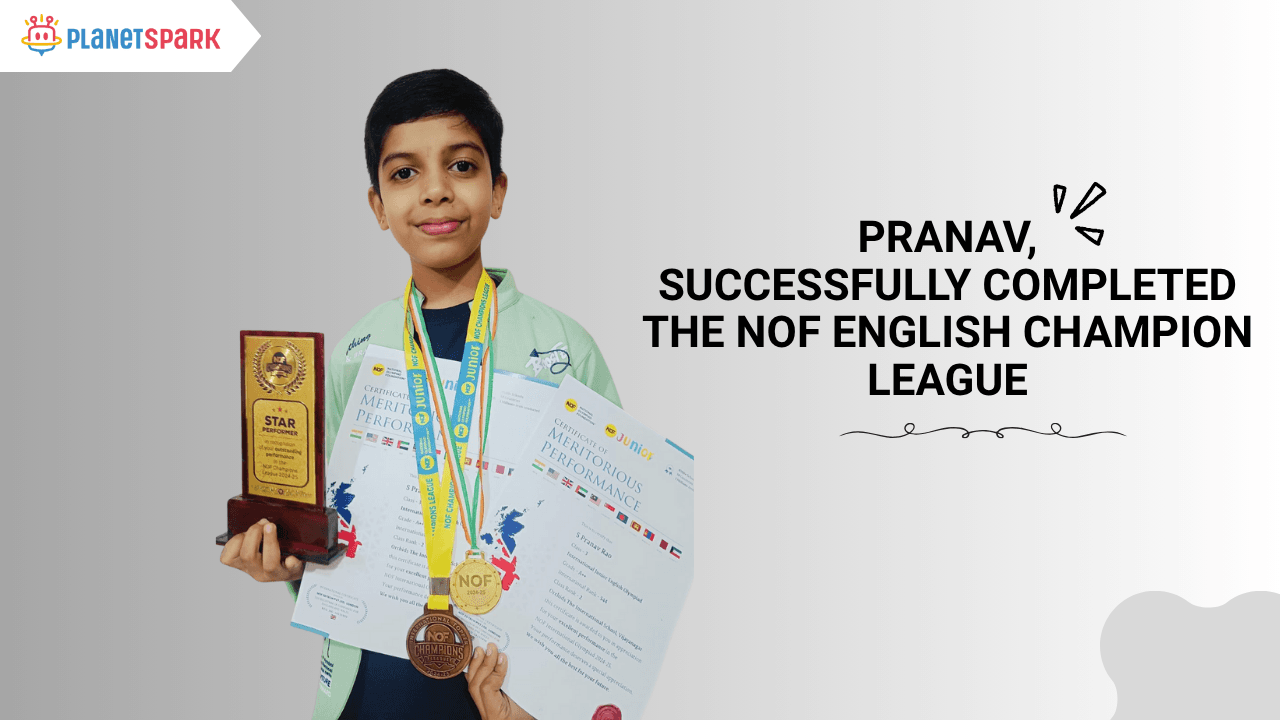
Pranav Showcases Excellence in English Skills
Pranav delivered an impressive performance by successfully completing the NOF English Champion League. His confidence in public speaking and creativity in writing highlight his growing command of English and his dedication to learning. A truly commendable achievement!
Master Conceptual and Creative Writing with PlanetSpark
Conceptual writing and creative expression go hand in hand in shaping confident, imaginative, and articulate learners. By practicing conceptual writing, mastering creative writing techniques, and engaging in storytelling for kids, students develop clarity of thought, strong communication skills, and a love for writing. PlanetSpark provides structured guidance, interactive exercises, and real publishing opportunities to help children transform ideas into compelling stories. With regular practice, feedback, and imaginative activities, every child can become a confident writer, thinker, and storyteller ready to excel academically and creatively.
Conceptual writing focuses on understanding and clearly expressing ideas rather than memorizing facts. It helps students think critically, organize thoughts, and communicate effectively.
It improves clarity, logical thinking, storytelling ability, creativity, and overall writing skills for students, making learning engaging and effective.
The course is designed for school-going children who want to improve imagination, storytelling, and structured writing skills.
The course covers short stories, poetry, journal writing, essays, book reviews, persuasive letters, and storytelling techniques.
Students present their written work orally, which improves expressive confidence, narrative flow, and communication skills.
Yes! Students can publish stories on PlanetSpark’s blog, e-magazine, or co-authored anthologies, boosting confidence and recognition.