
Understand Creative Writing Genres List to Improve Writing Skills


Table of Contents
- What Is a Creative Writing Genres List and Why It Matters
- Detailed Creative Writing Genres List for Kids
- Understanding Story Arc for Kids with Examples
- PEEL Method for Essay Writing Made Simple
- Creative Writing Prompts for 10-Year-Olds
- How Creative Writing Builds Leadership Goals
- How to Improve Writing Skills Using Genres
- Improve Your Child’s Skills with PlanetSpark Creative Writin
- Unlock Your Child’s Creative Potential
What if your child could turn simple ideas into powerful stories that others love to read?
Many kids struggle to start writing because they do not know what to write or how to express their thoughts clearly. Understanding a list of creative writing genres helps children discover different ways to write, think, and communicate.
This blog covers key writing genres, using a story arc for kids, the PEEL method for essay writing, and creative writing prompts for 10-year-olds. You will also learn how writing builds leadership goals and confidence.
Let us begin by exploring the different types of creative writing and how they shape strong writers.
What Is a Creative Writing Genres List and Why It Matters
A list of creative writing genres is a structured way to understand the different writing styles children can explore. Each genre has its own purpose, format, and techniques. Learning these genres helps kids become more expressive, organised, and confident writers.
Creative writing is not only about imagination. It is about how ideas are shaped and communicated clearly. When children learn genres, they also learn structure, tone, and audience awareness.
Core Creative Writing Genres
There are four primary categories of creative writing:
1. Fiction
Imaginary stories that focus on characters, plot, and setting.
2. Poetry
Writing that uses rhythm, sound, and emotion.
3. Creative Nonfiction
Real-life stories told using storytelling techniques.
4. Scriptwriting
Writing for plays, films, or performances using dialogue and action.
Why Understanding Genres Improves Writing
- Improves versatility by exploring different formats
- Teaches structure and organisation
- Enhances creativity and imagination
- Builds audience awareness
- Strengthens communication skills
Additionally, genre awareness helps children understand what readers expect. This makes their writing more engaging, purposeful, and easier to follow.
When kids explore multiple genres, they do not feel stuck. Instead, they learn to express ideas in different ways, which builds confidence and creativity.
Feeling your child lacks creativity in writing? Book a free trial class now and help them discover their favourite writing style before they lose interest.
Detailed Creative Writing Genres List for Kids
Understanding different genres helps children find what they enjoy and improve specific skills.
When children explore a wide range of genres, they begin to understand that writing is not limited to one format. Instead, it is a flexible skill that can be used to tell stories, share experiences, express emotions, and communicate ideas effectively.
This exploration also helps children discover their strengths. Some may enjoy imaginative storytelling, while others may prefer expressing real-life experiences or emotions. By experimenting with genres, children develop confidence and a strong writing identity.
1. Fiction Genres
Fiction is one of the most popular forms in any creative writing genre list.
It allows children to use their imagination freely and create stories that are not limited by reality. This makes fiction exciting and engaging for young writers.
Common types include:
- Fantasy with magical worlds: Children create imaginary lands, magical creatures, and exciting adventures. This improves creativity and world-building skills.
- Science fiction with futuristic ideas: This includes robots, space travel, and advanced technology. It helps children think about the future and develop innovative ideas.
- Mystery and thriller with suspense: These stories involve solving problems or uncovering secrets. Kids learn to build suspense and keep readers curious.
- Romance focusing on relationships: Simple friendship or emotional connection stories help children understand relationships and emotions.
- Historical fiction based on past events: Children learn about history while creating engaging stories set in different time periods.
- Realistic fiction based on real-life situations: These stories feel real and relatable, helping children connect writing with everyday experiences.
Each type of fiction teaches a different way of thinking. For example, mystery builds logical reasoning, while fantasy enhances imagination.
Skills learned:
- Character development: Creating believable and interesting characters with emotions and personalities.
- Plot building: Organising events in a way that keeps the story engaging from beginning to end.
- World creation: Designing settings that make the story feel real or magical.
Fiction also helps children understand cause and effect, which improves both storytelling and problem-solving skills.
2. Creative Nonfiction Genres
These are real stories written creatively.
Creative nonfiction helps children connect writing with real life. It teaches them how to observe their surroundings and express real experiences in an engaging way.
Examples include:
- Memoirs: Personal stories about important moments in a child’s life.
- Personal essays: Writing about thoughts, opinions, or experiences in a structured way.
- Travel writing: Describing places, journeys, and experiences in detail.
- Biographies: Writing about the life of a real person, which builds research and storytelling skills.
Skills learned:
- Observation: Noticing details in everyday life and describing them clearly.
- Reflection: Thinking deeply about experiences and learning from them.
- Real-world connection: Understanding how writing relates to real situations and communication.
This genre also builds emotional intelligence, as children learn to express feelings and understand different perspectives.
3. Poetry Types
Poetry teaches kids how to express emotions creatively.
Unlike other forms of writing, poetry focuses on feelings, rhythm, and word choice rather than long explanations. This makes it a powerful tool for self-expression.
Types include:
- Free verse: Poetry without strict rules, allowing children to express ideas freely.
- Haiku: A short three-line poem that teaches precision and creativity with limited words.
- Rhyming poems: Poems with repeating sounds that make writing fun and musical.
- Narrative poetry: Poems that tell a story while maintaining rhythm and flow.
Skills learned:
- Emotional expression: Sharing feelings in a creative and meaningful way.
- Language creativity: Using unique words, metaphors, and imagery to make writing vivid.
- Rhythm and flow: Understanding how words sound and move together.
Poetry also helps children develop a deeper connection with language, making them more expressive writers in all genres.
4. Drama and Scriptwriting
This involves writing for performance.
Drama and scriptwriting differ from other genres because they focus on action and dialogue rather than long descriptions. This makes writing more interactive and engaging.
Examples include:
- Screenplays: Scripts written for movies or videos, focusing on scenes and actions.
- Stage plays: Stories written for live performances, often involving characters and dialogue.
- Dialogue writing: Creating conversations between characters to move the story forward.
Skills learned:
- Communication: Expressing ideas clearly through dialogue and action.
- Dialogue creation: Writing realistic and engaging conversations between characters.
- Story visualisation: Imagining how a story looks and feels when performed.
This genre is especially helpful for building confidence, as children often perform or present their scripts. It also improves speaking and listening skills, as well as writing.
Understanding Story Arc for Kids with Examples
The story arc for kids is the foundation of good storytelling. It helps children organise their ideas and create engaging stories.
Without a proper story arc, children often jump from one idea to another, making their stories confusing or incomplete. A clear structure helps them present their ideas in a logical and engaging way.
Think of a story arc as a roadmap that guides the writer from the beginning to the end. It ensures that every part of the story has a purpose and keeps the reader interested throughout.
The Five Stages of a Story Arc
1. Beginning
Introduces characters and setting.
This stage helps readers understand who the story is about and where it is happening. A strong beginning grabs attention and sets the tone.
2. Rising Action
Builds the problem or conflict
This is where the story becomes interesting. Challenges and obstacles are introduced, creating curiosity about what will happen next.
3. Climax
The most exciting or important moment.
This is the turning point of the story where the main problem reaches its peak. It is often the most emotional or dramatic part.
4. Falling Action
Events start resolving.
After the climax, the story begins to settle. Problems start getting solved, and loose ends are tied together.
5. Ending
The conclusion of the story.
A strong ending gives closure and leaves a lasting impression on the reader. It can be happy, surprising, or thoughtful.
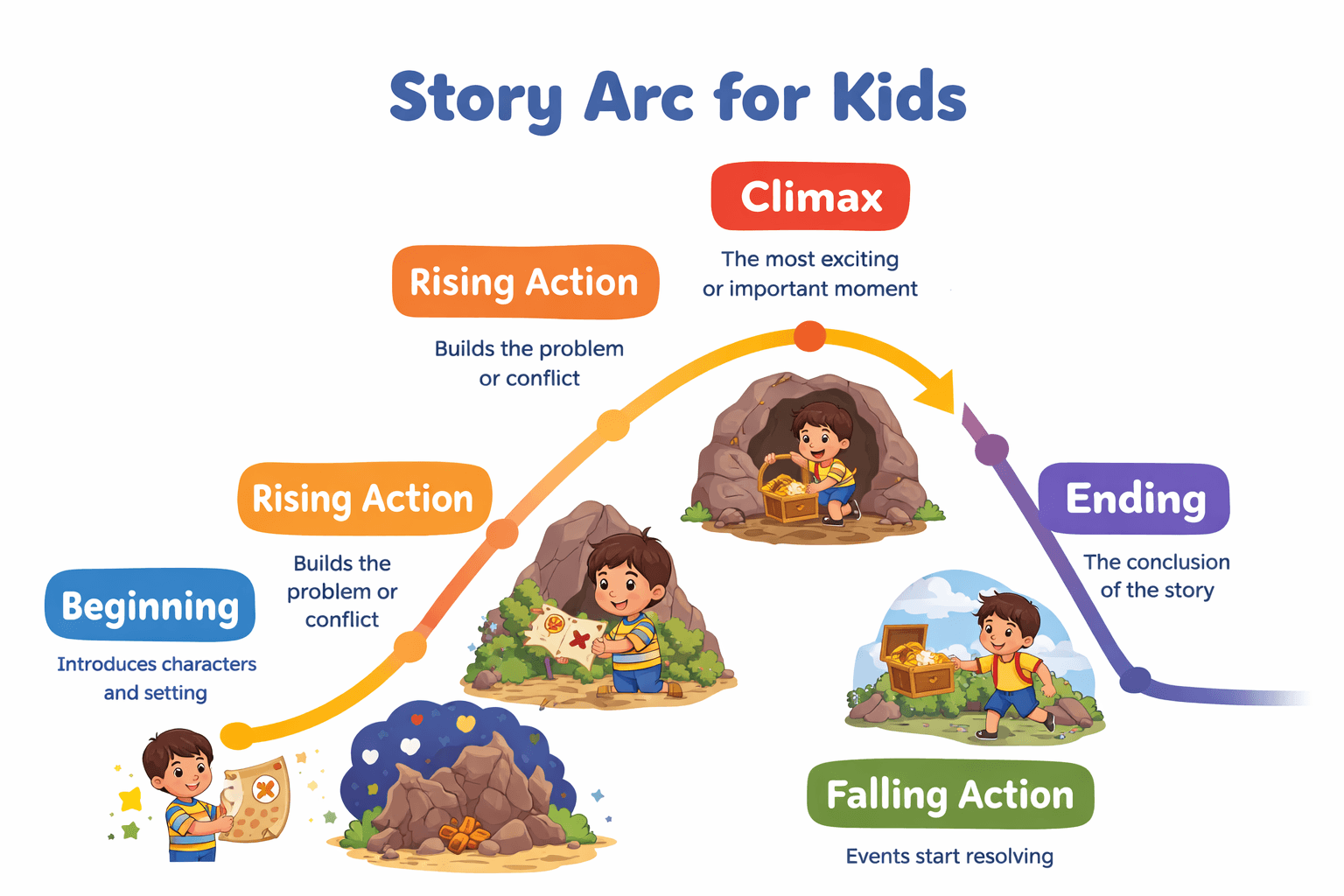
Example
A story about a lost treasure:
- Beginning: A child finds a treasure map
- Rising action: Faces challenges during the journey
- Climax: Finds the treasure hidden in a cave
- Falling action: Escapes safely
- Ending: Shares treasure with friends
This structure ensures that the story flows smoothly and keeps the reader engaged from start to finish.
Why Story Arc Matters
- Makes stories structured
- Keeps readers engaged
- Improves clarity
- Builds logical thinking
It also helps children avoid writing random or disconnected ideas. Instead, they learn to connect events in a meaningful way, which improves both creativity and organisation.
Worried your child writes random stories without structure? Book a demo class today and help them master storytelling step by step before they fall behind.
PEEL Method for Essay Writing Made Simple
The PEEL method for essay writing helps kids write clear and logical paragraphs.
Many children struggle with essay writing because they do not know how to organise their thoughts. The PEEL method provides a simple and effective structure that makes writing easier and more organised.
What PEEL Stands For
1. Point
Start with the main idea of the paragraph. This tells the reader what the paragraph is about.
2. Evidence
Provide facts, examples, or reasons to support the point. This makes the writing more convincing.
3. Explain
Explain how the evidence supports the point. This adds clarity and depth to the idea.
4. Link
Connect the paragraph back to the main topic or the next idea. This ensures smooth flow in writing.
Example
- Point: Reading improves imagination
- Evidence: Books introduce new ideas
- Explain: Kids learn new perspectives
- Link: This improves creative writing
Using this structure helps children write clear, meaningful, and easy-to-understand paragraphs.
Benefits
- Improves clarity
- Builds logical thinking
- Helps in exams
- Strengthens writing structure
It also helps children stay focused on one idea at a time, which makes their writing more organised and impactful.
Tips for Kids
- Write one idea per paragraph
- Support ideas with examples
- Keep sentences simple
- Practice regularly
With regular practice, the PEEL method becomes a habit, helping children write better essays naturally.
Is your child struggling to express ideas clearly? Book your FREE trial class today and see visible improvement in just a few sessions.
Creative Writing Prompts for 10-Year-Olds
Using creative writing prompts for 10-year-olds is one of the best ways to build writing habits.
Many children feel stuck because they do not know how to begin writing. Prompts act as a starting point that removes this fear and encourages them to start immediately.
Fun and Engaging Prompts
1. You Wake Up with Superpowers
Prompt: You wake up one morning and realise you have a superpower. It could be flying, becoming invisible, reading minds, or even controlling time.
- What is your superpower, and how did you get it?
- What is the first thing you do with your power?
- Do you use it to help others or for fun?
- Does anyone know your secret?
Twist: One day, your power suddenly stops working at the worst possible moment. What happens next?
2. A Day When Animals Start Talking
Prompt: One morning, you hear your pet or a nearby animal talking to you. Soon, you realise all animals can speak.
- What do animals say about humans?
- Do they have secrets or complaints?
- Do you become friends with an animal?
- Does the world change because of this?
Twist: At the end of the day, animals warn you about something important. What is it?
3. Your Life Inside a Video Game
Prompt: You suddenly get pulled into your favourite video game and become a character inside it.
- What game are you in?
- What is your mission or goal?
- What challenges or enemies do you face?
- Do you have special powers or tools?
Twist: You only have three chances to complete the game. If you fail, you are stuck forever. What do you do?
4. A Mysterious Door Appears in Your Room
Prompt: One night, a strange door appears in your room that you have never seen before.
- What does the door look like?
- Where does it lead?
- Do you go inside alone or with someone?
- What surprising world do you discover?
Twist: The door starts disappearing slowly while you are still inside. How will you get back?
5. A Robot Becomes Your Best Friend
Prompt: You receive a robot as a gift, but it is not an ordinary robot. It can think, feel, and learn like a human.
- What is your robot’s name and personality?
- How does it help you in daily life?
- Do others know about your robot?
- What fun adventures do you have together?
Twist: One day, the robot makes a decision on its own that surprises you. What happens?
Bonus Tip for Kids
Start with simple ideas, then build your story step by step using a story arc. Add characters, problems, and a strong ending to make your story exciting.
These prompts encourage imagination and allow children to explore creative ideas in a fun and engaging way.
Benefits of Using Prompts
- Removes fear of starting
- Builds imagination
- Encourages daily practice
- Improves thinking skills
Prompts also make writing feel like a game rather than a task, which increases interest and motivation.
How to Use Prompts Effectively
- Set a timer for 10 minutes
- Write without stopping
- Focus on ideas, not perfection
- Share stories with family
Regular use of prompts helps children build consistency, which is the key to improving writing skills over time.
Not sure how to keep your child consistent in writing? Secure your free trial session now and build daily writing habits with expert guidance before it's too late.
How Creative Writing Builds Leadership Goals
Creative writing plays a strong role in developing Leadership Goals in children.
Leadership is not just about speaking in front of others. It is about expressing ideas clearly, thinking independently, and communicating effectively. Creative writing helps develop all these skills.
1. Skills Developed Through Writing
- Confidence in expressing ideas
- Clear communication
- Critical thinking
- Decision making
- Creativity
These skills help children share their opinions, solve problems, and take initiative in different situations.
2. Activities That Build Leadership
- Writing speeches
- Group storytelling
- Presenting stories
- Writing opinion essays
These activities encourage children to think independently and present their ideas confidently, which are essential leadership qualities.
3. Real Life Impact
Kids who write regularly:
- Speak confidently in school
- Perform better in presentations
- Express ideas clearly
- Become future leaders
Strong writing skills often lead to strong communication skills, which are essential for success in academics and future careers.
How to Improve Writing Skills Using Genres
Learning genres is just the first step. Practice makes writing stronger.
Improvement in writing comes from consistent effort and applying what is learned. Children who practice regularly become more confident and skilled writers over time.
1. Effective Strategies
- Read different types of content
- Write daily for 10 to 15 minutes
- Experiment with genres
- Use prompts regularly
- Apply the story arc and the PEEL method
These strategies help children develop both creativity and structure, which are essential for strong writing.
2. Practice Plan
Day 1: Write a short story
Day 2: Write a poem
Day 3: Write an essay using PEEL
Day 4: Try a new genre
Repeating this cycle helps children improve steadily and explore different writing styles.
3. Mistakes to Avoid
- Skipping structure
- Writing without planning
- Ignoring feedback
- Repeating ideas
Avoiding these mistakes helps children write more clearly and effectively. Over time, they learn to plan, organise, and refine their writing like skilled writers.
Improve Your Child’s Skills with PlanetSpark Creative Writing for Strong Communication and Expression
PlanetSpark’s creative writing program is designed to help children express ideas clearly, creatively, and confidently. It focuses on building structured thinking, strong vocabulary, and real-world communication skills. Many children struggle to organise their thoughts or write engaging content. This program solves that through guided practice, expert feedback, and a structured learning path.
What Makes PlanetSpark Different
- Live interactive classes with expert teachers
- Personalised feedback on every assignment
- Practice-driven learning with real-world writing tasks
- Focus on communication, not just writing theory
- Confidence-building through speaking and storytelling
- Structured curriculum designed for long-term growth
Skills Your Child Will Build
- Clear and structured writing
- Strong vocabulary and expression
- Creative thinking and storytelling
- Presentation and communication skills
- Academic and real-world writing ability

Unlock Your Child’s Creative Potential
Creative writing is more than just storytelling. It is a skill that builds confidence, clarity, and strong communication. By exploring a list of creative writing genres, using the story arc for kids, and applying the PEEL method for essay writing, children can become powerful communicators.
Regular practice with creative writing prompts for 10-year-olds, along with a focus on Leadership Goals, helps children grow into confident individuals. Writing every day, even for a few minutes, can create a big difference over time.
Encourage your child to explore, experiment, and express. With the right guidance and consistent effort, every child can become a confident and creative writer.
Frequently Asked Questions
PlanetSpark classes are conducted online with interactive sessions, live practice, and personalized feedback to ensure effective learning.
Regular practice, even 10 minutes daily, can lead to significant improvement.
Creative writing builds confidence, communication skills, and decision making, which are essential for leadership development.
We provide fun prompts such as magical stories, adventures, and imaginative situations to help children start writing more easily.
PlanetSpark uses the PEEL method to help kids write clear, logical, and well-structured paragraphs for school and beyond.
We teach story arc to help children structure their stories with a clear beginning, middle, and end, making their writing more engaging.
At PlanetSpark, we explain that a list of creative writing genres includes different writing styles, such as fiction, poetry, and essays, that help children express ideas creatively and effectively.