
Direct Object Made Simple: Learn Sentence Secrets Like a Grammar Pro!
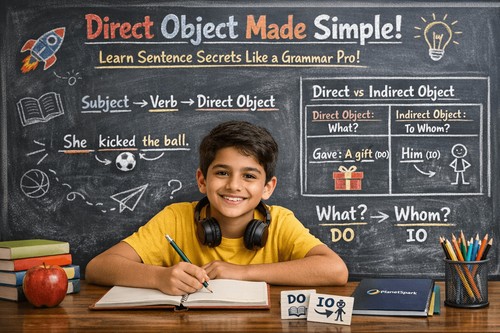

Direct Object Made Simple: Learn Sentence Secrets Like a Grammar Pro!
Ever wondered how sentences make sense
so easily? Let’s explore the Direct Object and discover how it helps you understand and build better sentences!
Have you ever said, “I ate
an apple” or “She kicked the ball”?
In both sentences, something is receiving the action. That “something” is called the Direct Object.
What is a Direct Object?
A Direct Object is the person, place, thing, or idea that receives the action of the verb in a sentence.
In simple words:
Subject → Verb → Direct Object
Let’s look at examples:
- I read a book.
- She drew a picture.
- They built a sandcastle.
In each sentence, the highlighted words are the Direct Objects because they receive the action.
How to Find a Direct Object Easily
Here’s a simple trick:
Ask the question: “What?” or “Whom?” after the verb
Example:
- She baked a cake.
- She baked what? → a cake (Direct Object)
- He called his friend.
- He called whom? → his friend (Direct Object)
💡 Fun Question:
Can you find the direct object in this sentence?
👉 “Riya wrote a letter.”
Why is the Direct Object Important?
Direct Objects make your sentences complete and meaningful.
Compare:
- She wrote. ❌ (Incomplete)
- She wrote a story. ✅ (Complete and clear)
Without a Direct Object, the sentence may feel unfinished.
Real-Life Example
Imagine you are playing cricket:
- “I hit…” sounds confusing, right?
- But “I hit the ball” makes perfect sense!
The Direct Object (the ball) tells us what the action is happening to.
Try This Yourself!
Look around your room and make 3 sentences using a Direct Object.
Example: “I opened the door.”
Ask a parent or teacher to check if you got them right!
Types of Direct Objects
Did you know Direct Objects can come in different forms? Let’s explore!
1. Noun as Direct Object
- She bought a toy.
- We watched a movie.
2. Pronoun as Direct Object
- He helped her.
- I saw them.
3. Phrase or Clause as Direct Object
- She enjoys reading books.
- I know that you tried your best.
Fun Fact:
Even a whole group of words can act as a Direct Object!What is the Difference Between Direct and Indirect Object?
Now comes an interesting part! Many students ask: what is the difference between direct and indirect object?
Let’s break it down simply.
Direct Object vs Indirect Object
| Feature | Direct Object | Indirect Object |
|---|---|---|
| Receives the action | Yes | No |
| Tells “what” or “whom” | Yes | No |
| Tells “to whom” or “for whom” | No | Yes |
Example:
- She gave him a gift.
“a gift” = Direct Object (what was given?)
“him” = Indirect Object (to whom?)
Another example:
- I sent my friend a message.
Fun Question:
Can you spot both objects here?
“She told her brother a story.”
Easy Trick to Remember
👉 Direct Object = What?
👉 Indirect Object = To whom / For whom?
Mini Scenario
Imagine your mom says:
- “I baked you a cake.”
👉 Cake = Direct Object (what was baked?)
👉 You = Indirect Object (for whom
Think About This
Next time someone gives you something, ask:
“What is the direct object here?”
Try this with your friends or family!
Common Mistakes Kids Make
Learning grammar can be tricky, but don’t worry! Let’s look at some common mistakes.
1. Confusing Subject with Direct Object
- Riya eats mango.
Riya = Subject
Mango = Direct Object
2. Missing the Direct Object
- He opened. ❌
- He opened the box. ✅
3. Mixing Up Direct and Indirect Object
- She gave a gift her friend. ❌
- She gave her friend a gift. ✅
Quick Practice Time!
Find the Direct Object:
- I cleaned my room.
- She painted a wall.
- They played football.
(Answers: my room, a wall, football)
Fun Ways to Practice Direct Objects
Learning can be fun if you turn it into a game!
Try These Activities:
- Story Time:
Read a story and underline Direct Objects. - Sentence Hunt:
Find Direct Objects in your school textbook. - Act It Out:
Act a sentence and let your friend guess the Direct Object!

Next time you watch a cartoon or read a book, pause and ask:
“What is the Direct Object in this sentence?”
You’ll be surprised how many you can find!
How PlanetSpark Can Help You Learn Grammar Better
Learning grammar like Direct Objects becomes easier when you practice with experts.
At PlanetSpark, students:
- Learn grammar through fun activities and real examples
- Practice speaking and writing confidently
- Get guidance from experienced teachers
Instead of memorizing rules, you actually use them in real life!
Conclusion: Become a Sentence Star!
Now you know:
- What is a Direct Object
- How to find it using simple questions
- What is the difference between direct and indirect object
- How to use it in real-life sentences
Direct Objects help your sentences become clear and complete.
Final Fun Thought:
Next time you speak or write, can you spot the Direct Object instantly?