
How English Words Have Beautifully Evolved Over Time
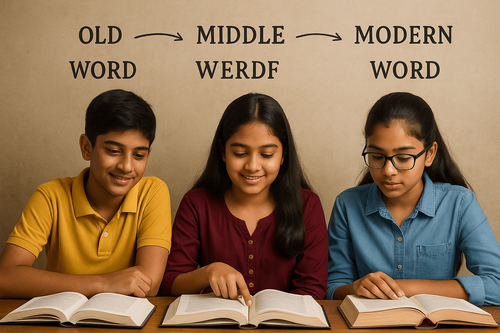

Table of Contents
- Origins of the English Language
- 2. Major Influences on English Word Evolution
- How Technology and Media Shaped Modern English
- Examples of Words That Changed Meaning Over Time
- The Role of Globalization and Pop Culture
- Linguistic Patterns in Word Evolution
- The Future of English Word Evolution
- Why English Keeps Evolving
- The Great Vowel Shift: A Turning Point in English Pronunciat
- The Role of Dictionaries in Preserving Word History
- How Migration and Cultural Exchange Shaped English
- The Digital Age: The Fastest Language Shift in History
- Why Choose PlanetSpark?
- Conclusion
Language is a living, breathing part of human culture and English is a perfect example of this evolution. Over the centuries, English has transformed from a mix of tribal dialects into the global language we know today. Every era, invasion, and innovation has left its mark, shaping how words sound, spell, and mean.
This article explores how English words have evolved over time, from their early roots to their modern, tech-driven forms, revealing how history, society, and technology continuously reshape the way we communicate.
Origins of the English Language
The English language didn’t appear overnight. It developed through centuries of blending different linguistic influences. Broadly, historians divide its evolution into three major stages, Old English, Middle English, and Modern English.
Old English (450–1100 AD): The Beginning
Old English originated from the Germanic tribes, Angles, Saxons, and Jutes, who settled in Britain. Their dialects mixed to form what we now call Anglo-Saxon or Old English. Many words we still use today come from this era: strong, water, earth, love, and house.
However, Old English was very different in sound and grammar. If you read “Beowulf,” one of the oldest English poems, you’d hardly recognize it as English.
During this period, Viking invasions also brought many Old Norse words into English like sky, egg, knife, husband, and window.
Middle English (1100–1500 AD): The French Influence
The Norman Conquest of 1066 was a turning point. French became the language of the ruling class, government, and law. As a result, English borrowed thousands of French words related to administration, art, fashion, and food such as court, judge, beauty, dinner, and language.
Grammar became simpler, and many Old English endings disappeared. The mix of Anglo-Saxon roots and French vocabulary gave rise to Middle English, the language used by Geoffrey Chaucer in The Canterbury Tales.

Modern English (1500–Present): The Global Form
The invention of the printing press by William Caxton in 1476 helped standardize spelling and grammar. During the Renaissance, English borrowed many Latin and Greek words in science, philosophy, and literature such as biology, education, memory, and culture.
Over time, Modern English absorbed influences from exploration, trade, colonization, and globalization, eventually becoming a global lingua franca.
2. Major Influences on English Word Evolution
English vocabulary didn’t just grow — it expanded dramatically, absorbing elements from every culture it touched.
a) Borrowing from Other Languages
English is famously described as a “thief” of words. It has borrowed from:
Latin and Greek (e.g., radius, democracy, philosophy)
French (e.g., justice, courage, beauty)
German (e.g., kindergarten, wanderlust, doppelgänger)
Indian languages (e.g., bungalow, shampoo, jungle, pajama)
Japanese (e.g., karaoke, tsunami, emoji)
Each borrowed word adds a layer of history, showing how languages evolve through contact and exchange.
b) Colonization and Trade
During the British Empire, English spread across continents. It borrowed local words to describe new environments, foods, and traditions.
For example:
From Hindi: loot, chutney, veranda
From Arabic: sugar, alcohol, coffee
From Spanish: mosquito, patio, canyon
This blending made English one of the richest vocabularies in the world.
c) Religion and Literature
The translation of the Bible into English by scholars like William Tyndale made complex Latin concepts accessible to common people. Literature, especially works by Shakespeare, added over 1,700 new words and phrases like lonely, gossip, majestic, and break the ice.
Discover how words shape the way we think, book a free demo class with PlanetSpark today!
How Technology and Media Shaped Modern English
The modern era brought rapid changes through science, technology, and digital communication.
a) New Words for New Inventions
As inventions appeared, English quickly adapted.
Examples include:
Telephone, television, computer, internet, email, and smartphone.
Modern slang like selfie, vlog, tweet, hashtag, and binge-watch.
Each innovation demands new vocabulary, showing English’s flexibility.
b) The Rise of Internet Slang
With social media came abbreviations and informal expressions. Words like LOL (laugh out loud), BRB (be right back), and OMG (oh my God) became part of everyday language.
Interestingly, many of these expressions now appear in dictionaries, proving that online slang shapes linguistic reality.
c) Memes and Pop Culture
Internet culture popularizes creative spellings and playful changes, like yeet, stan, or sus. These terms spread globally in days, demonstrating how digital spaces accelerate word evolution faster than ever before.
Examples of Words That Changed Meaning Over Time
Language doesn’t just add words; it reshapes meanings too. Some words today mean something entirely different from their original sense.
| Word | Original Meaning | Modern Meaning |
|---|---|---|
| Awful | Awe-inspiring, worthy of respect | Very bad, terrible |
| Nice | Foolish or ignorant | Pleasant, kind |
| Silly | Blessed or happy | Foolish or unserious |
| Meat | Any kind of food | Flesh of animals |
| Girl | Young person (any gender) | Female child |
| Wicked | Evil or sinful | Excellent or cool (slang) |
These shifts reflect cultural and emotional changes in how people interpret language. It shows that context defines meaning, and meanings evolve with society.
The Role of Globalization and Pop Culture
Globalization has turned English into a language of connection — adopted, adapted, and reshaped by cultures worldwide.
a) English Words Around the World
English has borrowed words like:
From Chinese: ketchup, typhoon, tea
From Swahili: safari, jumbo
From Arabic: algebra, zero, cotton
At the same time, English words have entered other languages, internet, weekend, club, selfie, and email are now globally understood.
b) Influence of Movies, Music, and Media
Hollywood movies, English songs, and global news media continuously spread new expressions. Phrases like “fake news,” “influencer,” and “binge-worthy” became mainstream through media exposure.
c) Hybrid Languages
English blends with local tongues to form hybrids:
Hinglish (Hindi + English)
Spanglish (Spanish + English)
Taglish (Tagalog + English)
These hybrid forms show how language adapts to reflect cultural identity and communication needs.
Build confidence, clarity, and creativity, book your free PlanetSpark demo class today!
Linguistic Patterns in Word Evolution
English evolution follows certain recognizable patterns:
a) Simplification
As people seek easier communication, complex grammar fades. For example, Old English had many verb endings; today, most are gone.
b) Shortening
Words become shorter: telephone → phone, advertisement → ad, refrigerator → fridge.
c) Blending and Compounding
New words form by merging old ones:
brunch (breakfast + lunch)
smog (smoke + fog)
motel (motor + hotel)
d) Conversion
Words shift grammatical categories:
Google (noun) → to google (verb).
Text (noun) → to text (verb).
e) Semantic Broadening and Narrowing
Holiday once meant “holy day” → now any day of leisure.
Meat once meant “food” → now only animal flesh.
These patterns show that word evolution follows human convenience and creativity.
The Future of English Word Evolution
The story of English isn’t over, it’s just entering a new chapter.
a) AI and Technology’s Role
With tools like ChatGPT and AI translation, new tech terms emerge daily — prompt, chatbot, neural net, token, and automation. Technology not only invents words but also changes how we create and spread them.
b) Social Media Acceleration
Platforms like X (Twitter), TikTok, and Reddit rapidly spread slang. New words or phrases can gain global popularity overnight, making dictionaries scramble to keep up.
c) Global Blending
In the coming decades, hybrid English varieties (like Hinglish) may become recognized dialects. The future may include more localized English forms — Indian English, Nigerian English, or Singaporean English — each with unique vocabulary and expressions.
d) Sustainability of Traditional Words
While modern slang evolves, older words also adapt or survive through literature and formal writing. This coexistence keeps English both dynamic and deeply rooted.
Why English Keeps Evolving
Language evolves for three main reasons:
Cultural Change – As societies change, their language follows.
Innovation – New ideas and technologies need new words.
Global Interaction – Constant contact with other languages reshapes vocabulary and expression.
In short, English evolves because humans evolve our needs, emotions, and creativity never stand still.
The Great Vowel Shift: A Turning Point in English Pronunciation
Between the 14th and 18th centuries, the Great Vowel Shift dramatically changed how English words were pronounced. During this period, the long vowel sounds of Middle English began moving closer to the sounds we use today. For instance, “bite” used to sound like “beet”, and “meet” sounded more like “mate.”
This shift didn’t just affect pronunciation — it also explains why English spelling and pronunciation often don’t match. Words were already printed before the shift finished, locking old spellings into place. As a result, words like knight, through, and though still reflect older pronunciations.
The Great Vowel Shift marked the beginning of Modern English pronunciation, bridging the gap between Chaucer’s Middle English and Shakespeare’s recognizable tone. It’s one of the most significant phonetic evolutions in the history of the English language.
The Role of Dictionaries in Preserving Word History
Dictionaries have played a major role in documenting the evolution of English words. Before standardized spelling existed, words were written in many different ways even Shakespeare spelled his own name differently!
When Samuel Johnson published A Dictionary of the English Language in 1755, it became the first major effort to organize and define English systematically. Later, the Oxford English Dictionary (OED) went even further by recording the history, meaning, and earliest use of every English word.
These dictionaries didn’t just preserve existing words they legitimized new ones and showed how meanings evolved over time. Today, digital dictionaries continue that work, updating constantly to include new slang, tech terms, and global variations. They act as living records, capturing English’s ongoing transformation.
Don’t just learn English, understand it! Enroll in PlanetSpark’s live sessions and boost your communication skills.
How Migration and Cultural Exchange Shaped English
Migration has always influenced English vocabulary. Every wave of migration, whether by conquest, colonization, or globalization — brought new words, accents, and expressions.
When the Normans invaded, English absorbed French terms. When British explorers and traders reached Asia, Africa, and the Americas, English gained local words describing new foods, animals, and traditions. In return, English spread worldwide, influencing other languages as well.
Modern migration continues this trend. In multicultural societies like the U.S., U.K., and Canada, people mix English with their native tongues, giving rise to diverse slang and dialects. Words like emoji (Japanese), ballet (French), and bungalow (Hindi) remind us how cultural exchange keeps English evolving making it one of the most adaptable languages ever spoken.
The Digital Age: The Fastest Language Shift in History
No period has changed English faster than the digital age. The internet, smartphones, and social media have made communication instant — and language evolution just as rapid.
New expressions, emojis, and abbreviations emerge daily. Words like selfie, viral, unfriend, meme, and DM didn’t exist two decades ago but are now part of global English. Social platforms have also blurred the line between formal and informal writing, introducing a conversational tone even in professional settings.
Artificial intelligence and predictive text are now shaping how we write and think. From hashtags to hybrid forms of communication (mixing visuals, text, and symbols), digital English reflects how technology mirrors human creativity.
The digital era shows that language evolution never stops, it simply adapts to the tools and cultures that define each generation.
Why Choose PlanetSpark?
At PlanetSpark, we believe that understanding how language evolves is key to mastering it. English isn’t just about grammar rules — it’s about expression, creativity, and confidence. By exploring how words have changed over time, students learn to use language with greater awareness and originality.
- Personalized Learning for Every Student: PlanetSpark’s courses are designed to suit every learner’s pace. Whether your child wants to improve spoken English, storytelling, or writing skills, our mentors use engaging techniques to make learning interactive and fun.
- Building Strong Communication Foundations: Through live sessions, interactive activities, and creative writing exercises, students don’t just learn vocabulary — they understand how and why words matter. This helps them express ideas clearly, confidently, and with emotion.
- Empowering the Communicators of Tomorrow: From public speaking to creative storytelling, PlanetSpark prepares young learners to communicate effectively in an evolving world — where language is constantly transforming.

Conclusion
The evolution of English words over time is not just a linguistic story it’s a human story. From tribal roots to digital slang, every word reflects our shared history, innovation, and imagination.
Old English gave us structure, Middle English gave us diversity, and Modern English gave us global reach. Today, technology and culture continue shaping its future ensuring English remains one of the most flexible and expressive languages in the world.
Language change isn’t decay it’s growth. Every new word or meaning enriches our ability to connect, express, and understand one another in an ever-changing world.
Frequently Asked Questions
Because society, culture, and communication constantly change. New inventions, global interactions, and creativity introduce new meanings and terms.
Old English (450–1100), Middle English (1100–1500), and Modern English (1500–present).
Technology introduces new words like emoji, cloud, AI, and streaming and speeds up how quickly slang spreads worldwide.
Yes. Dictionaries add hundreds of new words annually, reflecting social trends, tech, and pop culture.
Words like I, we, two, and three are among the oldest, dating back to Old English and Proto-Indo-European roots.
Globalization spreads English globally while allowing local influences to shape it, creating hybrid forms like Hinglish or Spanglish.