
Executive Summary Writing: 10 Tips for Professionals


Table of Contents
- Why Executive Summary Writing Matters in the Workplace
- Writing for the "Busy Reader": The Foundation of Clarity
- Understanding BLUF (Bottom Line Up Front) Communication
- How Do You Write an Executive Summary: Step-by-Step Process
- Distilling Complex Data for CEOs Effectively
- How to Write an Executive Summary for a Business Plan
- 10 Expert Tips for Executive Summary Writing
- Common Mistakes to Avoid
- Master Communication with PlanetSpark Creative Writing Progr
- Conclusion: Turn Ideas into Impactful Communication
What if your best ideas are being ignored simply because they are not presented clearly?
Many professionals struggle to communicate insights effectively to senior leaders. Long reports often go unread, and critical decisions get delayed. This is where executive summary writing becomes essential. It helps you present key information in a clear, concise, and actionable way.
In this blog, you will learn how to write powerful executive summaries using proven techniques like writing for the busy reader and BLUF communication. We will also explore step-by-step methods, real-world examples, and business applications.
Let us begin by understanding why this skill can transform your professional communication.
Why Executive Summary Writing Matters in the Workplace
Executive summary writing is one of the most valuable professional skills today. It enables you to translate complex ideas into clear, decision-ready insights that senior leaders can act on quickly.
In most organizations, leaders operate under constant time pressure. They do not have the bandwidth to go through lengthy reports or detailed analyses. Instead, they depend on concise summaries to understand key issues, evaluate options, and make informed decisions.

A strong executive summary helps you:
- Save time for decision-makers: Leaders can grasp the key message within minutes instead of spending hours reading full reports.
- Highlight key insights instantly: It brings the most important findings to the forefront, ensuring nothing critical is overlooked.
- Improve clarity and communication: It forces you to simplify complex ideas, making your communication more effective.
- Increase your influence at work: Clear communicators are trusted more and often have a stronger impact on decisions.
- Support faster decision-making: When information is structured and clear, leaders can act quickly and confidently.
An executive summary is typically 1 to 2 pages long and works as a standalone document. It should clearly explain the purpose, problem, solution, and next steps without requiring the reader to refer to the full report.
For example, instead of presenting a 25-page report, you provide:
- The problem statement
- Key findings
- Recommended solution
- Expected ROI
This structured and focused approach builds trust and credibility.
Professionals who master executive summary writing are often seen as strategic thinkers. They are valued not just for their ideas, but for their ability to communicate those ideas clearly and effectively.
Struggling to make your reports impactful? Book a free trial class today and learn how to communicate like top professionals before opportunities pass you by.
Writing for the "Busy Reader": The Foundation of Clarity
One of the most critical aspects of executive summary writing is writing for the "busy reader."
Your audience is not reading for depth. They are scanning for relevance, clarity, and action.
Key Principles
- Focus on what matters most:Prioritize key insights over background information. Ask yourself what the reader absolutely needs to know.
- Eliminate unnecessary details: Avoid over-explaining. Extra details dilute the core message and reduce impact.
- Use clear and simple language: Replace technical jargon with straightforward language that is easy to understand.
Structure for Easy Reading
Formatting plays a major role in readability. Use:
- Short paragraphs to avoid overwhelming the reader
- Bullet points to highlight key ideas
- Clear headings to guide navigation
Answer Key Questions Quickly
Your executive summary should immediately answer:
- What is the issue?
- Why does it matter?
- What action is required?
For example:
Weak version:
"This document provides an analysis of recent performance trends."
Strong version:
"Revenue dropped by 12% last quarter, requiring immediate cost optimization."
The second version is specific, actionable, and easy to understand.
Writing for the busy reader ensures your message is absorbed quickly and effectively, increasing the chances of action.
Understanding BLUF (Bottom Line Up Front) Communication
BLUF communication is a powerful technique used in executive summary writing. It stands for Bottom Line Up Front, which means presenting the conclusion at the beginning.
Instead of building up to your main point, you deliver it immediately.
Why BLUF Works
- Leaders want clarity immediately: They prefer knowing the outcome before diving into details.
- It reduces reading time: The reader gets the message within seconds.
- It improves decision-making speed: Clear conclusions help leaders act faster.
Example
Without BLUF:
"This report examines customer feedback trends over the last year."
With BLUF:
"Customer dissatisfaction has increased by 20%, requiring urgent improvements in service quality."
The second version immediately communicates urgency and direction.
How to Apply BLUF
- Start with the main conclusion or recommendation
- Follow with supporting data or reasoning
- Keep explanations concise and relevant
BLUF communication ensures that your message is not missed or misunderstood. It aligns perfectly with how leaders consume information.
Want to master powerful frameworks like BLUF? Book your demo session now and gain the skills professionals use to stand out instantly. Limited slots available.
How Do You Write an Executive Summary: Step-by-Step Process
If you are wondering how you write an executive summary, following a structured process can make it much easier and more effective.
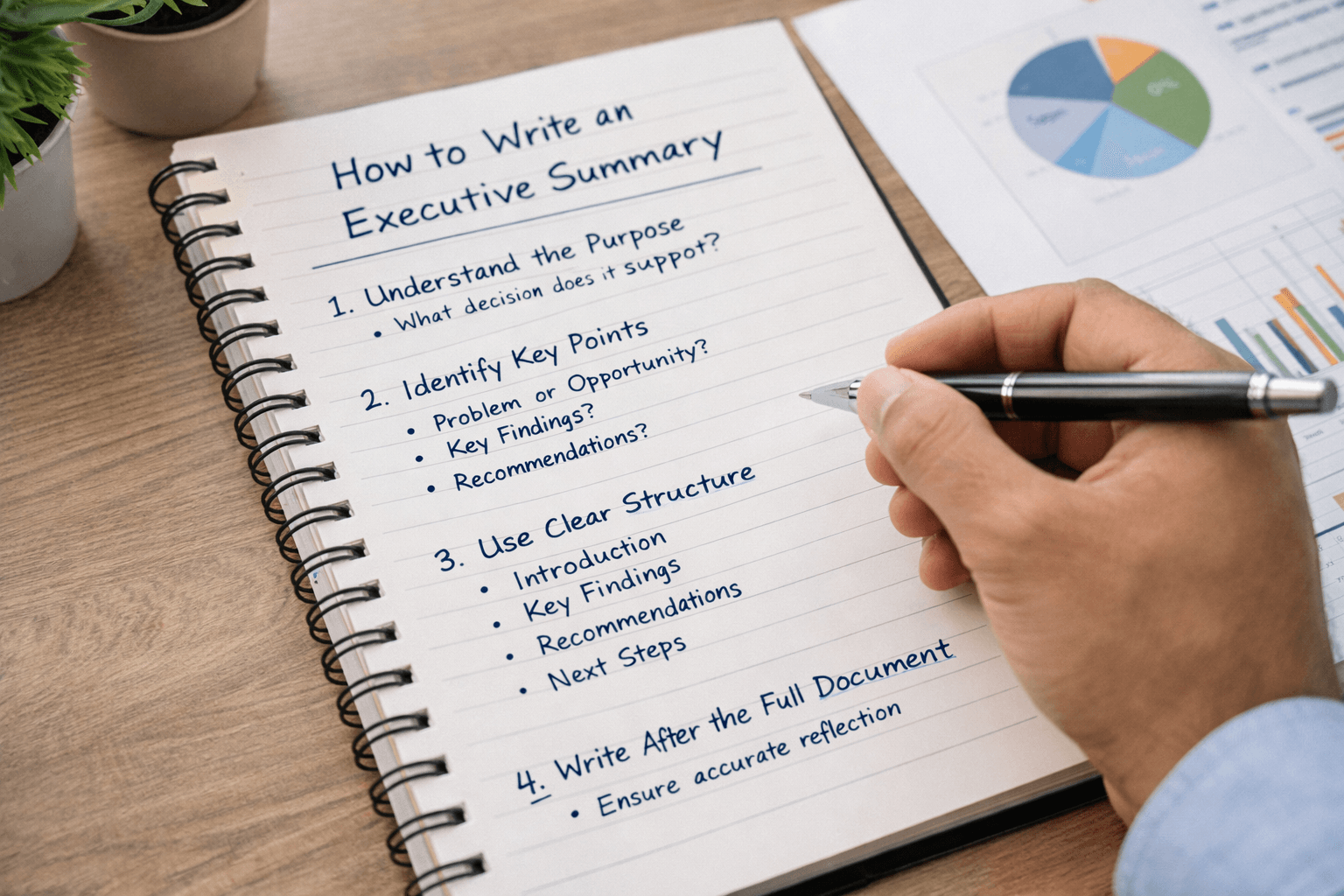
Step 1: Understand the Purpose
Before writing, clearly define why the document exists. Is it to inform, persuade, or recommend action? Understanding the purpose helps you stay focused and relevant.
Step 2: Identify Key Points
Extract the most important elements from the document:
- Problem or opportunity
- Key findings or insights
- Recommendations or actions
This step ensures you focus only on what truly matters.
Step 3: Write the Summary Last
Always write the executive summary after completing the main document. This ensures that your summary accurately reflects the final content, findings, and recommendations.
Step 4: Use a Clear Structure
A logical structure improves readability and flow:
- Introduction that sets context
- Key findings that present insights
- Recommendations that suggest actions
- Next steps that guide implementation
Step 5: Keep It Concise
An executive summary should typically be 5 to 10 percent of the original document. Remove unnecessary words and focus on clarity.
Step 6: Ensure Standalone Clarity
Your summary should make complete sense on its own. The reader should not need to refer to the full document to understand the message.
Step 7: Review and Refine
Editing is critical. Simplify sentences, remove jargon, and ensure the message is clear. You can also ask someone unfamiliar with the topic to review it for clarity.
A well-written executive summary delivers maximum impact in minimal time.
Distilling Complex Data for CEOs Effectively
One of the biggest challenges in executive summary writing is distilling complex data for CEOs.
Leaders do not need detailed data sets. They need meaningful insights that guide decisions.
Convert Data into Meaning
Numbers alone are not enough. You need to explain what they imply.
Instead of:
"Sales increased by 18%"
Write:
"Sales increased by 18%, indicating strong market demand and expansion potential."
This adds context and relevance.
Highlight Key Insights
Focus on the most important takeaways:
- Trends that show direction
- Risks that need attention
- Opportunities that can be leveraged
Use Comparisons
Comparisons make data easier to understand:
- Year-over-year performance
- Industry benchmarks
- Previous results
These provide perspective and clarity.
Keep It Focused
Avoid overwhelming the reader with too much information. Select only the most relevant data points that support your message.
The goal is not to present all data. The goal is to present the right data.
How to Write an Executive Summary for a Business Plan
Executive summaries are crucial in business plans because they often determine whether investors continue reading.
Key Components
- Business overview that explains what you do
- Problem and solution that show relevance
- Market opportunity that highlights potential
- Financial highlights that demonstrate viability
- Growth strategy that outlines future plans
Example Structure
- Introduction that sets the context
- Problem and solution that explain value
- Market potential that shows opportunity
- Financial summary that builds confidence
- Call to action that encourages next steps
Best Practices
- Keep it concise and focused
- Highlight ROI and business value
- Use simple and clear language
A compelling executive summary creates interest, builds trust, and encourages stakeholders to explore further.
Need expert guidance to write impactful business documents? Book a trial class today and start building professional communication skills before your next big opportunity.
10 Expert Tips for Executive Summary Writing
Here are proven tips explained in detail:
1. Write It Last
Writing the summary at the end ensures it reflects the final content accurately. It helps you capture the most important insights without missing key points.
2. Focus on the Audience
Always consider what your reader cares about. Decision-makers are interested in ROI, risks, and outcomes. Tailor your content accordingly.
3. Define the Problem Immediately
Start with the core issue or opportunity. This grabs attention and sets the context right away.
4. Use Specific Data
Concrete numbers and evidence make your summary more credible and persuasive.
5. Keep It Concise
Avoid unnecessary words. Every sentence should add value.
6. Use a Logical Structure
A clear structure makes your summary easy to follow and understand.
7. Highlight Recommendations
Clearly state what actions should be taken. This ensures your summary drives decisions.
8. Use Actionable Formatting
Formatting improves readability. Use bullet points, headings, and spacing effectively.
9. Ensure Standalone Clarity
Your summary should work independently. The reader should understand everything without additional context.
10. Review and Refine
Editing improves clarity. Always revise your summary to remove errors and simplify language.
Check out some of our summary templates shared by our experts.

Common Mistakes to Avoid
Even skilled professionals can make mistakes in executive summary writing. Being aware of these errors helps you avoid them.
1. Writing Too Much Detail
Including excessive information can overwhelm the reader and reduce clarity. Focus only on key insights.
2. Hiding the Main Point
If the main message is buried in the middle or end, the reader may miss it. Always lead with the key idea.
3. Using Complex Language
Overly technical or complicated language makes your summary harder to understand. Keep it simple and clear.
4. Ignoring the Audience
Failing to consider the reader’s needs can make your summary irrelevant. Always tailor your content to decision-makers.
Clarity, simplicity, and relevance are the foundations of effective executive summary writing.
Master Communication with PlanetSpark Creative Writing Programs
PlanetSpark creative writing classes are designed to help learners build clarity, structure, and confidence in communication. Whether you are a student or a professional, structured guidance can transform how you express ideas.
These programs focus on real-world communication skills, helping learners move from basic writing to impactful expression.
What Makes PlanetSpark Unique?
- 1:1 Personal Trainers for Every Learner: Personalized sessions tailored to individual learning styles
- Custom Learning Roadmap: Targets grammar, vocabulary, and communication gaps
- SparkX AI Video Analysis Tool: Tracks voice, confidence, and delivery
- AI-Led Practice Sessions: Enables independent, guided practice
- Spark Diary for Daily Writing: Builds consistency and creativity
- Gamified Learning Modules: Makes learning interactive and engaging
- Real Publishing Opportunities: Showcase writing on blogs and digital platforms
- Structured Feedback and Revision: Focus on improvement through guided editing
Structured learning ensures consistent growth, confidence, and clarity in communication.

Conclusion: Turn Ideas into Impactful Communication
Executive summary writing is a skill that defines how your ideas are received. When you communicate clearly, you build trust, influence decisions, and grow professionally.
Practice regularly and focus on clarity, structure, and relevance. Over time, you will develop the ability to turn complex information into simple, powerful insights.
Strong communication is not just helpful. It is essential for long-term success and confidence in any professional journey.
Frequently Asked Questions
Executive summary writing is the process of presenting key insights from a document in a concise format for decision-makers.
Focus on clarity, use BLUF communication, include key insights, and keep it concise.
BLUF stands for Bottom Line Up Front, where the main point is presented at the beginning.
It ensures that decision-makers understand key information quickly.
Focus on insights, trends, and actionable recommendations rather than raw data.
Include business overview, market opportunity, financials, and growth strategy.
Purpose, problem, solution, data, and next steps.
Personalized Communication Roadmaps
Record a video to get a AI generated personalized communication reports