
Expository Writing: Guide, Examples, and Tips for Students


Table of Contents
- What is Expository Writing
- Types of Expository Writing Every Student Should Know
- Expository Writing Style: A Complete Step-by-Step Writing Gu
- Best Expository Writing Examples to Understand the Format Ea
- Why Learning Expository Writing Matters
- Quick Tools & Tips for Students
- Expository Writing Topics for Students
- How PlanetSpark Helps Students Master Expository Writing
- Final Thoughts: Mastering the Art of Clear Expression
Well, imagine being able to deconstruct any concept and describe it in a way that everyone can understand. That is the strength of expository writing. It simply means explaining ideas clearly using facts, logic, and examples without personal opinions or emotions. Here, you will find its detailed meaning, types, examples, and tips. Once you get all the information about this style of writing, you can approach professionals at PlanetSpark and get assistance for writing the creative work.
What is Expository Writing
Expository writing is about turning on a bright lamp in a dark room, now all the ideas are clear and easy to see. Expository writing meaning can be explained as a presentation of facts, the breakdown of information, and step-by-step guidance of the reader without opinions or emotions. You can see it in school textbooks, articles, reports, and how-to manuals. Its aim is easy: to educate, explain, and make readers know something new rationally, with examples and systematic explanation.
Types of Expository Writing Every Student Should Know
Similar to the way that different tools assist you in constructing different things, in the same way, various types of expository writing assist you in explaining information. All forms serve a certain purpose, be it comparing ideas, defining a concept, or guiding readers through a process. The following are the most used and most common types that students learn and put into use in school and real-life communication:
- Definition Writing: Defines a term or idea in detail.
- Compare and Contrast: Points out the similarities and differences between two topics.
- Cause and Effect: Displays the relationship between an event that causes another.
- Process or "How-To" Writing: Provides step-by-step instructions on how to do something.
- Writing of Classification: Arranges ideas or objects in a system of classification.
- Problem and Solution: Gives a problem and how it can be solved logically.
These styles assist the students in conveying facts, reasoning, and making ideas structured, which are useful in schoolwork, competitive exams, presentations, and their careers. If you are further interested in learning Narrative Writing Style, just click the given link.
Expository Writing Style: A Complete Step-by-Step Writing Guide
This is a step-by-step guide that helps students write a clear, factual expository paper, selecting a topic to write the final draft.
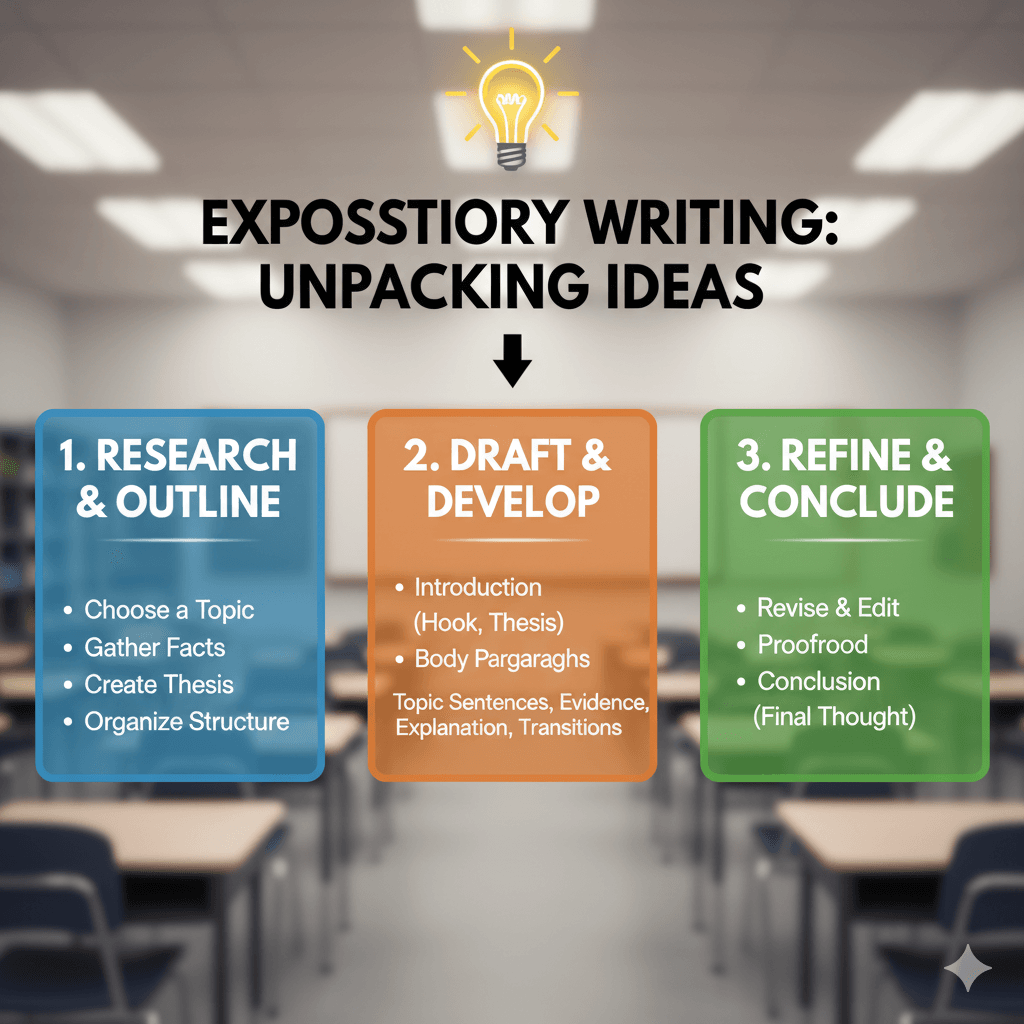
- Know your purpose and audience: Choose what you want to communicate and to whom. Do you teach classmates (work with simple language) or write to older students (more detailed)? Audience knowledge helps in determining tone, vocabulary, and richness.
- Choose a focused topic: Choose a small-focused topic that you can exhaust within the word limit. When you write on vague topics, you get scattered paragraphs, whereas when you write on focused topics, you can explain easily (e.g., how photosynthesis works vs. Plants).
- Study and gather good facts: Find credible sources: textbooks, educational websites, and academic articles. Make notes, list facts, and store references. Opinions are to be avoided, expository writing is based on facts that can be proved.
- Develop a clear thesis statement: Write a brief sentence that informs the reader what the key idea will be discussed. The thesis helps direct your paragraphs and keeps your writing on course.
- Make a logical outline: Arrange your facts in a logical order:
- Introduction (hook + thesis)
- Body paragraph 1 (main point + evidence + example)
- Body paragraph 2 (main point + evidence + example)
- Body paragraph 3 (main point + evidence + example)
- Conclusion (summary + final thought)
- Write clear body paragraphs: Begin every paragraph with a topic sentence. Continue with facts, definitions, statistics, or brief examples. Transition words (first, next, similarly, as a result) help the reader to go through the ideas seamlessly.
- Write a captivating introduction and a brief conclusion:
- Introduction: Grab the attention of your reader (a fact, a question, or a brief situation), and state your thesis.
- Conclusion: Paraphrase the thesis in your own words, summarize the key arguments, and leave the reader with a certain conclusion (there is nothing new here).
- Edit, proofread, and refine: Look at its clarity, logical sequence, grammar, and proper references. Eliminate repetition, shorten long sentences, and verify all facts. Read out loud to pick up clumsy phrases.
Writing is fun and easy!
Through stories, models, and guided practice, PlanetSpark turns children into confident writers.
Best Expository Writing Examples to Understand the Format Easily
It is easier to understand how expository writing works by looking at actual examples. The following are simple, easy-to-understand examples that are in the right format that will help you learn how to present ideas using facts, clarity, and logic. Here, you can also read an Essay on Time Management for more knowledge.
Example 1: Why Reading Every Day Helps Students Grow
Introduction
Did you ever question yourself why teachers always insist on reading every day? Reading is not merely turning pages, it is a way of strengthening your mind, making great learning habits. Reading aloud each day assists students in enhancing vocabulary, creativity, and thinking abilities.
Body Paragraph 1: Vocabulary Development
A key advantage of reading every day is that it develops a better vocabulary. By regularly reading, students encounter new words in new contexts, and they grasp the meaning intuitively. An example is that reading science books exposes the academic words, and storybooks teach expressive language. Communication also becomes better as vocabulary expands.
Body Paragraph 2: Imagination and Creativity
Imagination is also evoked by reading. Stories take the reader to a different world, culture, and experience that they might not be able to visit in real life. As children visualise scenes and characters, their ability to think creatively is reinforced. This creativity eventually assists in writing, problem-solving solving as well as decision-making in real life.
Body Paragraph 3: Thinking and Concentration Skills
Finally, reading enhances attention and critical thinking. Reading also needs focus, in contrast to the fast scrolling on screens. It trains the brain to use ideas carefully and to make out deeper meanings. Research indicates that those students who read achieve higher grades in school since they learn to think critically and can remain in a state of concentration.
Conclusion
Concisely, reading every day enhances vocabulary, encourages imagination, and enhances thinking capacity. It makes students ready to succeed in academics and lifelong learning. Reading as part of a daily routine, even as little as 15 minutes a day, can be a major difference maker in the future of a student.
Example 2: Why Independence Day Matters in History
Introduction
Each country has its own day of independence and national identity. In the case of India, it is 15th August, Independence Day. The significance of Independence Day is that it celebrates the sacrifice of the freedom fighters, the birth of our nation, and it reminds people of their responsibilities to the advancement.
Body Paragraph 1: Paying Tribute to Freedom Fighters
Independence Day celebrates the leaders and citizens who struggled heroically against colonialism. There was Mahatma Gandhi, Subhas Chandra Bose, Bhagat Singh, Rani Lakshmi Bai, and many more who sacrificed their lives to achieve freedom. Students are reminded of their daring character, which makes them appreciate justice, equality, and unity.
Body Paragraph 2: Birth of a Free Nation
It is a day when India became an independent democratic country, and it was no longer under British rule in 1947. It is a representation of what our Constitution, rights, and national identity began. Whether it is singing the national anthem or raising the flag, the celebrations remind all Indians of how the struggle was transformed into a human right.
Body paragraph 3: Duty to the Nation
Independence Day also makes citizens, particularly students, aware of their contribution to the future of the nation. India can be made stronger through hard work, honesty and education. When the children become responsible adults, they would help in areas such as science, defence, and technology, which would guarantee further development.
Conclusion
Summing up, Independence Day is a great day as it celebrates the heroism of the courageous soldiers, the birth of free India, and the invitation to the citizens to invest in the development of the country. And by celebrating this day, history lives on, and we pledge to a brighter future.
Assist Your Child in Articulating Ideas Effectively!
Transform common ideas into powerful, confident writing with playful, warm, and engaging lessons from PlanetSpark.
Why Learning Expository Writing Matters
Expository writing is important since students need to know how to explain ideas, organize their thoughts, and be able to communicate facts through writing. This skill enhances academic achievement, improves critical thinking, and readies students to write essays, reports, and presentations. Through learning how to write expositions, the students become confident about their ability to correctly convey information and learn to be good communicators, not just in school, but also in the real world and their professional lives.
Quick Tools & Tips for Students
Expository writing can appear difficult to start, so dividing it into easy steps is a way of making it easy and manageable for students.
- Select a simple subject you desire to describe.
- Gather information using reliable sources such as books or school websites.
- Prepare a basic outline - introduction, 2-3 body points, conclusion.
- Begin with a clear central point (thesis statement).
- Give examples or facts that support each point, not opinions.
- Use clear language and make sentences simple.
- Add some words such as first, next, also, and finally to tie up ideas.
- Revise and proofread your writing to fix errors and make it clear.
- Use small subjects to practice.
Transform Little Writers into Big Thinkers!
PlanetSpark teaches children to write with clarity, coherence, and eloquence.
Expository Writing Topics for Students
Expository writing is simpler and more engaging to write about when you select the correct subject. The following is a list of 15 topics that are interesting and that require the students to practice clear and logical explanations of ideas.
- The importance of reading books daily
- How to stay healthy as a student
- Benefits of exercise for young people
- How recycling helps the environment
- Steps to grow a small plant
- The life cycle of a butterfly
- Why students should manage their time
- Effects of pollution on the planet
- How the internet works
- Importance of teamwork in school projects
- Causes and effects of deforestation
- How to prepare for exams effectively
- The benefits of learning a second language
- How to keep your room organized
- Why is honesty important in daily life
How PlanetSpark Helps Students Master Expository Writing
With PlanetSpark, children learn to explain ideas clearly, organise thoughts, and write confidently through interactive lessons, creative tools, AI-based feedback, and live expert guidance—making writing fun, structured, and meaningful.
What Makes PlanetSpark Perfect for Creative Expression
- 1:1 live classes with expert writing coaches
- Genre-based curriculum (essays, reports, stories, speeches, poems)
- Step-by-step frameworks for clarity & structure (PEEL, 5W1H, STORY arc)
- SparkX AI feedback for voice, clarity, and fluency
- SparkDiary journaling to build daily writing habits
- Creative prompts, story dice, and imagination tools
- Gamified learning for vocabulary, grammar & fluency
- Digital clubs: Debate Club, Writers Guild, Podcasting, Poetry Circle
- Safe sharing space (SparkLine) for posting written work & speeches
- Regular PTMs and progress reports for visible growth
- AI-led speaking & writing practice beyond live classes
Final Thoughts: Mastering the Art of Clear Expression
Expository writing helps students learn to be able to explain ideas with clarity, apply facts well, and make their thoughts logical. With regular practice, engaging topics, and a systematic method, students can build their writing abilities and their communication skills effectively and be ready to succeed in their academic results and express themselves with confidence in their daily lives.
Frequently Asked Questions
Expository writing is a format that describes or informs with facts and examples. The reason is that it assists students in expressing ideas effectively, organizing thoughts, and learning to think critically.
Its major categories are descriptive writing, process (how-to) writing, compare and contrast writing, cause and effect writing, problem and solution writing, and classification writing. All the types assist in delivering information in an organized, logical manner.
The student can work upon it by practicing frequently, selecting clear subjects, gathering valid facts, making outlines, using simple words, and proofreading the draft to make it clear and well-organized.
Yes! PlanetSpark provides 1:1 live classes and has expert trainers who can teach students about writing strategies, well-controlled practice, and feedback, enabling them to develop assured writing and communication abilities.
Expository Writing examples are: why reading is important, recycling, the causes and consequences of pollution, exercise benefits, how to grow a plant, or historical events such as Independence Day.
PlanetSpark is a mix of live interactive classes, on-the-job examples, entertaining worksheets, and writing activities that appeal to students and make the process of learning basic writing entertaining and enhance their academic and communication skills.