
Try Funny Story Writing Prompts for Creative Fun


Table of Contents
- Why Funny Story Writing Prompts Make Writing Easy and Fun
- 40 Funny Story Writing Prompts for Kids
- How to Turn Funny Prompts into Amazing Stories
- Creative Writing Games for Classroom Engagement
- Humorous Storytelling Prompts That Boost Creativity
- Fun Writing Challenges for Kids to Build Daily Habits
- Tips for Parents to Encourage Creative Writing
- Build Creative Excellence with PlanetSpark Creative Writing
- Keep Creating, Keep Smiling
Ever wished your homework could talk back or your pet could tell jokes? Many kids find it hard to start writing because they are unsure what to write or how to make it interesting. That is where funny story writing prompts come in. They turn writing into a fun and imaginative activity instead of a boring task.
In this blog, you will discover silly story ideas for children, humorous storytelling prompts, creative writing games for classroom use, and fun writing challenges for kids. You will also learn simple ways to turn these ideas into engaging stories. By the end, you will feel more confident, creative, and excited to start writing your own funny stories.
Why Funny Story Writing Prompts Make Writing Easy and Fun
Writing can feel boring or even stressful when kids are asked to come up with ideas on their own. Many children sit with a blank page and do not know how to begin. But when humor is added, everything changes. Funny story writing prompts remove that pressure and turn writing into something playful and exciting. Instead of thinking too hard, kids start imagining fun and silly situations naturally.
When children laugh while writing, their creativity improves without effort. Humor helps them relax, and a relaxed mind is more open to ideas. They begin to explore unusual thoughts, create interesting characters, and build stories that are unique and enjoyable. Instead of worrying about spelling or grammar, they focus on expressing their ideas freely.
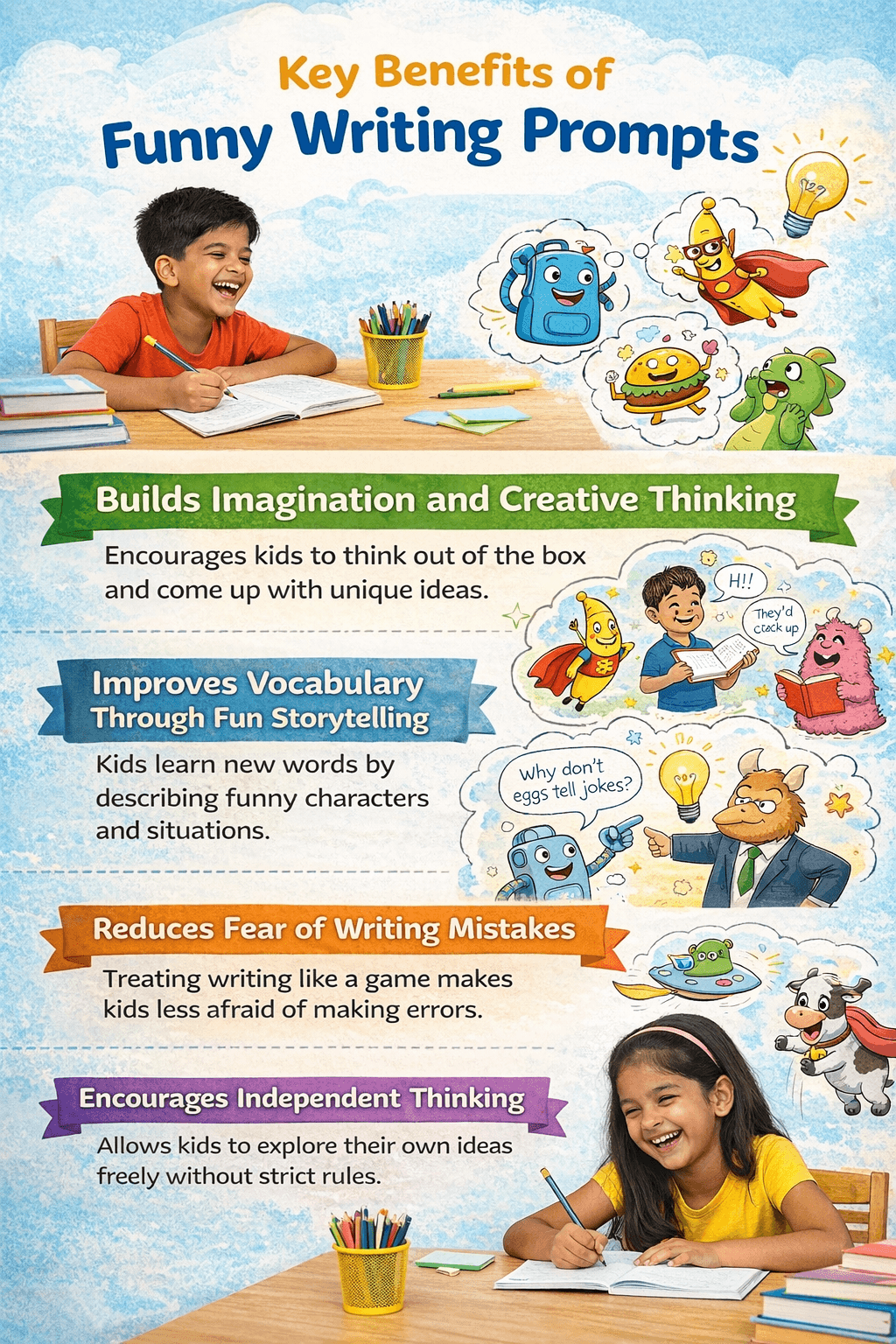
Key Benefits of Funny Writing Prompts
- Builds imagination and creative thinking: Funny prompts encourage kids to think beyond normal situations. For example, imagining a talking animal or a flying pizza helps them stretch their creativity and come up with original ideas.
- Improves vocabulary through fun storytelling: While writing funny stories, kids naturally use new words to describe actions, emotions, and situations. This helps them learn vocabulary in a fun and meaningful way.
- Reduces fear of writing mistakes: When writing feels like a game, children are less afraid of making errors. They focus on storytelling rather than perfection, which builds confidence over time.
- Encouraging independent thinking: Funny prompts allow kids to explore their own ideas. There is no single correct answer, so they feel free to experiment and express themselves.
- Makes learning enjoyable: When kids enjoy writing, they are more likely to practice regularly. This consistency leads to better skills and stronger communication abilities.
For example, a prompt like “Your school principal turns into a chicken for a day” instantly creates curiosity. Kids begin to imagine how the principal behaves, how students react, and what funny situations might happen in school. This kind of thinking helps them build a complete story step by step.
Humor also improves memory. When a story is funny, children remember it better. This helps them recall words, sentence structures, and ideas more easily. Over time, this strengthens both writing and speaking skills.
Parents and teachers can make the most of these prompts by using them regularly. Even 10 to 15 minutes of fun writing practice each day can lead to noticeable improvement. The key is to keep the activity light, enjoyable, and pressure-free so that kids look forward to writing every day.
Struggling to get your child excited about writing?
Book a FREE PlanetSpark trial class and unlock fun learning today. Limited slots available.
40 Funny Story Writing Prompts for Kids
Here are some engaging funny story writing prompts designed to spark creativity instantly. These prompts are more than just ideas. They help children imagine situations, build characters, and create stories step by step. Encourage kids to pick a prompt and ask simple questions like “What happens next?” or “Why did this happen?” to expand their story in a fun way.
Silly Story Ideas for Children
These prompts are perfect for younger kids who enjoy playful and imaginative thinking. They include funny characters and unusual situations that make writing exciting.
- A dinosaur who is scared of butterflies
- A banana that wants to become a superhero
- A talking backpack that complains about homework
- A pencil that refuses to write exams
- A robot that is afraid of electricity
How to expand these ideas: Children can think about the character’s feelings and actions. For example, why is the dinosaur afraid? Does the banana have a costume? What happens when the backpack refuses to carry books? Adding small details like emotions, conversations, and actions helps turn a simple idea into a complete story.
Everyday Situations with a Twist
These prompts take normal daily situations and add a funny or unexpected twist. This helps kids connect real life with imagination.
- Your shoes start running faster than you
- Your lunch box starts judging your food choices
- A teacher forgets how to teach
- Your bed refuses to let you wake up
- A school where students give homework to teachers
How to expand these ideas: Ask kids to imagine how people react in these situations. What would happen if your shoes ran away during a race? How would students behave if teachers forgot everything? These prompts help children think creatively while staying connected to familiar settings.
Absurd and Wacky Prompts
These ideas are completely unrealistic and encourage kids to think beyond logic. They are great for boosting imagination and creating funny, surprising stories.
- A ghost who is scared of humans
- A fish learning to fly
- A lion who wants to be a dancer
- A monster who loves cleaning rooms
- A flying cow that delivers pizza
How to expand these ideas: Kids can focus on the “why” and “how” of the story. Why is the ghost scared? How does the fish learn to fly? What challenges does the dancing lion face? Exploring these questions makes the story more interesting and detailed.
Mistakes and Misunderstandings
These prompts are based on confusion, accidents, and funny misunderstandings. They help kids create stories with humor and unexpected twists.
- You accidentally become the mayor of your city
- You wear a costume to the wrong event
- You send a message to the wrong person
- You misunderstand a simple instruction in a funny way
How to expand these ideas: Encourage kids to think about what goes wrong and how the character handles it. For example, what would you do as a mayor? How would people react to your mistake? These prompts help children build problem-solving and storytelling skills at the same time.
These prompts encourage kids to think freely, explore creative ideas, and enjoy the process of writing. The goal is not to write perfectly but to have fun while building imagination and confidence.

How to Turn Funny Prompts into Amazing Stories
A prompt is just the beginning. To create a complete and engaging story, kids need to learn how to build ideas step by step. With a simple structure, any funny idea can turn into a creative and memorable story. The goal is to take a small idea and expand it into something exciting, funny, and meaningful.
Step 1: Create Interesting Characters
Start by deciding who your story is about. A strong character makes the story more fun and relatable.
Ask questions like:
- Is it a funny animal or a silly object?
- What makes the character unique?
- How does the character behave?
For example, instead of just a dog, imagine a dog who believes he is a famous comedian but tells terrible jokes. This small detail makes the character more interesting.
Encourage kids to give their characters names, habits, and emotions. This helps bring the story to life.
Step 2: Build a Problem or Challenge
Every good story needs a problem. This is what makes the story exciting and keeps readers interested.
The problem can be funny or unusual.
Example: The talking dog wants to perform on stage, but nobody laughs at his jokes.
Ask kids:
- What goes wrong?
- Why is it a problem?
- What does the character want to achieve?
This step helps children understand how stories move forward.
Step 3: Add Funny and Unexpected Events
Now comes the most exciting part. Kids can add funny situations and surprising moments to make the story entertaining.
For example:
- The dog performs comedy in front of cats
- The cats start throwing tomatoes
- The dog tries new jokes but fails again
Encourage children to think creatively and add exaggeration. The more unexpected the events, the funnier the story becomes.
They can also include dialogue to make the story lively. For example: “Was that supposed to be a joke?” said one cat.
Step 4: End with a Funny Twist
A good ending makes the story memorable. Funny stories often end with a surprising or clever twist.
Example: Even though the dog’s jokes are bad, the cats find them so bad that they become funny. The dog becomes famous for telling the worst jokes ever.
Teach kids to think about:
- What is surprising?
- What will make readers laugh at the end?
Tips for Better and Funnier Stories
- Keep sentences short and simple
- Use dialogues to make the story engaging
- Add exaggeration to make situations funny
- Think of unexpected endings
- Use emotions to make characters relatable
With regular practice, kids will learn how to turn even the simplest prompts into amazing stories full of creativity and humor. Writing becomes easier when they follow a clear structure and enjoy the process.
Want your child to learn storytelling step by step?
Book a FREE trial class now and see real improvement from day one. Seats filling fast.
Creative Writing Games for Classroom Engagement
Using creative writing games for classroom activities makes learning exciting, interactive, and stress-free. Instead of seeing writing as a task, kids begin to enjoy it as a fun group activity. These games encourage participation, teamwork, and quick thinking while helping children develop storytelling skills naturally.
Popular Writing Games
1. Story Chain Game
In this game, each student adds one line to a story. The story moves from one student to another, creating a funny and unpredictable result.
How it helps: Kids learn to think quickly, listen carefully, and build on others’ ideas. It also teaches them how stories flow from one event to another.
2. Picture Prompt Game
Show a funny or unusual image and ask students to write a story based on it.
How it helps: Visual prompts make it easier for kids to imagine scenes, characters, and actions. It is especially useful for children who struggle to start writing.
3. Random Word Game
Give students three random words like “pizza,” “alien,” and “school,” and ask them to create a story using all three.
How it helps: This game improves creativity by forcing kids to connect unrelated ideas in a logical and funny way.
4. Role Reversal Game
Ask students to write from unusual perspectives such as a chair, a pet, or even a pencil.
How it helps: This builds empathy and imagination as kids learn to think from different points of view.

Why These Games Work
- Encourage teamwork and collaboration
- Improve quick thinking and creativity
- Make writing enjoyable and stress-free
- Increase classroom participation
Teachers can use these games regularly to create a lively and engaging learning environment where every child feels confident to share ideas.
Humorous Storytelling Prompts That Boost Creativity
Using humorous storytelling prompts helps kids think in new and creative ways. Humor allows children to explore ideas without limits and combine imagination with storytelling skills.
Examples
- A king who is afraid of his own crown
- A magician whose tricks always fail
- A dog working as a detective
- A teacher who turns into a cartoon character
Why Humor Matters
Humor encourages children to think outside the box. It pushes them to connect unusual ideas and create something original. When kids write funny stories, they are more engaged and willing to experiment with new ideas.
For example, imagining a detective dog solving mysteries using smell instead of clues makes the story both creative and entertaining.
Tips to Make Stories Funnier
- Use exaggeration to make situations more dramatic
- Add unexpected twists that surprise the reader
- Include funny dialogues between characters
- Mix real-life situations with imaginary elements
These prompts help children develop confidence in storytelling. They learn that creativity has no limits and that even the funniest ideas can turn into great stories.
Fun Writing Challenges for Kids to Build Daily Habits
Consistency is key to improving writing skills. Fun writing challenges for kids make daily practice enjoyable and motivating instead of repetitive or boring.
Daily Challenges
- Write a short story in just 5 minutes
- Create a story using only 50 words
- Write a story with a funny or surprising ending
How it helps: These quick challenges improve speed, creativity, and the ability to think on the spot.
Weekly Challenges
- Create a comic-style story with drawings
- Rewrite a fairy tale with a funny twist
- Write a story using only dialogue
How it helps: Longer challenges allow kids to explore ideas deeply and experiment with different writing styles.
Benefits of Writing Challenges
- Builds a strong writing habit
- Improves creativity and imagination
- Enhances thinking and problem-solving skills
- Boosts confidence in expressing ideas
With regular practice, kids become more comfortable with writing and start enjoying it as a daily activity.
Looking for structured practice and expert guidance?
Book your PlanetSpark demo today and give your child a creative edge. Limited time offer.
Tips for Parents to Encourage Creative Writing
Parents play an important role in helping children develop a love for writing. With the right support, kids can become confident and creative storytellers.
Simple Tips
- Provide interesting and fun prompts regularly
- Appreciate creativity instead of focusing on mistakes
- Avoid correcting every small error in the beginning
- Encourage kids to share stories during daily conversations
Build a Positive Environment
Children should feel safe expressing their ideas. When they know they will not be judged, they are more willing to try new things and take creative risks. Confidence grows when effort is appreciated.
Make Writing a Habit
Set a fixed time for writing every day, even if it is just 10 to 15 minutes. Keep the activity fun by using prompts, games, or storytelling challenges. Over time, this habit helps children improve naturally without feeling pressured.
By combining encouragement, consistency, and fun activities, parents can help children develop strong writing skills and a lifelong love for storytelling.
Want your child to become a confident storyteller?
Book a FREE trial class with PlanetSpark today and see instant transformation. Hurry before slots close.
Build Creative Excellence with PlanetSpark Creative Writing Classes
PlanetSpark creative writing classes are designed to help children become confident storytellers while mastering structure, vocabulary, and creativity. These programs go beyond basic writing and focus on complete communication development.
What Makes PlanetSpark Unique
- 1:1 personal trainers for every child with tailored guidance
- Personalised curriculum based on skill assessment and progress
- SparkX AI tool for analysing speech, confidence, and storytelling
- AI-led practice sessions for independent learning
- Spark Diary to build daily writing habits and creativity
- Gamified learning tools like SparkBee for fun skill building
- Access to SparkShop eBooks for grammar, writing, and vocabulary
Additional Learning Opportunities
- Debate Club, Story Writing Club, and Comedy Club
- Podcasting and public speaking practice
- Safe sharing platform through Sparkline
- Regular contests and performance showcases
Why Structured Learning Matters
Without guidance, kids may struggle with story structure and clarity. PlanetSpark provides step-by-step frameworks like story arcs, 5W1H, and structured writing techniques that help children grow faster and more confidently.

Keep Creating, Keep Smiling
Writing becomes powerful when it is enjoyable. Funny stories help children explore imagination without limits. With regular practice, even simple prompts can turn into amazing stories.
Keep writing, keep experimenting, and enjoy the journey of becoming a confident and creative storyteller.
Frequently Asked Questions
Funny story writing prompts are creative ideas that help kids write humorous and imaginative stories easily.
They improve creativity, imagination, and make writing enjoyable for kids.
Yes, they increase participation, teamwork, and make learning interactive.
These are prompts designed to create funny and imaginative stories.
They build consistency, creativity, and confidence through daily practice.
Regular practice, even 10 minutes daily, can lead to significant improvement.
Yes, they help children express ideas clearly and confidently.