
Challenging Hard Word List for Kids to Learn

Table of Contents
- Why Kids Should Learn a Hard Word List
- Top 10 Hardest Vocabulary Words
- Challenging Words to Spell
- Tricky Pronunciation Words
- Toughest Words to Pronounce
- Word Lists by Grade Level
- Fun Ways to Teach Hard Words to Kids
- Common Mistakes Kids Make While Learning Hard Words
- How Parents Can Support Learning at Home
- Help Your Child Master Vocabulary with PlanetSpark Creative
- Build Confidence One Word at a Time
What if your child could confidently spell words that even adults struggle with? Many children find it difficult to remember tricky spellings, especially when English words do not follow simple rules. This often leads to hesitation in writing and lack of confidence in communication.
A structured Hard Word List can make learning easier by helping kids understand spelling patterns, pronunciation, and meanings step by step. In this blog, you will explore hard English words to spell, categorized lists, pronunciation tips, fun learning strategies, and expert-backed methods to support your child’s growth.
Let us begin by understanding why learning hard words is important for kids.
Why Kids Should Learn a Hard Word List
A Hard Word List is more than just a collection of difficult spellings. It plays a critical role in shaping a child’s language skills and cognitive development. When children learn challenging words, they train their brains to recognize patterns, understand context, and express ideas clearly.
Hard words often appear in academic books, competitive exams, and creative writing tasks. Without a strong vocabulary, children may struggle to understand questions or express their thoughts effectively. This can affect both their academic performance and confidence.
Learning hard English words to spell helps children:
- Improve spelling accuracy and reduce common mistakes
- Build a strong vocabulary for better expression
- Enhance reading comprehension
- Develop confidence in speaking and writing
For example, words like “conscientiousness” or “idiosyncrasy” may seem intimidating at first, but learning them gradually helps children handle complex language with ease.
Parents should focus on consistent practice rather than memorization. A daily routine of learning 5 to 10 hard words can create long-term improvement.
Wondering how to make your child spell confidently? Book a free trial class today and see real improvement from Day 1. Limited slots available.
Top 10 Hardest Vocabulary Words
Some words are considered difficult because of their length, pronunciation, or abstract meaning. These words are excellent for building advanced vocabulary and helping children express complex thoughts clearly. Learning such words also improves reading comprehension and prepares kids for higher academic levels.
Here is a curated list of hard words with simple explanations and usage examples:
- Anachronism (uh-nak-ruh-niz-uhm): Something out of its proper time
Example: A smartphone in a medieval movie would be an anachronism.
- Cacophony (kuh-kof-uh-nee): A harsh mixture of sounds
Example: The cacophony of traffic made it hard to concentrate.
- Conscientiousness (kon-shee-en-shuhs-nis): Doing something carefully and responsibly
Example: Her conscientiousness helped her complete every task perfectly.
- Idiosyncrasy (id-ee-uh-sing-kruh-see): A unique habit or behavior
Example: His habit of talking to himself was just an idiosyncrasy.
- Pulchritudinous (puhl-kruh-too-duh-nuhs): Very beautiful
Example: The garden looked pulchritudinous in spring.
- Garrulous (gar-uh-luhs): Extremely talkative
Example: The garrulous child loved telling stories to everyone.
- Abhorrence (ab-hor-uhns): A feeling of strong dislike
Example: She felt abhorrence toward dishonesty.
- Unanimous (yoo-nan-uh-muhs): Complete agreement among everyone
Example: The class made a unanimous decision to go on a picnic.
- Camaraderie (kam-ruh-duh-ree): Friendship and trust among people
Example: Team sports build camaraderie among players.
- Sesquipedalian (ses-kwi-pi-dey-lee-uhn): A very long word
Example: “Conscientiousness” is a sesquipedalian word.
Why These Words Matter
These hard words are not just impressive but also useful in real-life communication. When children learn them, they begin to think more deeply and express themselves more clearly.
They help children:
- Express complex ideas with clarity
- Improve pronunciation and speaking confidence
- Understand advanced reading material
- Build a strong and impressive vocabulary
Tip: Encourage your child to pick one word each day, understand its meaning, and use it in a sentence. This builds long-term retention.
Challenging Words to Spell
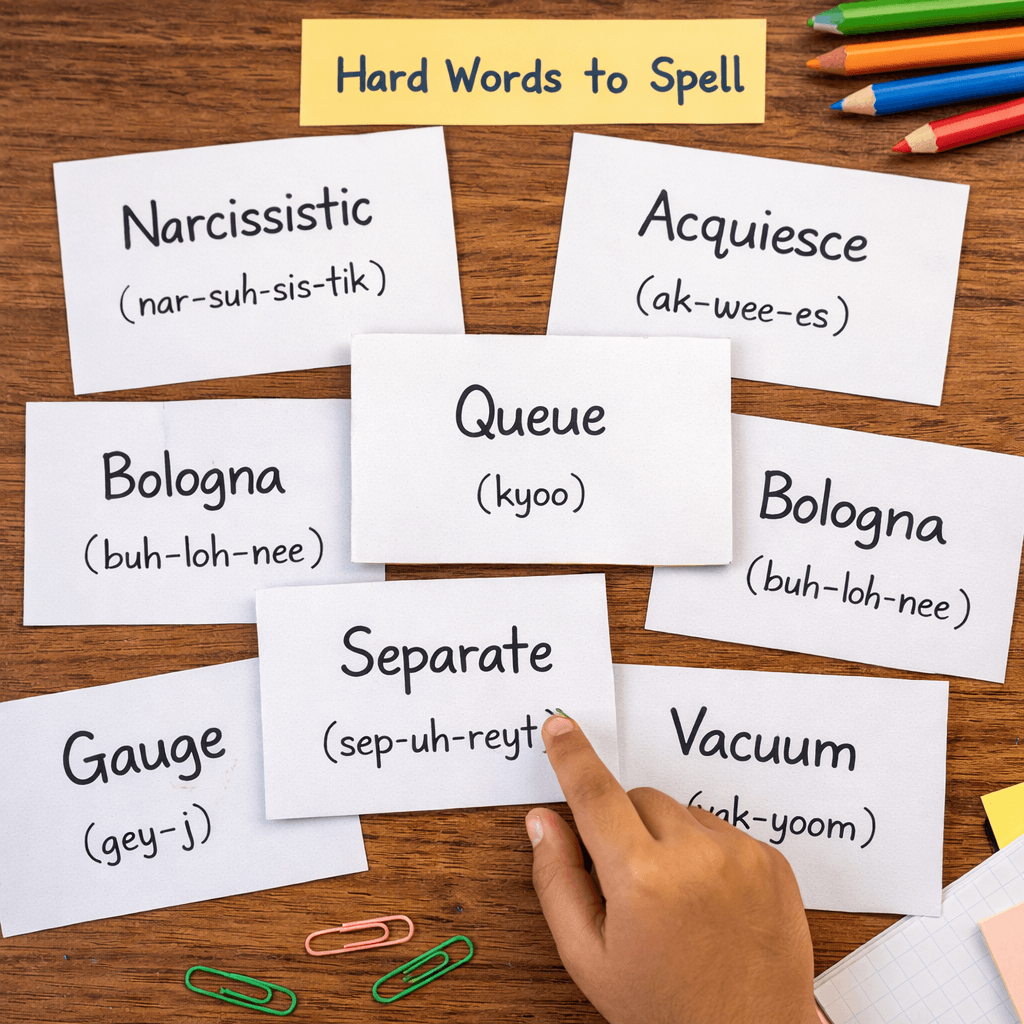
Spelling becomes difficult when words include silent letters, unusual patterns, or sounds that do not match their spelling. These hard English words to spell are perfect for improving accuracy and attention to detail.
Here are some commonly tricky words:
- Narcissistic
- Acquiesce
- Bologna
- Queue
- Separate
- Gauge
- Patience
- Vacuum
Why Are These Words Difficult?
Many of these words break common spelling rules, which confuses children.
For example:
- Queue looks long but sounds like just “Q”
- Bologna is pronounced very differently from how it is spelled
- Vacuum has double vowels that can be confusing
Common Challenges in Spelling
Children often struggle with:
- Silent letters like in “queue” and “bologna”
- Double letters like in “vacuum”
- Misleading pronunciation that does not match spelling
- Forgetting correct letter order
Practical Learning Tips
To make spelling easier and more effective, try these simple strategies:
- Break words into syllables: Example: Ac-qui-esce
- Write words multiple times: Repetition helps memory
- Use words in sentences: Example: “I waited patiently in the queue.”
- Practice dictation regularly: This improves listening and spelling together
- Highlight tricky parts: Example: Vacuum
Memory Trick Example
“Queue” can be remembered as:
Q + ueue
Think of the extra letters as people standing quietly in line behind Q.
Is your child still confused by tricky spellings? Book a live 1:1 demo session now and unlock confident spelling skills fast. Seats filling quickly.
Tricky Pronunciation Words
Some words are difficult not because of how they are written, but because of how they are spoken. English has many words where the pronunciation does not clearly match the spelling, which can confuse children. Learning such words helps kids become more confident speakers and better listeners.
Here are some tricky pronunciation words with meanings and examples:
- Asperity (uh-sper-i-tee): Harshness in tone or manner
Example: His asperity made the conversation uncomfortable.
- Belie (bih-lahy): To show something is false
Example: Her calm face belied her nervousness.
- Cajole (kuh-johl): To persuade gently
Example: She tried to cajole her friend into joining the game.
- Callous (kal-uhs): Emotionally insensitive
Example: His callous remarks hurt everyone.
- Deleterious (del-i-teer-ee-uhs): Harmful or damaging
Example: Too much screen time can have deleterious effects.
Why Pronunciation Matters
Correct pronunciation is an important part of communication. When children pronounce words correctly, they feel more confident and are better understood by others.
It helps children:
- Speak clearly and confidently in conversations
- Avoid misunderstandings while communicating
- Improve listening and comprehension skills
- Perform better in presentations and public speaking
Practice Strategies
To improve pronunciation, children should practice regularly using simple techniques:
- Listen to audio pronunciation: Use dictionaries or apps
- Repeat aloud multiple times: Focus on clarity
- Break words into syllables: Example: de-le-te-ri-ous
- Use the word in conversation: Helps long-term memory
For example:
“Cajole” means to persuade gently, and a child can say:
“I tried to cajole my friend to play with me.”
Tricky Spelling and Silent Letter Words
Some words are especially difficult because they contain silent letters or unexpected spelling patterns. These words do not follow standard phonics rules, which makes them tricky for children to learn.
Here are some common examples:
- Aisle (sounds like “I'll”)
- Colonel (pronounced “kernel”)
- Mnemonic (silent “m”)
- Queue (sounds like “Q”)
- Rhythm (no typical vowels)
- Subtle (silent “b”)
- Yacht (sounds like “yot”)
Why These Words Are Difficult
These words confuse learners because:
- Silent letters are written but not spoken
- Pronunciation does not match spelling
- Patterns are irregular and hard to predict
For example, in “subtle,” the “b” is not pronounced, which can lead to spelling mistakes.

Learning Approach
Children can master these words with the right strategies:
- Highlight silent letters: Example: subtle
- Practice visual memory: Write and observe patterns
- Use repetition: Write and say the word multiple times
- Create memory tricks: Associate the word with a story or image
For example:
“Mnemonic” can be remembered as “memory starts with ‘m’ but we do not hear it.”
Words with Challenging Meanings
Some words are not difficult to spell or pronounce but are challenging because of their deeper or abstract meanings. These words help children express thoughts more clearly and precisely.
Here are some important vocabulary-building words:
- Abundant: More than enough
- Benevolent: Kind and caring
- Conundrum: A confusing problem
- Meticulous: Very careful and detailed
- Obsolete: No longer in use
- Resilient: Able to recover quickly
- Tenacious: Not giving up easily
Benefits of Learning Meaning-Based Words
Understanding such words helps children:
- Improve writing quality and clarity
- Enhance storytelling and creative expression
- Build critical thinking skills
- Communicate ideas more effectively
For example:
“Resilient” can be used in a sentence like:
“She remained resilient even after facing challenges.”
Encourage children to not only learn meanings but also use these words in daily conversations or writing tasks.
Want your child to use powerful words confidently? Start a guided learning journey today with expert trainers. Book your trial before slots close.
Toughest Words to Pronounce
Some words are challenging even for adults because they have unusual sound patterns, repeated syllables, or confusing stress points. These words are great for improving speaking skills and articulation.
Here are some examples:
- Anemone (uh-nem-uh-nee): A sea creature
- Epitome (uh-pi-tuh-mee): A perfect example
- Hyperbole (hy-per-buh-lee): Exaggeration
- Mischievous (mis-chi-vus): Playfully naughty
- Onomatopoeia (on-uh-mat-uh-pee-uh): Words that imitate sounds
- Rural: Related to countryside
- Worcestershire (woo-ster-sher): A type of sauce
Why These Words Are Difficult
- Multiple syllables
- Unexpected pronunciation
- Confusing stress patterns
For example, many people incorrectly say “epi-tome” instead of “epitome.”
Tips to Master Pronunciation
- Break words into syllables: Example: on-o-mat-o-poe-ia
- Practice slowly and clearly
- Listen and repeat multiple times
- Record and compare pronunciation
For example: “Epitome” is pronounced as “uh-pi-tuh-mee”
Word Lists by Grade Level
Children learn best when content matches their age and ability level. A structured word list ensures that they are neither overwhelmed nor bored.
Grade 2
- Astronomy
- Demolish
- Shiver
These words introduce slightly advanced vocabulary while still being manageable.
Grade 3
- Ambition
- Journey
- Magnificent
At this stage, children begin to understand more descriptive and expressive words.
Grade 6
- Chronological
- Inevitable
- Hypothesis
These words are more academic and help prepare children for higher-level learning and exams.
Why Grade-Based Learning Helps
A level-based approach ensures effective learning:
- Matches the child’s cognitive ability
- Prevents confusion and frustration
- Builds confidence step by step
- Ensures gradual and consistent progress
Parents should always choose word lists appropriate to their child’s level and gradually increase difficulty as skills improve.
Fun Ways to Teach Hard Words to Kids
Learning a Hard Word List does not have to feel like a boring task. In fact, children learn better when the process is interactive, creative, and enjoyable. When kids associate learning with fun, they are more likely to stay consistent and retain what they learn.
Here are some creative and effective ways to teach hard words:
Engaging Learning Methods
- Spelling games and quizzes: Turn learning into a game by using spelling apps, quizzes, or even simple oral challenges. This adds excitement and reduces pressure.
- Word puzzles and crosswords: These activities improve memory and help children recognize patterns in hard English words to spell.
- Story writing exercises: Encourage kids to create short stories using newly learned words. This improves both vocabulary and creativity.
- Flashcards and visual aids: Use colorful flashcards with meanings and pictures to make learning visually appealing.
- Weekly word challenges: Introduce 5 to 10 new hard words every week and revise them through fun activities.
Why These Methods Work
These strategies:
- Make learning enjoyable instead of stressful
- Improve long-term retention
- Encourage active participation
- Build confidence in using new words
For example, ask your child to create a short story using 5 hard words like “resilient,” “cacophony,” or “meticulous.” This not only improves spelling but also helps them understand context.
Struggling to make vocabulary learning fun and effective? Book a free interactive class today and watch your child enjoy learning like never before. Limited seats available.
Common Mistakes Kids Make While Learning Hard Words
While learning difficult words, children often repeat certain mistakes. Recognizing these errors early can help parents and teachers guide children more effectively.
Common Errors
- Confusing similar sounding words: Words like “their,” “there,” and “they’re” often create confusion
- Ignoring silent letters: Words like “knife” or “subtle” are frequently misspelled
- Misspelling double letters: Words like “necessary” and “vacuum” are common examples
- Incorrect pronunciation: Mispronouncing words leads to incorrect spelling
Why These Mistakes Happen
- Lack of clarity in phonics rules
- Over-reliance on how words sound
- Limited exposure to correct spelling
- Inconsistent practice
How to Fix These Mistakes
- Encourage slow and clear pronunciation: Breaking words into syllables helps improve accuracy
- Practice regularly: Daily revision builds strong memory
- Use correction feedback: Gently correct mistakes and explain why they happened
- Revise weekly: Go over previously learned words to reinforce learning
- Teach patterns and rules: Help children understand common spelling patterns
For example:
“Necessary” can be remembered as:
One collar and two sleeves
(c = 1, s = 2)
This kind of memory trick makes learning easier and more fun.
Is your child repeating the same spelling mistakes again and again? Fix it early with expert guidance. Book your trial session now before slots fill up.
How Parents Can Support Learning at Home
Parents play a crucial role in helping children master a Hard Word List. A supportive and positive learning environment at home can make a significant difference in how children approach difficult words.
Effective Strategies for Parents
- Set a daily practice routine: Even 10 to 15 minutes of focused practice can bring great results over time
- Encourage reading habits: Reading books exposes children to new and challenging words naturally
- Use real-life examples: Include new words in daily conversations to reinforce learning
- Reward progress, not perfection: Celebrate effort to keep children motivated
- Keep learning stress-free: Avoid pressure and make learning enjoyable
Smart Ways to Integrate Learning
- Ask your child to use a new word during dinner conversations
- Play word games during travel time
- Practice spelling during bedtime routines
- Create a “word of the day” habit
For example, while reading a story, parents can pause and ask:
“What do you think this word means?”
This encourages curiosity and deeper understanding.
Why Parental Support Matters
Children learn best when they feel supported and encouraged. When parents actively participate in the learning process, children develop:
- Stronger confidence
- Better learning habits
- Positive attitude toward challenges
Consistency, patience, and encouragement are the most powerful tools parents can use to help their children succeed.
Help Your Child Master Vocabulary with PlanetSpark Creative Writing
PlanetSpark creative writing classes are designed based on research-backed learning methods that focus on vocabulary building, structured writing, and confidence development. These programs are ideal for kids who struggle with spelling, word usage, and expressing ideas clearly.
Unlike traditional learning, PlanetSpark uses a personalized approach where each child gets individual attention and feedback. This ensures that children not only learn hard words but also use them effectively in real-life communication.
Key Features:
- Live, interactive classes
- Expert teachers trained in child pedagogy
- Real-world communication practice
- Personalized feedback for improvement
- Confidence-building framework
- Structured curriculum aligned to age and skill level

Build Confidence One Word at a Time
Learning a Hard Word List is not just about spelling correctly. It is about building confidence, improving communication, and preparing children for future success.
When children consistently practice hard words, they become better readers, writers, and speakers. Over time, even the most difficult words become familiar and easy to use.
Encourage your child to explore new words daily, practice regularly, and enjoy the learning journey. Strong vocabulary today leads to confident communication tomorrow.
Frequently Asked Questions
A hard word list is a collection of difficult words designed to improve spelling, vocabulary, and communication skills in children.
Learning hard English words improves reading comprehension, writing ability, and overall confidence.
Children can use repetition, syllable breakdown, flashcards, and sentence practice to remember spellings.
Words like “conscientiousness,” “idiosyncrasy,” and “onomatopoeia” are considered difficult due to spelling and pronunciation.
Kids can start with 5 to 10 words per day and increase gradually.
Yes, spelling games improve memory, engagement, and retention of hard words.
PlanetSpark provides 1-to-1 coaching tailored to each child, focusing on speaking, listening, and confidence-building.