
Metaphor Examples: Understand Definition, Examples, and Types
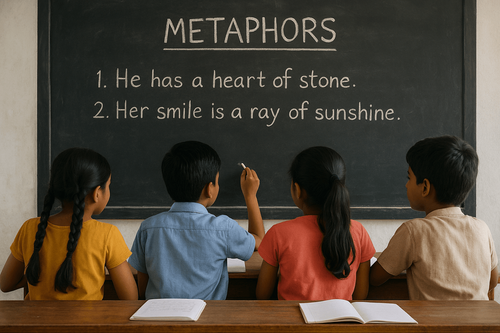

Language becomes powerful when it does not just inform but also paints a picture in the mind. That is exactly what metaphors do. Instead of explaining something in plain words, a metaphor converts it into an image or feeling or an experience that a reader can connect to.
Whether it’s a line in poetry, a dialogue in a movie, or a casual conversation with a friend, metaphors slip into our speech more often than we realise. Understanding them not only improves your writing and communication but also helps you appreciate the hidden layers of meaning in everyday language.
"Boost your English skills with PlanetSpark! Join our Grammar demo class and learn with games, stories, and fun challenges today!"
Metaphor Definition
A metaphor is a figure of speech that compares two unrelated things by implying that one is actually the other. Instead of stating that something is like something else, metaphors express it directly to create stronger imagery. They can involve people, objects, actions, or even abstract concepts to represent something beyond their literal meaning.
Metaphors fall under the wider category of figurative language, which includes expressions that are not meant to be taken word-for-word. Since some feelings or ideas are hard to explain plainly, metaphors help by linking them to something more familiar or visual, making the concept easier to grasp.
If interpreted literally, metaphors often sound strange or illogical. Consider what these metaphors would look like if taken at face value:
- Time is a thief.
- Her mind is a maze.
Obviously, time cannot steal like a person, and the human brain isn’t made of winding passages. Yet, these metaphors communicate vivid meanings, time quietly takes moments away, and her thoughts feel complicated or hard to navigate. Compared to simple statements like “time passes quickly” or “she is confused,” metaphors add colour, intensity, and emotional depth.
Metaphors are common in stories, songs, speeches, and everyday conversations. When someone says “speaking metaphorically,” they are hinting that their words carry symbolic meaning rather than literal truth.
Imagine a student after a long presentation saying, “That stage was a lion’s den.” Clearly, there were no wild animals involved, but the metaphor expresses fear, pressure, or nervousness more effectively than just saying “I was anxious.” This shows how metaphors help us express emotions and situations more powerfully than plain statements.
Learn How to Make Meaningful Sentences With Lessons
Examples of Metaphors
Metaphors are one of the most common figures of speech, metaphors appear across all forms of expression, whether it’s storytelling, advertisements, speeches, music, or everyday conversation. When a metaphor is strong and meaningful, it instantly grabs attention.
Examples of metaphors in everyday speech
- My inbox is a warzone.
- This traffic is a slow-moving snake.
- He’s a walking encyclopedia.
These everyday metaphors help express frustration, clutter, or admiration in a more expressive and relatable way.
Examples of metaphors in literature
- “Hope is the thing with feathers that perches in the soul.” Inspired by Emily Dickinson’s poetic style
- “Memory is a museum, and every thought is a framed moment.”
- “Her words were arrows, sharp and aimed straight at his pride.”
Writers use metaphors to add emotional depth, helping readers feel rather than just understand.
Examples of metaphors in history and speeches
- “We stand at the edge of a new dawn.”
- “Prejudice is a chain that binds the progress of society.”
- “Education is the passport to the future.”
Public speakers and leaders often use metaphors to inspire hope, unity, or change through memorable expressions.
Examples of metaphors in pop culture and music
- “You’re a wildfire, impossible to contain.”
- “My heart is a locked room, and you’re the forgotten key.”
- “She’s a storm in high heels.”
Artists and musicians rely on metaphors to express complex emotions in simple, impactful lines that listeners instantly connect with.
Metaphor vs. Simile
Metaphors and similes are both popular figures of speech used to compare two different things. However, the key distinction lies in how the comparison is made. Similes use connecting words like “like” or “as” to make the comparison direct, while metaphors skip those words and state the comparison as if it were literal.
Similes clearly point out the similarity between two things, making their meaning straightforward. Metaphors, on the other hand, imply the comparison, leaving it to the listener or reader to understand the symbolic connection.
Metaphor: In the morning, my brain is a frozen computer.
Simile: In the morning, my brain feels like a frozen computer.
While the difference between using and not using like or as may seem small, it changes the impact. Metaphors often sound more expressive and poetic because they encourage imagination. Similes are more direct and easier to interpret, which makes them useful for clarity.
Fresh Examples of Similes
- She’s as unpredictable as the weather.
- That idea spread like sparks in dry grass.
- He clings to his routine like a crab to its shell.
Types of Metaphors
Implied Metaphor
An implied metaphor moves away from the direct “A is B” format and instead suggests a comparison subtly, without clearly stating both elements. This allows the writer to be more nuanced and expressive.
Here are some fresh examples:
- Her words clawed at my confidence.
- The debate room erupted before the judge could speak.
In these examples, the comparison is hinted at rather than named outright. "Words" are implied to be claws, and the "room" is likened to a volcano or explosive force without explicitly mentioning those words. Implied metaphors add artistry, but be careful, if the connection is too vague, readers may miss the intended meaning.
Sustained Metaphor (Extended Metaphor)
A sustained or extended metaphor stretches across multiple lines, sentences, or paragraphs. Rather than a single metaphorical phrase, it builds a thematic image by layering related comparisons continuously.
This type of metaphor is often found in poetry, speeches, and songs. Here’s a fresh example inspired by that style:
Example:
She is the lighthouse at the edge of my darkest seas. When the storms rise, her presence cuts through the fog, guiding every lost part of me back to shore.
If the metaphor stopped after the first line, it would be a simple comparison. But by continuing with imagery like storms, fog, and shore, it evolves into an extended metaphor revolving around a single symbolic theme.
Dead Metaphor
A dead metaphor is a metaphor that was once vivid and imaginative but has been used so frequently that it no longer sparks imagery. It becomes a phrase people say without visualising it.
Here are some fresh examples of overused or worn-out metaphors:
- Time is running out
- Break the ice
- Hit the nail on the head
- The tip of the iceberg
While once expressive, these phrases are now often used without thought. To keep writing engagingly, it's better to reimagine a common metaphor or replace it with a fresh perspective.
Mixed Metaphor
A mixed metaphor happens when two unrelated metaphors are combined accidentally. This can confuse readers or unintentionally create humour due to clashing imagery.
Here’s a fresh example of a mixed metaphor:
- Let’s plant the idea and hit the ground sprinting.
This merges “plant the idea” (a growth metaphor) with “hit the ground running” (a motion/action metaphor), leading to a confusing mental image. Mixed metaphors are often unintentional, but when used deliberately, they can produce a humorous or satirical effect.
A playful, intentional example might be:
- We’ll cross that bridge when it sinks.
Unless humour is the goal, it's best to keep metaphors consistent so your message stays clear and impactful.
How to Use Metaphors
You don’t need anything more than creativity and observation to craft a strong metaphor. However, adding a touch of originality can make your expression truly memorable. Metaphors work best when they describe something abstract or emotional through a concrete and relatable image.
Take this metaphor: “She ruled the classroom with a velvet chain.”
No one literally governs with a chain, especially not one made of velvet. Yet the metaphor suggests a leadership style that is firm but gentle, control with softness. That’s the power of metaphor: it conveys complexity in just a few words.
When building metaphors, choose familiar ideas but pair them in unexpected ways to spark curiosity.
Here’s a simple example:
Ever since Dad started working from home, the kitchen has turned into a command centre.
A kitchen isn’t actually a military base, but this comparison makes us imagine orders being given, coffee fueling missions, and constant activity, painting a vivid picture with minimal words.
Tips for Using Metaphors Effectively
Use metaphors selectively
Metaphors can transform writing, but overusing them can create clutter instead of clarity. Bombarding your readers with metaphor after metaphor forces them to constantly interpret meaning, which can be overwhelming. Save metaphors for moments when a literal description feels too plain or emotionless, especially when dealing with complex ideas like stress, ambition, fear, or hope.
Choose comparisons that surprise, but make sense
A good metaphor makes people pause and think, but it shouldn’t feel random or forced. Avoid comparisons that are too predictable. Instead of saying “time is a river,” you could say:
“Time is a train station, people arrive, people leave, and nothing stays for long.”
This kind of metaphor creates a fresh visual while still being easy to understand.
Avoid mixing metaphors
As mentioned earlier, combining unrelated metaphors in the same sentence can lead to confusion rather than imagery. For example:
“Let’s plant the idea and let it take flight.”
This merges growth and flight imagery, causing mental conflict. Stick with one metaphor at a time, let it land, and then move on to the next idea.
Why Choose PlanetSpark for Metaphors?
The English Grammar course at Planet Spark is built with one simple idea: as the kids learn better when they use language instead of just memorising it. So, instead of mugging up tenses or parts of speech, the students must learn how to apply them in real sentences or conversations. Here are some reasons why you must learn metaphors for Planet Spark.
- Kids want to hear a story or dialogue rather than opening a grammar book or reading a definition. This approach keeps them curious and makes grammar learning natural and not technical.
- There are challenges, puzzles, as well as short tests that make learning a friendly competition. Kids look forward to winning grammar and improving their score instead of finishing a chapter.
- Every concept ends with a simple writing or expression task. Students try using what they just learned in their own words. This can happen through a short story, dialogue or creative line building. This is where grammar starts turning into confidence.
- From basic building blocks like nouns and verbs to trickier concepts like conditionals and speech. There is no jump or gap, so kids don't feel lost between levels.
- Each child is paired with a dedicated trainer and not a recorded lesson, as it does not fit all classes. The mentor observes how the child responds and adjusts the sessions according to their comfort and learning speed.
- PlanetSpark uses an AI-based assessment to understand where the learner currently stands. Then, that performance analysis is used to create a customised tracks so the journey feels personal from the start.
- Instead of waiting for feedback, learners get immediate suggestions through AI practice tools. They see what went wrong and fix it the right way to make the learning loop tight.
When Should You Use Metaphor in English?
Metaphors are best used when you want to make your language more expressive, memorable, or emotional. They help convey complex feelings or abstract ideas more vividly than plain words.
Use them when describing emotions, storytelling, persuasive writing, speeches, poetry, or whenever you want your message to create a strong visual or emotional impact on the listener or reader.
1. Identify the emotion or idea you want to express clearly.
Before writing a metaphor, decide what feeling, situation, or message you want to describe.
Example idea: Feeling overwhelmed with tasks.
2. Think of a familiar object or situation
Find something that people can easily imagine that matches your feeling.
Example comparison: A storm is chaotic and overwhelming, just like your tasks.
3. Create a direct comparison without using “like” or “as.”
Instead of saying “I feel like I’m in a storm” (simile), turn it into a metaphor.
Example metaphor: “My schedule is a storm pulling me in every direction.”
4. Ensure the metaphor adds clarity
A metaphor should paint a picture, not make the reader pause in confusion.
Confusing: “My schedule is a dragon barking at me.”
Clear: “My schedule is a storm that won’t settle.”
5. Use one strong metaphor at a time to maintain impact.
Too many metaphors together can clash or feel overwhelming. Stick to one clear image.
Good: “Her anger was a locked door.”
Overloaded (avoid): “Her anger was a locked door on a sinking ship in a desert of silence.”
6. Read it aloud to check if it feels natural and meaningful.
Speaking it helps you feel if the metaphor flows well and matches your tone.
If it sounds forced or dramatic, simplify it while keeping the emotion alive.
Example: If “My thoughts are fireworks in a silent sky” sounds too poetic for a casual context, you might adjust to “My thoughts are fireworks waiting to explode.”
"Turn grammar into a game! Sign up for PlanetSpark’s English course and master rules with stories, quizzes, and fun activities!"
Conclusion
Metaphors are more than just figures of speech; they are powerful concept that helps us connect ideas and experiences in a relatable way. They turn simple statements into something different, thus making communication engaging. The students can use metaphors easily to express their complex thoughts with more clarity and expression.
Frequently Asked Questions
A metaphor is a way of describing something by saying it is something else to show a deeper meaning. For example, saying “Her smile is sunshine” means her smile brings warmth and happiness, just like the sun.
We use metaphors to make language more expressive and interesting. They help us explain emotions and ideas in a way that paints a picture in the listener’s mind instead of using plain or direct words.
A simile uses “like” or “as” to compare two things, such as “He runs like the wind.” A metaphor skips those words and says it directly, like “He is the wind on the field.” Metaphors feel more powerful and poetic.
Yes, there are several types, such as implied metaphors, extended metaphors, dead metaphors, and mixed metaphors. Each type has a slightly different way of creating a comparison for effect or expression.
Absolutely! We use metaphors all the time without noticing. Phrases like “I’m drowning in work” or “Time is flying” are everyday metaphors people use casually in speech.
Start by identifying the feeling or situation you want to describe. Then think of an object or image that shares a similar quality and connect them directly. Keep it clear, relatable, and natural for the best effect.