
Narrative Writing Examples: Types, Tips & Best Story Samples
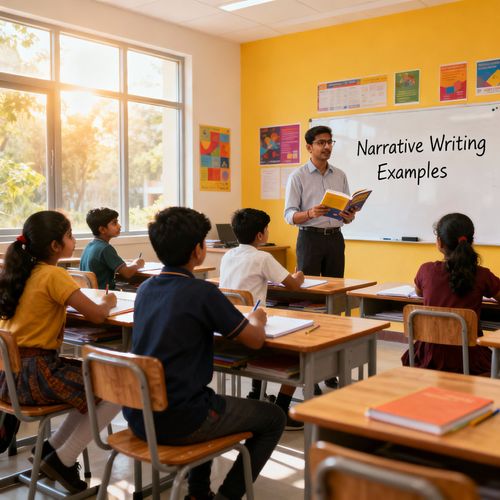

Narrative writing is the art of telling stories, real or imaginary, through structured events, characters, and emotions. Whether it’s a childhood memory, a fictional adventure, or a meaningful life lesson, good narrative writing makes readers feel, imagine, and experience.
In this blog, we’ll explore narrative writing examples, formats, templates, and tips to help students and beginners understand how stories are built. We will also break down elements, types, and samples so readers gain clarity and confidence.
Want your child to master storytelling? Check out the PlanetSpark Creative Writing Course!
What Is Narrative Writing?
Narrative writing is a form of composition where the writer tells a story. These stories may be real (personal narratives) or imaginary (fictional stories). The primary goal is to immerse the reader in a sequence of events and make them feel connected to characters and plot.
Narratives may be written in first-person or third-person, depending on the perspective. They are commonly used in short stories, novels, biographies, memoirs, children’s stories, and even academic essays.
Purpose of Narrative Writing
The purpose of narrative writing is to:
Engage readers with storytelling
Share experiences, lessons, and emotions
Spark imagination
Convey real or fictional events in a compelling way
Key Elements of Narrative Writing
1. Characters
Characters are central to the story. They provide emotional connection and drive the plot.
2. Setting
Time, place, mood, and atmosphere define where the story unfolds.
3. Plot
The sequence of events that form the storyline.
4. Conflict
The tension or challenge characters face.
5. Theme
The lesson or message the narrative conveys.
Narrative Writing Examples
Below are detailed narrative writing examples that reflect different categories and writing styles. These examples highlight how storytelling works in real, fictional, descriptive, and structured forms.
1. Personal Narrative Example
I still remember the first time I rode a bicycle without training wheels. My father held the seat while I nervously balanced. As he whispered, “You can do it,” I felt courage ignite. After a few shaky starts, I glided freely,wind brushing my face, never wanting the moment to end. That day, I learned fear disappears when you move forward.
2. Fictional Narrative Example
In the heart of a sparkling galaxy floated a tiny planet named Zollo. It was home to glowing creatures called Luminis. One curious Lumini, Nova, dreamed of exploring the stars. When she found an ancient spaceship hidden beneath crystal mountains, Nova began a journey beyond imagination.
3. Descriptive Narrative Example
The marketplace buzzed with life. Vibrant fabrics hung like rainbows from wooden stalls, and the aroma of spicy bread filled the air. Children laughed while merchants called out their best bargains. Every corner felt alive, warm, noisy, and full of stories.
4. Narrative Essay Example
Visiting my grandparents every summer shaped my childhood. Their home sat at the edge of a mango orchard where afternoons passed under shade. Grandma’s stories taught me empathy, while Grandpa’s garden taught me patience,lessons that stay with me even today.
5. Third-Person Narrative Example
Emma tiptoed across the dark hallway, clutching a glowing candle. The storm outside rattled the windows as lightning lit her path. She wasn’t afraid,only determined to find what made that strange noise in the attic.
6. First-Person Narrative Example
I shivered as I stepped onto the old wooden bridge. Every creak echoed through the silent forest. My heartbeat raced, but curiosity led me forward. Halfway across, a sudden gust almost knocked me off balance. Something was watching me , I could sense it.
7. Childhood Memory Narrative Example
When I was six, summer meant mangoes and mischief. My cousins and I raced across Grandma’s courtyard. One afternoon, we dared each other to climb the big mango tree. It was the first time I learned bravery comes in small steps.
8. Inspirational Narrative Example
I failed my first mathematics exam. For weeks, I avoided class until my professor sat with me daily, breaking concepts into simple steps. Months later, I topped the final exam , proof that failure can be the first step to success.
9. Adventure Narrative Example
Waves roared, but Leo wasn’t scared. With a backpack and binoculars, he sailed into the sparkling blue until he spotted a strange island , one not marked on maps. Something extraordinary was waiting.
10. Mystery Narrative Example
At midnight, the phone rang. A soft whisper said, “Come to the old library.” When Mira arrived, the door creaked open by itself...
11. Dialogue-Driven Narrative Example
“You stole it, didn’t you?” Sam whispered.
“No! I found it,” Maya insisted…
12. Real-Life Event Narrative Example
My legs trembled as I stepped on stage for the school play. When I finished, applause roared , I had conquered fear.
13. Reflective Narrative Example
Losing our dog Bruno was devastating. But I learned love remains in memories.
14. Travel Narrative Example
Kyoto felt like stepping back in time , cherry blossoms floated like snowflakes, and ancient temples whispered stories.
15. School-Life Narrative Example
During the science fair, Ria felt invisible. But her simple model volcano won because she understood the science deeply.
Types of Narrative Writing
Fiction
Fiction narratives are stories created from the imagination. They are not based on real events, though they may include realistic elements. Examples include fantasy, mystery, adventure, and science fiction. These narratives focus on plot, characters, conflict, and creativity.
Example: A story about a boy discovering he can control time.
Non-fiction
Non-fiction narratives tell real stories based on actual events, people, or experiences. While they follow a narrative style, they are grounded in truth. This includes memoirs, biographies, personal essays, and travelogues.
Example: A girl narrating her experience of moving to a new country.
Linear Narrative
A linear narrative tells the story in chronological order, from beginning to middle to end. Events unfold step-by-step without jumping back or forward in time.
Example: A story starting with a character’s childhood, followed by their teenage years, and ending in adulthood.
Non-linear Narrative
A non-linear narrative does not follow chronological order. It may include flashbacks, flash-forwards, parallel timelines, or events told out of sequence. This structure adds suspense and complexity.
Example: A mystery novel that reveals clues through flashbacks.
Quest-based Narrative
A quest narrative follows a character (or group) on a journey to achieve a goal—such as finding a treasure, solving a mystery, or completing a mission. Along the way, they face obstacles, meet allies, and learn valuable lessons.
Example: A character travelling through magical worlds to retrieve a lost artifact.
Structure of Narrative Writing
Exposition
The exposition introduces the story. It presents the main characters, setting, and the initial situation. It helps readers understand the world of the story before the conflict begins.
Rising Action
The rising action includes events that build tension and develop the main conflict. Characters face challenges, make decisions, and the stakes gradually increase. This is usually the longest part of the narrative.
Climax
The climax is the turning point of the story—the most intense moment where the main conflict reaches its peak. The protagonist faces the biggest challenge or makes a crucial choice.
Falling Action
After the climax, the falling action shows the consequences of the protagonist's actions. It begins to resolve the tension and moves the story toward closure.
Resolution
The resolution wraps up the story. Conflicts are resolved, loose ends are tied, and the final outcome for the characters is revealed. It gives readers a sense of completion or a hint of what may come next.
How to Write Narrative Stories
Writing a narrative means telling a story that feels real, emotional, and engaging. Whether it’s fiction or non-fiction, a strong narrative draws readers in and makes them care about what happens next. Here’s how to make your story compelling and memorable.
Start Strong
The beginning of your narrative should immediately capture the reader’s attention. Open with something intriguing—a surprising moment, a vivid description, an interesting character detail, or a question that pulls the reader in. A strong start sets the tone and makes readers want to keep going.
Example: Instead of “It was a normal day,” try “The day everything changed began like any other—until I found the letter.”
Build Conflict
Conflict is the heart of any narrative. It creates tension, drives the plot forward, and gives your characters a reason to act. Conflict can be internal (a character’s emotions or decisions) or external (a challenge, problem, or antagonist).
Why it matters:
Without conflict, your story becomes flat. With conflict, your narrative becomes engaging and meaningful.
Use Vivid Language
Vivid language helps readers see, hear, and feel the story. Use sensory details—what characters see, smell, taste, hear, and touch—to bring scenes to life. Strong adjectives, powerful verbs, and descriptive imagery make your writing more immersive.
Tip:
Replace dull words with specific ones. For example, instead of “walked quickly,” use “hurried,” “rushed,” or “darted.”
Show, Don’t Tell
Instead of directly stating emotions or situations, show them through actions, dialogue, and details. This makes the story more dynamic and lets readers experience it for themselves.
Example:
Telling: “She was nervous.”
Showing: “Her hands trembled as she adjusted the microphone.”
Showing brings readers closer to the character's feelings.
Add Reflection
Reflection adds depth to your narrative. After the events unfold, show how the character changes, what they learned, or how the experience affected them. Reflection turns a simple story into a meaningful one.
Example:
“The journey taught me that bravery isn’t the absence of fear, but the courage to keep going despite it.”
About PlanetSpark Creative Writing Course
Genre-Based Curriculum – Students explore stories, poems, essays, reviews, and more through structured lessons.
Writing + Speaking Integration – Learners present their written work verbally to strengthen articulation and confidence.
Editing & Feedback – Real-time guidance helps children revise, refine, and improve their writing.
Publishing Opportunities – Kids can get published on PlanetSpark’s blog, e-magazine, or anthologies for real recognition.
Creativity Stimulus Activities – Fun prompts, story dice, and imagination exercises spark original ideas.
1:1 Personal Trainers – Each child learns with a dedicated expert to build fluency, storytelling, and grammar skills.
Personalised Learning Roadmaps – Customized plans ensure every child grows at their own pace and ability.
Unlock the Storyteller in You!
Narrative writing teaches children to express ideas, emotions, and creativity with confidence. When guided correctly, kids learn to think deeply, write beautifully, and speak boldly.
PlanetSpark’s Creative Writing Course empowers children to explore fiction, poetry, journaling, storytelling, and more , unlocking imagination and fluency.
Let your child shine - Join PlanetSpark's Creative Writing Course today!
You may also read :
Frequently Asked Questions
Narrative writing examples are written samples that tell a story through characters, settings, and events.
To entertain, convey lessons, and help writers express experiences creatively.
Start with a character, setting, and conflict. Use vivid descriptions and personal reflection.
Personal narratives, fictional stories, descriptive narratives, essays, and memoirs.
PlanetSpark offers 1:1 training, AI feedback, publishing options, gamified learning, and structured growth.