
Pun meaning in a Creative Device at PlanetSpark


Table of Contents
- What Is a Pun? Understanding Pun Meaning Clearly
- Types of Pun Explained for Young Writers
- Puns, Double Entendres, and Malapropisms: What’s the Differe
- Pun Examples That Make Language Memorable
- Why Do Writers Use Puns to Strengthen Writing?
- How to Form Unputdownable Puns – Points to Remember
- Why Choose PlanetSpark Creative Writing for Literary Devices
- Mastering Pun Meaning for Confident Expression
Language becomes exciting when words start doing more than one job. One of the most playful and powerful ways writers achieve this is through puns. Whether you’re reading a joke, a comic strip, a poem, or even a catchy headline, chances are you’ve already encountered a pun without realizing it.
Understanding pun meaning is especially important for students because it trains the mind to look beyond surface-level definitions. A pun teaches you how words can twist, turn, and surprise the reader, all while staying grammatically correct. This skill is not only useful in creative writing but also in public speaking, debates, and storytelling.
In creative writing, puns add humor, intelligence, and originality. Writers who master wordplay often stand out because their writing feels lively and memorable. At PlanetSpark, students are encouraged to explore such creative devices early, helping them build confidence in how they use language.
What Is a Pun? Understanding Pun Meaning Clearly
So, what is a pun? In simple terms, a pun is a figure of speech that uses a word (or words) with multiple meanings, or words that sound alike, to create a humorous or clever effect.
The pun meaning lies in intentional ambiguity. A single word or phrase is crafted so that it can be understood in more than one way, often leading to surprise or amusement. This is why puns are commonly called “plays on words.”
For example:
I used to be a banker, but I lost interest.
Here, the word interest refers both to curiosity and money, two meanings cleverly packed into one sentence.
From an academic point of view, what is a pun in figure of speech? It is a rhetorical device that relies on:
Multiple meanings of a single word
Similar-sounding words with different meanings
Contextual interpretation
Unlike jokes that rely on exaggeration or storytelling, puns depend purely on language awareness. This makes them incredibly valuable for students learning vocabulary, sentence structure, and advanced expression.
When students grasp what is the meaning of pun, they begin to:
Think critically about word choice
Understand layered meanings in literature
Write more creatively and confidently
Creative writing classes that focus on wordplay are filling fast.
Sign up now to sharpen your language instincts before the next batch begins.
Types of Pun Explained for Young Writers
To fully understand pun meaning, it’s important to know that puns come in different forms. Each type trains a different creative muscle and helps students experiment with language in unique ways.
1. Homophonic Pun
This type of pun uses words that sound the same but have different meanings.
The knight had very shining armor; he was truly bright.
Here, knight and night sound alike, creating wordplay.
2. Homographic Pun
These puns rely on words that are spelled the same but have different meanings.
The teacher decided to desert her dessert.
The humor emerges from identical spelling with different interpretations.
3. Compound Pun
A compound pun uses multiple puns in one sentence.
A boiled egg every morning is hard to beat.
This type is common in witty writing and headlines.
4. Visual Pun
Often seen in comics and advertisements, visual puns combine imagery with wordplay. While not purely textual, they help students understand how context supports language creativity.
Learning these types improves clarity around pun meaning and helps students avoid accidental puns, which can confuse readers. Instead, they learn how to use puns intentionally and effectively.
Students who practice these techniques early write with confidence later.
Puns, Double Entendres, and Malapropisms: What’s the Difference?
Many students confuse puns with similar figures of speech. Let’s clear that up.
Pun vs. Double Entendre
A double entendre is a phrase with two meanings, where one is often indirect or suggestive. While all double entendres are a type of pun, not all puns are double entendres.
Pun: Time flies like an arrow; fruit flies like a banana.
Double entendre: She had a firm grip on the situation.
The key difference lies in intention. Double entendres often rely on subtlety, while puns can be openly playful.
Pun vs. Malapropism
A malapropism occurs when someone accidentally uses the wrong word that sounds similar to the correct one.
He is the pineapple of politeness (instead of pinnacle).
Unlike puns, malapropisms are usually mistakes. However, writers sometimes use them deliberately for humor, especially in dialogues.
Understanding these differences helps students use pun meaning accurately and strengthens their grasp of what is a pun in communication and writing.
Why This Matters for Creative Writing Students
Mastering puns is not about telling jokes; it’s about mastering language control. Writers who understand pun meaning:
Write sharper dialogue
Create engaging narratives
Develop a unique writing voice
PlanetSpark Creative Writing programs focus on such literary tools, ensuring students don’t just write correctly, but creatively.
Pun Examples That Make Language Memorable
To truly understand pun meaning, students need to see how puns work in real writing. Puns are not limited to jokes, they appear in literature, advertisements, speeches, and even exam-friendly creative answers.
Here are some pun examples that clearly show what a pun is in action:
I wondered why the baseball was getting bigger. Then it hit me.
→ “Hit” works both literally and figuratively.A bicycle can’t stand on its own because it’s two-tired.
→ The humor comes from sound similarity (too tired vs two-tired).The math teacher has too many problems.
→ “Problems” refers to both equations and difficulties.
In creative writing, these examples demonstrate how pun meaning relies on:
Context
Reader expectation
Multiple interpretations
In literature, authors often use puns subtly to add intelligence to dialogue. Shakespeare famously used puns to reflect a character’s wit or emotional state. For students, learning this technique helps them write answers and stories that feel polished and thoughtful.
Students who practice such wordplay stand out in creative writing tasks.
Why Do Writers Use Puns to Strengthen Writing?
Writers don’t use puns just to be funny; they use them to engage the reader’s mind. Understanding why puns work helps students use them more effectively.
1. Puns Make Writing Engaging
A well-placed pun rewards the reader for paying attention. It makes writing interactive, turning reading into a thinking process.
2. Puns Improve Language Awareness
When students learn what the meaning of pun is, they become more sensitive to:
Word choice
Vocabulary depth
Sentence structure
This directly improves essays, speeches, and creative answers.
3. Puns Add Personality
Puns reveal a writer’s voice. A playful pun can show humor, while a clever pun can show intelligence. This is especially useful in storytelling and dialogue writing.
4. Puns Create Memorability
Lines with puns are easier to remember. That’s why headlines, poems, and speeches often use them.
At PlanetSpark, students are taught how to balance creativity with clarity, so their writing is smart, not confusing.
How to Form Unputdownable Puns – Points to Remember
Learning how to form puns is as important as understanding pun meaning. Poorly placed puns can confuse readers, but strong ones elevate writing.
Here’s how students can craft effective puns:
Start with Strong Vocabulary
The more words a student knows, the more easily they can spot double meanings or sound-alike words.
Understand Context First
A pun must fit naturally into the sentence. Forced puns break the flow and distract readers.
Keep It Simple
Good puns feel effortless. Overcomplicating the sentence weakens the impact.
Avoid Overuse
Using too many puns in one paragraph can make writing feel gimmicky. One strong pun is better than five weak ones.
Read Aloud
If the pun sounds natural when spoken, it’s usually effective.
These skills are practiced step-by-step in structured creative writing programs, where students receive feedback on tone, clarity, and creativity.
Why Choose PlanetSpark Creative Writing for Literary Devices Like Puns
Understanding pun meaning is just one part of becoming a confident writer. What students really need is guided practice, feedback, and exposure to advanced writing tools, early.
PlanetSpark Creative Writing helps students:
Genre-Focused Curriculum: Covers diverse forms like stories, poems, essays, reviews, and persuasive letters to build versatile writing skills.
Framework-Based Learning: Students master story arcs, the S.T.O.R.Y structure, the 5W1H method, and the PEEL technique for structured writing.
Writing and Speaking Integration: Learners present their written pieces to strengthen expression and storytelling confidence.
Real-Time Editing: Classes emphasize rewriting and refinement through peer reviews and teacher feedback.
Publishing Opportunities: Students can feature their work on PlanetSpark’s blog, e-magazine, or co-authored anthologies for recognition.
Creativity Boosters: Writing prompts, imagination games, and story dice activities nurture originality and creative thinking.
Students don’t just learn what is a pun, they learn when and how to use it effectively.
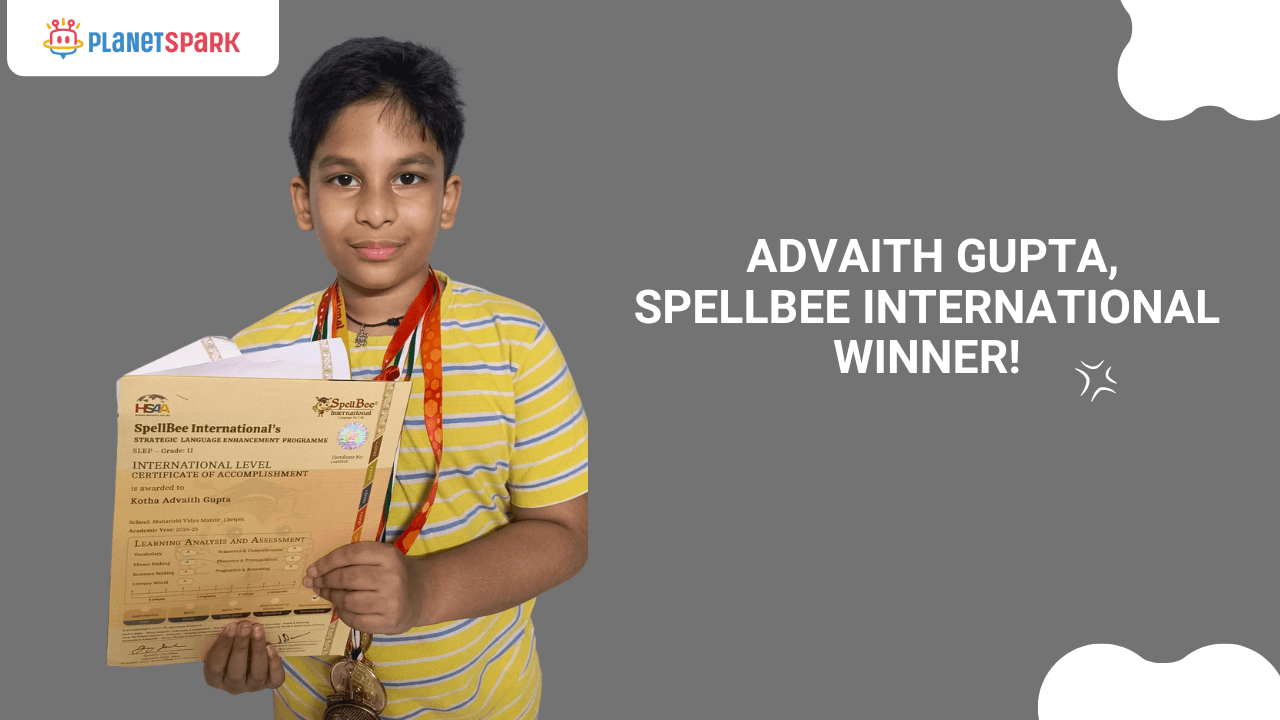
Advaith Gupta – Spelling His Way to Global Recognition!
From mastering vocabulary to shining at SpellBee International, Advaith creates remarkable achievements.
Advaith Gupta’s journey shows what happens when strong vocabulary meets confident expression. By mastering words, meanings, and usage, he didn’t just excel academically; he gained the confidence to perform on global platforms like SpellBee International.
His success highlights an important truth:
Language mastery isn’t about memorizing words; it’s about understanding and using them effectively.
PlanetSpark nurtures this exact skill set by combining:
Vocabulary development
Creative writing techniques
Public speaking confidence
High-impact writing skills are best built before habits settle.
Sign up now and secure a spot before the limited seats run out.
Mastering Pun Meaning for Confident Expression
Understanding pun meaning goes far beyond humor. It trains students to think deeply about language, meanings, and reader perception. When students learn what is a pun in figure of speech, they gain control over words, and that control shows in every form of communication.
From creative writing to public speaking, puns help students:
Think critically
Write creatively
Communicate confidently
With the right guidance, students don’t just use puns, they use language with purpose and style.
If You Enjoyed Learning About Puns, Read This Too
Frequently Asked Questions
A pun is a figure of speech that uses a word or phrase with more than one meaning, or words that sound alike, to create humor or clever expression. In writing, puns are used not just to amuse readers but to show intelligence, creativity, and language control. Understanding pun meaning helps students write sharper dialogues and engaging narratives.
No. While puns are often humorous, skilled writers use them for emphasis, irony, and wordplay. In literature and speeches, puns can reveal a character’s personality or add depth to a sentence. This is why learning what is a pun in figure of speech is important for students who want to write beyond basic storytelling.
Yes, when used correctly. In creative writing tasks, speeches, and storytelling assignments, puns can enhance expression. However, they should be avoided in formal essays unless context allows. Learning when not to use a pun is just as important as knowing how to use one.
Students should start by improving their vocabulary, reading widely, and paying attention to double meanings in everyday language. Practicing short sentences, jokes, or dialogues helps. Structured guidance, where feedback is given, makes a huge difference in mastering pun meaning naturally.
Overusing puns, forcing them into sentences, or confusing the reader are common mistakes. A good pun feels effortless. That’s why students benefit from expert-led creative writing practice instead of trial-and-error learning.