
Sample Essays on 4 Stages of Plant Life Cycle for Kids
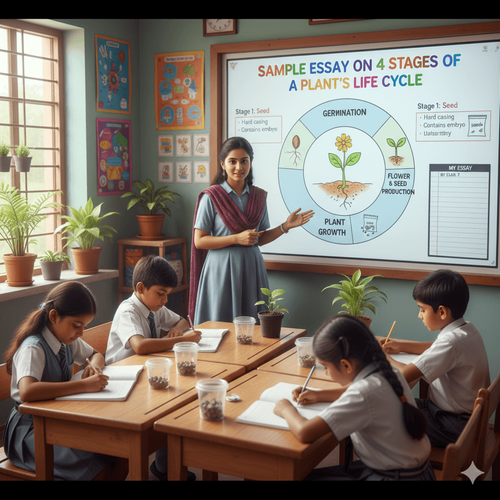

Table of Contents
- Easy Essays on the Four Stages of Plants
- Outline: Sample Essays on the Four Stages of Plant Life Cycl
- Tips for Writing Plant Life Cycle Essays
- Making Essay Writing Easy and Creative
- Using Imagination to Write Plant Life Cycle Essays
- Boost Your Child’s Writing Creativity with PlanetSpark
- Grow Your Writing Skills with PlanetSpark
Explaining the essay topic helps children understand what they are expected to write. This blog focuses on Sample Essays on the 4 Stages of Plant Life Cycle, guiding kids to describe each stage clearly and creatively. Here, you will find easy-to-understand sample essays, writing tips, and fun activities to make learning interactive. Platforms like PlanetSpark can further help children improve their essay-writing skills with expert guidance and personalised practice sessions.
Easy Essays on the Four Stages of Plants
Sample essays help children understand topics clearly. They provide a simple structure, demonstrate how to write sentences, and offer examples that make learning and essay writing easier. Here are the 4 stages of plant life cycle for Kids to understand:
Stage 1: Seed – The Beginning of Life
The seed is the first stage of a plant’s life. It may look small and simple, but it holds all the potential for a new plant. Seeds come in different shapes, sizes, and colours, depending on the type of plant.
Inside every seed is a tiny baby plant called an embryo. The seed also contains stored food that helps the baby plant grow when the conditions are right. Seeds can remain dormant for weeks, months, or even years until they get the right combination of water, sunlight, and temperature.
Sample Essay on Seed Stage
"The seed is the first stage of a plant’s life. It is very small but very powerful. Inside the seed, there is a tiny plant waiting to grow. The seed has food to help the plant start its life. When we plant the seed in soil and give it water and sunlight, it starts to grow into a new plant. Seeds are amazing because they can grow into big plants that give us food and flowers."
Seeds teach children patience and the importance of care. By observing seeds sprout, kids can understand that even small beginnings can lead to great outcomes.

Stage 2: Germination – The Sprouting Stage
Germination is the process by which a seed begins to grow into a young plant. When a seed absorbs water, it swells, and the outer shell cracks open. The tiny root, called a radicle, comes out first, followed by a small shoot that grows upward to find sunlight.
This stage is fascinating because it shows the miracle of life in action. During germination, children can observe changes almost daily. This makes learning interactive and exciting.
Sample Essay on Germination
"Germination is the second stage of the plant life cycle. When the seed gets water, air, and sunlight, it starts to grow. A small root comes out first, and then a tiny shoot grows upward. This stage is very exciting because we can see the seed changing into a plant. Germination shows us how living things need care to grow. Every plant starts from a tiny seed, and germination is the first sign of life."
Germination is a great way for kids to learn about growth and development. Simple science experiments, like planting beans in a transparent cup, allow children to watch the roots and shoots grow day by day.
Stage 3: Growth – Becoming a Young Plant
After germination, the seedling enters the growth stage. The seedling starts developing leaves, stems, and roots. It needs sunlight, water, and nutrients from the soil to grow healthy and strong.
During this stage, the plant produces more leaves to capture sunlight for photosynthesis. Photosynthesis is the process by which plants make their food using sunlight, carbon dioxide, and water. Growth is a crucial stage because it prepares the plant for flowering and reproduction.
Sample Essay on Growth Stage
"The growth stage is the third stage of a plant’s life. In this stage, the small seedling grows taller and stronger. It develops leaves that help make food through sunlight. The roots grow deep into the soil to get water and nutrients. This stage takes time, and the plant needs care to grow healthy. When we water and give sunlight to the plant, it grows into a big plant that can live for many years."
This stage teaches kids responsibility. By taking care of plants, children learn the importance of nurturing and the role of basic needs in growth.
Stage 4: Flowering and Reproduction – Completing the Cycle
The final stage of the plant life cycle is flowering and reproduction. When a plant grows fully, it produces flowers. Flowers are not just beautiful—they help the plant make seeds for the next generation.
Pollination occurs when pollen from the male part of a flower (the stamen) reaches the female part (the pistil). Pollination can happen with the help of insects, birds, wind, or water. After pollination, seeds develop inside fruits, and the life cycle begins again.
Sample Essay on Flowering and Reproduction
"The fourth stage of a plant’s life is flowering and reproduction. When a plant grows big, it makes flowers. Flowers help the plant make seeds. Bees, butterflies, and wind help move pollen from one flower to another. After pollination, fruits with seeds grow. These seeds can start a new plant, and the life cycle continues. This stage is important because it makes sure that new plants can grow in the future."
By learning this stage, children understand the continuity of life and the importance of reproduction in nature. It also introduces them to pollinators and their role in our ecosystem.
One-on-One Magic! – Personal trainers help kids write confidently and creatively.
Outline: Sample Essays on the Four Stages of Plant Life Cycle
This outline helps children understand how to write essays on plant life cycles. It provides a clear structure, highlighting each stage and guiding simple, easy-to-follow essay writing.
1. Introduction
- Briefly introduce what a plant is.
- Mention that plants grow through different stages.
- Explain why learning about plant life cycles is important.
2. Stage One: Seed
- Describe what a seed is.
- Explain how seeds are planted and start to grow.
- Include examples of common seeds.
3. Stage Two: Germination
- Explain the process of germination.
- Describe how roots and shoots appear.
- Mention conditions needed for germination, like water and sunlight.
4. Stage Three: Growth
- Discuss how the plant develops leaves, stems, and roots.
- Explain the importance of sunlight, water, and nutrients.
- Include examples of small plants growing into larger ones.
5. Stage Four: Flowering and Reproduction
- Describe how plants produce flowers and seeds.
- Explain pollination and seed formation.
- Mention the continuation of the plant life cycle.
6. Conclusion
- Summarise the four stages.
- Reinforce the importance of plants in nature.
- Encourage observation of plant growth in daily life.
This outline can guide kids to write a simple and structured sample essay on the four stages of a plant’s life cycle. Interested students can also read essay on positive thinking by clicking this link.
Grow Your Writing Skills! – Get feedback, improve daily, and watch your stories bloom.
Tips for Writing Plant Life Cycle Essays
Writing about plant life cycles can be simple if kids follow these tips:
- Start with an Introduction: Explain what a plant life cycle is.
- Describe Each Stage: Write a small paragraph for seed, germination, growth, and flowering/reproduction.
- Use Simple Words: Keep sentences easy to understand.
- Add Examples: Mention beans, sunflowers, or other plants as examples.
- Conclude Properly: Summarise all stages and their importance.
Following these steps helps kids write informative and interesting essays about plants.
Making Essay Writing Easy and Creative
Essay writing can be exciting because kids learn to organise their ideas clearly. First, think about what you want to say and note small points for each stage of the plant life cycle. Next, use simple words, colourful descriptions, and personal observations to make your essay lively. Additionally, drawing diagrams or giving examples of plants can help. By practicing this way, writing becomes fun and improves learning about nature. Student can click this link to read sample essays on plants.
Using Imagination to Write Plant Life Cycle Essays
Essay writing becomes more interesting when children use their imagination. Instead of just describing the plant’s stages, they can pretend to be the seed or the plant itself. For example, they can write from the seed’s perspective, explaining how it feels when it starts to grow. Additionally, adding creative details, like imagining talking roots or dancing leaves, makes the essay fun and engaging. By combining facts with imagination, kids not only learn the plant life cycle but also develop storytelling and writing skills in a playful way.
Boost Your Child’s Writing Creativity with PlanetSpark
PlanetSpark empowers children to express themselves confidently while mastering structure, vocabulary, and storytelling. Through expert guidance and innovative tools, kids develop both writing and speaking skills in a fun, engaging environment. Key features and services include:
- 1:1 Personalised Coaching – Certified trainers guide each child individually, providing feedback on essays, stories, and poems.
- Creative Writing Curriculum – Genre-based lessons covering short stories, poetry, journal writing, persuasive letters, and book reviews.
- Framework-Driven Instruction – Learn story arcs, S.T.O.R.Y structure, 5W1H method, and PEEL technique for essays and arguments.
- Writing + Speaking Integration – Present written work orally to build narrative flow and expressive confidence.
- Editing and Feedback – Real-time revisions, peer reviews, and teacher guidance to improve clarity and creativity.
- Publishing Opportunities – Showcase stories on PlanetSpark blogs, e-magazines, or anthologies.
- Imaginative Activities – Story dice, prompts, and guided exercises to spark original thinking.
With PlanetSpark, children not only write but create with confidence.
Grow Your Writing Skills with PlanetSpark
To sum it up, writing essays helps children organise their thoughts and express ideas clearly. By planning each part carefully, kids learn to structure their writing, just like a plant grows step by step from a tiny seed to a strong, flourishing plant.
Using examples, personal observations, and simple language makes essays engaging. Children can describe the plant life cycle creatively, imagining themselves as seeds sprouting, growing leaves, and eventually blooming, which brings both learning and fun together.
Regular practice in essay writing improves language skills, creativity, and confidence. Just as every plant completes its life cycle, every essay has a beginning, middle, and end. Learning to write thoughtfully helps children communicate ideas clearly and enjoyably while exploring the wonders of nature.
Frequently Asked Questions
The four stages are seed, germination, growth, and flowering/reproduction. Kids can write essays explaining each stage with simple words, examples, and observations to make learning engaging and easy to understand.
Children can add colorful descriptions, personal experiences, small drawings, and storytelling elements. Including examples of familiar plants like beans or sunflowers makes essays lively and enjoyable to read.
Start with an introduction, explain each of the four stages in separate paragraphs, use examples or observations, and end with a conclusion summarizing the life cycle’s importance.
PlanetSpark provides 1:1 coaching, structured creative writing lessons, real-time feedback, and exercises that guide children to write clear, imaginative, and confident essays.
Yes! Children can write from the plant’s perspective, imagine being a seed or a sprout, and include observations, making science essays more creative and engaging.
Tools like Spark Diary, SparkX, and gamified exercises let kids write daily, receive personalized feedback, and track progress, improving writing structure, creativity, and confidence effectively.