
Learn to write powerful six-word stories with creative storytelling techniques
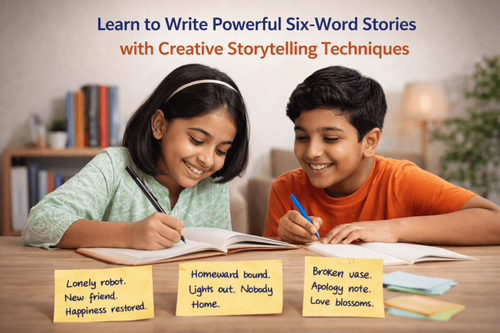

Table of Contents
- Focus on the Core Conflict in Six-Word Stories
- Use High-Value Verbs to Strengthen Your Writing
- The “Turn” or Twist That Makes Stories Memorable
- Leave the Gaps for the Reader’s Imagination
- Practice Techniques to Master Six-Word Stories
- Why PlanetSpark is the Best Choice to Learn Creative Writing
- Transform Your Writing with PlanetSpark Creative Writing for
- Showcase Your Creativity Through Powerful Storytelling
Many people believe storytelling requires long paragraphs and detailed plots. However, six-word stories prove that even a few words can create a powerful emotional impact. Writing such short stories may seem simple, but it actually requires strong creative thinking, clarity, and precision.
If you struggle with expressing ideas concisely or want to improve your short story writing skills, learning how to write six word stories can be a great starting point. These stories sharpen creativity and teach you to choose words carefully.
In this blog, you will learn how to craft impactful six-word stories using techniques like conflict, powerful verbs, twists, and strategic gaps. You will also discover how structured learning can enhance your storytelling skills. Let’s begin with the most important element that drives every great story: conflict.
Focus on the Core Conflict in Six-Word Stories
At the heart of every memorable story lies conflict. Even in six-word stories, conflict is what makes the reader pause, think, and feel something. Without conflict, your story may sound flat or incomplete.
Conflict creates tension and curiosity. It gives your story direction and meaning. In short story writing, especially in six-word formats, you do not have the luxury of explanation. Every word must contribute to the central idea.
Why Conflict Matters
Conflict helps your story stand out by adding depth and emotion. It allows readers to connect with the situation instantly.
A strong conflict can:
- Create curiosity within seconds
- Trigger emotional responses
- Make the story memorable
For example:
“Lost wallet. Found truth. Never same.”
This story hints at a situation, a realization, and a change.
Types of Conflict You Can Use
Even in six words, you can explore different types of conflict.
Some examples include:
- Internal conflict such as fear or doubt
- External conflict such as loss or challenge
- Relationship conflict such as misunderstanding
How to Build Conflict in Six Words
To build conflict effectively:
- Start with a situation
- Add tension or challenge
- End with a shift or outcome
This structure helps your story feel complete despite its brevity.
When you focus on conflict, your six-word stories become meaningful rather than random. It trains your mind to think like a storyteller and strengthens your overall creative writing ability.
Use High-Value Verbs to Strengthen Your Writing
In six-word stories, every word carries weight. You do not have space for filler words or unnecessary details. This is where high-value verbs play a crucial role.
Strong verbs bring action, emotion, and clarity to your story. They replace longer descriptions and make your writing more vivid and engaging.
Why Verbs Matter in Short Story Writing
Verbs are the driving force of your story. They show action and create movement.
Using strong verbs helps you:
- Convey meaning quickly
- Add intensity to your story
- Reduce the need for extra words
For example:
Instead of “He was very scared,” you can write “He trembled.”
Examples of High-Value Verbs
Using impactful verbs can transform your six-word stories.
Consider verbs like:
- Shattered instead of broke
- Whispered instead of said
- Escaped instead of ran
These words add depth without increasing word count.
How to Choose the Right Verbs
Selecting the right verbs requires practice and awareness.
Follow these tips:
- Replace weak verbs with stronger alternatives
- Avoid repetition
- Focus on clarity and impact
Practice Exercise
Try rewriting a simple sentence using stronger verbs.
For example:
“She was very sad” becomes “She mourned silently.”
This exercise improves your ability to write concise and impactful stories.
Mastering high-value verbs is essential if you want to learn how to write six word stories effectively. It also enhances your overall short story writing skills.

The “Turn” or Twist That Makes Stories Memorable
A twist is what makes a six-word story unforgettable. It surprises the reader and adds a deeper meaning to your words.
In such a short format, the twist often comes at the end. It changes how the reader interprets the entire story.
Why the Twist is Important
A good twist creates impact. It makes the reader think beyond the words.
It helps to:
- Add surprise
- Create emotional depth
- Leave a lasting impression
For example:
“Finally home. Realized I never left.”
This creates curiosity and invites interpretation.
Types of Twists You Can Use
Twists can take different forms depending on your story.
You can use:
- Emotional twists that reveal hidden feelings
- Situational twists that change context
- Ironical twists that create contrast
How to Create a Strong Twist
Building a twist requires planning and creativity.
You can:
- Set up an expectation
- Break it in the final words
- Keep it subtle but impactful
Common Mistakes to Avoid
Avoid making your twist confusing or forced.
Be careful not to:
- Overcomplicate the story
- Add unnecessary words
- Lose clarity
A well-crafted twist elevates your six-word stories and makes them stand out. It also builds your ability to think creatively and communicate effectively.
Leave the Gaps for the Reader’s Imagination
One of the most powerful techniques in six-word stories is leaving gaps. Since you have limited words, you cannot explain everything. Instead, you allow the reader to fill in the missing pieces.
This makes your story more engaging and interactive.
Why Gaps Matter in Storytelling
Gaps invite the reader to think and interpret. This creates a deeper connection with the story.
They help to:
- Encourage imagination
- Make stories more engaging
- Add layers of meaning
For example:
“She smiled. He never returned again.”
The reader imagines the backstory.
How to Use Gaps Effectively
Using gaps requires balance. You need to give enough information without over-explaining.
You can:
- Suggest instead of explaining
- Use implied emotions
- Keep the story open-ended
Avoid Overuse of Details
Too many details reduce the impact of your story.
Instead:
- Focus on key elements
- Let readers interpret meaning
- Keep language simple
Practice Tip
Write a story and remove unnecessary words. See if the meaning still holds. Learning to leave gaps improves both your six-word stories and your overall creative thinking.
Practice Techniques to Master Six-Word Stories
Writing six-word stories is a skill that improves with consistent practice. While understanding techniques like conflict, verbs, twists, and gaps is important, applying them regularly is what truly builds mastery. Many learners struggle because they practice randomly instead of following a structured approach.
To improve your six-word stories and overall short story writing skills, you need focused exercises that strengthen creativity, clarity, and word selection.
Start with Daily Writing Prompts
One of the easiest ways to practice is by using prompts. Prompts give direction and reduce the pressure of thinking from scratch.
You can try prompts like:
- A lost opportunity
- A surprising reunion
- A hidden truth
- A childhood memory
For example, using “lost opportunity,” you might write:
“Missed call. Life changed forever afterward.”
Practicing daily with prompts builds consistency and improves your ability to think creatively under constraints.
Rewrite Longer Stories into Six Words
This exercise helps you understand how to condense ideas effectively. Take a paragraph or a short story and try to rewrite it in six words.
This teaches you to:
- Identify the core message
- Remove unnecessary details
- Focus on impact
For instance, a long emotional story can become:
“Waited years. He never came back.”
Experiment with Different Emotions
Great six-word stories often evoke emotions. Practicing with different emotional tones helps you expand your creative range.
Try writing stories based on:
- Happiness
- Fear
- Regret
- Surprise
For example:
“Finally succeeded. Still felt completely empty.”
This exercise improves your ability to connect with readers on an emotional level.
Time-Based Writing Practice
Set a timer for 5 to 10 minutes and write as many six-word stories as possible. This helps you think quickly and reduces overthinking.
Benefits of this method include:
- Faster idea generation
- Improved creativity
- Better decision-making in word choice
Get Feedback and Improve
Writing in isolation can limit your growth. Feedback helps you understand what works and what does not.
You can:
- Share your stories with peers
- Join writing groups
- Learn from expert feedback
This is where structured platforms like PlanetSpark can make a big difference by providing guided feedback and improvement plans.
Track Your Progress
Keep a record of your stories and review them over time. This helps you see improvement and identify patterns.
You may notice:
- Better word choices
- Stronger emotional impact
- More creative twists
Tracking progress keeps you motivated and focused on growth.
Following these practice techniques, will help you not only improve your ability to write six-word stories but also strengthen your overall creative thinking. With consistent effort, you will find it easier to express powerful ideas in fewer words, which is a valuable skill in all forms of communication.
Why PlanetSpark is the Best Choice to Learn Creative Writing
Learning creative writing on your own can be challenging. You may struggle with consistency, feedback, or structured learning. This is where guided learning makes a difference.
PlanetSpark provides a structured and engaging way to develop storytelling skills. It helps learners build confidence and creativity through expert-led sessions.
What Makes PlanetSpark Unique
PlanetSpark focuses on practical learning and real-world application. It ensures that learners not only understand concepts but also apply them effectively.
With PlanetSpark, you get:
- Personalized attention from expert teachers
- Structured modules designed for skill development
- Real-time practice and feedback
How It Helps You Improve
Creative writing requires practice, guidance, and feedback. PlanetSpark provides all three in a supportive environment.
It helps you:
- Improve storytelling techniques
- Build confidence in writing
- Develop consistency
Learn Beyond Basics
PlanetSpark goes beyond basic writing skills. It focuses on creativity, expression, and clarity.
You learn to:
- Write impactful stories
- Think creatively
- Communicate effectively
Transform Your Writing with PlanetSpark Creative Writing for Kids
PlanetSpark has a special creative writing course which is designed for learners who want to develop strong storytelling and writing skills. It helps you master techniques like six-word stories, short story writing, and creative expression.
With expert guidance and structured learning, PlanetSpark makes writing engaging and impactful.
- A personalised skill check to identify your current level with expert teachers
- 1:1 Business communication coaching class by Experts
- TED-Style Training Modules
- Real-Time Practice with Global Peers
- AI Video Feedback and Practice Tools
- Transparent Progress Tracking and Parent Reports
- Focus on clarity, persuasion, and leadership presence
- Continuous performance tracking and improvement plans
Showcase Your Creativity Through Powerful Storytelling
Writing six-word stories teaches you one powerful lesson: less can truly be more. When you learn to express deep ideas in just a few words, you develop clarity, creativity, and confidence.
Every story you write is an opportunity to improve. With consistent practice and the right techniques, you can transform simple ideas into meaningful narratives.
Keep experimenting, stay curious, and enjoy the process of storytelling. With expert guidance, your words will become more powerful, and your ability to connect with readers will grow stronger.
Frequently Asked Questions
They are extremely short stories written in just six words that convey a complete idea or emotion.
Begin with a simple idea, add conflict, and refine your words carefully.
They improve creativity, clarity, and concise writing skills.
Using weak words, over-explaining, and lacking a clear idea.
Practice regularly, read more, and seek feedback.
Yes, it is a great way to develop creativity and expression.
Yes, structured learning improves skills faster with expert guidance.