
Understand Slam Poetry Prompts for Middle School Students


Table of Contents
- What is Slam Poetry and Why It Matters for Teens
- 100+ Slam Poetry Prompts for Middle School Students
- Understanding Rhythm and Rhyme for Class 8
- Slam Poet Vs Spoken Word: Clear Understanding
- How to Write a Slam Poem Step by Step
- How to Perform a Slam Poem with Confidence
- Tips to Make Your Slam Poetry Powerful
- Common Challenges Students Face
- Boost Creativity with PlanetSpark Creative Writing Classes
- Find Your Voice and Own the Stage
Many students struggle to express their thoughts, emotions, and opinions in a creative and confident way. Writing poetry can feel confusing when ideas do not come easily or structure feels overwhelming.
What if your thoughts could turn into powerful words that people actually listen to?
This blog explores slam poetry prompts for middle school, helping you discover meaningful topics, understand rhythm and rhyme for class 8, and learn how to perform a slam poem with confidence. You will also understand slam poet vs spoken word and get practical strategies to improve both writing and performance.
By the end of this guide, you will have everything you need to start writing and performing your own slam poetry.
What is Slam Poetry and Why It Matters for Teens
Slam poetry is a powerful form of performance poetry where emotions, storytelling, and voice come together. It is usually performed live, often within a time limit of around three minutes, and focuses on originality and authenticity.
Unlike traditional poetry, slam poetry allows students to speak freely about real experiences such as identity, school life, friendships, and social issues.
In slam poetry, the way you say something is just as important as what you say. Your tone, pauses, expressions, and confidence all help bring your words to life. This makes it a complete communication activity, not just a writing exercise.
Why Slam Poetry is Important
- Builds confidence in public speaking: Students learn to present their thoughts clearly in front of others, which reduces stage fear over time and builds strong communication skills.
- Encourages emotional expression: It gives teens a safe space to talk about feelings like stress, happiness, fear, or confusion that they may not easily share otherwise.
- Develops creative thinking: Students learn to look at everyday experiences in unique ways and turn simple ideas into powerful messages.
- Improves communication skills: By organizing thoughts into structured poetry, students become better at expressing ideas clearly and effectively.
- Helps students form their own voice: Slam poetry encourages individuality, helping teens discover what they believe in and how they want to express it.
Slam poetry is especially valuable for teens because it gives them a safe space to express thoughts that are often difficult to share otherwise.
Struggling to express your thoughts clearly? Turn your ideas into confident speech. Book your FREE trial class now before slots fill up!
100+ Slam Poetry Prompts for Middle School Students
These slam poetry prompts for middle school are designed to spark creativity and help students explore personal, emotional, and social themes.
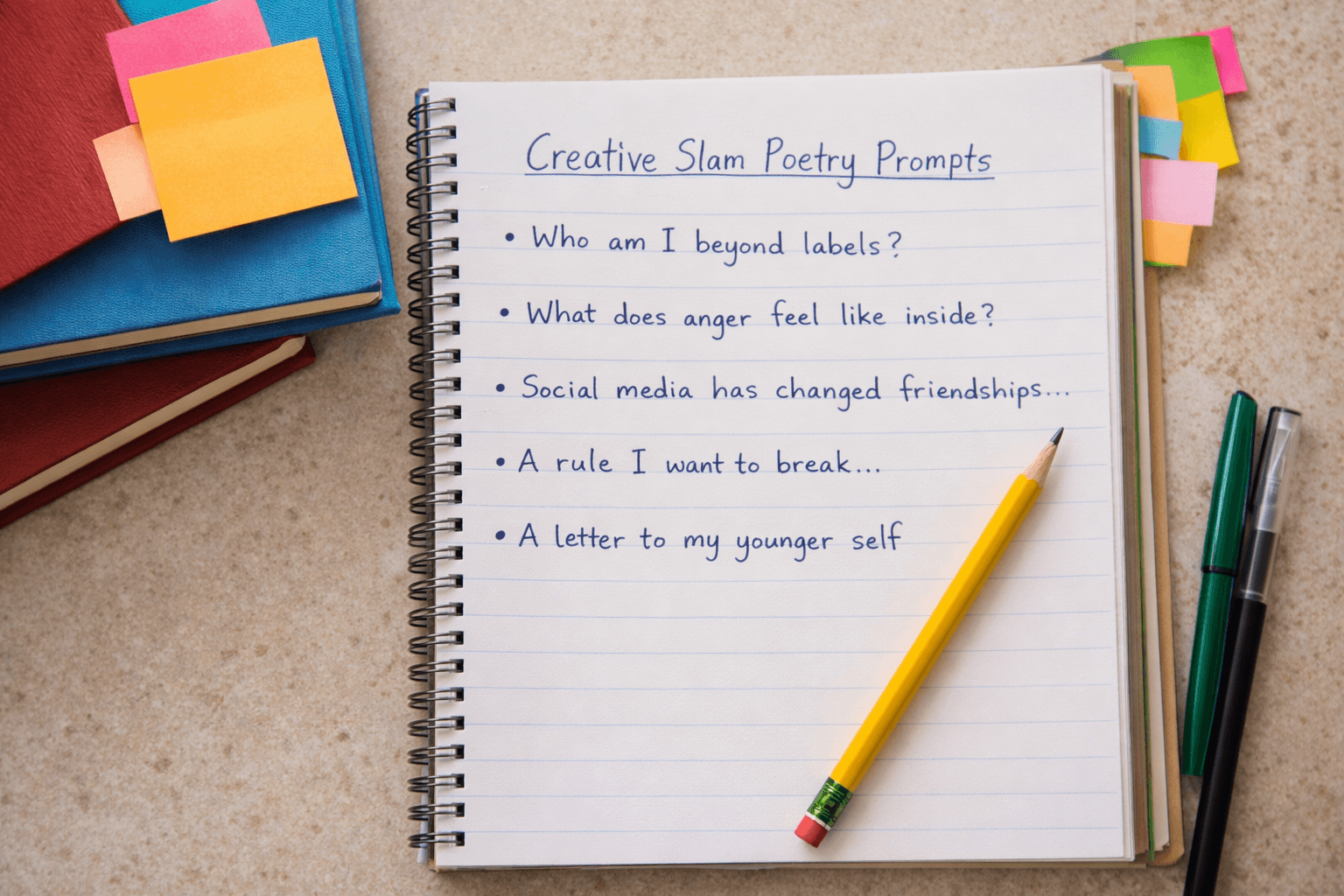
Each category below focuses on a different aspect of self-expression so students can discover what they connect with most.
Identity and Personal Experience Prompts
- Who am I beyond what people see
- The story behind my name
- A moment that changed my life
- The real me vs the me people know
- A fear I want to overcome
- A memory I cannot forget
- My biggest strength and weakness
- A time I felt invisible
These prompts encourage self-reflection and help students explore their identity. Writing about personal experiences often leads to the most powerful and authentic slam poems.
Emotional Expression Prompts
- What anger feels like inside
- A moment of pure happiness
- When I felt completely alone
- Hope during difficult times
- My inner voice speaking to me
These topics help students describe emotions in detail. Instead of simply naming a feeling, they learn to show it through imagery, actions, and sensory details.
Pet Peeves and Strong Opinions
- Something small that frustrates me deeply
- A rule that makes no sense
- An opinion people disagree with
- Why something unfair needs to change
- A stereotype I want to break
These prompts push students to think critically and express strong opinions. They also help in building persuasive speaking skills, which are important in debates and discussions.
Social and School Life Prompts
- My experience with school pressure
- The truth about friendships
- Social media and self image
- Bullying from different perspectives
- What success means to me
These ideas connect poetry with real-life situations that students face daily. This makes their writing more relatable and meaningful for both the writer and the audience.
Object and Metaphor Prompts
- An ode to my phone
- A broken object that represents me
- If my backpack could talk
- A mirror that reflects more than appearance
These prompts develop creativity by encouraging students to use metaphors. They learn to connect objects with emotions or life experiences, which makes their poetry more imaginative.
Imaginative Prompts
- A world where emotions are visible
- If silence had a voice
- A letter from my future self
- A dream that changed everything
These prompts allow students to think beyond reality and explore creative storytelling. They help in building imagination and expanding writing possibilities.
These prompts help students create authentic and meaningful poetry by connecting their thoughts, emotions, and experiences in a structured way.
Running out of creative ideas again and again? Get expert-guided prompts and feedback. Book your demo class today before it is gone!
Understanding Rhythm and Rhyme for Class 8
To make your poem impactful, understanding rhythm and rhyme for class 8 is essential. These elements make your poetry engaging and enjoyable to listen to.
When your poem has a smooth flow and pleasant sound, it becomes easier for the audience to connect with your message and remember your words.
What is Rhythm
Rhythm is the natural flow of words when spoken aloud. It creates a pattern that helps your audience connect with your poem.
Think of rhythm like the beat of a song. Just like music has a steady pattern, your poem should have a flow that sounds natural and not forced. Good rhythm makes your poem easier to perform and more enjoyable to hear.
Example:
I speak my truth
I stand up tall
I will not break
I will not fall
In this example, each line has a similar length and pace, creating a steady rhythm that feels strong and confident.
What is Rhyme
Rhyme happens when words have similar ending sounds. It adds musical quality and makes your poem memorable.
Rhyme helps your poem sound catchy and engaging. However, it should feel natural. Forced rhymes can make your poem sound awkward or unnatural.
Example:
I found my voice, I found my way
No longer lost, I choose to stay
Here, "way" and "stay" rhyme smoothly, making the lines flow well and sound pleasing to the ear.
Tips to Improve Rhythm and Rhyme
- Read your poem aloud: This helps you hear if your poem flows smoothly or feels uneven.
- Use repetition for emphasis: Repeating key words or phrases can create rhythm and make your message stronger.
- Keep sentences simple: Simple sentences are easier to speak and understand during performance.
- Focus on clarity before rhyming: Your message should always be clear. Do not sacrifice meaning just to make words rhyme.
- Avoid forcing rhymes: Choose words that fit naturally instead of trying to match sounds artificially.
With regular practice, rhythm and rhyme will become more natural, helping you create poems that are both powerful and enjoyable to perform.

Slam Poet Vs Spoken Word: Clear Understanding
Understanding slam poet vs spoken word helps students choose their style and improve performance.
While both forms involve performing poetry aloud, they differ in purpose, structure, and presentation style. Knowing these differences helps you decide how you want to express yourself.
Slam Poetry
- Competitive format
- Performed in front of judges
- Time limit usually under three minutes
- Focus on performance and impact
In slam poetry, your goal is to engage the audience and impress judges. Your voice, expressions, and confidence play a major role in how your poem is received.
Spoken Word Poetry
- Non competitive
- Focus on storytelling and expression
- Flexible structure
- Can be recorded or performed
Spoken word poetry allows more freedom. It focuses on sharing experiences and emotions without the pressure of scoring or competition.
Key Difference
Slam poetry involves competition and scoring, while spoken word focuses purely on expression.
In simple terms, slam poetry is like a performance contest, while spoken word is more like sharing your story openly. Both help build confidence and creativity.
Both styles are valuable, but slam poetry adds excitement through performance and audience engagement.
How to Write a Slam Poem Step by Step
Writing a slam poem becomes easier with a structured approach.
Following a step by step process helps you organize your thoughts and turn them into a meaningful and impactful poem.
Step 1: Choose a Meaningful Topic
Pick something personal or emotional. Strong feelings create strong poetry.
The more connected you are to your topic, the more authentic and powerful your poem will feel to the audience.
Step 2: Brainstorm Freely
Write your thoughts without worrying about grammar or structure.
This stage is about letting your ideas flow. Do not stop to edit. Just write everything that comes to your mind.
Step 3: Build Structure
Break your writing into lines and focus on flow.
Start shaping your poem by arranging your ideas into short lines. This helps create rhythm and makes your poem easier to perform.
Step 4: Add Literary Devices
- Repetition
- Metaphors
- Imagery
- Questions
These tools make your poem more expressive and engaging. For example, metaphors help you compare ideas creatively, while repetition strengthens your message.
Step 5: Edit and Refine
Read aloud and improve clarity and impact.
Editing helps you remove unnecessary words, improve flow, and make your poem stronger and clearer.
Step 6: Prepare for Performance
This connects directly to how to perform a slam poem.
Once your poem is ready, practice delivering it with emotion, clarity, and confidence. Performance is what makes slam poetry truly powerful.
Not sure how to turn your ideas into structured writing? Learn step by step writing frameworks. Book your FREE trial class now!
How to Perform a Slam Poem with Confidence
Learning how to perform a slam poem is essential for making your poetry impactful.
Even a well-written poem can lose its effect if it is not performed confidently. Performance helps you connect emotionally with your audience.
Performance Rules
- No props or costumes
- No background music
- The author must perform
- Keep it under three minutes
These rules ensure that the focus remains on your words and your voice.
Performance Techniques
- Maintain eye contact: Helps build connection and trust with the audience.
- Use expressive gestures: Hand movements and facial expressions add emotion to your words.
- Vary tone and pace: Changing your voice keeps the audience engaged and highlights important parts.
- Pause for effect: Pauses create suspense and give your audience time to absorb your message.
- Emphasize key lines: Highlight important ideas so they leave a lasting impact.
Practice Methods
- Practice in front of a mirror: Helps you observe your body language and expressions.
- Record yourself: Allows you to identify areas for improvement.
- Perform for friends: Builds confidence in a comfortable environment.
- Focus on clarity: Make sure your words are clear and easy to understand.
Common Mistakes
- Speaking too fast: This makes it hard for the audience to follow your poem.
- Avoiding eye contact: Reduces connection with listeners.
- Overacting: Too much expression can feel unnatural. Keep it balanced.
- Lack of practice: Without practice, even a great poem can lose impact.
Feeling nervous about speaking in front of others? Build stage confidence with expert coaches. Book your demo class before slots fill!
Tips to Make Your Slam Poetry Powerful
To stand out, your poem must be authentic and engaging.
The most memorable slam poems are those that feel real, emotional, and relatable.
Key Tips
- Keep it real and personal: Authenticity helps your audience connect with your story.
- Use vivid imagery: Describe scenes and emotions so clearly that the audience can visualize them.
- Show, do not tell: Instead of simply stating emotions, describe actions and sensations.
- Focus on emotions: Strong feelings make your poem more impactful.
- Be original: Avoid copying ideas. Your unique voice is your strength.
Example
Instead of saying “I was scared,” say:
“My hands trembled, my voice faded, my heart raced like thunder.”
This creates a clear picture in the listener’s mind and makes the emotion more powerful.
These techniques make your poetry more relatable and impactful.
Common Challenges Students Face
1. Fear of Judgement
Start by sharing your poem with close friends. This helps you gain confidence gradually without feeling overwhelmed.
2. Lack of Ideas
Use slam poetry prompts for middle school regularly. Prompts give direction and help you overcome writer’s block.
3. Difficulty in Writing
Focus on expressing feelings rather than perfection. Your first draft does not need to be perfect. Focus on honesty and clarity.
4. Stage Fear
Practice in small groups.Gradual exposure helps reduce nervousness and builds confidence.
5. Low Confidence
Celebrate small improvements. Every small step forward helps you grow as a writer and performer.
Still feeling stuck or unsure where to start? Get personalised guidance and feedback. Book your FREE trial class today!
Boost Creativity with PlanetSpark Creative Writing Classes
PlanetSpark creative writing classes are designed for students who want to become confident writers and speakers through structured and engaging learning experiences. These classes go beyond basic writing and focus on building creativity, clarity, and communication skills.
Students often struggle with organizing thoughts, expressing ideas clearly, and maintaining consistency in writing. PlanetSpark solves these challenges through a personalised and structured approach.
What Makes PlanetSpark Different
- 1:1 personal trainers for every child for focused attention
- Personalised curriculum based on learning gaps and goals
- SparkX AI tool for detailed performance analysis
- AI-led practice sessions for independent learning
- Spark Diary to build daily writing habits
- Gamified learning tools like SparkBee for vocabulary and grammar
- Access to SparkShop eBooks for additional practice
Advanced Learning Ecosystem
- Regular parent teacher meetings
- Detailed progress reports with actionable insights
- Clubs like Debate Club, Poetry Circle, Writers Guild
- Safe sharing platform Sparkline for student content
- Competitions, open mic sessions, and showcases
This structured ecosystem ensures that students not only learn but consistently improve and gain confidence in real world communication.

Find Your Voice and Own the Stage
Slam poetry is not just about writing. It is about expressing who you are with confidence and clarity. When you start using slam poetry prompts for middle school, you begin to understand your thoughts, emotions, and voice in a deeper way.
Keep practicing, keep experimenting with rhythm and rhyme for class 8, and continue learning how to perform a slam poem with confidence. Growth takes time, but every word you write brings you closer to becoming a powerful communicator.
Your voice matters. Use it.
Frequently Asked Questions
At PlanetSpark, we define slam poetry prompts for middle school as guided ideas that help students express emotions, identity, and opinions creatively.
We recommend practicing voice modulation, maintaining eye contact, and using body language to engage your audience confidently.
Slam poetry is competitive and performance based, while spoken word focuses on expression without judging.
It helps students make their poems engaging, structured, and easier to perform.
Yes. At PlanetSpark, we guide beginners step by step using prompts, frameworks, and feedback.
A typical slam poem should be under three minutes for effective performance.
Consistent practice, feedback, and structured learning can significantly improve writing and performance skills.