
Learn What is Pacing in Writing with Examples

Table of Contents
- What Is Pacing in Writing?
- Pacing Definition in Literature
- Why Pacing in Writing Matters for Students
- Fast Pacing Vs Slow Pacing
- How Writers Control Pacing
- Examples of Pacing in Writing
- Common Pacing Mistakes Students Make
- How to Fix These Mistakes
- How Students Can Improve Pacing in Writing
- Help Your Child Become a Powerful Storyteller with PlanetSpa
- Conclusion: Master the Rhythm of Great Writing
Why do some stories make you turn pages quickly, while others feel boring after just a few lines? The answer is pacing.
If you are wondering what is pacing in writing, it is the speed, rhythm, and flow at which a story unfolds for the reader. Pacing decides when readers feel suspense, excitement, emotion, curiosity, or relief. A well-paced story keeps readers engaged from the first sentence to the final line.
For students, pacing is one of the most powerful creative writing skills because it helps transform simple ideas into exciting stories. In this guide, you will learn the pacing definition in literature, examples of fast and slow pacing, techniques writers use, common mistakes to avoid, and how students can master pacing through practice.
Whether you write school essays, short stories, speeches, or competition entries, learning pacing can instantly improve your writing quality.
What Is Pacing in Writing?
Pacing in writing refers to how quickly or slowly readers experience events in a story. It is the rhythm of the narrative and the speed at which information, action, emotions, and scenes are revealed. Good pacing helps readers stay interested and emotionally connected from beginning to end.
Pacing is not only about how many things happen in a story. It is about how much attention the writer gives each moment.
For example:
- A one-minute chase scene may take three pages because the writer adds suspense, movement, thoughts, and sensory details.
- A whole year might pass in one sentence if those events are not central to the plot.
This means pacing is really about controlling reader attention and emotional experience.
Think of pacing as the heartbeat of a story:
- Fast heartbeat = tension, urgency, danger, excitement
- Slow heartbeat = reflection, emotion, world-building
- Balanced heartbeat = satisfying storytelling that feels natural
Good pacing helps readers:
- Stay interested throughout the story
- Understand plot progression clearly
- Feel connected to characters and their emotions
- Experience suspense at the right moments
- Enjoy a smooth reading rhythm
Without strong pacing, stories can feel rushed, dull, confusing, or repetitive.
Pacing Definition in Literature
The pacing definition in literature is the rate at which a narrative moves and reveals events, character information, and tension. Authors carefully manage pacing to shape the reader’s emotional response.
Different genres use pacing in different ways:
1. Mystery Stories
Writers often slow the pace by revealing clues one at a time. This creates suspense and curiosity, making readers want to solve the mystery.
2. Adventure Stories
These stories usually use faster pacing during action scenes, battles, escapes, or discoveries to maintain excitement.
3. Fantasy Stories
Fantasy stories may slow the pace to explain magical worlds, cultures, or history. This helps readers understand the setting.
4. Drama Stories
Drama often uses balanced pacing, combining emotional conversations, conflicts, and thoughtful scenes.
5. Horror Stories
Horror frequently alternates between slow and fast pacing. Quiet scenes build tension, then sudden danger creates shock.
In literature, pacing is one of the most important storytelling tools because it controls tension. Readers keep turning pages when writers know exactly when to slow down and when to speed up.
Want your child to write stories readers cannot stop reading?
Book a FREE PlanetSpark trial class today before this week’s slots fill up.
Why Pacing in Writing Matters for Students
Many students focus only on grammar and vocabulary. While these are important, pacing often decides whether writing feels exciting or boring.
Strong pacing helps students:
1. Write Engaging School Stories
Even a simple idea becomes more interesting when events unfold at the right speed.
2. Improve Marks in Creative Writing Tasks
Teachers often reward writing that feels organized, clear, and engaging.
3. Perform Better in Competitions
Good pacing keeps judges and audiences interested during storytelling contests.
4. Hold Audience Attention During Speeches
Pacing matters in spoken storytelling too. Pauses and speed changes create impact.
5. Show Advanced Storytelling Skills
Students who understand pacing often appear more mature and confident as writers.
6. Build Suspense and Emotion Naturally
Pacing helps readers feel curious, excited, nervous, or emotional at the right moments.
Example
A student writes:
"Rahul entered the cave. He found treasure."
This gives information, but little emotion or suspense.
Now with pacing:
"Rahul stepped into the dark cave. Water dripped from the ceiling. His torch shook in his hand. Then something glittered in the shadows."
The second version slows the moment down, allowing readers to feel curiosity and tension before the treasure appears.
That is why learning pacing in writing helps students stand out academically and creatively.
Fast Pacing Vs Slow Pacing
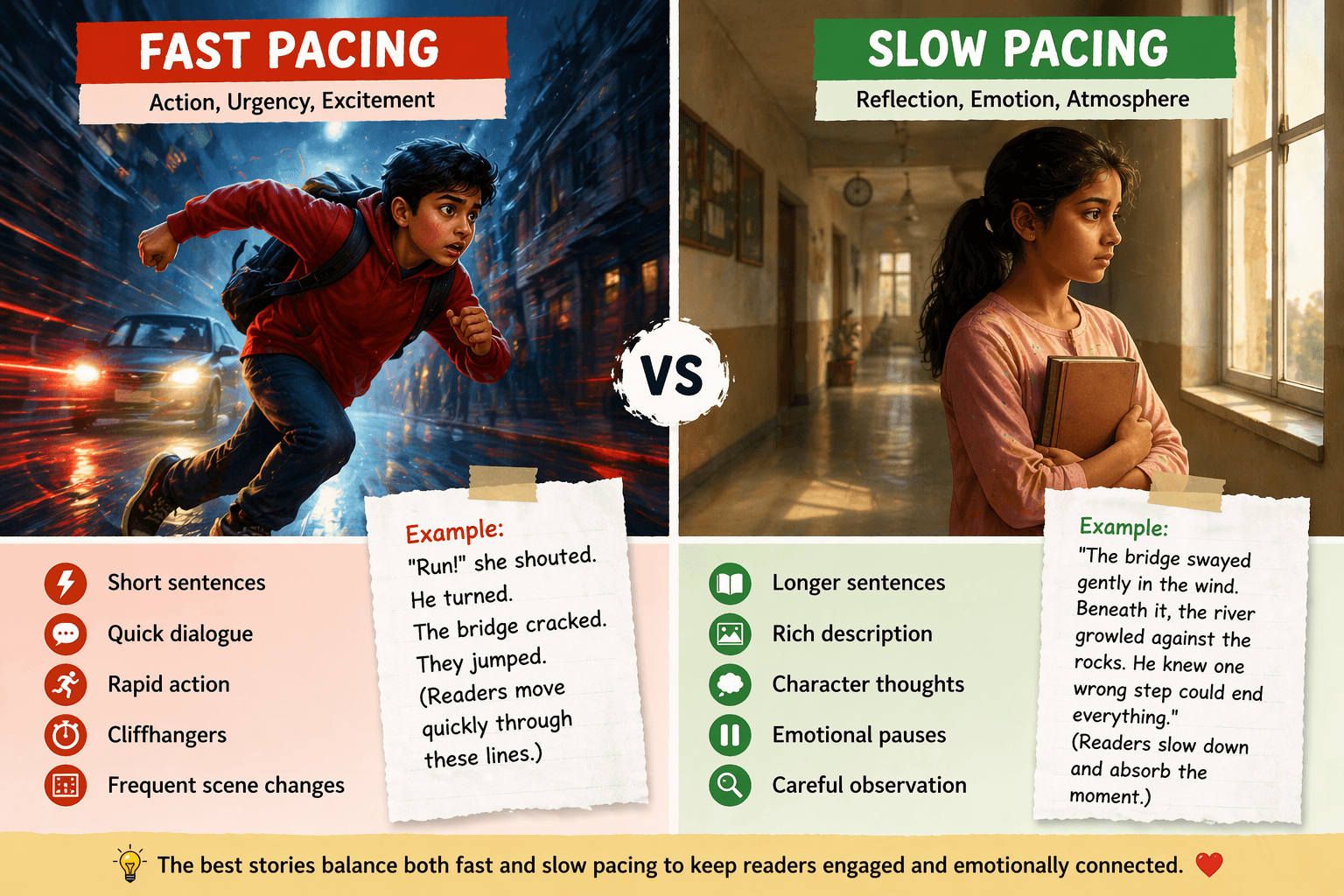
Great stories need both fast and slow pacing. Each creates a different effect.
Fast Pacing
Fast pacing creates urgency, danger, excitement, or momentum. It is often used during action scenes or major turning points.
Writers use:
1. Short Sentences
They are quicker to read and create a sense of speed.
2. Quick Dialogue
Rapid conversations increase tension and movement.
3. Rapid Action
Multiple things happening quickly keeps readers alert.
4. Cliffhangers
Ending scenes with unanswered questions pushes readers forward.
5. Frequent Scene Changes
Moving quickly between locations or events creates energy.
Example
"Run!" she shouted.
He turned.
The bridge cracked.
They jumped.
Readers move quickly through these short lines, which mirrors the danger in the scene.
Slow Pacing
Slow pacing builds emotion, atmosphere, suspense, or reflection. It is useful for important emotional moments or rich descriptions.
Writers use:
1. Longer Sentences
These naturally slow the reading speed.
2. Rich Description
Details about setting or mood allow readers to imagine the scene.
3. Character Thoughts
Inner feelings deepen emotional connection.
4. Emotional Pauses
Moments of silence or reflection give weight to events.
5. Careful Observation
Small details can create tension before something happens.
Example
"The bridge swayed gently in the wind. Beneath it, the river growled against the rocks. He knew one wrong step could end everything."
Readers slow down and absorb the danger.
Key principle
- A story with only fast pacing feels exhausting.
- A story with only slow pacing feels dull.
The best stories balance both.
How Writers Control Pacing
Writers use several tools to manage speed and rhythm.
1. Sentence Length
Short sentences increase speed because they are quick to process.
Example: He ran. She screamed. The door slammed.
Longer sentences slow readers down and create a thoughtful mood.
Example: He paused at the doorway, listening to the storm as the old house trembled around him.
2. Paragraph Length
Small paragraphs feel faster and more intense because the eye moves quickly down the page.
Large paragraphs feel slower and more detailed because readers stay longer in one block of text.
3. Dialogue
Dialogue often speeds pacing because conversations move naturally and quickly.
Example:
"Where is it?"
"I lost it."
"You what?"
This creates immediate tension.
4. Description
Detailed settings, emotions, or objects slow pacing because readers pause to imagine the scene.
Example: describing a dark forest before a character enters it builds suspense.
5. Scene Focus
Important scenes deserve more space. Writers slow down key moments to maximize emotional impact.
Less important scenes may be summarized.
Example:
- Important: the hero’s final battle
- Less important: three days of travel
6. Chapter Endings
Ending chapters with suspense encourages readers to continue.
Example:
"Then she saw who was standing in the doorway."
This increases momentum.
7. Emotional Pause
After intense scenes, writers often slow pacing to let characters and readers process what happened.
For example, after an argument, a quiet reflection scene gives emotional depth.
Does your child have ideas but struggle to turn them into stories?
Book a demo class now and unlock guided creative writing mentorship.
Examples of Pacing in Writing
Understanding pacing becomes easier when you see it in action. Below are examples of fast pacing, slow pacing, and mixed pacing, along with explanations of why each style works.
Example 1: Fast Pacing
"The bell rang. Maya grabbed her bag and ran. Footsteps followed behind her. She did not look back."
Why It Works
Short Sentences
The sentences are brief and direct. Readers move quickly from one action to the next, which creates speed and urgency.
Immediate Action
The story begins with movement right away. There is no long explanation, so readers are instantly pulled into the scene.
Strong Urgency
Maya is running, someone is following her, and she refuses to look back. This creates tension and makes readers wonder what will happen next.
Reader Effect
Fast pacing makes readers feel nervous, excited, and eager to continue reading.
Example 2: Slow Pacing
"Maya stood alone in the empty hallway. Dust floated through the afternoon light. She tightened her grip on the old note before opening it."
Why It Works
Description
The hallway, floating dust, and afternoon light help readers clearly imagine the scene. This slows the reading speed in a positive way.
Suspense
The old note creates curiosity. Readers want to know what is inside, so the delay builds tension.
Emotional Pause
Maya tightening her grip suggests nervousness or fear. This pause helps readers connect emotionally with her.
Reader Effect
Slow pacing creates atmosphere, mystery, and emotional depth.
Example 3: Mixed Pacing
"The hallway was silent. Maya heard one step behind her. Then another. She ran."
Why It Works
Slow Tension at the Start
The silence and footsteps build suspense. Readers sense danger approaching.
Sudden Fast Action
The final sentence, She ran, changes the pace instantly and releases the tension into action.
Balance
This combination keeps the story dynamic. Readers get suspense first, then movement.
Reader Effect
Mixed pacing is powerful because it mirrors real emotions. Fear builds slowly, then reaction happens quickly.
Your child’s confidence growth can begin this week.
Book a FREE trial class today before new batch seats close.
Common Pacing Mistakes Students Make
Many students have creative ideas but lose reader interest because pacing is uneven. Here are common mistakes and why they weaken writing.
1. Too Much Description
Some students spend too much time describing rooms, weather, clothes, or objects that are not important.
Why It Hurts
The story stops moving forward, and readers may lose patience.
Example
Instead of describing every tree in a forest, focus on details that create mood or affect the plot.
2. Too Many Events at Once
Sometimes students try to fit every exciting idea into one paragraph.
Why It Hurts
Readers feel confused because they do not have time to process each event.
Example
If a character fights a monster, finds treasure, meets a stranger, and escapes all in five lines, the story feels rushed.
3. No Emotional Pause
Some stories move from one action scene to another without giving characters time to react.
Why It Hurts
Readers may stop caring because emotions are missing.
Example
After a dangerous escape, a short quiet scene can show fear, relief, or growth.
4. Repetition
Repeating the same type of scene again and again slows momentum.
Why It Hurts
Readers feel like nothing new is happening.
Example
If every chapter shows the hero walking and thinking, the pace becomes dull.

5. Long Backstory at the Start
Students sometimes explain a character’s full history before the story begins.
Why It Hurts
Readers usually want action, conflict, or curiosity early in the story.
Better Approach
Start with something interesting first, then reveal the backstory naturally later.
6. Rushed Endings
Many students spend lots of time building conflict but solve everything too quickly.
Why It Hurts
Readers feel unsatisfied because the ending lacks emotional payoff.
Example
If the hero searches for treasure for ten pages, finding it in one sentence feels weak.
How to Fix These Mistakes
Strong pacing often comes during editing. Here are practical solutions.
1. Cut Unnecessary Details
Remove descriptions that do not create mood, reveal character, or move the plot.
Ask yourself: Does this detail matter?
2. Expand Important Moments
Spend more time on scenes that are emotional, dangerous, surprising, or meaningful.
Readers enjoy key moments when they feel fully developed.
3. Use Dialogue
Dialogue speeds pacing and reveals personality naturally.
Instead of explaining conflict, let characters speak.
4. Read Aloud
Reading aloud helps you hear awkward rhythm, slow sections, or rushed scenes.
If you stumble or get bored, revise that section.
5. Ask Others for Feedback
Friends, parents, or teachers can tell you where they lost interest or felt confused.
Fresh readers notice pacing problems quickly.
6. Rewrite Weak Scenes
Sometimes the best solution is rewriting a scene from scratch with clearer focus and better rhythm.
How Students Can Improve Pacing in Writing
Pacing improves with regular practice. Students can train this skill using simple habits.
1. Read Strong Stories
Pay attention to books or stories you enjoy.
Ask:
- Where did the story feel exciting?
- Where did it slow down emotionally?
- How did the writer do that?
This builds instinct for pacing.
2. Practice Scene Rewriting
Write the same scene in two ways:
Once Fast
Use short sentences and action.
Once Slow
Use description, thoughts, and atmosphere.
This teaches control over rhythm.
3. Use Timed Writing Exercises
Set a timer for 10 minutes and write a scene with clear beginning, middle, and end.
This builds focus and flow.
4. Read Aloud Again
Reading aloud is one of the fastest ways to improve pacing because you can hear rhythm immediately.
5. Highlight Boring Sections
When editing, mark any section where you lose interest.
If the writer is bored, the reader may be too.
6. Get Expert Feedback
A good teacher or mentor can quickly identify where to cut, slow down, or expand scenes.
Guidance often speeds growth dramatically.
Still unsure how to help your child become a confident writer?
Reserve a free PlanetSpark class now. Limited trial slots available this month.
Help Your Child Become a Powerful Storyteller with PlanetSpark’s Creative Writing Classes
Many children have amazing imaginations but struggle to structure ideas into engaging stories. PlanetSpark creative writing classes help students learn storytelling, grammar, expression, vocabulary, and confidence through a structured system guided by experts.
PlanetSpark combines live teaching, AI tools, practice platforms, contests, and publishing opportunities to help children grow faster than self-learning alone.
Why Parents Choose PlanetSpark
1. 1:1 Personal Trainers
Every child learns differently. PlanetSpark offers personalized one-on-one live classes where trainers adapt to learning pace, strengths, and challenges.
2. Customized Learning Roadmap
Skill gaps are identified in:
- Grammar
- Vocabulary
- Story structure
- Fluency
- Confidence
Then a roadmap is created.
3. SparkX AI Video Analysis
Children upload speeches or storytelling videos. AI analyzes:
- Voice clarity
- Body language
- Confidence
- Grammar usage
- Flow of ideas
4. AI Practice Sessions
Students practice independently with instant feedback on storytelling and speaking.
5. Spark Diary
A digital journal where children build daily writing habits through guided prompts.
6. Gamified Learning
Includes:
- Grammar Guru Challenge
- Word Wisdom
- Spell Knockout
- Daily Quizzes
7. Publishing Opportunities
Children can publish stories on internal platforms, blogs, and showcases.
8. Clubs & Communities
- Debate Club
- Story Writing Club
- Podcasting Club
- Writers Guild
9. Progress Reports for Parents
Regular structured feedback tracks measurable growth.
10. Safe Expression Platform
Children share creative work in moderated spaces that build digital confidence.
Why Structured Learning Matters
Children often improve faster when they receive:
- Real-time feedback
- Weekly goals
- Writing frameworks
- Consistent accountability
- Expert correction
- Confidence coaching
That is exactly where PlanetSpark adds value.

Conclusion: Master the Rhythm of Great Writing
Now that you understand what is pacing in writing, you can see why some stories feel unforgettable while others are quickly forgotten. Pacing gives writing life, movement, suspense, and emotional depth.
For students, mastering pacing is a long-term advantage. It improves storytelling, school performance, communication, and confidence.
The more you practice controlling speed, pause, and rhythm, the stronger your writing becomes.
Great writers do not just tell stories. They control how readers feel every moment of the journey.
Frequently Asked Questions
Pacing in writing is the speed and rhythm of how readers experience events in a story. It helps control suspense, emotion, and excitement.
Good pacing helps students write engaging stories, score better in creative tasks, and communicate ideas clearly.
Children learn pacing through guided writing practice, reading analysis, scene-building exercises, and expert feedback.
Yes, PlanetSpark offers structured creative writing courses that help children learn story building, descriptive writing, grammar, vocabulary, and storytelling through fun and interactive sessions.
PlanetSpark offers personalized live learning formats, including focused one-on-one guidance.
Yes. Better story flow, structure, and clarity often improve academic writing performance.
Programs are designed for school-going children across age groups with level-based learning paths.
You can begin with a free trial class to understand your child’s current level and growth path.