
Learn Zeugma Meaning Usage and Examples With PlanetSpark


Table of Contents
- What Is Zeugma? (Zeugma Meaning Explained Simply)
- The Origin of Zeugma: A Quick Look Back
- Why Writers Love Using Zeugma
- Types of Zeugma (With Examples)
- 50+ Powerful Zeugma Examples for All Levels
- How to Identify a Zeugma Easily
- How to Use Zeugma in Your Own Writing (Tips for Students & W
- Why Learning Zeugma Matters for Students
- Eshaan’s Journey From Classroom Writer to Author
- Master Literary Devices Like Zeugma
- Why PlanetSpark Is the Best Place to Build Exceptional Skill
- Grow Skills, Confidence, and Creativity Through PlanetSpark
Zeugma is a unique figure of speech where one word connects different ideas to create clarity, impact, or humour. This guidance helps you understand its meaning, types, and effective usage with simple explanations and examples. Learning such advanced language tools strengthens writing and communication skills for students. With PlanetSpark’s engaging learning methods, children can master concepts like zeugma easily and develop strong creative expression and confident speaking abilities.
What Is Zeugma? (Zeugma Meaning Explained Simply)
To understand the Zeugma figure of speech, let’s begin with a simple definition.
Zeugma is a literary device in which a single word, usually a verb or an adjective, is used to modify or govern two or more words in a sentence, even though the word logically applies to only one of them.
The effect?
A sentence that is witty, surprising, elegant, or sometimes humorously ambiguous.
Basic Example:
“She broke his car and his heart.”
The verb broke applies literally to the car and figuratively to the heart.
This is the core of Zeugma meaning one shared word connects two different ideas, producing a stylistic twist.
Writers use zeugma to:
Make writing more compact
Create clever contrasts
Add humor or sarcasm
Highlight emotional and intellectual duality
With the right training, even young learners can master such devices, enhancing both academic writing and creative expression.
The Origin of Zeugma: A Quick Look Back
The word Zeugma comes from the Greek term zeugnynai, meaning to yoke, to join, or to link together.
Just like two oxen are yoked together to pull a cart, a zeugma “yokes” multiple parts of a sentence using a single controlling word.
Ancient Greek and Latin writers frequently used zeugma in poetry and rhetoric. Over time, English literature adopted it as a hallmark of clever expression.
Why Writers Love Using Zeugma
Before diving into extensive Zeugma examples, let’s understand why this figure of speech is so powerful:
1. It Creates Clarity With Brevity
Instead of repeating the verb or adjective, zeugma condenses the sentence without losing meaning.
2. It Adds Surprise
The unexpected pairing often catches the reader’s attention.
3. It Builds Emotional & Intellectual Contrast
Literal and figurative meanings appear in a single frame.
4. It Enhances Humour & Sarcasm
Witty writers use zeugma to deliver impactful humor.
5. It Enriches Style
From Shakespeare to Dickens to modern authors, zeugma adds sophistication to writing.
These are the same outcomes students experience in PlanetSpark’s communication programs where children learn not just what to say but how to say it creatively.
Types of Zeugma (With Examples)
Zeugma can appear in different forms. Here are the major types with detailed explanations and examples.
A. The Classical Zeugma
This is the traditional version: one word governs two others even when it fits only one grammatically.
Example:
“She opened the door and her heart to the stranger.”
The verb opened is only grammatically correct with door, but the figurative expression gives emotional depth.
Help Your Child Become a Powerful Young Storyteller
B. The Semantic Zeugma
Here, the shared word applies to both parts semantically, but in different senses.
Example:
“He lost his keys and his temper.”
The verb lost works logically, but the meanings differ.
C. The Synecdoche like Zeugma
A verb takes two objects in a way that is grammatically correct for both but stylistically surprising.
Example:
“You can tune a guitar, but you can’t tuna fish.”
This often produces humor.
D. The Prozeugma
Here, the controlling word appears at the beginning of the sentence and governs subsequent clauses.
Example:
“She loved coffee, books, and quiet mornings.”
The verb loved is used once but applies to multiple objects.
E. The Mesozeugma
The controlling word appears in the middle of the sentence.
Example:
“The car was sleek, the driver confident, the journey smooth.”
The verb was applied to all three phrases.
F. The Hypozeugma
The controlling word comes at the end.
Example:
“The sun, the water, and the sand all dazzled.”
This creates a powerful closing effect.
Build Strong Writing Skills That Last a Lifetime!
Claim Your Complimentary Trial Session!
50+ Powerful Zeugma Examples for All Levels
To understand the richness of the device, here are classified examples.
A. Humorous Zeugma Examples
“He stole my wallet and my peace of mind.”
“She lifted her eyebrows and the mood of the room.”
“He caught the bus and a cold.”
B. Emotional & Poetic Zeugma Examples
“She carried her dreams and her suitcase into the new city.”
“He held her hand and his breath.”
“The sunset filled the sky and my heart with warmth.”
C. Smart Academic Zeugma Examples
“The teacher addressed the class and the growing noise.”
“The scientist measured the results and the risks.”
D. Modern Conversational Zeugma Examples
“I need to fix my schedule and my life.”
“She changed her hairstyle and her attitude.”
“He left the meeting and his patience behind.”
E. Classic Literary Zeugma Examples
1. Charles Dickens
“She looked at the object with suspicion and a magnifying-glass.”
2. Alexander Pope
“Or stain her honour, or her new brocade.”
3. Sylvia Plath
Often used in poetic imagery to pair emotions and actions.
These timeless writers used zeugma to create striking contrasts, something students at PlanetSpark learn to do through guided writing activities.
Boost Grammar, Vocabulary, and Story Structure Effortlessly!
Start Your Free Trial Right Away!
How to Identify a Zeugma Easily
Here’s a simple formula:
Step 1: Locate the shared verb or adjective.
Scan the sentence to find the single verb or adjective that appears once but seems to relate to multiple nouns or phrases; this word is the candidate 'yoke' or controller.
Step 2: Identify the parts it governs.
Mark each noun, pronoun, or phrase connected to that controlling word, noting grammatical roles (object, complement) and their positions so you can see which sentence elements the controller links together.
Step 3: Check if the meanings differ in literal, figurative, or logical sense.
Compare how the shared word applies to each governed element; determine whether it carries literal, figurative, or distinct logical senses for each object, producing semantic contrast or multiple interpretations thereby.
Step 4: See if the sentence gains cleverness or compression.
Evaluate the effect: does the construction add wit, emphasis, economy, or ambiguity? Assess whether meaning is clearer or artfully compacted, ensuring the zeugma enhances rather than confuses communication for readers.
If you find surprising pairings, contrasting meanings, or stylistic brevity which is likely a zeugma.
How to Use Zeugma in Your Own Writing (Tips for Students & Writers)
Using zeugma well requires a blend of creativity and clarity. Here’s how to do it:
Tip 1: Start with a Strong Verb
Use a vivid, impactful verb that can connect two different ideas smoothly. A strong verb creates contrast, adds energy, and makes the zeugma sound clever and intentional.
Example:
“She changed her clothes and the entire conversation.”
Tip 2: Pair Literal & Figurative Meanings
Combine a literal action with a figurative idea for an engaging effect. This contrast creates depth, highlights dual meanings, and produces the surprise that makes zeugma memorable and effective.
Example:
“He carried her books and her hopes.”
Tip 3: Keep the Sentence Clear
Ensure your zeugma doesn’t confuse readers. The contrast should feel clever, not complicated. The sentence must remain understandable, natural, and easy to interpret despite its stylistic twist.
Turn Everyday Experiences Into Extraordinary Stories!
Book Your Free Introductory Session!
Tip 4: Use It Sparingly
Zeugma works best when used occasionally. Too many stylistic twists can distract readers. Include just one strong, meaningful zeugma in a paragraph to maintain elegance and clarity.
Tip 5: Practice Through Creative Writing
Regular practice helps students craft better zeugmas. Writing prompts, storytelling, speeches, and exercises like those at PlanetSpark build skill, creativity, and confidence in using advanced literary devices effectively.
Why Learning Zeugma Matters for Students
Many parents wonder: Is learning such advanced figures of speech necessary for kids?
Yes—absolutely.
And here’s why:
1. Improves creative writing
Students learn to express complex ideas in fewer words.
2.Enhances vocabulary
They understand how words shift in meaning across contexts.
3. Sharpens analytical skills
Identifying zeugma strengthens literary analysis.
4.Makes communication stylish
It adds personality, humour, and depth to writing and speaking.
These are key skills nurtured at PlanetSpark, where children grow into confident, expressive communicators capable of using advanced literary techniques with ease.
Eshaan’s Journey From Classroom Writer to Author
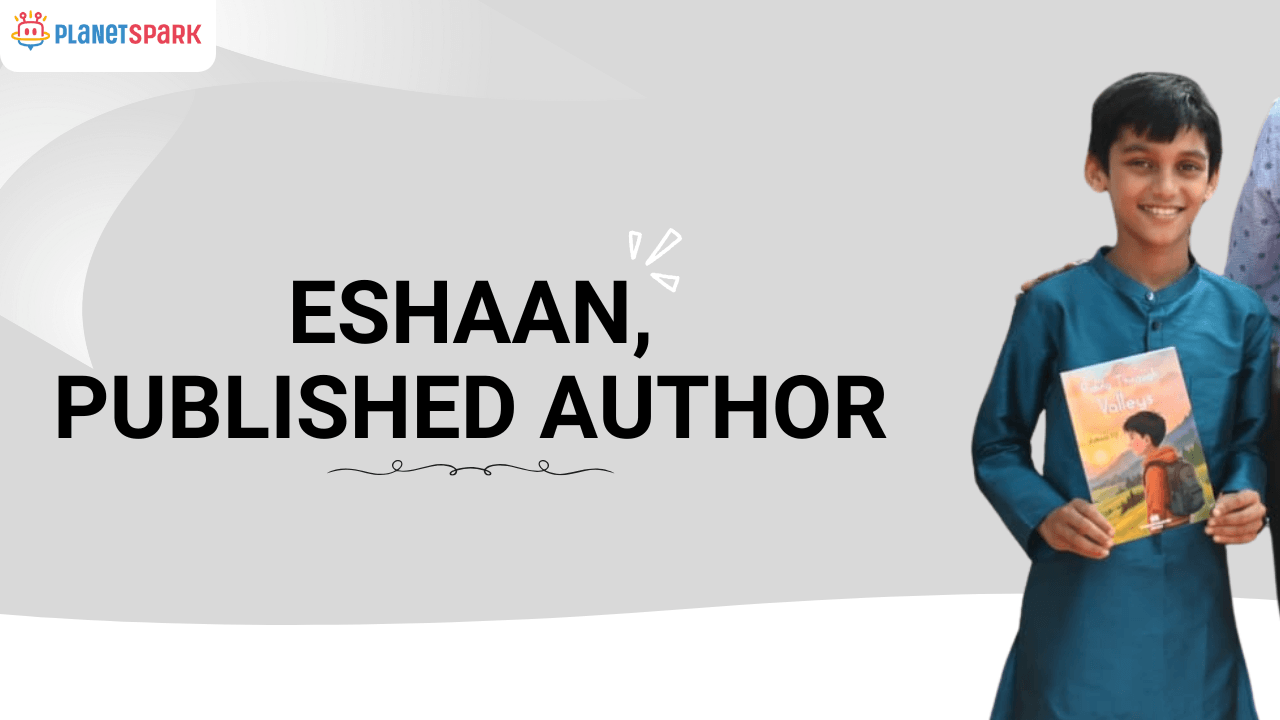
Eshaan has officially become a published author, turning classroom activity into a captivating storybook.
Your child can achieve success like this too. With PlanetSpark’s expert guidance, students learn to write confidently, think creatively, and turn ideas into real accomplishments. Enrol your child today and let them create their own inspiring success story.
Master Literary Devices Like Zeugma
PlanetSpark’s learning approach blends:
Creative Writing
Public Speaking
Vocabulary building
Advanced grammar
Literary appreciation
Speech crafting
Students not only understand concepts like Zeugma meaning but also apply them in stories, essays, speeches, poems, debates, and even stand-up comedy routines.
As a result, children become:
Clear thinkers
Confident speakers
Impressive writers
Creative problem-solvers
If you want your child to express ideas elegantly with devices like zeugma, metaphors, irony, and more, PlanetSpark offers the perfect platform.
Why PlanetSpark Is the Best Place to Build Exceptional Skills
PlanetSpark offers a complete learning ecosystem that helps children become confident, expressive, and imaginative writers. With expert-led classes, AI-powered tools, and engaging activities, students don’t just learn writing—they master the art of storytelling, clarity, structure, and creativity. Here’s how PlanetSpark transforms every child into a skilled young author:
What PlanetSpark Offers for Creative Writing Excellence
1:1 Personal Trainers who guide children through grammar, storytelling, vocabulary, and expression
Personalised Writing Curriculum tailored to your child’s level, goals, and pace
Spark Diary for daily writing practice that builds consistency and creativity
Genre-Based Learning covering stories, poems, essays, book reviews, speeches, and more
Creative Stimulus Activities like story dice, picture prompts, and imagination games
Real Publishing Opportunities through blogs, e-magazines, anthologies, and showcases
SparkX AI Video Analysis to refine delivery when presenting written work
Gamified Tools like SparkBee and quizzes that strengthen grammar, vocabulary, and spelling
PlanetSpark ensures your child not only writes better but thinks sharper, imagines deeper, and communicates with confidence that lasts a lifetime.
Grow Skills, Confidence, and Creativity Through PlanetSpark
To sum it up, Zeugma is more than a clever literary device. It is a powerful way to make language expressive, clear, and memorable. When students learn to use such techniques, they begin to think creatively and communicate with confidence.
Understanding zeugma encourages learners to explore words deeply, recognize multiple meanings, and craft sentences that stand out. These skills enrich their writing, speeches, and everyday conversations, helping them grow into thoughtful and impactful communicators.
At PlanetSpark, children discover these advanced concepts through engaging lessons and enjoyable activities. With expert guidance and practical learning experiences, your child learns to communicate with clarity, creativity, and strength. PlanetSpark helps every young learner shine brighter in academics and in life.
Frequently Asked Questions
Zeugma is a figure of speech where one verb or adjective connects two different ideas in a sentence. It creates a clever or surprising effect by linking literal and figurative meanings together.
Writers use zeugma to add creativity, humor, or emphasis. It helps make sentences concise, engaging, and memorable by connecting contrasting ideas in a single expression.
Zeugma broadly links one word to multiple ideas, while syllepsis follows stricter grammar rules. In syllepsis, the controlling word fits grammatically with only one idea but still governs both.
Yes, zeugma works well in stories, essays, speeches, and conversations. When used naturally and sparingly, it adds style and sharpness without making the sentence confusing or complicated.
Yes. PlanetSpark introduces students to creative writing tools such as zeugma, metaphors, imagery, and more through fun activities and guided lessons that strengthen communication, expression, and academic writing skills.
PlanetSpark offers interactive classes, personalised coaching, and engaging assignments that build vocabulary, confidence, and clarity. Students learn to write, speak, and express ideas creatively, preparing them for real world communication success.