
50 Opposite Words for Kids
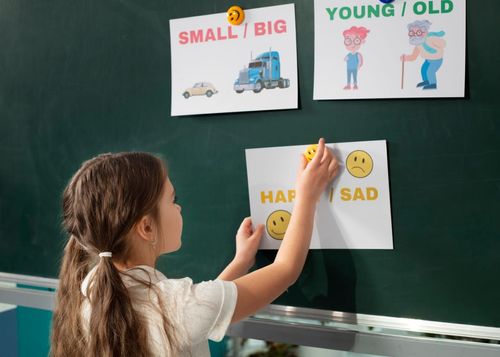

Table of Contents
- Why Opposite Words Matter in Early Vocabulary Development
- List of 50 Opposite Words for Kids (With Examples)
- Word - Opposite Word
- How Kids Can Learn Opposite Words Easily at Home
- Teaching Tips for Parents and Teachers
- Parent’s 5-Step Routine to Reinforce Vocabulary
- How PlanetSpark helps in Vocabulary Building
- Turn Vocabulary into Confidence
Is your child learning new English words every day? Great! But to truly master vocabulary, kids also need to understand opposite words, also known as antonyms. Knowing both sides of a word like hot and cold or happy and sad, helps children express themselves more clearly and think more creatively.
Here is a simple, age-appropriate list of 50 opposite words for kids with examples that will make English learning fun and easy for your child. Plus, we’ll show you how PlanetSpark helps kids remember and use these words in real conversations, not just memorize them.
Why Opposite Words Matter in Early Vocabulary Development
Children start recognising differences long before they speak big toys vs tiny toys, hot milk vs cold ice-cream, loud music vs quiet room. When these everyday contrasts are connected to words, vocabulary becomes meaningful. Opposites help kids think logically, observe carefully, and choose correct words while communicating.
Opposite words support young learners by:
- Boosting language comprehension and sentence construction
- Helping kids compare objects, actions, size, time, feelings
- Encouraging creative thinking and concept understanding
- Improving reading fluency, writing clarity, and verbal confidence
- Making learning interactive, curious and playful
When children know opposites, they can describe the world more accurately. Instead of only big, they also know small. Instead of only fast, they learn slow. This dual awareness makes communication richer, sharper, and more expressive.
List of 50 Opposite Words for Kids (With Examples)
Now that your child understands what opposite words are, it’s time to explore them in action! Below is a fun and easy-to-understand list of 50 opposite words for kids, complete with simple example sentences:
Word - Opposite Word
1. Big - Small : The elephant is big, but the mouse is small.
2. Hot - Cold : I like my tea hot and my juice cold.
3. Happy - Sad : She felt happy after winning the game, but sad when it ended.
4. Fast - Slow : The rabbit runs fast, but the turtle moves slowly.
5. Day - Night : We play during the day and sleep at night.
6. Up - Down : The balloon went up in the sky and then came down.
7. Old - Young : My grandfather is old, and I am young.
8. Inside - Outside : The cat sleeps inside the house, not outside.
9. Tall - Short : The tree is tall, but the bush is short.
10. Early - Late : We reached the park early, but our friends came late.
11. Full - Empty : The glass was full of milk, now it’s empty.
12. Hard - Soft : The rock is hard, while the pillow is soft.
13. Near - Far : My school is near my home, but the zoo is far away.
14. Loud - Quiet : The thunder was loud, but the classroom was quiet.
15. Light - Dark : The room is light in the morning and dark at night.
Every great communicator starts with knowing how to express opposites - clearly and confidently.
Start your child’s journey today - book a free demo class now!
16. Clean - Dirty : Always keep your hands clean, not dirty.
17. Right - Wrong : It is good to admit when you’re wrong and learn what’s right.
18. Open - Close : Please open the door and close it gently.
19. Left - Right : Turn left at the gate, then right at the signal.
20. Wet - Dry : My clothes got wet in the rain but dried in the sun.
21. Strong - Weak : Eating healthy food makes you strong, not weak.
22. Pretty - Ugly : The flowers are pretty, but the wilted ones look ugly.
23. True - False : The statement was true, not false.
24. Push - Pull : Push the door to open it and pull to close.
25. Begin - End : The movie will begin soon and end after two hours.
26. Sweet - Sour : The mango is sweet, but the lemon is sour.
27. Above - Below : The fan is above us, and the carpet is below.
28. Long - Short : I watched a long movie and read a short story.
29. Buy - Sell : My father will buy a car, and the dealer will sell it.
30. Give - Take : Always give respect and take advice.
31. Beautiful - Ugly : The rainbow is beautiful, not ugly.
32. Laugh - Cry : Babies laugh when happy and cry when upset.
33. Start - Stop : Start running when the whistle blows and stop when it ends.
34. Thick - Thin : The book is thick, but the notebook is thin.
35. Win - Lose : It’s okay to lose sometimes , every win teaches you something.
36. Brave - Scared : The fireman was brave, not scared.
Build Your Child’s Vocabulary, Word by Word!
Book a FREE demo class today and watch your child fall in love with studies!
37. Happy - Angry : Mom looked happy when I cleaned my room and angry when I didn’t.
38. Lazy - Active : Lazy people rest all day, active people love to move.
39. Sweet - Bitter : Chocolate is sweet, but medicine can be bitter.
40. Gentle - Rough : Handle the puppy gently, not roughly.
41. Easy - Difficult : The puzzle was easy yesterday but difficult today.
42. Kind - Cruel : The king was kind to his people, not cruel.
43. Begin - Finish : Let’s begin our project and finish it on time.
44. Lost - Found : I lost my pen but found it later.
45. Empty - Filled : The basket was empty, now it’s filled with apples.
46. Deep - Shallow : The sea is deep, but the pond is shallow.
47. Win - Fail : Sometimes we win, and sometimes we fail while learning.
48. Bold - Shy : The speaker was bold on stage, while I felt shy.
49. Rich - Poor : The rich man helped the poor family.
50. Smooth - Rough : The marble floor is smooth, but the stone path is rough.
How Kids Can Learn Opposite Words Easily at Home
Learning opposite words doesn’t have to be boring! Here are 5 fun, proven techniques to help your child remember antonyms effortlessly:
1. Word Match Game
Write words on one set of flashcards and their opposites on another. Mix them up and let your child match the pairs, it’s a vocabulary workout in disguise!
2. Word Wall Activity
Create a colorful “Opposite Words Wall” in your child’s room. Every week, add 5–10 new pairs. Visual memory is powerful for young learners.
3. Story Time Practice
Encourage your child to write a short story using at least 3 pairs of opposite words. This boosts writing skills, creativity, and understanding of context.
4. Use PlanetSpark’s Gamified Tools
With PlanetSpark’s AI-powered SparkBee and SparkX, kids learn through quizzes, live word challenges, and sentence-building games.
These tools help students remember antonyms naturally while improving grammar and speaking confidence.
5. Spark Diary Routine
Ask your child to jot down one new pair of opposite words daily in their Spark Diary and use both in sentences. Over time, this simple habit builds vocabulary depth and fluency.
6. Sing Opposite Songs
Use simple tunes to sing pairs like “Fast and Slow” or “Big and Small” to strengthen recall.
7. Opposite Sorting
Provide objects or picture cards and let kids sort them into two groups of opposites.
These activities make opposites tangible and memorable because children use movement, sight and sound while learning.
Teaching Tips for Parents and Teachers
1. Make opposites part of routine talk
Narrate daily routines using opposites, for example, “We wake up early; later we sleep late at night.” Use contrasting words naturally in conversation so children hear them in context.
2. Focus on pairs, not lists:
Teach opposites two at a time. Master one pair before introducing another so words stick better.
3. Use repetition with variety
Repeat pairs across songs, books, and games. Variety keeps attention while repetition improves retention.
4. Encourage explanations
Ask the child to explain why two words are opposites. This. This deepens understanding beyond memorisation.
5. Personalise examples
Use the child’s toys, family members or favorite foods as examples. Personal connection enhances memory.
6. Be patient and positive
Mistakes are part of learning. Praise efforts and show examples gently to correct misconceptions.
Parent’s 5-Step Routine to Reinforce Vocabulary
Step 1: Introduce 5 opposite pairs weekly
Start by teaching your child just five new opposite word pairs each week. This keeps the learning process light and consistent, allowing them to build a strong vocabulary foundation without feeling overwhelmed.
Step 2: Use flashcards for 10 minutes daily
Spend around ten minutes every day revising these words with flashcards. This short but regular practice helps children retain information better through repetition and visual memory.
Step 3: Encourage storytelling using new words
Ask your child to create short stories or sentences that include the new opposite words. This not only makes learning creative and fun but also helps them use these words naturally in context.
Step 4: Review words with PlanetSpark tools
Revisit the week’s words using PlanetSpark’s interactive tools like SparkBee and Grammar Guru Challenge. These gamified activities make practice engaging and improve long-term retention effortlessly.
Step 5: Celebrate progress every Sunday
End the week on a positive note by celebrating your child’s progress. A small reward, a new storytime, or even a fun quiz can motivate them to keep learning and make opposite words an enjoyable part of their routine.
How PlanetSpark helps in Vocabulary Building
At PlanetSpark, we don’t believe in rote memorization. We help kids use new words in stories, speeches, and daily conversations.
1.Personalised Coaching: Every student learns at their pace with individual attention.
2. Gamified Learning: (SparkBee, Grammar Guru Challenge) Makes grammar and vocabulary exciting and reward-driven.
3. AI-Led Practice (SparkX): Intelligent prompts and quizzes adapt to each learner’s level.
4. Spark Diary & Writers Guild: Encourages journaling, storytelling, and creative word usage.
5. Public Speaking & Debate Clubs: Reinforces word mastery through real-life speaking experiences.
Parents have noticed remarkable improvement not just in their child’s vocabulary, but also in their confidence and communication.
From shy sentences to shining stories - it all starts here!
Book a FREE demo class and watch your child fall in love with speaking and learning.
Turn Vocabulary into Confidence
Strong vocabulary isn’t built in a day, it grows through fun, repetition, and the right guidance. When learning becomes engaging, children absorb new words effortlessly and begin using them in meaningful ways. With the right exposure, practice, and encouragement, vocabulary becomes more than just memorising words, it becomes a tool for thinking better, speaking better, and understanding the world with clarity.
At PlanetSpark, your child doesn’t just learn opposite words they learn how to communicate clearly, think creatively, and express themselves confidently in every situation. The platform ensures that vocabulary blends naturally into everyday conversation, storytelling, and real-life communication. Through interactive methods, personalised support, and consistent practice, children build language skills that strengthen their communication ability, spark imagination, and shape confident speakers for the future.
Frequently Asked Questions
We use interactive activities, flashcards, actions, games, storytelling, and sentence building. Kids learn through fun, repetition, and engagement rather than memorisation.
We use interactive activities — flashcards, actions, games, storytelling, and sentence building. Kids learn through fun, repetition, and engagement rather than memorisation.