
Adjective Clauses: Definition, Types, Rules & Examples
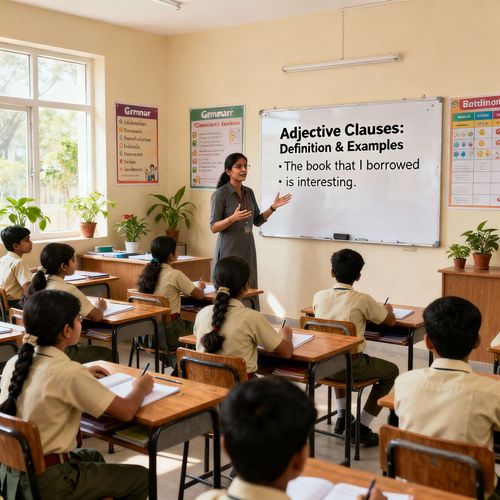

When learning English grammar, adjective clauses are an essential topic to master. They help you write more detailed, descriptive, and meaningful sentences. In this blog, we’ll explore what adjective clauses are, how they function, and how to use them effectively in writing and speaking. We’ll also share examples, rules, and practice tips to make learning simple and practical.
Understanding Adjective Clauses in English Grammar
What Are Adjective Clauses?
An adjective clause, also known as a relative clause, is a group of words that describes or gives more information about a noun or pronoun. Like adjectives, these clauses answer questions such as which one?, what kind?, or how many?
For example:
The book that I borrowed from you is amazing.
Here, “that I borrowed from you” is an adjective clause describing the book.
Adjective clauses usually begin with relative pronouns like who, whom, whose, which, or that, or relative adverbs like where, when, why.
Why Adjective Clauses Matter
Understanding adjective clauses helps you:
Add depth and precision to sentences.
Avoid short, choppy writing.
Connect ideas clearly and logically.
Speak and write English with greater fluency and accuracy.
For instance:
Simple: The girl is my sister. She is wearing a red dress.
With adjective clause: The girl who is wearing a red dress is my sister.
Master adjective clauses and elevate your English with PlanetSpark’s interactive Grammar Course.
Types of Adjective Clauses
1. Defining Adjective Clauses
A defining adjective clause gives essential information about a noun. Without it, the sentence loses its meaning.
Example:
The man who repaired my car is very skilled.
(Without the clause, we wouldn’t know which man.)
Defining clauses do not use commas and are crucial for clarity.
2. Non-Defining Adjective Clauses
These clauses add extra information about a noun that’s already clear. The sentence would still make sense if the clause were removed.
Example:
My father, who loves gardening, spends hours in the backyard.
Non-defining clauses are always separated by commas.
3. Adjective Clauses with Relative Pronouns
These start with words such as who, whom, whose, which, and that.
| Relative Pronoun | Used For | Example |
|---|---|---|
| who | people | The teacher who teaches English is kind. |
| whom | people (object) | The man whom we met was friendly. |
| whose | possession | The artist whose work won is my friend. |
| which | things/animals | The dog which barked all night is mine. |
| that | people/things | The car that I bought is new. |
Tip: In defining clauses, you can sometimes omit that or who when they are the object.
Example: The movie (that) we watched was exciting.
4. Adjective Clauses with Relative Adverbs
Relative adverbs like where, when, and why also introduce adjective clauses.
Examples:
This is the place where I grew up.
I remember the time when we met.
Tell me the reason why you’re upset.
These words help connect ideas smoothly, making sentences more fluent and natural.
How to Form Adjective Clauses
Step 1: Identify the Noun You Want to Describe
Start with a simple sentence and find the noun that needs more detail.
Example: The car is fast.
Step 2: Add the Clause Using a Relative Pronoun
Combine it with another sentence that gives more information.
The car is fast. + The car belongs to John. → The car that belongs to John is fast.
Step 3: Ensure It Fits Grammatically
Make sure the clause directly follows the noun it describes and that punctuation is correct (especially for non-defining clauses).
Common Mistakes to Avoid
❌ Using the wrong relative pronoun
The man which came here → ✅ The man who came here
❌ Misplacing the clause
The car is red that I bought → ✅ The car that I bought is red
❌ Overusing commas
The teacher, who teaches math is nice → ✅ The teacher, who teaches math, is nice
Practice Makes Perfect
Adjective clauses become easy once you use them often. Try these exercises:
Combine: The book is on the table. It belongs to Sarah.
→ The book that belongs to Sarah is on the table.Combine: The boy is running. He won the race.
→ The boy who won the race is running.
Adjective Clauses in Spoken English
How They Improve Communication
Using adjective clauses makes your speech sound more natural and sophisticated. Instead of speaking in short, disconnected sentences, you can express complex thoughts effortlessly.
Example:
Basic: I met a man. He is an astronaut.
Improved: I met a man who is an astronaut.
This fluency boost is why PlanetSpark focuses on usage-based learning rather than memorization.
Using Adjective Clauses in Everyday Speech
That’s the restaurant where we had dinner last night.
She’s the person who helped me find my phone.
Do you know the reason why he left early?
Such natural usage helps in conversations, storytelling, and public speaking,skills honed through PlanetSpark’s personalised 1:1 live classes.
Master English Grammar Through Fun, Interactive Learning
The PlanetSpark English Grammar Course is designed to make grammar engaging, practical, and fun. It helps students understand concepts rather than memorize them.
Unique Learning Features:
Interactive Grammar Learning: Grammar taught through stories, role plays, and dialogues.
Gamified Tools: Word puzzles, quizzes, and grammar games for better retention.
Integrated Writing Practice: Apply grammar in writing tasks for real results.
Clear Progress Levels: From basics (nouns, verbs) to advanced (conditionals, reported speech).
Parent Reports: Track writing fluency, grammar accuracy, and creativity.
1:1 Personal Trainers for Every Child
Each learner is guided by a certified communication expert who personalizes every class to match the student’s pace and style. Trainers focus on fluency, storytelling, grammar, and writing, ensuring fast and confident learning.
AI-Enabled Learning Tools (SparkX & Spark Diary)
Students receive AI-based feedback on voice clarity, grammar, and sentence structure while practising speeches or storytelling. They also maintain a digital writing journal to improve writing consistency and creativity.
Gamified Learning for Motivation
Through daily quizzes and fun challenges like “Grammar Guru,” students revise and apply grammar effortlessly.
Community Learning and Recognition
PlanetSpark hosts clubs, contests, and safe online communities where kids practise debates, podcasts, and storytelling,turning grammar learning into a real-world skill.
Fuel Your Child’s Confidence: Learn Grammar the Smart Way!
At PlanetSpark, learning grammar isn’t about memorizing definitions,it’s about expressing thoughts clearly, creatively, and confidently. Adjective clauses and other grammar topics are taught through stories, games, and interactive exercises that make English fun and effective.Grammar is more than just rules,it’s the foundation of confident communication. By understanding adjective clauses and other key concepts, you unlock the power to write beautifully and speak fluently.
At PlanetSpark, every lesson turns grammar into a skill your child enjoys mastering. With gamified learning, expert mentors, and AI-enabled tools, every student learns to think, write, and express better,step by step.
You may also read :
1.Proper Adjectives – Definition, Examples, and Worksheets for Kids
Frequently Asked Questions
An adjective clause (also called a relative clause) is a group of words that describes or modifies a noun or pronoun. It usually begins with relative pronouns like who, which, that, or whose.
Example: The man who fixed my bike is very helpful.
There are two types:
Defining (restrictive) clauses – give essential information.
Non-defining (non-restrictive) clauses – add extra information and are separated by commas.
Look for a clause that answers questions like which one? what kind? or whose? and begins with a relative pronoun. If it describes a noun or pronoun, it’s an adjective clause.
Yes. In some cases, you can reduce an adjective clause by removing the relative pronoun and verb.
Example: The girl who is singing → The girl singing.
PlanetSpark’s English Grammar Course helps students learn adjective clauses and other grammar concepts through interactive stories, AI-based feedback, and gamified practice sessions. It’s a fun, practical way to strengthen grammar skills and build confident communication.