
Antonym Mistakes: Meaning, Identification, Top Examples
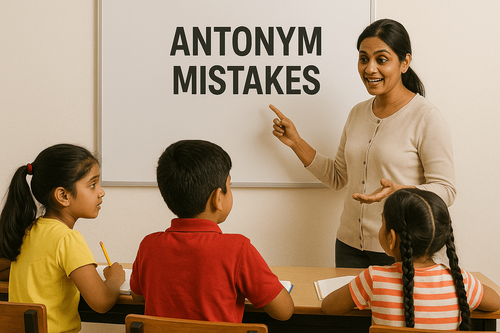

Antonyms are the heartbeat of expressive language; they add contrast, depth, and clarity to our thoughts. Yet, many learners unknowingly trip over antonym mistakes that twist meanings or weaken sentences. Whether it’s mixing up prefixes or choosing the wrong opposite in context, these errors can quietly hinder fluency. Mastering antonyms isn’t just about memorising word pairs; it’s about understanding how words work together. Let’s uncover how to spot and avoid these common antonym pitfalls effectively.
What Are Antonyms?
Antonyms are words that have opposite meanings to one another. They help us express contrast, describe differences, and add clarity and precision to our language. Understanding antonyms strengthens both vocabulary and communication, allowing you to choose words that fit the exact tone and meaning you want to convey.
For example:
- Hot – Cold
- Happy – Sad
- Win – Lose
- Light – Dark
Antonyms make speech and writing more expressive. Instead of saying, “The water isn’t hot,” you can simply say, “The water is cold.” The use of an antonym delivers a stronger and more natural sentence.
There are three main types of antonyms, each functioning differently in context:
1. Graded Antonyms
These describe words that exist on a scale or degree, where the contrast isn’t absolute but relative.
Examples: Big – Small, Hot – Cold, Fast – Slow.
Notice that between “hot” and “cold,” there can be “warm” or “cool”, showing a range rather than a fixed opposition.
2. Complementary Antonyms
These are completely opposite pairs, one negates the other, and no middle ground exists.
Examples: Alive – Dead, True – False, Male – Female.
If something is “alive,” it cannot be “dead”, the relationship is total and binary.
3. Relational (Converses) Antonyms
These pairs show opposite relationships or roles, where one depends on the existence of the other.
Examples: Buy – Sell, Parent – Child, Give – Receive.
You can’t have a “seller” without a “buyer,” which makes the relationship interdependent.
Antonyms aren’t always one-sise-fits-all, the correct opposite depends on context. For example:
- Light can mean not heavy (antonym: heavy) or not dark (antonym: dark).
- Fast can mean quick (antonym: slow) or firmly fixed (antonym: loose).

What Are Antonym Mistakes?
Antonym mistakes occur when learners confuse opposite words or misinterpret their meanings in context. Such errors often happen due to partial understanding, similar spellings, or poor vocabulary. Recognising antonym errors is key to improving grammar, comprehension, and word choice accuracy in writing and speech.
1. Confusing Near-Opposites
Sometimes words that seem opposite aren’t true antonyms.
Example: Thinking “angry” is the opposite of “sad” instead of “calm.”
Correct Pair: Angry – Calm
2. Using Contextually Wrong Opposites
Choosing antonyms without considering context leads to mistakes.
Example: Opposite of “light meal” isn’t “dark meal” but “heavy meal.”
3. Relying on Literal Meanings Only
Some words have figurative opposites, not direct ones.
Example: Opposite of “sweet person” is “rude person,” not “bitter person.”
4. Misusing Prefix-Based Antonyms
Prefixes like un-, dis-, or in- don’t always make correct antonyms.
Example: “Uncapable” is wrong; “Incapable” is correct.
5. Ignoring Part of Speech
Antonyms must match the same part of speech.
Example: Opposite of “failure (noun)” is “success (noun),” not “succeed (verb).”
Unlock Better English Skills, Join a Free Planet Spark Demo Class Today
Why Do People Make Antonym Mistakes?
Antonym mistakes occur when learners use or understand opposite words incorrectly, often due to confusion in meaning, translation errors, or poor context awareness. These mistakes can completely alter a sentence’s meaning, making communication unclear or inaccurate. Understanding the main causes behind such errors helps in avoiding them effectively.
Limited Vocabulary Knowledge
A restricted vocabulary leads to overdependence on common word pairs like good–bad or big–small, while ignoring more precise opposites. Without knowing word nuances, learners often choose the wrong antonym.
Example: Using bad as the opposite of pleasant instead of unpleasant shows lack of vocabulary depth.
Confusion Between Similar Words
English has many look-alike or sound-alike words (homophones and near-synonyms) that create confusion when identifying opposites. This often leads to pairing unrelated terms.
Example: Mistaking accept and except as antonyms, when they are completely different in meaning, is a common error.
Context Misinterpretation
Words can have multiple meanings, and their antonyms change depending on how they are used. Failing to consider context leads to inaccurate pairings.
Example: Light can mean not heavy (antonym: heavy) or not dark (antonym: dark). Without context, it’s easy to choose the wrong opposite.
Overgeneralisation
Learners often assume adding prefixes like un- or in- automatically creates an antonym. While it works for some words (happy–unhappy), it doesn’t apply universally.
Example: Unvaluable is incorrect; the correct antonym of valuable is valueless.
Influence of Direct Translation
When learners translate from their native language, they often assume the same antonym relationships exist in English. However, meanings and word structures differ across languages.
Example: In some languages, borrow and lend share one root, leading learners to confuse the two in English.
Also Read, Basic English Grammar for Kids
Common Antonym Mistakes in English
Antonyms help express contrast and clarity, but many learners make errors while using them due to misunderstanding meanings or word forms. Identifying these mistakes improves precision in both spoken and written English. Here are some of the most common antonym mistakes with clear explanations and examples.
1. Confusing Similar-Sounding Words
Learners often mistake homophones or similar-sounding words for antonyms.
Example: Thinking “accept” and “except” are opposites, they are not.
Accept means to agree or receive; except means to exclude.
2. Using Incorrect Prefixes to Form Opposites
Prefixes like un-, dis-, im-, or in- do not apply to every word.
Example: “Unpossible” is wrong; the correct antonym of “possible” is “impossible.”
Incorrect prefix use changes meaning or creates non-existent words.
3. Ignoring Word Forms and Parts of Speech
Antonyms must be in the same grammatical category.
Example: The antonym of “beauty (noun)” is “ugliness (noun),” not “ugly (adjective).”
Mismatching forms disrupts sentence structure and clarity.
4. Choosing Literal Instead of Contextual Opposites
Many words have context-based opposites, not just literal ones.
Example: The opposite of “deep sleep” is “light sleep,” not “shallow sleep.”
Understanding the context helps select the right antonym.
5. Mixing Up Degrees of Opposites
Not all opposites are absolute; some describe degrees.
Example: Opposite of “hot” can be “cold” or “cool” depending on intensity.
Using the wrong degree can alter the sentence’s meaning or tone.
How to Identify Antonym Mistakes
Identifying antonym mistakes requires more than spotting two opposite words, it involves checking meaning, context, grammar, and tone to see whether they truly contrast each other. Many antonym errors go unnoticed because the words “sound right,” but careful observation and logical testing can reveal whether they actually make sense together.
Check Meaning, Not Just Form
Don’t assume two words are antonyms just because one has a negative prefix like un- or in-. Always verify their actual meanings. Prefixes can be misleading, and not all opposites are formed this way.
Example: Responsible–Irresponsible but Possible–Unpossible (the correct word is Impossible).
Before finalising a word as an antonym, look it up in a dictionary or check reliable examples of its usage.
Test the Words in a Sentence
A quick way to identify errors is by using both words in the same sentence and checking if they logically oppose each other. If the sentence doesn’t sound natural, you’ve likely chosen the wrong antonym.
Example:
- Correct: “He is kind, not cruel.”
- Incorrect: “He is kind, not happy.” (Happy isn’t the opposite of Kind).
When used correctly, antonyms create balance and contrast within a statement.
Give Your Child a Learning Boost—Book a Planet Spark Demo Class Now
Consider Context and Tone
Some antonyms work only in certain contexts or levels of formality. Using the wrong word may change the tone or make the sentence sound unnatural.
Example: Rich–Poor is neutral, while Wealthy–Destitute is more formal and extreme.
Always match the antonym to the tone and purpose of the text.
Check for Multiple Meanings
Many English words have more than one meaning, and each meaning may have a different antonym. Identify which meaning fits the sentence before deciding its opposite.
Example:
- Light (not heavy) → Heavy
- Light (not dark) → Dark
Misunderstanding the word’s intended sense is one of the most common causes of antonym errors.
Compare with Related Words
If you’re unsure whether two words are true antonyms, list other related terms. Comparing helps you understand degrees of opposition and find the most accurate pair.
Example:
For Beautiful, possible opposites include Plain, Ugly, Unattractive, but each conveys a slightly different intensity. Choosing based on context ensures accuracy.
How to Avoid Antonym Mistakes
Avoiding antonym mistakes requires understanding word meanings, grammar, and context. By strengthening vocabulary and practicing consciously, learners can prevent common mix-ups and use opposites accurately in communication. Here are key strategies to avoid antonym errors effectively.
1. Learn Words in Pairs
Studying antonyms together helps retain correct opposites.
Example: Learn “increase–decrease”, “success–failure”, “happy–sad”.
This builds stronger word associations and reduces confusion.
2. Understand Context Before Choosing Antonyms
Always check how a word is used in a sentence.
Example: In “light rain”, the antonym is “heavy rain”, not “dark rain.”
Context decides the correct opposite, not just dictionary meaning.
3. Check Prefix Rules Carefully
Don’t assume adding un-, dis-, in-, or im- always creates the antonym.
Example: “Disactive” is incorrect; “Inactive” is right.
Review each prefix’s pattern through reliable vocabulary sources.
4. Focus on Word Forms and Grammar
Match antonyms with the same part of speech.
Example: “Success (noun)” ↔ “Failure (noun)”; “Succeed (verb)” ↔ “Fail (verb)”.
This keeps sentences grammatically correct and natural.
5. Practice with Real Sentences
Use antonyms in daily writing and speaking exercises.
Example: Instead of memorising “good–bad”, write “He is a good student” vs. “He is a bad student.”
Applying antonyms in real contexts reinforces correct usage.
Examples of Correct and Incorrect Antonyms
Antonym mistakes often happen because two words appear related or sound opposite but differ in meaning or context. Understanding why a pair is wrong and what the correct opposite should be helps build accuracy and confidence in vocabulary use. Below are some common examples of both correct and incorrect antonym pairs, along with explanations.
Incorrect: Accept – Except
These words are often confused but are not antonyms.
- Accept means to receive or agree to something.
- Except means to exclude or leave out.
Correct antonym: Accept – Reject
Example: “She accepted the offer” → opposite: “She rejected the offer.”
Incorrect: Win – Defeat
Both win and defeat carry the idea of success, not opposition. Using them as antonyms is incorrect.
Correct antonym: Win – Lose
Example: “They won the game” → opposite: “They lost the game.”
Incorrect: Safe – Careful
These are related in meaning but not opposites. Being careful may lead to safety, but the two don’t contrast directly.
Correct antonym: Safe – Dangerous
Example: “The road is safe during the day” → opposite: “The road is dangerous at night.”
Incorrect: Beautiful – Bad
Bad doesn’t logically oppose beautiful; it describes moral or quality judgment, not appearance.
Correct antonym: Beautiful – Ugly or Beautiful – Plain (depending on tone).
Example: “The garden looked beautiful” → opposite: “The garden looked ugly.”
Kickstart Confident Communication, Book Your Planet Spark Demo Now
Incorrect: Possible – Unpossible
There is no such word as unpossible in standard English. This is a prefix error.
Correct antonym: Possible – Impossible
Example: “It’s possible to finish early” → opposite: “It’s impossible to finish early.”
Incorrect: Brave – Fear
Fear is a noun, while brave is an adjective, a grammatical mismatch.
Correct antonym: Brave – Cowardly
Example: “He was brave in the face of danger” → opposite: “He was cowardly in the face of danger.”
Incorrect: Success – Unsuccessful
Here, the mistake lies in mixing noun and adjective forms. Both belong to different grammatical categories.
Correct antonym: Success – Failure (noun vs noun) or Successful – Unsuccessful (adjective vs adjective).
Example: “Her success was celebrated” → opposite: “Her failure was disappointing.”
Incorrect: Arrive – Leave Out
Leave out means to omit, not to depart, so it’s not a direct antonym of arrive.
Correct antonym: Arrive – Depart
Example: “The train arrived on time” → opposite: “The train departed on time.”
Incorrect: Increase – Down
Down is a direction, not the opposite of increase.
Correct antonym: Increase – Decrease
Example: “Prices increased in summer” → opposite: “Prices decreased in winter.”
Incorrect: Kind – Happy
Kind relates to behavior, while happy expresses emotion, not opposites.
Correct antonym: Kind – Cruel
Example: “She was kind to everyone” → opposite: “She was cruel to everyone.”
Read Here, English Grammar for Class 3 Kids
How Planet Spark Helps in Improving Grammar?
PlanetSpark helps children build strong grammar skills through structured lessons, personalised coaching, and interactive activities. With expert mentors and engaging learning methods, kids develop accuracy, clarity, and confidence in both spoken and written English.
- 1:1 Personal Coaching by Expert Mentors: Trained mentors guide children individually, helping them understand grammar rules clearly and apply them correctly in everyday communication.
- Structured Step-by-Step Lessons: Lessons simplify topics like tenses, parts of speech, sentence structure, and punctuation, making grammar easy to understand and use.
- Engaging Games and Fun Learning: Grammar-based games, challenges, and storytelling activities make learning enjoyable while reinforcing correct usage naturally.
- Mastery of Sentence Construction: Children learn how to build clear, correct, and meaningful sentences, improving both writing quality and spoken English fluency.
- Focus on Error Correction and Usage: PlanetSpark trains students to identify common grammar errors, understand why they occur, and use grammar rules correctly in real-life communication.
Conclusion
Mastering antonyms enhances clarity, accuracy, and confidence in English communication. By learning word pairs, understanding context, and practicing regularly, you can easily avoid common antonym mistakes. To strengthen your vocabulary and grammar skills through interactive, expert-led sessions, join PlanetSpark today, where learning English becomes fun, practical, and results-driven.
Frequently Asked Questions
Antonym mistakes happen when someone uses the wrong opposite of a word, either because of confusion in meaning, grammar, or context. For example, saying “Win–Defeat” instead of “Win–Lose” is an antonym mistake.
They occur mainly due to limited vocabulary, prefix confusion, or ignoring context. Many learners also assume every word forms its opposite by adding un- or in-, which isn’t always correct.
Try using them in the same sentence. If the sentence sounds logical and clearly shows contrast, they are likely correct antonyms. Example: “The water is hot, not cold.”
Yes. Many words have multiple opposites depending on meaning. For instance, light can mean not heavy (opposite: heavy) or not dark (opposite: dark).
Read regularly, check meanings in a reliable dictionary, and learn antonyms through example sentences instead of memorising lists. Understanding context and usage is the key to choosing the right opposite every time.