
Class 7 Grammar Worksheet on Comprehensive Writing [Free PDF]
![Class 7 Grammar Worksheet on Comprehensive Writing [Free PDF]](https://cdn5.planetspark.in/media/small_Class_7_English_Worksheet_on_Writing_Skills_Review_Free_PDF_20260507_161330_0000_1f063de9e2.png)

Comprehensive Writing Skills for Grade 7: An English Grammar Worksheet
Writing mastery is essential for students at Grade 7, and it becomes a crucial skill that impacts not only exams but also communication in real life. The skills students learn in crafting clear, organized compositions set the foundation for confident writing. In this worksheet, we cover critical aspects like planning, organizing ideas, crafting body paragraphs, and ensuring logical flow. Whether you're preparing for exams or improving writing in everyday scenarios, these skills will help you excel.
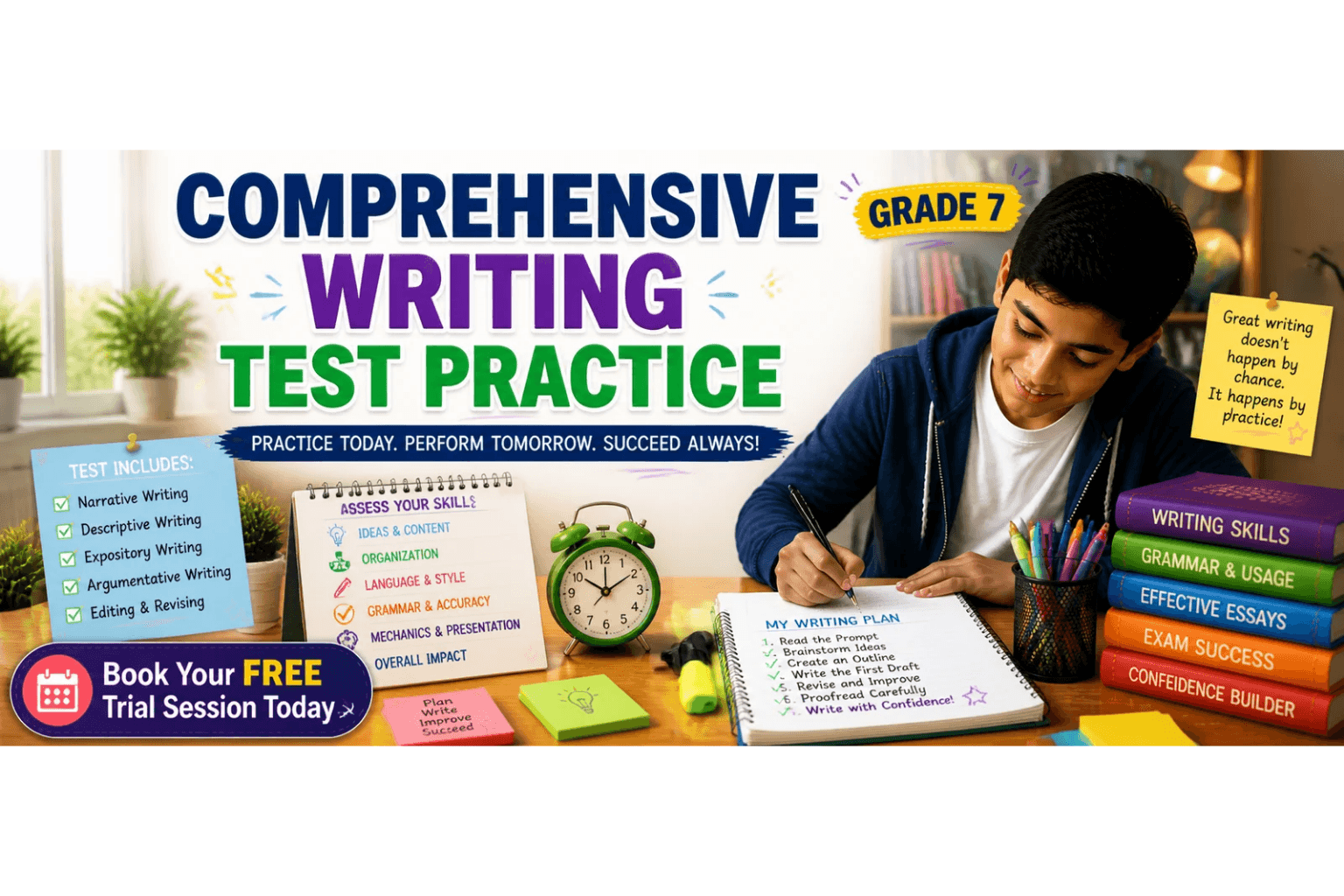
Download these English grammar worksheets and practice regularly to strengthen your language skills and build a strong foundation. You can also book a free trial to get expert guidance and improve your reading, writing, and comprehension abilities. The worksheets are designed in a simple and structured way to help K–8 students learn grammar concepts easily and use them confidently in everyday communication.
What is the topic?
This worksheet focuses on comprehensive writing, a critical skill for Grade 7 students. Comprehensive writing involves structuring a composition effectively by organizing thoughts, writing clear body paragraphs, and providing a concise introduction and conclusion. Students will practice understanding the components of a well-written essay, recognizing the importance of cohesion, and learning to provide detailed, organized explanations. These exercises help students practice blending various writing techniques into one cohesive piece, which is important for creating effective and persuasive writing.
What’s in this worksheet?
This worksheet consists of different types of questions that aim to strengthen the student's understanding of comprehensive writing. It includes:
1. Multiple-choice questions to assess comprehension of key writing concepts.
2. Fill-in-the-blank exercises to ensure understanding of writing structure.
3. True/False questions to check the recognition of proper writing skills.
4. Underlining key elements in the passage to reinforce focus on essential writing parts.
5. A final paragraph-writing task that encourages the students to organize their ideas into a well-structured composition.
The worksheet helps students practice writing while focusing on planning, structuring body paragraphs, and supporting ideas with relevant examples. Completing these tasks can boost exam preparation and writing skills by ensuring students learn to apply grammar in practical, real-world contexts.
Definitions, examples, techniques, and tips
Here are the key concepts explored in the worksheet:
- **Writing Structure**: Writing starts with an introduction that presents the topic and ends with a conclusion that summarizes the ideas. The body paragraphs in between contain detailed explanations and examples to support the main argument.
- **Introduction**: This part should engage the reader's attention while introducing the topic clearly.
- **Body Paragraphs**: These paragraphs should each focus on one main idea supported by relevant examples. The logical flow between paragraphs is important for coherence.
- **Conclusion**: The conclusion should summarize the main points and restate the topic, reinforcing the argument or message.
- **Planning and Revising**: Writing is improved with careful planning and revision. Starting with an outline and revising drafts ensures clarity and logical flow.
Quick learning tips:
- Always organize your ideas before writing.
- Make sure each paragraph supports the main idea.
- Use transitions between paragraphs to maintain the flow.
Why is it important to learn this?
Learning comprehensive writing is vital because it equips students with the tools they need to structure their thoughts clearly and effectively. It builds a foundation for writing essays, completing writing tasks in exams, and communicating ideas effectively. A strong writer is better able to express their thoughts and arguments in an organized manner, making their writing more persuasive and easier to understand. Whether it's a formal essay, a creative piece, or answering questions in exams, mastering these skills will help students stand out academically.
Where will this knowledge help you?
The skills learned in this worksheet are directly applicable in various situations:
1. **Exams**: Understanding writing structure will help students complete written exams with clarity and organization.
2. **Writing Tasks**: Whether writing essays, reports, or creative pieces, students will be able to organize their thoughts and write effectively.
3. **Class Participation**: Strong writing skills also boost performance in class discussions and assignments.
How to use this worksheet?
To make the most of this worksheet, follow these steps:
1. **Attempt independently first**: Try answering the questions on your own before reviewing the solutions.
2. **Review answers carefully**: Go through the answer key and compare your answers.
3. **Correct mistakes**: Identify areas of improvement and try to correct any mistakes you made.
4. **Practice regularly**: Make grammar and writing practice a routine to improve over time.
The solutions follow the exact worksheet order, so compare your answers carefully to ensure you’re on the right track.
Important tips and tricks
To excel in comprehensive writing, keep these tips in mind:
1. **Common mistakes**: Not having a clear introduction or conclusion is a common mistake. Ensure your composition has both.
2. **What examiners expect**: Examiners look for a well-organized structure. Ensure each paragraph has a main idea, and your composition flows logically from one point to the next.
3. **How to score full marks**: Write clear, concise paragraphs with relevant examples. Always revise your work to eliminate errors.
4. **Activity-based tasks**: When given writing tasks or activities, make sure to plan your composition first. This will help ensure that your ideas are organized and your arguments are coherent.
Complete answer key
Exercise 1 – Multiple Choice Questions:
1. c) An essay with clear structure
2. b) Planning and organizing
3. a) Using multiple skills together
4. b) Writing and revising compositions
5. c) They completed everything easily
6. c) All skills together improve writing
7. a) The introduction clearly presented the topic
8. c) Students practiced writing their own compositions
9. b) Writing needs practice and revision
10. a) Skills in writing are interconnected
Exercise 2 – Fill in the Blanks:
1. introduction
2. structure
3. skills
4. ideas
5. examples
6. body
7. planning
8. revision
9. mastery
10. conclusion
Exercise 3 – True/False:
1. True
2. True
3. True
4. True
5. False
6. False
7. False
8. True
9. False
10. True
Exercise 4 – Underline the Key Part:
1. The essay had a clear introduction.
2. Examples supported ideas.
3. Skills worked together.
4. Writing improved with practice.
5. The conclusion summarized points.
6. Body paragraphs had main ideas.
7. They organized paragraphs.
8. They revised their work.
9. Students planned their writing.
10. The essay was well-structured.
Exercise 5 – Mastery-Level Paragraph Answers:
1. *Introduction*
2. *Body*
3. *Ideas*
4. *Examples*
5. *Structure*
6. *Skills*
7. *Supported*
8. *Coherence*
9. *Persuasion*
10. *Conclusion*