
Class 7 Grammar Worksheet on Writing Mastery Review [Free PDF]
![Class 7 Grammar Worksheet on Writing Mastery Review [Free PDF]](https://cdn5.planetspark.in/media/small_Class_7_English_Worksheet_on_Writing_Skills_Review_Free_PDF_20260507_161713_0000_427ca46403.png)

Mastering Writing Skills: A Grade 7 Review on Composition and Structure
Writing is a crucial skill for students at every grade level, and mastering the fundamentals of composition and structure is essential for academic success. This Grade 7 English grammar worksheet offers students the opportunity to enhance their writing abilities through a variety of engaging exercises. From multiple-choice questions (MCQs) to fill-in-the-blank tasks, true/false statements, and practical writing exercises, this worksheet helps students practice and refine their skills in organizing and composing clear, effective writing.
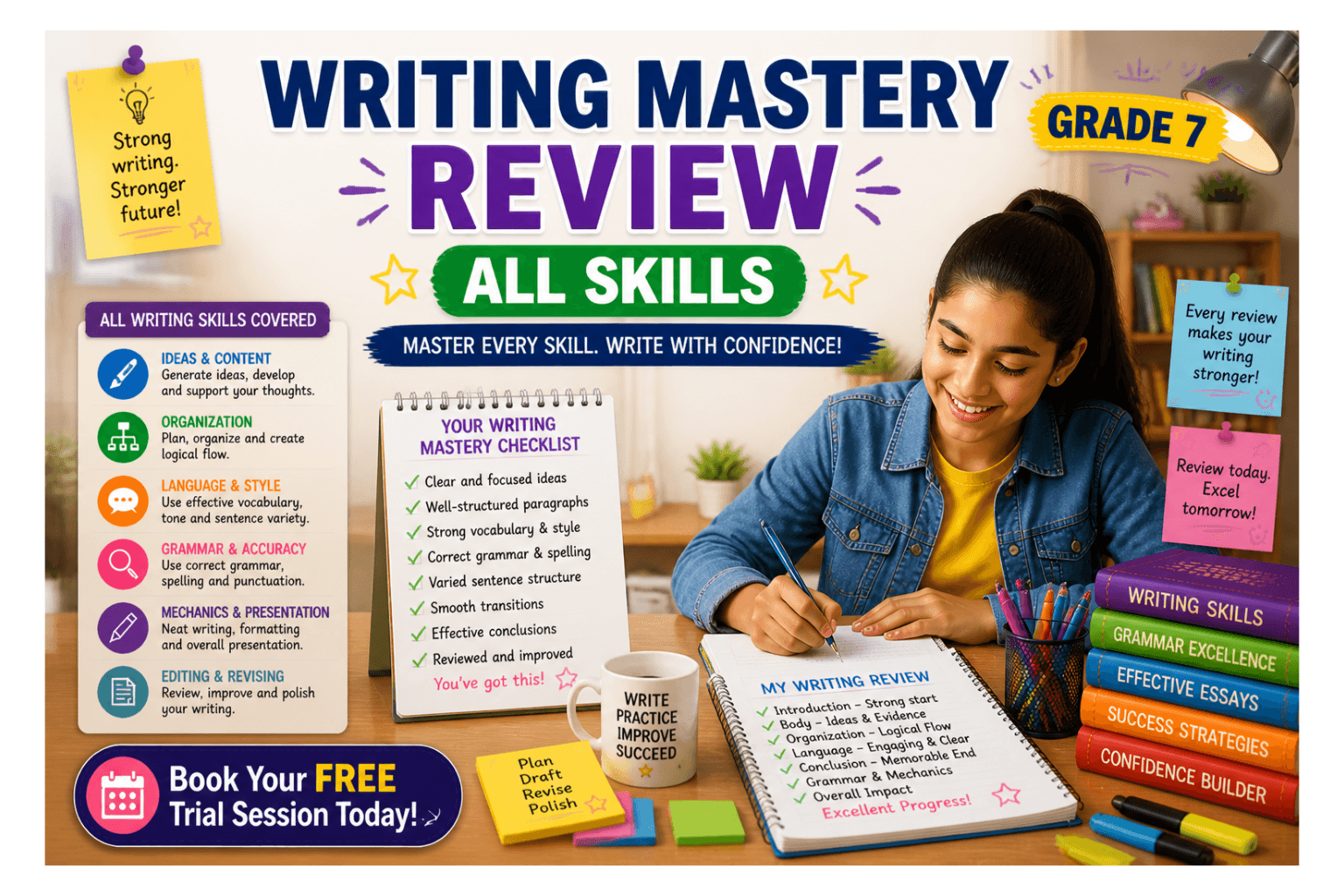
Download these English grammar worksheets and practice regularly to strengthen your language skills and build a strong foundation. You can also book a free trial to get expert guidance and improve your reading, writing, and comprehension abilities. The worksheets are designed in a simple and structured way to help K–8 students learn grammar concepts easily and use them confidently in everyday communication.
What is the topic?
In this Grade 7 worksheet, students focus on mastering the key components of writing. The exercises target fundamental writing skills, such as combining different writing techniques, organizing an essay with a clear structure, and using revision and planning effectively. This worksheet covers essential writing skills that students need to develop clear, coherent essays with strong introductions, body paragraphs, and conclusions. Through these activities, students will better understand how to apply these skills in their writing.
What’s in this worksheet?
This worksheet includes various exercises that help students practice and refine their writing skills. The worksheet structure is designed to guide students through different stages of writing, with exercises that promote the development of essential writing components.
1. **Multiple-choice questions (MCQs)**: These questions test students’ understanding of key writing components, such as structure, planning, and organization.
2. **Fill-in-the-blank tasks**: Students will complete sentences to reinforce their understanding of key writing concepts like skills, structure, and revision.
3. **True/false statements**: This activity encourages students to analyze statements about writing and identify whether they are true or false, helping reinforce the writing process.
4. **Underline the key part**: This exercise helps students identify important aspects of a well-written essay, including introductions, body paragraphs, and conclusions.
5. **Mastery-level paragraph writing**: In this exercise, students practice writing a well-structured paragraph by applying the writing techniques they have learned in the worksheet.
These exercises will not only strengthen students’ writing skills but also prepare them for exams by emphasizing the importance of clear structure and organization in writing.
Definitions, examples, techniques, and tips
Definitions
- **Introduction**: The opening section of an essay that introduces the main topic or idea.
- **Body paragraphs**: The middle part of an essay, where the main points are developed and explained.
- **Conclusion**: The final paragraph of an essay, where the main points are summarized and the topic is brought to a close.
- **Revision**: The process of reviewing and making changes to improve a piece of writing.
- **Skills**: The abilities required to effectively plan, organize, and write essays.
Examples
- **Example of a strong introduction**: ""In this essay, I will explore how effective planning can lead to clearer and more organized writing.""
- **Example of body paragraph structure**: ""First, planning helps the writer create a roadmap for their ideas, ensuring each paragraph supports the main argument.""
- **Example of a conclusion**: ""In conclusion, mastering writing requires not just knowledge of grammar but also the ability to organize and express ideas clearly.""
Techniques
- **Planning**: Before writing, students should plan their ideas and outline the structure of their essay to ensure clarity and logical flow.
- **Revising**: After completing a draft, it’s important to review and revise for errors in grammar, structure, and clarity.
Quick learning tips
- Always start with a clear introduction that states the purpose of the essay.
- Use body paragraphs to develop each point with examples or explanations.
- End with a strong conclusion that summarizes the key points and reinforces the main argument.
Why is it important to learn this?
Mastering the skills of composition and structure is essential for students in Grade 7 and beyond. These writing techniques are foundational to academic success, as students are often required to write essays, reports, and other types of compositions in school and exams. By learning how to structure their writing effectively, students can better express their ideas and arguments in a clear and organized manner. Additionally, these skills will help students communicate more effectively in real-world situations, such as writing emails, reports, or even personal letters.
Where will this knowledge help you?
The skills learned from this worksheet will have a significant impact on various areas of academic work, including:
1. **Exams**: Students will be better prepared to write structured essays for exams that require a clear introduction, well-developed body paragraphs, and a concise conclusion.
2. **Writing tasks**: Students will be able to produce well-organized compositions for assignments, essays, and creative writing tasks.
3. **Class participation**: By mastering writing skills, students can better express their thoughts in written form, contributing more effectively to classroom discussions, debates, and written responses.
How to use this worksheet?
Here is a step-by-step guide on how to make the most out of this worksheet:
1. **Attempt independently first**: Before looking at the answer key, try to complete the exercises on your own. This will help you gauge your current understanding of writing techniques.
2. **Review answers carefully**: Once you have completed the worksheet, compare your answers with the provided key. Check if your answers align with the expected writing structure and concepts.
3. **Correct mistakes**: If you find any discrepancies, review the relevant section and correct your mistakes. Pay attention to areas where you need improvement.
4. **Practice regularly**: Continue practicing writing by using similar worksheets or creating your own writing tasks. Regular practice will help reinforce these skills over time.
Remember, the solutions follow the exact worksheet order. Students should compare answers carefully and use this feedback to improve their writing skills.
Important tips and tricks
Here are some tips to help you succeed in mastering writing:
1. **Common mistakes**:
- Not having a clear structure: Ensure that your writing has a clear introduction, body, and conclusion.
- Lack of organization: Make sure your ideas are presented in a logical order, with each paragraph supporting the main topic.
2. **What examiners expect**:
- Examiners look for clarity and coherence in your writing. Ensure your ideas are well-organized and clearly expressed.
- They also expect proper grammar and sentence structure.
3. **How to score full marks**:
- Focus on planning your essay before writing, ensuring each part is well-developed.
- Pay attention to the language and format, ensuring there are no grammatical errors.
4. **How to approach activity-based or writing-based tasks**:
- Always follow the instructions carefully, whether it’s identifying key parts of a paragraph or writing a complete paragraph.
- Take your time and organize your thoughts before you start writing.
Complete Answer Key
Exercise 1 – Multiple Choice Questions:
1. a) Combining different writing skills.
2. c) An essay with clear structure.
3. b) Each paragraph had main idea.
4. a) The introduction clearly presented.
5. a) The conclusion summarized ideas.
6. b) Planning and organizing.
7. c) Using multiple skills together.
8. b) Writing and revising.
9. c) They struggled without using all skills.
10. a) Together improve writing.
Exercise 2 – Fill in the Blanks:
1. skills
2. structure
3. body
4. ideas
5. examples
6. revision
7. planning
8. introduction
9. mastery
10. conclusion
Exercise 3 – True/False:
1. True
2. False
3. True
4. True
5. False
6. False
7. True
8. True
9. True
10. True
Exercise 4 – Underline the Key Part:
1. The essay had a clear introduction.
2. Body paragraphs had main ideas.
3. Examples supported ideas.
4. The conclusion summarized points.
5. Students planned their writing.
6. They organized paragraphs.
7. They revised their work.
8. Skills worked together.
9. The essay was well structured.
10. Writing improved with practice.
Exercise 5 – Mastery-Level Paragraph Writing (Answers may vary):
Example answers may include:
- **introduction**
- **body**
- **ideas**
- **examples**
- **revision**
- **skills**
- **conclusion**
- **mastery**