
Improve Writing with Strong Cohesive Devices in English


Table of Contents
- Introduction to Cohesive Devices
- What Are Cohesive Devices?
- Cohesive Devices in English Grammar
- Why Are Cohesive Devices Important for Students?
- Types of Cohesive Devices
- How to Use Cohesive Devices Correctly
- Common Mistakes Students Make
- Practical Tips to Improve Cohesion in Your Writing
- Examples of Cohesive Devices in Paragraphs
- Why PlanetSpark Is the Ultimate Destination for English Mast
- Level Up Your Writing Journey with PlanetSpark
Cohesive devices in English are the invisible threads that hold writing together, helping ideas flow smoothly and clearly. This guide breaks down what they are, why they matter, and how students can use them confidently in essays, stories, and exams. Along the way, PlanetSpark supports learners with engaging lessons, smart practice tools, and personalised guidance to strengthen their writing skills effortlessly.
Introduction to Cohesive Devices
In English writing, your ideas may be terrific, but if they are not connected logically, the reader will get lost. Cohesive devices help create a flow by linking ideas, sentences, and paragraphs smoothly. Think of them as “glue words” that hold your writing together.
For example:
- I completed my homework. Then I watched TV.
- I completed my homework; after that, I watched TV.
The second one flows better because of the cohesive device after that.
Many students struggle with writing, not because they lack ideas, but because their sentences sound disconnected. This guide will help you solve that problem entirely.
What Are Cohesive Devices?
Cohesive devices are words or phrases that connect ideas in writing so that the meaning is clear and easy to follow. They show relationships such as cause, contrast, sequence, similarity, emphasis, and result.
Examples include:
- and, but, because, therefore, however, firstly, in addition, for example, although, as a result, meanwhile
These are essential tools in academic writing, essays, emails, letters, reports, speeches, and even everyday communication.

Cohesive Devices in English Grammar
Cohesive devices in English grammar include connectors, linking words, transitional phrases, pronouns, substitution words, conjunctions, and reference words. They help:
- Join sentences
- Link paragraphs
- Show logical order
- Express relationships like cause and effect
- Clarify meaning
- Avoid repetition
- Improve coherence
Whether you're writing a story, an essay, or a presentation, cohesive devices make your writing polished and reader-friendly.
Why Are Cohesive Devices Important for Students?
Students often hear teachers say, “Your ideas are good, but the writing lacks flow.” This usually means the writing lacks cohesion.
Importance for Students
- Boosts clarity: Readers understand your points easily.
- Improves academic scores: Examiners look for coherence and cohesion.
- Enhances professionalism: Essays, reports, and emails look well-structured.
- Builds confidence: You express your thoughts smoothly.
- Reduces repetition: Instead of repeating words, you use smart linking structures.
If you are preparing for school exams, college submissions, IELTS, TOEFL, or even debate competitions, cohesive devices are essential. Students interested to learn grammar rules for clear and confident English can click here.
Types of Cohesive Devices
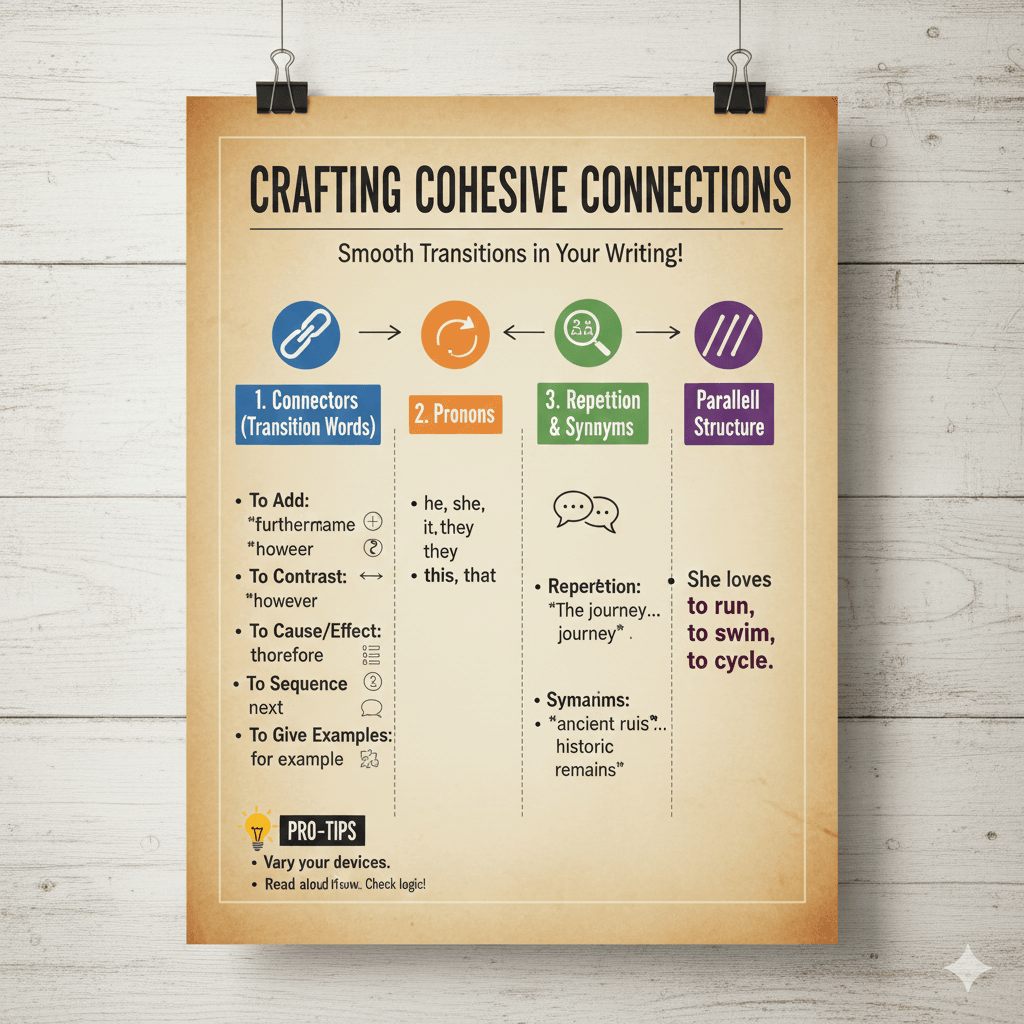
Cohesive devices come in many forms. Below is a complete breakdown with examples.
1. Additive Cohesive Devices (Adding Information)
These devices are used when you want to add more information to a sentence.
Common words:
- and
- also
- moreover
- in addition
- furthermore
- as well as
- besides
- not only … but also
Examples:
- She is hardworking and responsible.
- The school introduced new sports programs; moreover, they upgraded the gym.
- Not only did he finish early, but he also helped others.
2. Adversative/Contrastive Devices (Showing Contrast)
Use these when you want to show opposing ideas.
Common words:
- but
- however
- although
- though
- nevertheless
- on the other hand
- whereas
Examples:
- I studied hard, but I was still nervous for the exam.
- She is shy; however, she performs confidently on stage.
- Whereas he loves sports, his brother prefers reading.
3. Causal/Result Cohesive Devices (Cause and Effect)
These show reasons or results.
Common words:
- because
- therefore
- so
- hence
- as a result
- consequently
- due to
Examples:
- She missed the bus because she woke up late.
- It was raining; therefore, the match was cancelled.
- He didn’t prepare, so he struggled during the quiz.
Turn Grammar Learning Into a Daily Confidence Booster!
4. Sequential/Ordering Devices (Showing Order or Sequence)
Use these in essays, instructions, storytelling, and reports.
Common words:
- first / firstly
- next
- then
- finally
- afterwards
- earlier
- later
- eventually
Examples:
- Firstly, mix the ingredients; then, bake at 180°C.
- He completed school and later moved to another city.
- Eventually, they reached the top of the mountain.
5. Exemplification Devices (Giving Examples)
These are used when you want to illustrate or clarify an idea.
Common words:
- for example
- for instance
- such as
- like
- specifically
- to illustrate
Examples:
- Many fruits, such as apples and bananas, contain vitamins.
- Students must carry stationery, for example, pens and notebooks.
- She enjoys outdoor activities, like hiking.
6. Comparative Devices (Showing Similarity or Difference)
Used to compare ideas.
Common words:
- similarly
- likewise
- in the same way
- just as
- unlike
- compared to
Examples:
- He loves maths; similarly, his sister enjoys solving problems.
- Unlike his brother, he is quiet and introverted.
7. Emphasising Devices (Highlighting Important Points)
These show importance or stress ideas.
Common words:
- indeed
- in fact
- above all
- especially
- significantly
- most importantly
Examples:
- It is indeed a major breakthrough.
- Most importantly, students must submit assignments on time.
8. Conclusive Devices (Ending or Concluding Ideas)
Useful for closing paragraphs or essays.
Common words:
- in conclusion
- to sum up
- ultimately
- overall
- in summary
Examples:
- In conclusion, regular reading improves communication skills.
- Overall, the event was a great success.
Give Your Child the Advantage of Expert Grammar Training!
9. Referencing Devices (Avoiding Repetition)
Instead of repeating nouns, writers use pronouns and determiners.
Common devices:
- he, she, it, they
- this, that, these, those
- the former, the latter
Examples:
- I bought a book. It was interesting.
- I have two pets: a dog and a cat. The former loves running.
10. Substitution Devices (Replacing Words)
These help avoid repetition by substituting words with “do,” “so,” “one,” etc.
Examples:
- I need a pen. Do you have one?
- She said she would study, and she did.
How to Use Cohesive Devices Correctly
Many students overuse cohesive devices, making their writing feel artificial. Here is how to avoid that.
1. Do Not Start Every Sentence with a Connector
WRONG:
- However, I woke up early. Moreover, I made breakfast. Furthermore, I cleaned the room.
RIGHT:
- I woke up early. I also made breakfast and cleaned the room.
2. Use Only When Needed
Using too many makes writing look forced.
Use them naturally, only when there is a logical need.
3. Avoid Mixing Contradictory Connectors
WRONG:
- Although it was raining, but we went outside.
RIGHT:
- Although it was raining, we went outside.
4. Understand the Relationship You Want to Show
Ask yourself:
- Am I adding information?
- Am I showing contrast?
- Am I giving an example?
- Am I concluding?
Choose the device accordingly. Students seeking a complete guide for sentence structure can click here.
Build Lifelong Communication Skills With PlanetSpark!
Common Mistakes Students Make
Here are the mistakes teachers see most often:
1. Using the same cohesive device repeatedly
Students often overuse and, but, or so.
2. Using a connector without a logical link
Example: I like pizza. However, my school starts at 8 AM.
There is no contrast here.
3. Using formal connectors in casual writing
Words like hence or therefore may sound too formal in conversations or informal letters.
4. Incorrect sentence structure
Starting with a connector requires correct punctuation.
Practical Tips to Improve Cohesion in Your Writing
Here are strategies you can start using immediately:
1. Read good essays and observe connectors.
Books, articles, and editorials show excellent usage.
2. Practice rewriting paragraphs using different cohesive devices.
3. Make a personal list of connectors for:
- addition
- contrast
- results
- examples
- comparison
- conclusions
4. Use pronouns to avoid repetition.
5. Keep sentences clear and simple.
Examples of Cohesive Devices in Paragraphs
Below is a sample paragraph showing strong cohesion:
Online learning has become increasingly popular in recent years. Firstly, it provides flexibility for students who can study at their own pace. Moreover, it reduces travel time and costs. For instance, learners from rural areas can access high-quality courses without moving to big cities. However, online classes require self-discipline. In conclusion, online learning is beneficial, but it is effective only when students manage their time well.
Notice how each cohesive device improves clarity and guides the reader.

Why PlanetSpark Is the Ultimate Destination for English Mastery
PlanetSpark offers a complete, future-ready learning ecosystem designed to strengthen every aspect of a child’s English grammar, communication, and confidence. With personalised one-on-one training, AI-powered tools, and engaging practice modules, PlanetSpark ensures children not only learn, but they transform. Here’s what makes our platform exceptional:
Services That Build Strong English Grammar & Communication Skills
- 1:1 Personal Trainers for personalised grammar correction, fluency development, and concept mastery
- Customised Learning Roadmaps tailored to your child’s grammar level and growth needs
- SparkX AI Analysis for evaluating grammar usage, sentence structure, and clarity
- AI-Led Practice Sessions to reinforce grammar, fluency, and speaking accuracy
- Spark Diary for daily grammar application through writing
- Gamified Learning Tools like Grammar Guru, Antonyms Quiz, Spell Knockout & Word Wisdom
- SparkBee Daily Quizzes to improve spelling, vocabulary, and grammar foundations
- SparkShop eBooks covering grammar, writing, reading, and vocabulary skills
- Progress Reports & PTMs for tracking grammar improvement with actionable insights
With PlanetSpark, your child gains confidence, clarity, and a strong command of English—skills that last a lifetime.
Level Up Your Writing Journey with PlanetSpark
Cohesive devices are essential tools in English writing. They help connect ideas logically so that the reader understands your message clearly. Whether you're writing essays, answering exam questions, preparing presentations, or crafting emails, cohesive devices make your writing structured and easy to follow.
By understanding cohesive devices in English grammar and practising them regularly, you can transform your writing from ordinary to excellent. Remember: good writing is not just about having ideas but about presenting them in a connected, meaningful way.
Spend time learning, practising, and experimenting with different cohesive devices. With consistent effort, you will soon find that your writing flows naturally and communicates your thoughts powerfully and professionally.
Frequently Asked Questions
Cohesive devices are words and phrases that connect ideas, sentences, and paragraphs. They help writing flow smoothly, making meaning clearer and easier for readers to follow. Examples include however, therefore, moreover, and for instance.
Cohesive devices help students express ideas logically, improve clarity, and make academic writing stronger. They are essential for essays, exams, stories, and reports because they guide readers smoothly from one point to the next.
Cohesion refers to linking words that connect sentences, while coherence refers to the overall clarity and logical flow of ideas. Both are essential for writing that feels meaningful, organised, and easy for readers to understand.
Start by reading examples in essays, rewriting sentences using different connectors, and avoiding overuse. Practice regularly, review your mistakes, and focus on meaning. The more you write, the more naturally cohesive devices will fit.
PlanetSpark offers interactive writing classes, personalised feedback, and practice activities that help students develop strong cohesion. Through guided lessons, they learn where, when, and how to use cohesive devices confidently in essays and homework.
Yes, PlanetSpark prepares students with structured writing modules, exam-oriented practice, and live mentor support. Students learn to use cohesive devices correctly, improving clarity, grammar, and overall writing performance for better exam results.