
Collective Nouns Grammar Practice for Grade 6 – Worksheet & Answers
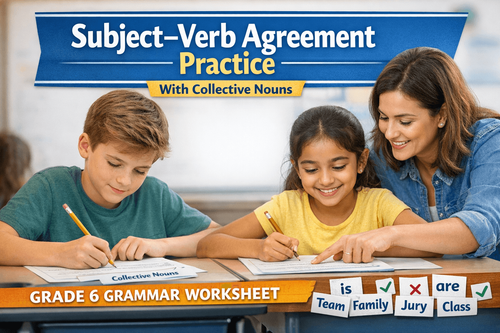

Collective Nouns Grammar Practice for Grade 6 – Worksheet & Answers
Learning grammar becomes easier when students practice through meaningful exercises. For Grade 6 learners, understanding how subjects and verbs agree in a sentence is an important step toward stronger writing and speaking skills. This English grammar worksheet on Subject–Verb Agreement (with collective nouns) helps students observe how verbs change depending on the subject. Through activities like true or false questions, multiple choice questions, fill in the blanks, sentence correction, and paragraph completion, students gradually develop confidence in using correct verb forms.
What Is the Topic?
Subject–verb agreement means that the verb in a sentence must match the subject in number. When the subject is singular, the verb should also be singular. When the subject is plural, the verb should be plural.
Collective nouns refer to a group of people or things considered as one unit. Words like team, class, committee, crowd, staff, family, audience, and jury represent many individuals but function as a single group.
In sentences, these collective nouns may sometimes take a singular verb when the group is acting as one unit. In other cases, they may take a plural verb when the individuals in the group are acting separately. This worksheet helps Grade 6 students practice identifying the correct verb form for collective noun subjects and understanding how subject–verb agreement works in different contexts.
By working through the exercises, students learn to observe the relationship between the subject and the verb and recognize correct and incorrect usage.
What’s in This Worksheet?
This English grammar worksheet for Grade 6 includes a variety of exercises that help students practice subject–verb agreement with collective nouns.
1. True and False questions where students decide whether the sentence correctly shows subject–verb agreement with collective nouns.
2. Multiple choice questions where students choose the correct verb that agrees with the collective noun subject.
3. Fill in the blanks with the correct verb forms for collective nouns.
4. Underline and rewrite activity where students identify incorrect subject–verb agreement and correct the sentences.
5. A paragraph writing task where students fill blanks with suitable collective nouns and verb forms.
These exercises help students build grammar awareness while improving their understanding of sentence structure. Practicing these question types also helps students prepare for grammar questions that appear in school exams and class assessments.
Definitions, Examples, Techniques, and Tips
Definition
Subject–verb agreement refers to the rule that the verb must agree with the subject in number and form. Collective nouns are words that represent a group but can act as either singular or plural depending on how the group behaves in the sentence.
Examples From The Worksheet Context
Collective nouns used in the worksheet include:
jury
government
team
faculty
family
committee
crowd
class
staff
audience
These nouns represent groups and therefore require careful attention to verb choice.
Techniques
Students can improve their accuracy in subject–verb agreement by:
• Identifying the subject of the sentence first
• Checking whether the subject refers to one group acting together or individuals acting separately
• Selecting the verb that correctly matches the subject
Quick Learning Tips
• Read the full sentence carefully before choosing the verb.
• Look for clues such as pronouns like its or their.
• If the group behaves like one unit, a singular verb is often used.
• If the group members act individually, a plural verb may be used.
• Always check whether the verb form matches the collective noun subject.
Why Is It Important to Learn This?
Learning subject–verb agreement with collective nouns helps students write grammatically correct sentences. It ensures clarity and accuracy in both written and spoken communication.
When students understand how verbs change according to the subject, they become more confident in constructing sentences. This skill is essential in school assignments, grammar tests, and classroom discussions.
For Grade 6 students, mastering this concept strengthens overall grammar foundations. It also improves reading comprehension because students can better understand sentence structure when subjects and verbs agree correctly.
Where Will This Knowledge Help You?
Understanding subject–verb agreement with collective nouns helps students in many academic situations.
In Exams
Grammar questions in school tests often require students to choose the correct verb or correct incorrect sentences.
In Writing Tasks
Students use this knowledge when writing paragraphs, essays, and assignments where correct grammar improves clarity.
In Class Participation
Speaking clearly and using correct verb forms helps students communicate ideas effectively during discussions and presentations.
By practicing regularly with an English grammar worksheet like this one, students can develop stronger grammar accuracy and confidence.
How to Use This Worksheet?
1. Attempt the worksheet independently first. Carefully read each question and choose or write the answer you believe is correct.
2. Review the answers carefully. Compare your responses with the complete answer key provided.
3. Correct mistakes. If you find incorrect answers, rewrite the sentences correctly and understand why the change is needed.
4. Practice regularly. Repeating similar exercises helps reinforce the rule of subject–verb agreement with collective nouns.
The solutions below follow the exact worksheet order. Students should compare their answers carefully with each question to understand where improvements are needed.
Important Tips and Tricks
1. Always identify the subject before selecting the verb in the sentence.
2. Pay attention to collective nouns such as team, class, committee, family, and audience because they can sometimes take different verb forms depending on context.
3. Read the entire sentence before answering multiple choice questions to understand the meaning clearly.
4. In sentence correction tasks, underline the incorrect verb first before rewriting the corrected sentence.
5. When filling blanks in a paragraph, make sure the verb matches the collective noun subject.
6. Examiners expect correct subject–verb agreement and proper sentence structure in grammar questions.
7. Double-check your answers before submitting your worksheet to avoid simple grammar mistakes.
Complete Answer Key
Exercise No. 1
1. b) False
2. a) True
3. a) True
4. a) True
5. b) False
6. a) True
7. b) False
8. a) True
9. b) False
10. a) True
Exercise No. 2
1. a) audience were
2. a) staff was
3. b) team are
4. a) faculty have
5. a) committee is
6. b) family are
7. a) crowd were
8. b) jury is
9. a) class was
10. a) students are
Exercise No. 3
1. The government is launching a new campaign this year.
2. The majority of the group is waiting outside.
3. The committee are divided on the proposal.
4. The class is silent during reading time.
5. The faculty are planning workshops for teachers.
6. The family is living in Jaipur happily.
7. The jury are disagreeing on the punishment.
8. The staff is finishing its project report.
9. The crowd is moving into the stadium.
10. The team is wearing blue jerseys today.
Exercise No. 4
1. The committee has completed its task.
2. The jury is discussing the case today.
3. The class was working together in silence.
4. The faculty have sent its ideas to the board.
5. The government is planning new rules.
6. The team was quarrelling loudly after the match.
7. The staff was preparing its targets.
8. The family is cooking their meals together.
9. The audience was clapping hands happily.
10. The crowd was moving slowly down the lane.
Exercise No. 5
During the cultural fest in Mumbai, the staff were preparing decorations while the students were arranging chairs for the guests. At the music stage, the team were tuning instruments for the performers. In the auditorium, the audience were clapping for the children’s play. At the gate, the committee was divided in opinion about seating but managed to smile. Later, the jury was announcing results of the competitions. The family was serving food to parents and visitors cheerfully. By the end, the class was gathering for a group photo. The festive mood grew as the crowd was celebrating the success together while the faculty were guiding students safely to their buses.
Practicing with this Grade 6 English grammar worksheet on Subject–Verb Agreement with collective nouns helps students strengthen their grammar accuracy and sentence construction skills. By completing the exercises and reviewing the answer key carefully, learners can build confidence in identifying correct verb forms and using collective nouns properly. With regular practice, students will find grammar easier and more enjoyable to master.