
Simple Guide for Students to Understand Dangling Modifiers


Table of Contents
- What is a Dangling Modifier?
- Dangling Modifiers Meaning (Simplified for Students)
- Why Dangling Modifiers Cause Confusion
- Common Types of Dangling Modifiers
- Dangling Modifiers Examples (With Corrections)
- Why Students Often Make Dangling Modifier Errors
- How to Fix Dangling Modifiers (Simple Techniques for Student
- Tips to Avoid Dangling Modifiers in School Essays and Exams
- Dangling Modifiers vs Misplaced Modifiers (Students Often Co
- Practice Exercise for Students to Clear Above Concepts (Answ
- Real-Life Situations Where Students Use Dangling Modifiers
- Why PlanetSpark Is the Ultimate Destination for English Mast
- Master Clear Grammar and Avoid Confusing Sentences With Plan
Dangling Modifiers happen when a describing phrase is left hanging and doesn’t clearly tell who or what it is talking about, making sentences sound confusing or funny. This guide explains the idea in easy words, shows examples, and teaches simple tricks to fix these mistakes in your writing. You will also see how PlanetSpark’s fun, interactive classes help students strengthen grammar skills and become confident, clear, and mistake-free writers.
What is a Dangling Modifier?
A dangling modifier is a word or phrase that is supposed to describe something, but the thing it describes is missing from the sentence. Because of that, the sentence becomes unclear or incorrect.
In simple words:
A modifier dangles when it has nothing to modify.
Example:
- Walking home, the rain soaked the students.
Here, “Walking home” is meant to describe the students, but the sentence actually makes it sound like the rain was walking home. The modifier is “dangling.”
You must fix the sentence so the modifier clearly connects to the noun it describes.
Corrected:
- Walking home, the students were soaked by the rain.

Dangling Modifiers Meaning (Simplified for Students)
To understand the dangling modifiers' meaning, break it into two parts:
Modifier
A modifier is a word or phrase that gives extra information.
Examples: running fast, tired after school, while studying, after eating lunch.
Dangling
Something is dangling when it is not attached properly.
Combined Meaning
A dangling modifier is a phrase that is supposed to give more information, but it is not attached to the right subject in the sentence.
Because of this, the sentence sounds illogical or silly.
Example:
- Hungry after school, the pizza was quickly eaten.
It sounds like the pizza was hungry.
Corrected:
- Hungry after school, the students quickly ate the pizza.
Why Dangling Modifiers Cause Confusion
Students often wonder: If the meaning is obvious, why does this matter?
Here’s why dangling modifiers create problems:
1. They make your writing unclear
Your teacher, examiner, or reader may not understand what you mean.
2. They make sentences grammatically incorrect
Exams like IELTS, TOEFL, SAT, and school English tests mark such errors.
3. They create unintentional humor
Dangling modifiers often make sentences sound funny or absurd.
Example:
- Rushing to finish the assignment, the laptop fell off the table.
It sounds like the laptop was rushing to finish the assignment.
4. They weaken professional and academic writing
Schools, colleges, and workplaces prefer clear, correct, and logical sentences.
Give Your Child a Strong Grammar Foundation Today!
Common Types of Dangling Modifiers
Understanding the types helps you identify and fix them better.
1. Dangling Participial Phrases
These start with verbs ending in -ing or -ed.
Example:
- Walking to school, the bus splashed me with water.
2. Dangling Infinitive Phrases
These start with to + verb.
Example:
- To get good marks, the homework must be completed.
3. Dangling Prepositional Phrases
Usually begin with prepositions like after, before, while, and during.
Example:
- After reading the chapter, the summary seemed easy.
4. Dangling Adjectives or Adverbs
Example:
- Tired and sleepy, the bed looked inviting.
In every example, the modifier does not match the subject. Once students learn the topic, it becomes important for them to revise it. Click this link to learn the effective ways for revision.
Dangling Modifiers Examples (With Corrections)
This section provides plenty of Dangling Modifiers examples so students can easily understand and practice.
1. Easy Examples
Incorrect:
While running to class, the bell rang.
Here, it sounds like the bell was running.
Correct:
While running to class, I heard the bell ring.
Incorrect:
To pass the exam, focus must be improved.
Correct:
To pass the exam, students must improve their focus.
Incorrect:
After finishing the book, the movie felt disappointing.
Correct:
After finishing the book, I found the movie disappointing.
Transform Your Child’s Grammar Skills With 1:1 Coaching!
2. Funny Examples That Show the Problem Clearly
Incorrect:
Flying over the city, the buildings looked tiny.
Sounds like the buildings were flying.
Correct:
Flying over the city, we saw the buildings looking tiny.
Incorrect:
Covered in chocolate, the child ate the cake.
It sounds like the child was covered in chocolate instead of the cake.
Correct:
The child ate the cake that was covered in chocolate.
Incorrect:
Driving down the road, a deer suddenly appeared.
Sounds like the deer was driving.
Correct:
While I was driving down the road, a deer suddenly appeared.
3. Academic Writing Examples
Incorrect:
To succeed in school, consistent effort is required.
Correct:
To succeed in school, students need to make consistent effort.
Incorrect:
After completing the project, the presentation was easy.
Correct:
After completing the project, we found the presentation easy.
4. Essay & Exam Examples
Incorrect:
While researching the topic, the data seemed confusing.
Correct:
While researching the topic, I found the data confusing.
Incorrect:
To improve communication skills, practice is necessary.
Correct:
To improve communication skills, students must practice regularly.
Make English Grammar Simple, Fun, and Engaging!
Why Students Often Make Dangling Modifier Errors
Students usually make these mistakes because:
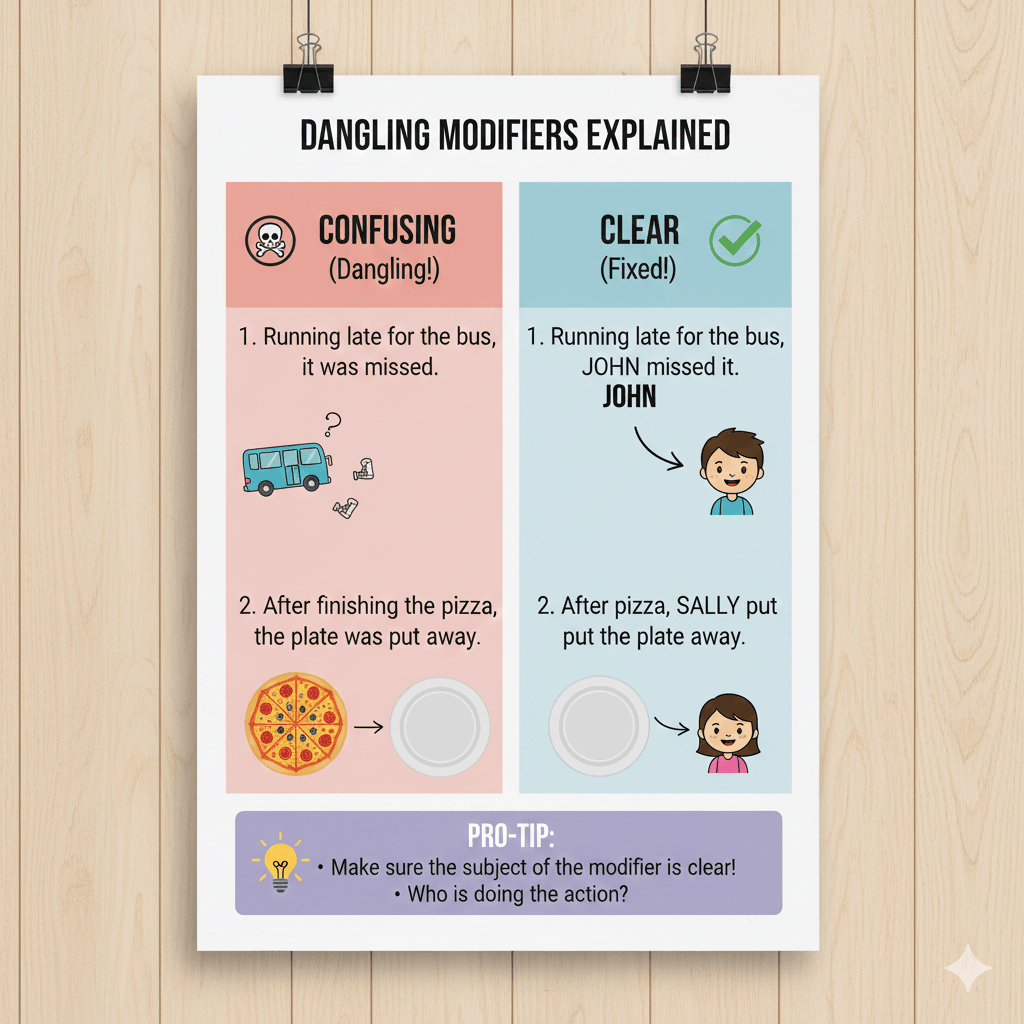
1. They start a sentence with a descriptive phrase but forget to mention who it refers to.
Most dangling modifiers appear at the beginning of sentences.
2. They assume the meaning is obvious.
English grammar requires the subject to be written clearly.
3. They write too fast in exams.
Rushing leads to incomplete or unclear subjects.
4. They translate mentally from another language.
Many languages do not require subjects to be explicitly stated.
How to Fix Dangling Modifiers (Simple Techniques for Students)
Fixing dangling modifiers becomes easy once you follow these steps.
Technique 1: Add the missing subject
Incorrect:
Running fast, the finish line got closer.
Correct:
Running fast, the athlete saw the finish line get closer.
Technique 2: Rewrite the sentence to include the subject earlier
Incorrect:
After studying all night, the test looked difficult.
Correct:
After studying all night, I still found the test difficult.
Technique 3: Change the phrase into a full clause
Incorrect:
To get better marks, regular practice is needed.
Correct:
If students want better marks, they need regular practice.
Technique 4: Place the modifier next to the correct noun
Incorrect:
Walking into the hall, a loud noise surprised the audience.
Correct:
Walking into the hall, the audience was surprised by a loud noise.
Build Lifelong Communication Skills With PlanetSpark!
Tips to Avoid Dangling Modifiers in School Essays and Exams
Here are practical tips especially useful for students:
1. After writing a sentence, ask: “Who is doing the action?”
If the answer is missing, the modifier is dangling.
2. Keep the subject close to the modifier.
Do not separate them.
3. Avoid starting too many sentences with –ing words.
4. Remove unnecessary introductory phrases.
Sometimes the easiest fix is to simplify the sentence.
5. Read your sentence aloud.
If it sounds funny or confusing, it may have a dangling modifier.
6. Practice regularly.
The more examples you study, the easier it becomes.
Dangling Modifiers vs Misplaced Modifiers (Students Often Confuse the Two)
Here, students can learn about the misplaced modifiers and dangling modifiers to get a clear insight into them. This resolves their confusion:
Misplaced Modifier:
The modifier is attached to the wrong noun, but the noun is still present.
Dangling Modifier:
The modifier has no noun to attach to.
Example (Misplaced):
- She almost drove her kids to school every day.
This means she “almost drove,” which is wrong.
Correct:
- She drove her kids to school almost every day.
Example (Dangling):
- Driving to school, the rain started.
No one is mentioned as driving.
Correct:
- Driving to school, I saw the rain start.
Practice Exercise for Students to Clear Above Concepts (Answers Included)
Identify and correct the dangling modifiers.
1. Running late for school, the gate was already closed.
Correct: Running late for school, the students found the gate already closed.
2. To finish the project on time, teamwork is important.
Correct: To finish the project on time, students must work as a team.
3. After waking up early, the bus still arrived late.
Correct: After waking up early, I found that the bus still arrived late.
4. Reading the instructions carefully, the experiment made sense.
Correct: After reading the instructions carefully, I understood the experiment.
5. To improve grammar, practice should be done daily.
Correct: To improve grammar, students should practice daily.
Real-Life Situations Where Students Use Dangling Modifiers
Students commonly make dangling modifier errors in:
1. School essays: Especially in descriptive writing.
2. English exam papers: Grammar marks are lost easily.
3. College application statements: These must be clear and professional.
4. Lab reports: Science writing requires logical sentences.
5. Creative writing assignments: Stories sometimes unintentionally sound funny.
Understanding dangling modifiers ensures your writing is clear, correct, and polished. Students can click this link to know more grammar rules that are misunderstood by them and learn them easily.

Why PlanetSpark Is the Ultimate Destination for English Mastery
PlanetSpark offers a complete, future-ready learning ecosystem designed to strengthen every aspect of a child’s English grammar, communication, and confidence. With personalised one-on-one training, AI-powered tools, and engaging practice modules, PlanetSpark ensures children not only learn, but they transform. Here’s what makes our platform exceptional:
Services That Build Strong English Grammar & Communication Skills
- 1:1 Personal Trainers for personalised grammar correction, fluency development, and concept mastery
- Customised Learning Roadmaps tailored to your child’s grammar level and growth needs
- SparkX AI Analysis for evaluating grammar usage, sentence structure, and clarity
- AI-Led Practice Sessions to reinforce grammar, fluency, and speaking accuracy
- Spark Diary for daily grammar application through writing
- Gamified Learning Tools like Grammar Guru, Antonyms Quiz, Spell Knockout & Word Wisdom
- SparkBee Daily Quizzes to improve spelling, vocabulary, and grammar foundations
- SparkShop eBooks covering grammar, writing, reading, and vocabulary skills
- Progress Reports & PTMs for tracking grammar improvement with actionable insights
With PlanetSpark, your child gains confidence, clarity, and a strong command of English—skills that last a lifetime.
Master Clear Grammar and Avoid Confusing Sentences With PlanetSpark
Dangling modifiers may look like a small grammar issue, but they have a big impact on clarity, logic, and professionalism in writing. For students, mastering them is especially important because school exams, assignments, and competitive entrance tests all value clean, correct, and precise sentence construction. When a modifier is left “dangling,” your reader struggles to understand who is acting, and this weakens the entire message.
By understanding the dangling modifiers meaning, studying enough dangling modifiers examples, and practicing simple correction techniques, you can completely avoid such mistakes. Clear writing leads to better grades, stronger communication skills, and improved confidence. Remember: every modifier must clearly connect to the correct subject. When your sentences are properly structured, your ideas shine.
Master the rules, practice regularly, and you will never let a modifier dangle again.
Frequently Asked Questions
A dangling modifier is a phrase placed incorrectly in a sentence, making it unclear who is doing the action. This creates confusing or funny sentences that need rewriting to make sense.
Students usually make this mistake when writing quickly, skipping the subject, or placing the describing phrase too far from the noun. With practice, spotting and fixing them becomes easy.
Ask yourself: “Who is doing the action in the opening phrase?” If the sentence doesn’t clearly mention that person or thing, the modifier is dangling and needs correction.
Add the correct subject after the introductory phrase or rewrite the sentence so the describing phrase clearly matches the person or thing performing the action. Simple rearranging often solves it.
Yes! PlanetSpark offers interactive classes, grammar practice, and real-time feedback from expert trainers, helping students understand tricky concepts like modifiers and write clearer, stronger, mistake-free sentences confidently.
PlanetSpark makes grammar fun through activities, storytelling, and personalised guidance, helping students quickly master confusing rules. Their engaging lessons build accuracy, fluency, and confidence in everyday and academic writing.