
Defamiliarization Meaning: Making the Familiar Strange


Table of Contents
- Defamiliarization Meaning
- Defamiliarization Explanation
- How is Defamiliarisation Making Familiar Things Strange?
- Defamiliarisation in Literature
- Defamiliarization Examples
- What Is Defamiliarisation in Poetry
- Simple Examples in Poetry
- Defamiliarisation in Formalism
- What Russian Formalists Believed (In Simple Words)
- Viktor Shklovsky and Russian Formalism
- Writing Techniques Using Defamiliarisation
- How to Practice Defamiliarisation in Easy Steps
- PlanetSpark Success Stories
- Why choose PlanetSpark for Mastering Defamiliarisation?
- Conclusion: Seeing the Ordinary with New Eyes
Have you ever read a line in a poem or novel that made you stop and think that you had never read something like that before? That sudden pause, that fresh way of seeing something ordinary, is the power of defamiliarisation. In a world where daily life often runs on autopilot, literature and art employ this artistic technique to wake us up.
This blog by PlanetSpark explains the concept of defamiliarisation, including its definition, origin, literary and poetic applications, examples, writing techniques, and its roots in Russian Formalism, as explored by the ideas of Viktor Shklovsky. By the end, you will clearly understand how defamiliarisation works and why it is so important in creative writing and art.
Defamiliarization Meaning
Defamiliarisation means presenting familiar things in an unfamiliar or strange way so that people notice them again. Instead of quickly recognising something, the reader is forced to slow down and see it properly. The term comes from the Russian word "ostranenie", which literally means making strange. It was introduced by Russian literary theorist Viktor Shklovsky in 1917.

How To Understand Defamiliarisation?
In daily life, we do many things without thinking, such as walking without noticing our legs, eating without tasting carefully, and seeing objects without really observing them. According to Shklovsky, this habit makes life dull and mechanical. Art exists to break this habit. Defamiliarisation renews perception by making ordinary things feel new.
Easy example of Defamiliarisation:
- Normal sentence: The sun rose.
- Defamiliarised sentence: A burning red-hot ball slowly climbed the sky.
Both mean the same thing, but the second one makes us pause and imagine.
Defamiliarization Explanation
The defamiliarisation explanation is simple at its core. Art deliberately slows down our understanding so that we feel and notice more. Viktor Shklovsky believed that when language becomes too familiar, it loses its power. Art uses special devices, such as unusual descriptions, strange metaphors, unexpected viewpoints, or twisted sentence structures, to interrupt automatic reading.
When reading is fast and easy, we recognise things without thinking. Defamiliarisation makes reading slower, makes perception deeper, and makes emotions stronger.
For example, instead of saying "He was injured", a writer may say "his skin opened into thin red mouths". This delays understanding and increases emotional impact. Psychologically, defamiliarisation brings back childlike wonder, where everything feels new and mysterious.
How is Defamiliarisation Making Familiar Things Strange?
The core idea of defamiliarisation is making familiar things strange so that we notice them again. In everyday life, we repeat the same actions so often that we stop paying attention to them. Our mind works on auto-mode. Defamiliarisation breaks this habit.
Why is this important?
When something is too familiar, we do not truly see it; we only recognise it. Art and literature exist to slow us down and restore awareness. By describing common experiences in unusual ways, defamiliarisation forces us to pause, think, and feel.
Shklovsky’s famous example
Walking feels natural because we have done it since childhood. We do not think about how complex it actually is. But when walking is described as “balancing forward on two unreliable pillars,” it suddenly feels awkward and risky. The action has not changed; only the way it is described. This strange description makes us consciously notice something we usually ignore. That moment of surprise is defamiliarisation at work.
Where do we see defamiliarisation in different art forms
In literature: Writers describe ordinary objects or actions in unexpected ways. A door may become a “mouth that swallows people,” or a mirror may feel like a “silent judge.” Such descriptions slow down reading and deepen meaning.
In films: Directors use slow motion, unusual camera angles, or silence to make common moments like walking, eating, or fighting feel unfamiliar. This makes viewers emotionally and visually alert.
In theatre: Actors may speak directly to the audience or suddenly step out of character. This breaks the illusion of reality and forces viewers to think instead of watching passively.
Why does this technique work?
Defamiliarisation challenges assumptions. It stops us from accepting reality as fixed or ordinary. By refreshing perception, it helps us understand emotions, ideas, and experiences more deeply. In short, making familiar things strange wakes us up, reminding us that even the most ordinary parts of life can be meaningful when truly seen.
Defamiliarisation in Literature
Defamiliarisation in literature is a technique writers use to stop readers from reading mechanically. Instead of letting the story flow too smoothly, authors deliberately make certain parts strange so that readers slow down, think, and feel more deeply. Normally, readers expect stories to follow familiar patterns. Defamiliarisation breaks these expectations and keeps the reader mentally active.
How do writers use defamiliarisation?
Authors disrupt normal storytelling in several simple ways:
- Using strange imagery: Ordinary things are described in unusual ways so they appear new.
- Shifting perspectives: Stories may be told from the viewpoint of animals, children, or outsiders.
- Breaking narrative flow: Writers interrupt the story with direct comments, reflections, or sudden changes.
- Describing common events in shocking ways: Everyday actions like eating, walking, or fighting are shown in disturbing or unexpected detail.
These techniques force readers to pause and rethink what they are reading.
Leo Tolstoy and Defamiliarisation
Leo Tolstoy is one of the strongest and clearest users of defamiliarisation in literature. He often makes social customs look strange by describing them from unfamiliar angles.
Kholstomer
In Kholstomer, the story is narrated by a horse. Through the horse’s eyes, human ideas such as property, ownership, and status appear illogical and cruel. The horse cannot understand how a person can “own” another living being. This unfamiliar perspective makes readers question social rules they usually accept without thought.
War and Violence
Tolstoy often describes violence without emotion or heroism. Instead of saying someone is brave or wounded, he focuses on the physical damage, such as torn skin, blood, and pain. This removes the glory usually associated with war and makes violence feel shocking and real.
War and Peace (Opera Scene)
In War and Peace, Tolstoy describes people watching an opera as if they were strange insects in a decorated box. High society, usually seen as elegant, suddenly looks artificial and ridiculous. This defamiliarisation exposes social vanity and false pride.
Anna Karenina (Social Rituals)
In Anna Karenina, social gatherings and polite conversations are shown as repetitive and empty. Familiar social rituals feel meaningless when described in detail, making readers question social hypocrisy.
Defamiliarisation in Modern Literature
Franz Kafka
In The Metamorphosis, Gregor Samsa wakes up as an insect. This shocking transformation defamiliarises identity, family responsibility, and human value. Readers see how love disappears when usefulness ends.
Italo Calvino
Calvino often talks directly to the reader, reminding them that they are reading a book. This breaks immersion and forces readers to think about how stories are constructed.
Science Fiction
Science fiction uses alien worlds and futuristic societies to reflect human habits. By showing familiar human behaviour in strange settings, writers make readers question culture, politics, and morality.
Why Defamiliarisation Matters in Literature?
Across all genres, defamiliarisation forces readers to actively participate. Instead of passively consuming a story, readers must interpret, imagine, and reflect. In simple terms, defamiliarisation refreshes perception, deepens emotional impact, challenges social norms, and makes literature more powerful and memorable. This is why defamiliarisation remains one of the most important artistic techniques in literature.
Defamiliarization Examples
Defamiliarisation works by showing ordinary things in unusual ways. These examples help readers pause and see familiar things differently.
More Classic Literature Examples by Leo Tolstoy
War and Peace: Soldiers marching are described not as heroes but as moving machines, their faces blank and tired. This removes the glory of war.
Anna Karenina: High-society conversations feel like rehearsed performances, exposing their emptiness and hypocrisy.
Kholstomer: Human ownership is described as meaningless noise from the horse’s point of view, making social rules look cruel and illogical.
Other Examples of Defamiliarisation
- William Wordsworth- A simple flower is described as a silent teacher, making nature feel alive and meaningful rather than decorative.
Emily Dickinson- Death is described as a polite visitor who kindly stops by, making a frightening concept strangely calm and thoughtful.
- Franz Kafka- In The Metamorphosis, a bedroom becomes a cage, turning a safe, familiar space into a prison.
Blake: Turns a tiny grain of sand into a symbol of the entire universe, making the small feel infinite.
Dickinson: Describes a train like a living creature, making a machine feel strange and unsettling.
Poetry and Figurative Examples
- Rain is described as tiny fingers tapping the earth.
- The moon is described as a pale coin lost in the sky.
- Silence is described as a loud weight pressing on the room.
These images slow down reading and force imagination.
Simple Daily Life Defamiliarisation Examples
These are especially useful for beginners:
A phone described as a glowing rectangle that steals hours from human hands.
Traffic lights are seen as mechanical gods deciding when humans may move.
A classroom is described as a box where young minds are trained to sit still.
Shoes are described as portable floors tied to feet.
A clock is described as a cage that traps time into numbers.
Ice cream melting is described as "white snow pierced by red rivers"
A mirror compared to "a broken ancient statue"
Action-Based Examples
Eating is described as breaking and grinding once-living matter.
Breathing is described as borrowing invisible air and returning it slightly damaged.
Sleeping described as a temporary disappearance from the world.
How These Examples Work?
Each example:
Avoids normal naming
Uses strange imagery or metaphor
Slows understanding
Forces reinterpretation
That pause, where the reader stops and thinks, is defamiliarisation in action.
What Is Defamiliarisation in Poetry
Defamiliarisation in poetry means describing familiar things in strange, unexpected ways so that readers slow down and see them freshly. Poetry is especially powerful at this because it does not explain directly. Instead, it shows ideas through images, sounds, and symbols.
Why poetry intensifies defamiliarisation
Poetry naturally strengthens defamiliarisation because it uses:
Compressed language
Poems use very few words, so each word carries strong meaning and forces careful reading.Sound devices
Alliteration, rhyme, and rhythm make readers hear language differently, not just understand it.Unusual line breaks (enjambment)
Lines may stop in surprising places, delaying meaning and creating tension.Metaphorical leaps
Poems often jump between ideas, connecting unrelated things in surprising ways.
All these techniques slow down reading and break automatic understanding.
Simple Examples in Poetry
- T.S. Eliot – The Waste Land
Eliot mixes different languages, voices, and references. This confuses the reader at first but forces deeper attention. Familiar ideas like love, religion, and culture feel broken and unfamiliar. - H.D. – “Oread”
The sea is described as a powerful force that attacks the land. Nature is not calm or gentle but wild and commanding. This makes readers rethink how they usually imagine the sea. - William Blake
In poems like “Auguries of Innocence,” Blake connects very small things to vast ideas. A grain of sand becomes a symbol of the universe. The ordinary becomes infinite.
How Defamiliarisation Works in Poetry
Through sound patterns, strange imagery, and unexpected structure, poetry slows down perception. Readers cannot rush through a poem. They must pause, imagine, and interpret.
In simple words, defamiliarisation in poetry makes us feel wonder again, helping us see everyday things with new eyes.
Defamiliarisation in Formalism
Defamiliarisation in formalism is a key idea of Russian Formalism, a literary movement that developed between 1915 and 1930. Russian Formalists wanted to understand what makes literature different from ordinary language. They believed that literature is special not because of the story itself, but because of how the story is told.
What Russian Formalists Believed (In Simple Words)
Russian Formalists focused on form, not content. According to them:
Literature is made of devices
Writers use techniques like imagery, metaphor, repetition, and defamiliarisation.Plots are designed to slow understanding
Stories are arranged to delay meaning, not to tell events quickly.Art fights automatic thinking
Daily life becomes routine and mechanical. Art exists to break this habit and make us notice things again.
In short, art makes us see, not just recognise.
Fabula and Syuzhet
Russian Formalists made an important distinction:
Fabula
The raw events of a story
What happens in a simple, logical order
Example: A man is born, grows up, falls in love, and dies.
Syuzhet
The artistic arrangement of those events
How the writer presents the story using techniques like flashbacks, delays, or strange perspectives
Example: The story starts with the man’s death and slowly reveals his life.
Viktor Shklovsky and Russian Formalism
Viktor Shklovsky (1893–1984) was a Russian writer and literary theorist who first introduced the idea of defamiliarisation. He is considered one of the founders of Russian Formalism.
In his famous essay “Art as Technique”, Shklovsky explained that people get used to things so quickly that they stop truly noticing them. Every day actions become automatic. According to him, habit kills perception—we see without really seeing.
Shklovsky believed that art restores sensation. It brings back freshness by describing ordinary things in strange or unexpected ways. This process, which he called defamiliarisation, slows down our understanding and forces us to pay attention. For him, this was the main function of art.
Shklovsky was part of a literary group called OPOYAZ in Petrograd. This group studied literature scientifically, focusing on form, structure, and technique rather than emotions or social messages. He worked with other important thinkers, including Roman Jakobson.
During Stalin’s rule, Russian Formalism was criticised and suppressed because it did not follow political ideology. Even so, Shklovsky continued writing, and his ideas survived. Over time, his theory spread beyond Russia and influenced literary studies around the world.
Today, defamiliarisation is a key concept taught in literature, media studies, and creative writing, showing how Shklovsky’s ideas remain important and widely used.
Writing Techniques Using Defamiliarisation
Writers use defamiliarisation on purpose to make ordinary things feel new and interesting. By changing how something is described, they slow the reader down and encourage deeper thinking and imagination.
Below are some easy and common writing techniques used to create defamiliarisation.
- Perspective shift
The writer tells the story from an unusual point of view, such as an animal, object, or outsider. This makes normal human behaviour look strange.
Example: a chair describing the people who sit on it. - Unusual metaphors
Ordinary things are compared to something unexpected or vast, like comparing a cup of tea to a quiet universe. This gives familiar objects new meaning. - Syntax manipulation
Sentences may be broken, incomplete, or long and winding. This slows down reading and mirrors how thoughts or perceptions actually move. - Sensory exaggeration
Small details are described very strongly, such as how something looks, sounds, smells, or feels, so the reader notices what is usually ignored. - Self-reflexivity
The writer reminds the reader that they are reading a story, sometimes by commenting on the act of storytelling itself. This breaks the flow and makes readers think.
How to Practice Defamiliarisation in Easy Steps
Choose an everyday object (like a phone, mirror, or shoe).
Do not name it directly—describe it instead.
Focus on its shape, purpose, and feeling.
Rewrite slowly, adding unusual images or comparisons.
PlanetSpark Success Stories
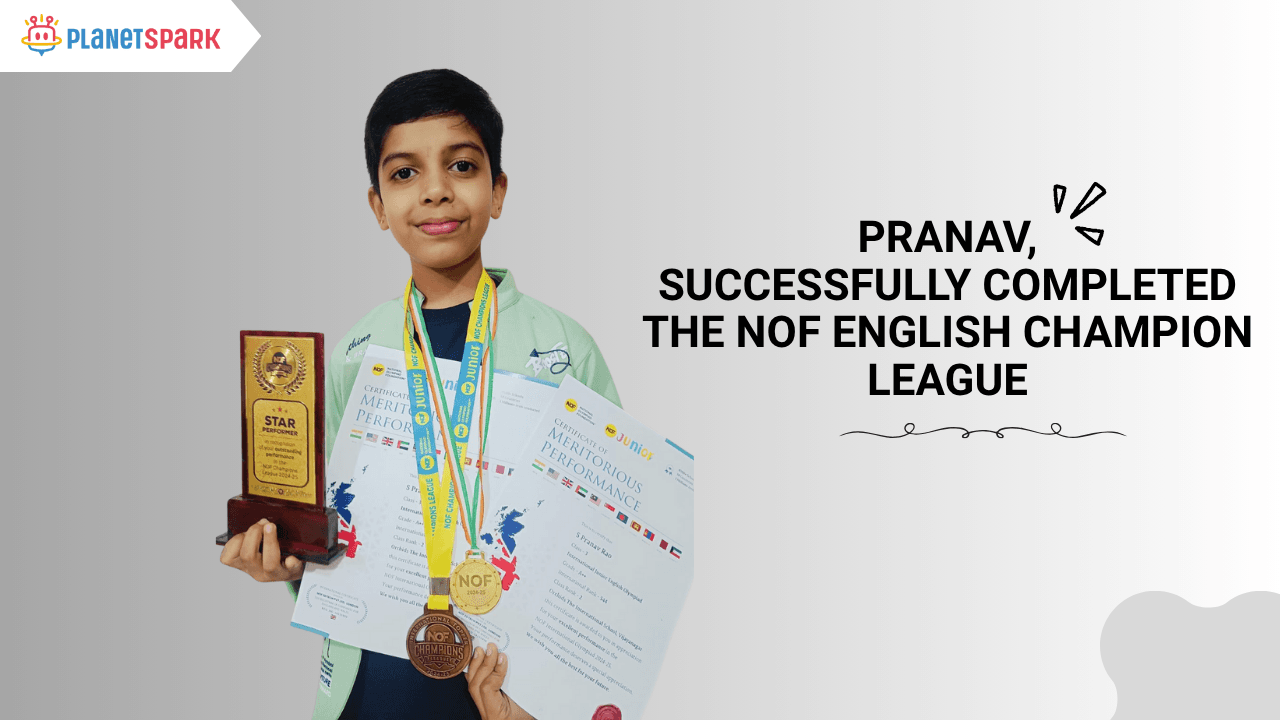
Pranav, a Grade 3 star, successfully completed the NOF English Champion League, proving his excellence in Public Speaking and Creative Writing. Through PlanetSpark’s structured guidance and engaging sessions, Pranav gained confidence, expressed ideas clearly, and showcased creativity beyond his age. His journey reflects how the right mentorship can unlock a child’s true potential.
Help your child become the next Pranav!
Enroll today with PlanetSpark and give your child the skills to speak confidently, think creatively, and shine academically.
Why choose PlanetSpark for Mastering Defamiliarisation?
Here’s what makes PlanetSpark different from other ed-tech platforms:
- Personalised 1:1 Classes: As every child learns differently, PlanetSpark provide personal communication experts for teaching spellings, grammar, and writing live, 1:1. The trainers get familiar with the child’s pace and provide instant feedback to the parents for improvement.
- Customised Learning Roadmap: Planetspark begins with a skills assessment and creates a personalised roadmap that focuses on grammar, vocabulary, and English fluency.
- Interactive Grammar Learning: Sentence Formation is taught by stories, role-play, dialogues, and error correction, making the class fun and interactive. The child can learn how tenses and grammar actually work in real-life speaking and writing.
- Gamified Learning: At PlanetSpark, children practice grammar with the help of gamified learning. We immerse fun, games, puzzles, and interactive quizzes like Grammar Guru Challenge and SparkBee. With the help of this, every lesson is a rewarding experience that brings points and badges for the learner.
- AI-supported Grammar Feedback: SparkX - AI-enabled Grammar Feedback tool by PlanetSpark checks your child’s speech and grammar usage, and their sentence flow during speaking exercises. Also, you receive clear reports showing where the child is strong and where they need to improve.
- Daily Grammar Practice Sessions: PlanetSpark offers story writing, journaling (Spark Diary), and AI-led storytelling sessions where kids use grammar in action daily. With this, the gap between knowing the rules and applying them naturally in communication gets filled.
- Detailed and Regular Progress Tracking: Every few weeks, parents receive a detailed progress report of their child that tracks the improvement in grammar accuracy, tense usage, sentence formation, and speaking skills.
Conclusion: Seeing the Ordinary with New Eyes
Defamiliarisation reminds us that the world only feels dull because we have stopped truly noticing it. Through strange descriptions, unexpected perspectives, and creative language, writers and artists bring freshness back to everyday life. From Viktor Shklovsky’s ideas in Russian Formalism to powerful examples in literature and poetry, defamiliarisation shows us that art exists to wake us up.
Young learners at PlanetSpark understand that defamiliarisation builds imagination, observation, and expressive power. It encourages children to think creatively, write originally, and see language as a tool for discovery rather than memorisation.
Frequently Asked Questions
Yes. Using defamiliarisation improves creative writing answers, descriptive essays, and literary analysis.
No. With practice, even young students can learn to describe everyday objects creatively and effectively.
PlanetSpark teaches children powerful writing techniques like imagery, perspective shift, and defamiliarisation through structured, age-appropriate lessons.
Defamiliarisation is important because it slows down reading, increases awareness, and helps readers actively engage with the text instead of reading mechanically.
Examples include:
- A train described as a living creature
- A mirror compared to a broken statue
- A story told from an animal’s point of view
These make ordinary objects feel unfamiliar.
No. A metaphor is a comparison, while defamiliarisation is a broader artistic technique that may use metaphors, structure, or perspective shifts.