
Easy Prepositions for Kids : Simple and Fun Explained

Table of Contents
- Easy Prepositions Explained for Kids
- What Are Prepositions
- How Children Naturally Learn Prepositions
- Why Children Must Learn Prepositions
- Types of Prepositions
- Prepositions of Time
- Prepositions of Direction
- Prepositions of Movement
- Prepositions Used for Objects
- Easy Preposition Model for Children
- Prepositions of Position
- Prepositions of Time
- How to Explain a Preposition to a Child
- Easy Preposition Examples for Kids
- Table of Common Prepositions and Their Uses
- Preposition Checkpoints for Kids
- Easy Preposition Worksheets for Kids (Parent-Friendly)
- Fun Acts for Children to Learn Prepositions
- Common Mistakes Children Make with Prepositions
- How Parents Can Support Learning
- Easy Preposition Exercise (Self-Check)
- Conclusion
- About PlanetSpark : English Grammar
Prepositions may look like tiny words, but they have the power to change the entire meaning of a sentence.Prepositions are small words, but they have a huge role in English grammar. They help us understand the place, time, direction, and movement of things. Without prepositions, sentences would sound confusing and incomplete.
This blog is written in simple and easy language so that both children and parents can understand prepositions clearly. Planet Spark will helps you to learn with examples, activities, tables, checkpoints, and fun tasks, this lesson will make learning prepositions smooth and enjoyable.
Easy Prepositions Explained for Kids
Prepositions are small words that tell us where things are, when something happens, or how something moves. Words like in, on, under, behind, before, after, and across help us make our sentences clear and easy to understand. Without prepositions, it would be hard for children to describe simple things in daily life, like where their book is or when their class starts.
Learning prepositions becomes easy when children see real-life examples, use pictures, and practise through fun activities. When kids understand these words correctly, they can speak better, write stronger sentences, and understand stories more clearly. This makes communication simpler at home and in school.
What Are Prepositions
Prepositions are words that tell the relationship between a noun or a pronoun and the other words in a sentence. These relationships can show place, time, direction, purpose, or movement.
Easy Preposition Definition
A preposition is a word that shows where something is, when something happens, or how something moves.
Prepositions Simple Meaning for Kids
Prepositions help us answer questions like:
Where is it
When did it happen
Which direction is it going
Who is it for
Examples of Simple Prepositions
in
on
at
to
from
under
over
behind
beside
near
These are short words, but they make sentences clear and easy to understand.
How Children Naturally Learn Prepositions
How Prepositions Make Sentences Clear
Prepositions make sentences meaningful by showing place, time, and direction. For example, “The cat sits on the mat” becomes clearer with the preposition on.
Everyday Learning Through Real Situations
Children hear prepositions in daily life:
• Keep the bag under the table
• Stand behind me
• Walk across the road
These repeated instructions slowly build understanding.
How Parents Can Support Preposition Learning
Parents can reinforce prepositions at home through simple instructions like:
• Put your shoes near the door
• Keep toys between the shelves
• Place the bottle inside the fridge
Classroom Activities That Strengthen Understanding
Teachers can use action-based games such as:
• Raise your hand above your head
• Place your pencil under your notebook
• Stand next to your friend
Why Early Preposition Learning Matters
Early understanding of prepositions improves reading comprehension. Children understand stories better when they know where and when events happen.
Why Children Must Learn Prepositions
Prepositions are important in speaking, writing, reading, and even storytelling. Without them, ideas become unclear. When children understand prepositions, they improve their grammar, make stronger sentences, and express themselves better.
Benefits of Learning Prepositions
| Skill | How Prepositions Help |
|---|---|
| Grammar | Makes sentence structure clear |
| Speaking | Helps describe places and actions accurately |
| Writing | Improves sentence quality |
| Reading | Helps understand story details |
| Communication | Makes explanations easy |
Types of Prepositions
To understand prepositions better, let us look at different kinds of prepositions used in English.
Prepositions of Place
These prepositions tell us where something is.
Common Examples
in
on
under
above
behind
between
near
beside
Easy Examples
The book is on the table.
The cat is under the chair.
The bag is between the two boxes.
The school is near my house.
Clear Sentences, Confident Expression.
Book a Free Demo Class and strengthen your child’s grammar skills.
Fun Activity
Place different objects in different positions at home and ask your child to describe their location using prepositions of place.
Prepositions of Time
These prepositions show when something happens.
Common Prepositions
at
in
on
during
before
after
Easy Examples
The class starts at 9 am.
My birthday is in May.
We play on Sunday.
I study after dinner.
Checkpoint for Kids
Can you use prepositions to answer these
When do you eat breakfast
When do you go to bed
When do you play outside
If you can answer in full sentences using prepositions, you understand this part well.
Prepositions of Direction
These prepositions show movement from one place to another.
Common Words
to
towards
into
across
through
Easy Examples
The boy is going to school.
The car moved towards the gate.
The dog ran into the room.
We walked across the road.
Fun Act
Ask the child to move around the room following commands:
Walk to the door
Jump across the mat
Go towards the window
This helps children understand direction prepositions through action.
Prepositions of Movement
These prepositions show how something is moving.
Examples
around
up
down
along
past
Easy Examples
The dog ran around the park.
We walked along the river.
The car drove past the shop.
Quick Practice
Complete these sentences:
The bird flew ____ the sky.
She walked ____ the stairs.
They ran ____ the playground.
Prepositions Used for Objects
Sometimes prepositions tell us the relationship between two objects.
Examples
with
without
of
for
Easy Sentences
The girl came with her mother.
Tea without sugar tastes plain.
A box of crayons is on the table.
This gift is for you.
Every Child Can Master English Grammar!
Book a Free Demo Class and discover how personalised coaching makes it easy.
Easy Preposition Model for Children
We encourages simple, clear, child-friendly models to teach concepts. Here is an easy model:
The Three Step Preposition Model
Identify the noun
Find the relationship
Add the correct preposition
Example
Sentence: The cat is ___ the table.
Noun: cat
Relationship: position
Correct preposition: under
So the answer is: The cat is under the table.
Meaning of Movement Prepositions
Words like through, across, into, out of, and along show how someone or something moves from one place to another.
Activity to Learn Movement Prepositions
A mini obstacle course helps children act out instructions like:
• Walk around the chair
• Jump over the book
• Crawl under the table
• Move along the line
Prepositions of Position
Understanding Prepositions of Position
Words such as near, far, beside, behind, in front of, and among help children describe where things are.
Observing Daily Objects to Learn Position Prepositions
Ask children to describe objects in their room:
• The bag is near the table
• The lamp is beside the bed
• My shoes are under the chair
Prepositions of Time
Why Time Prepositions Matter
Words like before, after, during, and at help children understand routines and schedules.
Using Routine Charts to Practise Time Words
Children can describe their day using prepositions of time:
• I brush my teeth before school
• I eat lunch at 1 pm
• I play during the evening
How to Explain a Preposition to a Child
Explaining a preposition becomes simple when shown through real-life examples.
Child-Friendly Explanations
Use physical movement
Place a toy and ask: Where is the toyUse storybooks
Ask: Where is the characterUse drawings
Draw simple pictures showing position
Example Activity
Draw a table on a paper. Place a small object like a pencil on different positions:
On the table
Under the table
Behind the table
Near the table
Let the child label each drawing.
Easy Preposition Examples for Kids
Here are simple examples covering all common prepositions:
Preposition of Place
The bottle is in the bag.
The shoes are under the bed.
The poster is on the wall.
Preposition of Time
We study at night.
School starts in the morning.
We play on Saturday.
Preposition of Direction
He walked to the park.
The ball rolled into the basket.
Preposition of Movement
She ran past the tree.
The boat moved across the lake.
From Tenses to Vocabulary Master It All!
Book a Free Demo Class and make grammar fun and easy for your child.
Table of Common Prepositions and Their Uses
| Preposition | Type | Meaning | Example |
|---|---|---|---|
| in | Place/Time | inside something | The toys are in the box. |
| on | Place | on the surface of | The plate is on the table. |
| at | Time/Place | specific point | Meet me at the gate. |
| under | Place | below | The dog is under the bed. |
| behind | Place | at the back | The ball is behind the sofa. |
| before | Time | earlier than | Wash hands before eating. |
| after | Time | later than | We rest after lunch. |
| to | Direction | going somewhere | Go to school. |
| across | Movement | from one side to another | Walk across the street. |
Preposition Checkpoints for Kids
Use this checklist to see if your child understands prepositions:
Can they explain where an object is
Can they use at, on, in correctly
Can they describe movement using to and into
Can they show direction using towards
Can they complete simple preposition worksheets
Can they identify incorrect prepositions in a sentence
If most answers are yes, they have mastered the basics.
Easy Preposition Worksheets for Kids (Parent-Friendly)
Worksheet 1: Fill in the Blanks
The boy is ____ the bus. (in/on)
The cat jumped ____ the roof. (onto/under)
We will meet ____ Monday. (on/at)
Put your shoes ____ the cupboard. (in/behind)
Walk ____ the bridge. (across/under)
Worksheet 2: Choose the Right Preposition
The bag is ____ the chair. (near/to)
My birthday is ____ July. (in/on)
The dog ran ____ the house. (around/at)
Worksheet 3: Match the Sentence
Match column A with column B.
| Column A | Column B |
|---|---|
| The ball rolled | into the box |
| She walked | across the road |
| The bird flew | over the tree |
Fun Acts for Children to Learn Prepositions
Act 1: Preposition Treasure Hunt
Hide an object. Give clues:
It is under the pillow
It is behind the curtain
Act 2: Preposition Drawing Game
Say: Draw a cat on a mat
Draw a ball under the chair
Act 3: Preposition Role Play
One child gives commands like:
Stand near the door
Sit between the two chairs
Act 4: Home Object Hunt
Ask children to find objects around the room and describe their positions.
Act 5: The Picture Search Game
Children look at a picture and answer questions like:
• What is under the table?
• Who is behind the tree?
This builds observation and preposition usage.
Act 6: Build a Scene Activity
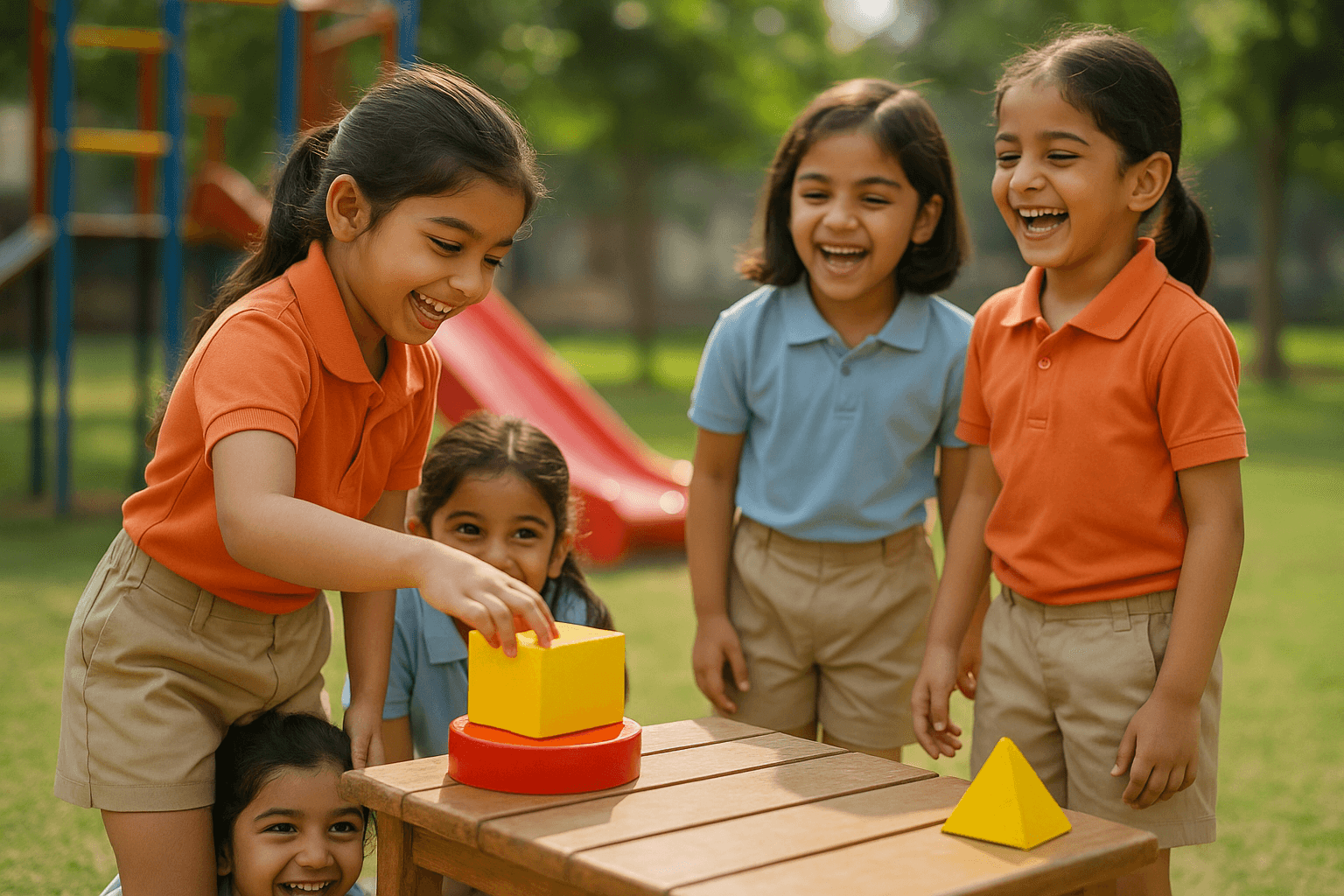
Using toys, blocks or cutouts, children follow instructions like:
• Place the red block on the blue block
• Put the car beside the house
• Keep the flower inside the pot
Act 7: Preposition Hunt at Home
Parents hide items and give clues:
• Look behind the curtain
• Check inside the drawer
This turns learning into an exciting game.
Common Mistakes Children Make with Prepositions
Mistake 1: Using on instead of in
Wrong: The clothes are on the cupboard.
Right: The clothes are in the cupboard.
Mistake 2: Using at for days
Wrong: I play at Sunday.
Right: I play on Sunday.
Mistake 3: Using to instead of from
Wrong: I came to Delhi.
Right: I came from Delhi.
Grammar Skills That Last a Lifetime.
Book a Free Demo Class now and start your child’s journey to English mastery.
How Parents Can Support Learning
Parents can make learning prepositions easy with daily practice.
Tips for Parents
Describe household objects using prepositions.
Encourage children to speak full sentences.
Use picture books to identify prepositions.
Play short games to make learning fun.
Easy Preposition Exercise (Self-Check)
Fill these sentences:
The cup is ____ the table.
The boy walked ____ the park.
We study ____ the morning.
The cat ran ____ the tree.
My birthday is ____ December.
Answers: on, to, in, around, in
Conclusion
Prepositions are simple but powerful words that help children understand relationships in language. They show place, time, direction, movement, and connection. By learning prepositions step by step, children develop clearer speaking, better writing, and stronger communication skills. With practice and fun activities, prepositions become easy to understand and use in everyday life. With support from parents and tools from PlanetSpark-style learning, any child can master prepositions confidently.
About PlanetSpark : English Grammar
PlanetSpark helps children build strong English grammar skills through engaging 1:1 live classes. Our English Grammar Program strengthens sentence structure, tenses, parts of speech, vocabulary, and writing accuracy helping kids communicate clearly and confidently in school and everyday life.
1. 1:1 Expert Grammar Coaching
Each child learns with a certified English trainer who explains grammar in simple, interactive ways. Lessons are customised to the child’s pace, ensuring clarity, understanding, and steady improvement.
2. Personalised Grammar Learning Path
A tailored curriculum helps students master tenses, parts of speech, sentence construction, punctuation, and error-free writing progressing from basic rules to advanced application.
3. AI-Powered Grammar Practice & Feedback
With SparkX and AI-supported exercises, learners receive instant feedback on sentence accuracy, grammar usage, and writing clarity making corrections faster and more effective.
4. Interactive & Gamified Grammar Learning
Fun tools like Grammar Guru, Word Builders, and Sentence Fixer turn complex grammar rules into enjoyable activities, helping kids practise consistently through play-based learning.
5. Confidence in Writing & Communication
Through guided writing tasks, story construction, and real-life language activities, students develop the confidence to write and speak with clarity whether in exams, schoolwork, or daily communication.
Frequently Asked Questions
A preposition is a word that tells us where, when, or how something happens. For example: The cat is on the table.
Kids can start with simple words like in, on, under, behind, next to, and between. These show places and positions clearly.
Prepositions like in, on, and at tell us when something happens:
In → months, years, parts of the day (in July, in 2025)
On → days and dates (on Monday, on 5th June)
At → exact time (at 5 o’clock)
Kids can practise by:
Talking about their toys or room (The ball is under the chair.)
Drawing and labeling pictures
Playing games or doing worksheets with prepositions
Some can be tricky because the same word can mean different things. Practising every day and using examples helps kids get them right quickly.