
Feeling Words Every Child Should Know for Strong Communication Skills
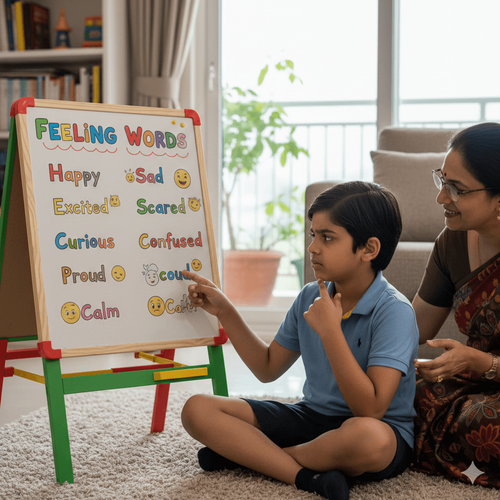

Table of Contents
- Comprehensive Feeling Words List: Building Blocks of Emotion
- Teaching Feeling Words: Practical Strategies for Parents and
- Age-Appropriate Emotional Vocabulary Development
- Overcoming Challenges in Emotional Vocabulary Development
- The Long-Term Impact of Emotional Vocabulary
- The PlanetSpark Approach: Communication Skills Meet Emotiona
- Transform Your Communication with PlanetSpark
"I'm fine." "It's okay." "I don't know." These are the responses parents hear repeatedly when they ask their children how they're feeling. But behind these vague answers often lies a complex world of emotions that children simply don't have the words to express. The truth is, when children can't name what they're feeling, they struggle to manage those feelings, leading to tantrums, frustration, withdrawal, or even behavioral issues.
Feeling words are the building blocks of emotional intelligence and effective communication. They empower children to understand their inner world, express themselves clearly, and build stronger relationships with peers, teachers, and family members.
At PlanetSpark, we recognize that true communication excellence goes beyond grammar and vocabulary; it's about helping children articulate their emotions, thoughts, and ideas with confidence and clarity. Our 1:1 live communication programs integrate emotional vocabulary development with public speaking, creative writing, and critical thinking skills, creating well-rounded communicators who can express themselves authentically.
In this comprehensive guide, we'll explore essential feeling words that every child should know, understand why emotional vocabulary matters, and discover practical ways to help children master the language of emotions.
Understanding Feeling Words: The Foundation of Emotional Intelligence
Feeling words are descriptive terms that help us identify, label, and communicate our emotional experiences. These words range from basic emotions like "happy" or "sad" to more nuanced feelings like "overwhelmed," "grateful," or "anxious." For children, learning rich feeling words is like being handed a map to navigate their emotional landscape; it transforms confusion into clarity and frustration into understanding.
Research consistently shows that children with broader emotional vocabularies demonstrate better emotional regulation, improved social skills, and enhanced academic performance. When a child can distinguish between feeling "annoyed" versus "furious," or "worried" versus "terrified," they gain the ability to calibrate their responses appropriately and communicate their needs effectively.
Why Emotional Vocabulary Matters for Children?
The journey of emotional literacy begins early in life. Studies indicate that children as young as two years old start recognizing basic feelings like happiness, anger, fear, surprise, and sadness. However, without intentional vocabulary building, many children and even adults remain stuck with this limited emotional language throughout their lives.
Building emotional vocabulary offers numerous benefits:
Enhanced Self-Awareness: When children learn specific feeling words in English, they develop greater awareness of their internal states. Instead of experiencing a confusing jumble of sensations, they can identify "I'm feeling nervous about the test" or "I'm disappointed that my friend canceled our playdate."
Improved Emotional Regulation: Naming an emotion is the first step in managing it. Research demonstrates that labeling feelings actually reduces their intensity, a process neuroscientists call "affect labeling." When children can say "I'm frustrated," they're already beginning to gain control over that frustration.
Stronger Relationships: Children who can articulate their feelings build deeper connections with others. They can express appreciation ("I feel grateful when you help me"), set boundaries ("I feel uncomfortable when you tease me"), and show empathy ("You seem sad—do you want to talk?").
Better Academic Performance: Emotional intelligence and academic success are deeply interconnected. Children who can manage their emotions handle test anxiety better, navigate peer conflicts more successfully, and engage more fully in classroom learning.
Reduced Behavioral Issues: Many childhood behavioral problems stem from the inability to express feelings verbally. Tantrums, aggression, and withdrawal often decrease significantly when children gain the vocabulary to communicate their emotional needs.
Stop emotional outbursts before they start! Give your child the language to express feelings clearly.
Comprehensive Feeling Words List: Building Blocks of Emotional Expression
Let's explore an extensive feeling words list organized by basic emotional categories. This structured approach helps children understand that emotions exist on a spectrum, with many nuanced variations of each basic feeling.
Happy Feelings: Expressing Joy and Positivity
These feeling words help children articulate various levels and types of happiness:
Basic Happy Words:
- Happy: General feeling of pleasure and contentment
- Glad: Pleased about something specific
- Cheerful: Noticeably happy and optimistic
- Content: Satisfied and peaceful
Excited and Energetic:
- Excited: Eagerly anticipating something
- Thrilled: Extremely pleased and enthusiastic
- Ecstatic: Overwhelmingly joyful
- Energized: Feeling full of energy and enthusiasm
- Exhilarated: Intensely excited and happy
Calm and Peaceful:
- Peaceful: Free from anxiety or disturbance
- Calm: Tranquil and relaxed
- Relaxed: Free from tension
- Comfortable: At ease physically and emotionally
- Serene: Completely calm and peaceful
Proud and Confident:
- Proud: Satisfied with one's achievements
- Confident: Feeling sure of oneself
- Accomplished: Feeling successful
- Capable: Believing in one's abilities
Grateful and Loving:
- Grateful: Feeling thankful
- Thankful: Appreciative of what one has
- Loved: Feeling cared for and valued
- Cherished: Feeling deeply valued
- Appreciated: Feeling recognized and valued
Watch your child's confidence bloom as they learn to name and share positive emotions! PlanetSpark makes emotional vocabulary fun and engaging.
Sad Feelings: Understanding Disappointment and Sorrow
These words help children express various forms of sadness with appropriate intensity:
Basic Sad Words:
- Sad: General feeling of unhappiness
- Unhappy: Not content or satisfied
- Down: Feeling low in spirits
- Gloomy: Persistently sad or depressed
Disappointed and Let Down:
- Disappointed: Sad when expectations aren't met
- Let down: Feeling failed by someone or something
- Discouraged: Losing confidence or enthusiasm
- Defeated: Feeling like you've lost or failed
Lonely and Isolated:
- Lonely: Feeling alone and disconnected
- Isolated: Separated from others
- Left out: Excluded from activities or groups
- Abandoned: Feeling deserted or forgotten
Deep Sadness:
- Heartbroken: Extremely sad, especially about loss
- Devastated: Overwhelmingly shocked and saddened
- Grief-stricken: Deeply sorrowful, usually from loss
- Miserable: Extremely unhappy
Angry Feelings: Expressing Frustration and Irritation
Understanding anger's many shades helps children respond appropriately:
Mild Annoyance:
- Annoyed: Slightly angry or irritated
- Bothered: Mildly disturbed or irritated
- Irritated: Feeling impatient or slightly angry
- Aggravated: Made worse or more annoyed
Moderate Anger:
- Angry: Strongly feeling displeasure
- Mad: Informal word for very angry
- Frustrated: Upset when unable to achieve something
- Cross: Annoyed or angry (British usage)
Intense Anger:
- Furious: Extremely angry
- Enraged: Violently angry
- Outraged: Shocked and very angry at injustice
- Livid: Extremely angry (informal)
Scared Feelings: Naming Fear and Anxiety
Fear vocabulary helps children identify different levels of apprehension:
Mild Fear:
- Nervous: Slightly anxious or worried
- Uneasy: Slightly fearful or uncomfortable
- Worried: Anxious about potential problems
- Concerned: Feeling care and worry about something
Moderate Fear:
- Scared: Feeling fear
- Afraid: Fearful of something specific
- Frightened: Suddenly scared
- Fearful: Experiencing fear
Intense Fear:
- Terrified: Extremely frightened
- Petrified: So scared one cannot move
- Horrified: Shocked and frightened
- Panicked: Overwhelmed by sudden fear
Anxiety-Related:
- Anxious: Worried and tense
- Stressed: Under mental or emotional pressure
- Overwhelmed: Unable to cope with too much
- Tense: Mentally or emotionally strained
Confused and Uncertain Feelings
These words help when children feel unsure:
- Confused: Unable to understand clearly
- Puzzled: Perplexed and uncertain
- Uncertain: Not sure or confident
- Doubtful: Feeling uncertainty
- Bewildered: Completely confused
- Lost: Feeling directionless or confused
- Stuck: Unable to progress or decide
Surprised Feelings: Expressing the Unexpected
- Surprised: Caught off guard by something
- Amazed: Filled with wonder
- Astonished: Greatly surprised
- Shocked: Suddenly and intensely surprised
- Startled: Suddenly alarmed or surprised
- Stunned: Unable to think clearly due to surprise
Other Important Feeling Words in English
Embarrassment and Shame:
- Embarrassed: Feeling awkward or ashamed
- Ashamed: Feeling guilt or disgrace
- Humiliated: Deeply embarrassed
- Self-conscious: Overly aware of oneself
Boredom and Disinterest:
- Bored: Feeling uninterested
- Uninterested: Lacking interest
- Indifferent: Not caring either way
- Apathetic: Lacking enthusiasm
Guilt and Regret:
- Guilty: Feeling responsible for wrongdoing
- Regretful: Feeling sorry about past actions
- Remorseful: Deeply sorry for wrongdoing
Hope and Anticipation:
- Hopeful: Feeling optimistic about the future
- Optimistic: Expecting good things
- Eager: Enthusiastically wanting something
- Anticipating: Looking forward to something
Turn confusion into clarity with the right words! PlanetSpark teaches children to articulate complex emotions beautifully.
Teaching Feeling Words: Practical Strategies for Parents and Educators
Understanding the theory is important, but how do we actually help children learn and use these feeling words? Here are proven strategies that make emotional vocabulary stick:
Model Emotional Language Yourself
Children learn primarily through observation and imitation. When you consistently label your own emotions aloud, children naturally absorb this vocabulary:
- "I'm feeling frustrated because I can't find my keys."
- "I'm so grateful you helped me with the groceries."
- "I'm anxious about tomorrow's presentation at work."
- "I'm disappointed that our picnic got rained out, but I'm also hopeful we can reschedule."
This modeling shows children that everyone experiences emotions and that talking about feelings is normal and healthy.
Use Visual Aids and Feeling Charts
Visual learning tools make abstract emotions concrete and memorable:
Feelings Charts: Create or purchase charts showing faces expressing different emotions with corresponding feeling words. Place these in common areas where children see them daily.
Emotion Wheels: These circular diagrams show how basic emotions branch into more specific feelings, helping children understand emotional nuances.
Emoji Guides: Connect familiar emojis to their corresponding feeling words, making the learning relevant to children's digital lives.
Illustrated Story Cards: Picture cards showing scenarios with emotional content prompt discussions about how characters might feel.
Read Books About Emotions
Literature provides safe scenarios for exploring feelings without personal stakes. When reading with children:
- Pause to ask: "How do you think the character feels right now?"
- Encourage specific vocabulary: "Can you think of a more specific word than 'bad'? Maybe disappointed or frustrated?"
- Connect to personal experience: "Have you ever felt that way? When?"
- Discuss different perspectives: "How might the other character be feeling?"
Create Daily Check-In Rituals
Establish regular opportunities for emotional expression:
Morning Check-Ins: "How are you feeling about the day ahead? What word best describes your mood?"
Mealtime Sharing: "What was the high and low of your day? What emotions did you experience?"
Bedtime Reflections: "What feelings did you have today? Let's name three different ones."
Feeling Journals: Encourage older children to write or draw about their emotions regularly.
Play Emotion-Focused Games
Learning through play makes vocabulary acquisition natural and enjoyable:
Feeling Charades: Act out emotions for others to guess, using feeling words from your expanding list.
Emotion Sorting: Write feeling words on cards and sort them by intensity, category, or positive/negative valence.
Story Starters: Begin stories like "Once there was a child who felt..." and have children complete them using specific emotional vocabulary.
Feelings Scavenger Hunt: Search for examples of different emotions in books, TV shows, or real life throughout the day.
Validate and Expand Emotional Expression
When children share feelings, respond thoughtfully:
Acknowledge First: "I hear that you're feeling upset."
Expand the Vocabulary: "It sounds like you might be feeling disappointed that the playdate was canceled. Disappointed means sad when something you were looking forward to doesn't happen."
Ask Questions: "What made you feel that way?" "Where in your body do you notice that feeling?"
Problem-Solve Together: "Now that we know you're feeling anxious about the test, what can we do to help?"
Connect Physical Sensations to Emotions
Help children recognize how feelings manifest in their bodies:
- "When you're angry, do you feel hot? Do your muscles get tight?"
- "Where in your body do you feel nervousness? Your stomach? Your chest?"
- "What happens to your energy when you feel sad? Do you feel heavy or tired?"
This mind-body connection deepens emotional awareness and provides early warning signals for emotion regulation.
From nervous speakers to confident communicators, emotional mastery makes the difference!
Join PlanetSpark's transformative programs. FREE trial available now!
Age-Appropriate Emotional Vocabulary Development
Children's capacity for emotional vocabulary grows with cognitive development. Here's how to match teaching to developmental stages:
Preschool (Ages 3-5)
Focus on Basic Feelings: At this stage, concentrate on the fundamental emotions: happy, sad, angry, scared, surprised, and disgusted.
Recommended Teaching Methods:
- Use picture books with clear facial expressions
- Play emotion matching games
- Practice making faces that show different feelings
- Use simple sentences: "I feel happy when..."
Sample Activities:
- "Today I feel..." morning circle
- Emotion puppet shows
- Feeling songs and rhymes
Early Elementary (Ages 6-8)
Expand the Vocabulary: Introduce variations like excited, frustrated, worried, proud, lonely, and embarrassed.
Recommended Teaching Methods:
- Connect emotions to story characters
- Introduce intensity scales (a little angry vs. very angry)
- Discuss the causes of different feelings
- Begin teaching empathy through perspective-taking
Sample Activities:
- Feeling thermometers (rate emotional intensity)
- "What would you do?" emotional scenario cards
- Journaling with feeling word prompts
Upper Elementary (Ages 9-12)
Introduce Nuanced Emotions: Add sophisticated terms like overwhelmed, confident, anxious, grateful, discouraged, content, and anticipating.
Recommended Teaching Methods:
- Analyze complex emotions in literature and media
- Discuss how multiple emotions can exist simultaneously
- Explore cultural differences in emotional expression
- Connect emotions to values and decision-making
Sample Activities:
- Emotion mapping for complex situations
- Debate emotional responses to ethical dilemmas
- Creative writing focusing on emotional depth
Teenagers (Ages 13+)
Master Emotional Complexity: Introduce abstract emotional concepts like ambivalent, nostalgic, vulnerable, validated, resentful, and apathetic.
Recommended Teaching Methods:
- Explore emotional intelligence theory
- Discuss emotion regulation strategies
- Analyze how emotions influence behavior and relationships
- Connect emotional awareness to future success
Sample Activities:
- Emotional intelligence self-assessment
- Real-world communication practice using "I feel" statements
- Analysis of emotional expression in various cultures and contexts
Give your elementary schooler the emotional edge! PlanetSpark's age-appropriate programs build vocabulary that lasts a lifetime.
Overcoming Challenges in Emotional Vocabulary Development
Some children resist or struggle with emotional vocabulary development. Here's how to address common challenges:
"I Don't Know How I Feel"
Strategy: Offer multiple choices: "Are you feeling frustrated, disappointed, or something else?" Narrowing options makes identification easier.
"I'm Fine" (When They're Clearly Not)
Strategy: Respect their boundaries while keeping the door open: "I notice you seem upset. I'm here whenever you want to talk." Model vulnerability yourself to show that sharing feelings is safe.
Emotional Outbursts Before Verbal Expression
Strategy: Wait for calm, then retrospectively label: "Earlier when you threw the toy, you seemed really frustrated. Next time, can you try saying 'I feel frustrated' before acting?"
Gender Stereotypes About Emotions
Strategy: Actively counter harmful messages that certain emotions are "for girls" or "for boys." All humans experience all emotions, and expressing them is a sign of strength, not weakness.
Cultural Differences in Emotional Expression
Strategy: Honor your family's cultural values while ensuring children have the vocabulary they need. Some cultures emphasize emotional restraint, but having the words for internal understanding remains valuable even if external expression is limited.
Real-World Application in Every Lesson
PlanetSpark lessons consistently incorporate emotional intelligence:
- Character Analysis: "How does Harry Potter feel when he discovers he's a wizard? Let's use at least five different feeling words to describe his emotions."
- Personal Narratives: "Tell a story about a time you felt proud. What specific actions led to that feeling?"
- Persuasive Speaking: "When making an argument, acknowledge how others might feel: 'I understand this change might make some people feel anxious, but...'"
- Conflict Resolution: "Practice using 'I feel' statements: 'I feel hurt when you interrupt me because...'"
From "I'm bored" to "I'm frustrated," give your child precise words for every feeling! PlanetSpark's expert trainers make vocabulary building exciting.
The Long-Term Impact of Emotional Vocabulary
The investment in teaching children feeling words pays dividends throughout their lives:
Academic Success: Students with strong emotional vocabularies handle academic stress better, communicate effectively with teachers and peers, and engage more deeply with learning.
Career Advancement: Emotional intelligence is consistently identified as a top trait of successful leaders. Adults who can articulate feelings navigate workplace conflicts, build professional relationships, and lead teams effectively.
Mental Health: People with rich emotional vocabularies experience better mental health outcomes. They recognize when they need support, can communicate effectively with therapists, and have tools for self-regulation.
Relationship Quality: From friendships to romantic partnerships to parent-child bonds, relationships thrive when people can express feelings clearly and empathetically.
Personal Fulfillment: Understanding one's emotional landscape leads to better life decisions, clearer value alignment, and greater overall life satisfaction.
Invest in your child's future success, one feeling word at a time! PlanetSpark builds emotional intelligence alongside communication excellence.
Book your free demo class now!
The PlanetSpark Approach: Communication Skills Meet Emotional Intelligence
At PlanetSpark, we understand that strong communication skills require more than just vocabulary and grammar; they demand emotional intelligence, self-awareness, and the confidence to express authentic feelings. Our comprehensive programs integrate emotional vocabulary development into every lesson through:
Expressive Storytelling: Children learn to create narratives rich with emotional depth, using diverse feeling words in English to bring characters to life.
Debate and Discussion: Through structured debates, children practice articulating opinions while respecting others' emotional perspectives, learning phrases like "I understand you might feel differently, but I feel..."
Creative Writing Projects: Students craft poems, stories, and essays that explore complex emotions, expanding their ability to express subtle feelings.
Public Speaking Practice: Presenting in front of others naturally involves managing anxiety, nervousness, and excitement, providing real-world opportunities to practice emotional vocabulary.
1:1 Personalized Coaching: Every child's emotional landscape is unique. Our expert trainers provide individualized attention, helping each student build emotional vocabulary at their own pace.
Transform Your Communication with PlanetSpark
The journey from "I'm fine" to "I'm feeling disappointed but also hopeful" represents more than vocabulary growth; it's a transformation in how children understand themselves and relate to the world. Feeling words unlock emotional intelligence, strengthen communication skills, and build resilient, self-aware individuals ready to navigate life's complexities.
Every time a child learns a new emotion word with grammar, they gain a tool for self-understanding and connection. Every time they practice expressing feelings verbally, they strengthen neural pathways that support emotional regulation. Every conversation about emotions builds the foundation for lifelong mental health and relationship success.
At PlanetSpark, we're passionate about nurturing the whole child, not just their speaking abilities, but their capacity for self-expression, emotional awareness, and authentic communication. Our programs integrate emotional vocabulary naturally into every lesson, creating confident communicators who can articulate not just facts and ideas, but feelings and perspectives.
The power of feeling words extends far beyond childhood. Adults who grew up with rich emotional vocabularies become empathetic leaders, supportive friends, effective parents, and emotionally healthy individuals. By teaching children these essential words today, we're investing in a more emotionally intelligent, compassionate future.
Frequently Asked Questions
Feeling words are vocabulary that help children name their emotions, like happy, nervous, frustrated, jealous, or proud. These words act as tools so kids can explain what’s happening inside them instead of acting out through tantrums, withdrawal, or anger. The more feeling words they know, the better they can communicate and manage emotions.
When children can label emotions accurately, they can explain their needs instead of crying, yelling, or shutting down. Feeling words support clearer conversations with parents, teachers, and friends. This improves relationships, reduces conflicts, and builds strong communication skills that help in school, friendships, and future workplaces.
Children can start learning basic feeling words like happy, sad, angry, and scared as early as ages 2–3. As they grow, you can gradually introduce more specific emotions like nervous, proud, disappointed, or overwhelmed. The key is to keep naming emotions in daily life so the vocabulary grows naturally over time.
Parents can model emotional language (“I feel frustrated,” “I’m proud of you”), use feelings charts, read storybooks about emotions, and do quick check-ins like “What are you feeling right now?” Games like charades, role-play, and emotion cards make learning feeling words fun and memorable.