
Identify the Figure of Speech: Meaning, Importance and Types

Table of Contents
- What is a Figure of Speech?
- Importance of Identifying Figures of Speech
- Types of Figures of Speech
- How to Identify Figures of Speech in a Sentence
- Summary Table of Figures of Speech
- Practice Sentences to Identify Figures of Speech
- Figures of Speech in Literature and Daily Life
- Examples from Daily Life
- Examples from Literature
- Common Confusions Explained in Figures of Speech
- How Does PlanetSpark Help in Identifying Figures of Speech?
- Conclusion
Identifying the figure of speech in a sentence is like uncovering a hidden layer of magic in language. Every comparison, exaggeration, or playful twist of words reveals how writers add colour and emotion to their ideas. When we look closely, ordinary lines transform into vivid images, powerful expressions, and memorable moments. Learning to spot these creative techniques helps us read with imagination and understand writing on a deeper, more meaningful level.
What is a Figure of Speech?
A figure of speech is a
special way of using words to create a strong image, express feelings, or make writing more interesting. It does not always use the literal meaning of words. Writers use figures of speech to compare things, exaggerate ideas, or give human qualities to non-living things. Common figures of speech include simile, metaphor, and personification.
Examples:
- Simile: “Her smile is like sunshine.”
- Metaphor: “Time is a thief.”
- Personification: “The wind whispered softly.”

Importance of Identifying Figures of Speech
dentifying figures of speech is important because it helps readers understand deeper meanings, emotions, and creativity in language. It improves interpretation skills and makes reading more enjoyable. Recognizing figure of speech meaning, spotting figure of speech examples, and understanding how they function in figure of speech in English strengthens both comprehension and writing skills.
- Understanding the figure of speech meaning helps readers clearly grasp the deeper message or emotion the writer wants to express.
- Identifying figure of speech examples allows learners to see how language can be used creatively to make ideas more vivid and powerful.
- Recognising figure of speech in English improves comprehension skills, especially in poems, stories, and complex texts.
- It enhances writing abilities by teaching students how to add imagery, emotion, and style to their own sentences.
- It strengthens critical thinking by helping readers analyse how authors use language to persuade, describe, or emphasise ideas.
Give your child the confidence to speak, write, and express brilliantly—book a free PlanetSpark demo class today and experience the power of personalised learning.
Types of Figures of Speech
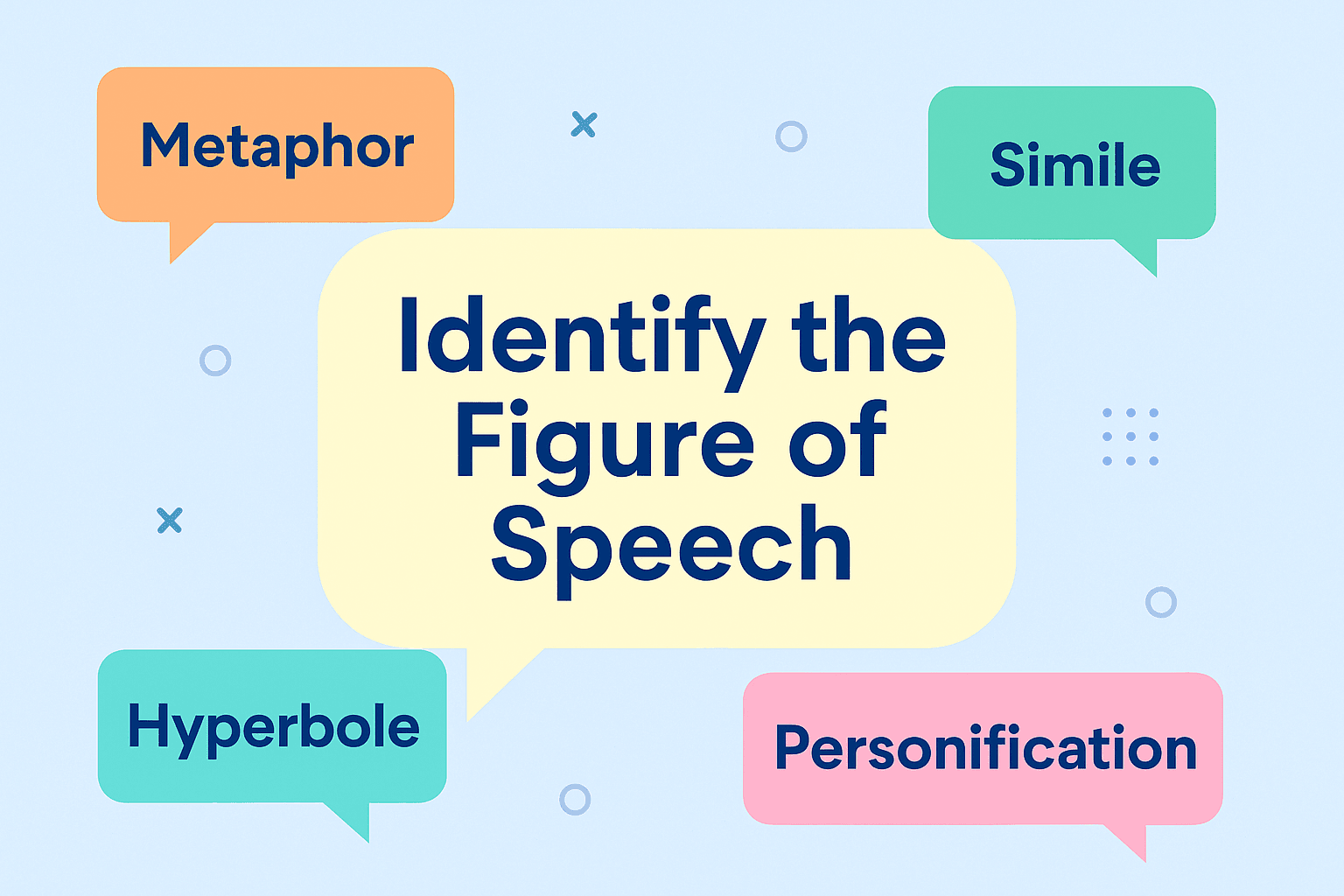
Figures of speech are expressive language techniques used to add beauty, clarity, and imagination to writing. They help writers communicate emotions, strengthen descriptions, and create lasting impressions on readers. By understanding various types of figures of speech, learners can interpret literature more effectively and enhance their own writing with creativity and depth. These figures transform ordinary sentences into powerful expressions filled with imagery, comparison, sound, and emotion.
Simile
A simile compares two different things using the words “like” or “as” to highlight similarities clearly.
Examples:
- Her smile is like a ray of sunshine.
- He fought as bravely as a lion.
Metaphor
A metaphor makes a direct comparison by stating that one thing is another, creating a strong image without using “like” or “as.”
Examples:
- Time is a thief.
- Her mind is a deep ocean of ideas.
Personification
Personification gives human qualities to animals, objects, or abstract ideas to make descriptions lively and relatable.
Examples:
- The wind whispered through the trees.
- Opportunity knocked on his door.
Alliteration
Alliteration is the repetition of the same beginning consonant sound in a series of nearby words, often used to create rhythm or musicality.
Examples:
- Peter picked perfect peaches.
- The wild winds whipped wildly.
Hyperbole
Hyperbole is a deliberate exaggeration used to emphasize a point or create a dramatic effect, not meant to be taken literally.
Examples:
- I am so hungry I could eat a mountain.
- She waited for ages.
Onomatopoeia
Onomatopoeia refers to words that imitate natural sounds, helping readers hear what is happening.
Examples:
- The bees buzzed in the garden.
- The door creaked open slowly.
Oxymoron
An oxymoron places two opposite or contradictory words side by side to create a striking expression.
Examples:
- Bittersweet memory.
- Deafening silence.
Irony
Irony expresses something different from or opposite to the literal meaning, often creating humor or emphasis.
Examples:
- A fire station catching fire.
- Saying “Great weather!” during a storm.
Pun
A pun is a humorous play on words that have similar sounds or multiple meanings.
Examples:
- Time flies like an arrow; fruit flies like a banana.
- I’m reading a book on anti-gravity—it’s impossible to put down.
Metonymy
Metonymy replaces the name of a thing with the name of something closely associated with it.
Examples:
- The pen is mightier than the sword. (pen = words, sword = force)
- The White House issued a statement. (White House = government)
Synecdoche
Synecdoche uses a part to represent the whole or the whole to represent a part.
Examples:
- All hands on deck. (hands = sailors)
- India won the match. (India = Indian cricket team)
Apostrophe
Apostrophe occurs when a speaker addresses someone absent, dead, or non-human as if they are present and capable of understanding.
Examples:
- O Death, where is thy sting?
How to Identify Figures of Speech in a Sentence
Identifying figures of speech involves looking beyond the literal meaning of words to understand the writer’s deeper intention. A figure of speech often adds comparison, exaggeration, sound effect, or imaginative expression to a sentence. By recognising unusual patterns, emotional tone, or creative descriptions, readers can interpret how language is being used to create imagery, highlight ideas, or convey emotions more effectively.
- Look for comparisons using “like” or “as”; these usually indicate a simile.
- Notice comparisons stated directly without comparison words; these often signal a metaphor.
- Check if a non-living thing or idea is given human qualities; this is personification.
- Identify extreme or impossible exaggerations; these point to hyperbole.
- Observe repeated beginning sounds in nearby words; this shows alliteration.
- Listen for words that imitate natural sounds like "buzz" or "clang"; this suggests onomatopoeia.
- Look for two contradictory words placed together; this indicates an oxymoron.
- Check whether a part represents a whole or vice versa; this may be synecdoche.
- Notice if something is referred to by a related name; this is often metonymy.
Summary Table of Figures of Speech
Figures of speech are creative language tools that enhance expression, add beauty to writing, and help convey ideas more vividly. They allow writers to compare, exaggerate, personify, or play with words to create strong imagery and emotional impact. Understanding different figures of speech improves both reading and writing skills, enabling learners to interpret deeper meanings and appreciate the artistic use of language across poems, stories, and everyday communication.
Practice Sentences to Identify Figures of Speech
Practising with sentences helps learners recognise figures of speech more confidently by analysing comparisons, exaggerations, sound patterns, and imaginative expressions. When you read each sentence, focus on how the writer uses language creatively to describe an idea or emotion. Look for keywords, unusual phrasing, repeated sounds, or expressions that are not literally possible. These clues will help you understand whether the sentence contains a simile, metaphor, personification, hyperbole, or any other figure of speech.
- The old mansion stood silently on the hill, watching over the village as though it had guarded its people for centuries.
- Her laughter burst through the quiet room like a sudden splash of sunlight breaking through dark clouds after a long storm.
- Even though he had repeated the instructions a thousand times, his younger brother still stared at him with complete confusion.
- The marketplace roared to life each morning as vendors shouted, carts rattled, and children’s excited voices danced through the air.
- My thoughts raced wildly across my mind, crashing into one another like waves attacking a rocky shore during a fierce storm.
- The city, wrapped in the golden glow of dawn, stretched its tired limbs as the first rays of light touched the streets.
- She carried the weight of the world on her shoulders, believing every problem in her family depended on her solution.
- As the wind howled angrily outside, the trees bowed deeply, pleading for the storm to finally calm its furious mood.
- His words were daggers dipped in ice, delivered with a coldness that made everyone in the room fall silent.
- The clock on the wall ticked impatiently, reminding us that time was slipping away faster than we expected.
Want your child to become a strong communicator and creative thinker? Reserve a PlanetSpark demo class now and watch how fun, interactive coaching transforms their skills.
Figures of Speech in Literature and Daily Life
Figures of speech appear naturally in both literature and everyday communication. In literature, writers use them to create strong images, express emotions, and give depth to characters and scenes. In daily life, people use figures of speech to exaggerate feelings, compare ideas, or make conversations lively and relatable. Whether in poems, novels, advertisements, or friendly chats, these expressions make language more colourful, meaningful, and memorable.
Examples from Daily Life
- “I’m drowning in homework today.” — Hyperbole
- “Her smile is like sunshine.” — Simile
- “Time flies when we’re together.” — Personification
- “That joke cracked me up!” — Metaphor
- “The news hit him like a thunderbolt.” — Simile
Examples from Literature
- “All the world’s a stage, and all the men and women merely players.” — Shakespeare (Metaphor)
- “The moon was a ghostly galleon tossed upon cloudy seas.” — Alfred Noyes (Metaphor + Imagery)
- “Because I could not stop for Death—He kindly stopped for me.” — Emily Dickinson (Personification)
- “Hope is the thing with feathers.” — Emily Dickinson (Metaphor)
- “The silence was broken by the cough of the engine.” — Personification
Common Confusions Explained in Figures of Speech
Figures of speech can sometimes be confusing because many of them appear similar in structure or meaning. Understanding the differences between them helps readers identify the correct type and interpret sentences accurately. Students often mix up comparisons, exaggerations, sound-based expressions, or phrases that use unusual wording. By learning how each figure of speech works, what it emphasises, and how it is used, one can read literature more confidently and communicate ideas more clearly.
Simile vs. Metaphor
A simile compares using like or as, while a metaphor directly says one thing is another.
Simile: “She sings like an angel.”
Metaphor: “She is an angel.”
Personification vs. Anthropomorphism
Personification gives human qualities to non-living things for expression; anthropomorphism gives human behaviour to animals or objects as characters.
Personification: “The wind whispered.”
Anthropomorphism: “The mouse wore a coat and spoke politely.”
Hyperbole vs. Exaggeration
All hyperboles are exaggerations, but hyperbole is extreme and impossible, used for emphasis.
Example: “I’ve walked a million miles.”
Alliteration vs. Assonance
Alliteration repeats consonant sounds at the beginning of words; assonance repeats vowel sounds within words.
Alliteration: “Bright blue birds.”
Assonance: “The mellow bells echoed.”
Irony vs. Sarcasm
Irony means the opposite of what is said; sarcasm uses irony with the intention to mock or hurt.
Irony: “A pilot afraid of heights.”
Sarcasm: “Wow, great job!” (after a mistake)
Discover how PlanetSpark makes learning exciting, engaging, and effective—sign up for a free demo class and see your child grow in confidence from the very first session.
How Does PlanetSpark Help in Identifying Figures of Speech?
PlanetSpark helps students confidently identify figures of speech by combining personalised teaching, structured lessons, interactive practice, and smart learning tools. The platform makes abstract concepts like simile, metaphor, personification, and hyperbole easy to understand through examples, activities, and guided feedback.
- Trained mentors explain each figure of speech in simple language, give personalised examples, and help students differentiate similar concepts like metaphor vs. simile or irony vs. sarcasm. Individual attention ensures every student learns at their own pace.
- Lessons break down figures of speech into easy, structured steps—definition → identification → explanation → practice. This removes confusion and helps students understand exactly how to spot figures of speech in any sentence or poem.
- Students complete worksheets, reading exercises, and writing tasks where they identify and use figures of speech.
- Quizzes, matching games, storytelling tasks, and creative challenges make learning figures of speech engaging. Fun activities help students remember definitions and examples more effectively.
- With continuous guidance and practice, students learn to recognise figures of speech naturally in stories, poems, essays, and daily conversations. This boosts communication skills and makes them stronger, more expressive writers.
Conclusion
PlanetSpark makes identifying figures of speech easy, enjoyable, and confidence-boosting for every student. Through personalised coaching, structured lessons, and engaging practice, learners develop a clear understanding of how creative language works in literature and daily communication. With fun activities, smart feedback, and consistent support, students not only master similes, metaphors, personification, and more but also grow into expressive, skilled communicators who can read and write with greater clarity and imagination.
Frequently Asked Questions
Identifying a figure of speech means recognising when words are used creatively rather than literally. It involves spotting comparisons, exaggerations, sound patterns, or human qualities given to objects in order to understand the writer’s deeper meaning.
Look for comparison words. If the sentence uses “like” or “as,” it’s usually a simile. If it directly equates one thing with another without these words, it is a metaphor.
If an object, animal, or abstract idea is performing human actions or having human feelings, it is personification. For example: “The clouds marched across the sky.”
It improves reading comprehension, helps you appreciate literature, and strengthens your writing. Understanding figures of speech allows you to interpret emotions, imagery, and style more effectively in any text.
It improves reading comprehension, helps you appreciate literature, and strengthens your writing. Understanding figures of speech allows you to interpret emotions, imagery, and style more effectively in any text.