
Fix Run-On Sentences with Easy Practice | PlanetSpark
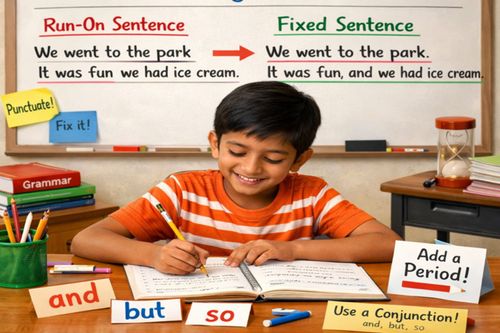

A run-on sentence happens when two or more complete ideas are joined together without proper punctuation or connecting words. This makes the meaning confusing, as ideas flow in one long line instead of having clear sentence breaks. For children, learning how to fix run-on sentences is essential for making their writing smoother and easier to understand.
By focusing on sentence breaks, punctuation, and connectors through short activities and guided practice, students can spot errors and correct them confidently. Gradually, writing feels more natural, ideas flow better, and sentence clarity improves in a stress-free way. At PlanetSpark, we help students learn how to correct a run-on sentence with fun, engaging activities that make writing enjoyable and effective!

Common Mistakes Leading to Run-On Sentences
Run-on sentences usually occur when writers rush or try to include too many ideas at once. Common mistakes include forgetting punctuation, misusing commas, or not knowing where to place conjunctions. A lack of practice with sentence structure can also lead to this error, resulting in unclear and confusing writing.
Example with Explanation
A run-on sentence happens when two or more complete thoughts are joined together without proper punctuation or conjunctions, making the sentence unclear. Correctly using punctuation or conjunctions separates these ideas and improves readability.
Examples:
- Example 1: I finished my homework I watched TV.
This is a run-on sentence because both parts are complete ideas. Adding a comma and a conjunction fixes it.
Correct form: I finished my homework, and I watched TV. - Example 2: She was tired she kept studying.
Both parts are independent clauses, but there’s no punctuation between them.
Correct form: She was tired, but she kept studying. - Example 3: The bell rang we left the classroom.
The ideas are joined without a break, making it a run-on sentence.
Correct form: The bell rang, so we left the classroom.
Simple Ways to Fix Run-On Sentences
Fixing run-on sentences becomes easier when you spot where ideas collide without breaks. Start by checking if a sentence contains more than one complete thought. Then, decide whether to separate them or connect them correctly.
Struggling with long, confusing sentences? Learn how to fix run-on sentences using simple rules, clear examples, and guided practice. Start improving sentence clarity today. Get started with our free class now!
Therefore, using periods, commas with conjunctions, or semicolons can help you improve the clarity. As a result, with regular practice, you can quickly spot missing breaks and correct them, making sentences clearer and well-structured.
Using Punctuation Marks Correctly
Proper punctuation is key to separating ideas and improving sentence clarity. A period (.) should be used to end a complete thought, while commas (,) can separate items in a list or create pauses in a sentence. By adding these punctuation marks where needed, you can clearly separate ideas and avoid run-on sentences.
Example:
Run-on: I love playing football it’s my favorite sport.
Fixed: I love playing football. It’s my favorite sport.
Breaking Long Sentences into Smaller Parts
When a sentence becomes too long and includes too many ideas, it can lead to confusion. A simple solution is to break the sentence into two or more shorter sentences. This helps maintain clarity and ensures that each thought is expressed clearly.
Example:
Run-on: She went to the store, and then she met her friend at the park, and they decided to grab a coffee.
Fixed: She went to the store. Then, she met her friend at the park, and they decided to grab a coffee.
Adding Conjunctions to Connect Ideas
Conjunctions like “and,” “but,” “so,” or “because” can help link two related ideas in a sentence. Adding a conjunction where necessary allows you to combine two independent clauses while keeping the sentence clear and easy to understand.
Example:
Run-on: I wanted to go for a walk it was raining outside.
Fixed: I wanted to go for a walk, but it was raining outside.
By practicing these simple techniques, students can easily fix run-on sentences and make their writing more readable and coherent.

Types of Run-On Sentences
Run-on sentences occur when independent clauses are improperly joined, making writing unclear. The main types of run-ons include fused sentences, comma splices, and polysyndetons. Each involves different ways of connecting clauses incorrectly. In this section, we'll explore these types and provide examples to help you recognize and correct them.
What is a Fused Sentence?
A fused sentence occurs when two or more independent clauses are joined together without any punctuation.
Example:
We met for a date there was no chemistry we won’t meet again.
What is a Comma Splice?
A comma splice happens when two independent clauses are joined with just a comma, without a conjunction, leading to an incorrect sentence structure.
Example:
We met for a date, there was no chemistry, we won’t meet again.
What is Polysyndeton?
Polysyndeton is when too many conjunctions are used, or more conjunctions are added than necessary, making the sentence feel overloaded.
Example:
We met for a date and there was no chemistry and we won’t meet again.
Practice Activities for Fixing Run-On Sentences
Understanding 3 ways to fix run-on sentences is a key skill that helps students organize their writing clearly and logically. When run-on sentences occur, it’s because multiple ideas are joined together without proper punctuation or conjunctions.
By learning how to correct a run-on sentence through simple techniques such as adding punctuation, using conjunctions, or breaking sentences into smaller parts, students can improve their writing skills. Here's how to practice fixing run-on sentences:
Way 1: Adding Proper Punctuation
Punctuation marks such as periods or semicolons are essential for separating ideas that are wrongly connected in a run-on sentence. Adding these marks helps indicate where one thought ends and another begins. This method is ideal when both parts of the sentence are independent and can stand alone.
Examples:
- I like apples I like oranges → I like apples. I like oranges.
- She was late she apologised → She was late; she apologised.
- The test ended we left → The test ended. We left.
- He ran fast he won → He ran fast; he won.
Help your child understand how to fix run-on sentences through structured grammar lessons and real examples. Build strong writing foundations with PlanetSpark. Try PlanetSpark’s free trial today!
Way 2: Using Coordinating Conjunctions
Coordinating conjunctions like and, but, or, and so connect related ideas effectively. Using these conjunctions with a comma helps to form clear, correct sentences, making it easier to fix run-on sentences.
Examples:
- I was tired I kept studying → I was tired, but I kept studying.
- She practised daily she improved → She practised daily, so she improved.
- He likes tea he likes coffee → He likes tea, and he likes coffee.
- The bell rang we left → The bell rang, so we left.
Way 3: Rewriting It as Two Clear Sentences
Sometimes the easiest way to fix a run-on sentence is by splitting it into two shorter, simpler sentences. This ensures each idea is clear and makes reading easier.
Examples:
- It was raining we stayed inside → It was raining. We stayed inside.
- She loves art she paints daily → She loves art. She paints daily.
- The movie ended we clapped → The movie ended. We clapped.
- He studied hard he passed → He studied hard. He passed.
- The class began we sat down → The class began. We sat down.
How PlanetSpark Helps Students Fix Run-On Sentences Confidently?
PlanetSpark helps students to understand grammar through structured guidance and regular practice. Instead of memorising rules, learners actively apply them while speaking and writing. In the middle of lessons, students are shown practical ways to fix a run-on sentence, making corrections feel simple and logical.
With clear explanations, real-time feedback, and repeated exposure, students gain confidence in spotting errors and correcting them independently, leading to clearer and more effective communication.

1:1 Grammar Coaching with Real-Time Feedback
At PlanetSpark, students receive one-on-one grammar coaching where mistakes are corrected instantly. Trainers explain errors clearly and guide students step by step, helping them understand sentence structure and avoid run-on sentences with confidence.
Sentence Clarity Through Speaking and Writing Practice
Students practise grammar through both speaking and writing tasks. Therefore, this dual approach helps them to recognise how sentences should sound and look. Regular practice improves clarity, making it easier to spot missing breaks or punctuation in run-on sentences.
Confidence Building with Guided Examples and Corrections
Guided practice includes clear explanations using a run-on sentence example to show what went wrong and how to fix it. Seeing corrections in context helps students to understand patterns, build confidence, and apply the same logic in their own writing.
Want your child to confidently know how to fix run-on sentences and write with clarity? PlanetSpark offers expert-led grammar practice that delivers results. Book PlanetSpark’s free demo today!
Conclusion
Run-on sentences can make writing confusing, but they are easy to fix with the right approach. By learning simple grammar rules, practising regularly, and reviewing sentences carefully, students can write more clearly and confidently. Over time, these habits improve sentence flow and idea organisation.
With expert guidance, structured lessons, and practical examples at PlanetSpark, students not only correct mistakes but also build strong grammar skills that support academic writing, effective speaking, and clear everyday communication.
Frequently Asked Questions
Run-on sentences happen when two or more complete ideas are written together without proper punctuation. This makes sentences long, confusing, and hard to read because ideas are not clearly separated.
Students often write run-on sentences when they rush, think faster than they write, or are unsure where to pause. Missing punctuation, weak grammar basics, and trying to include many ideas at once also cause this error.
The easiest 3 ways to fix run-on sentences are adding full stops, using commas with conjunctions, or rewriting the sentence into two clear sentences. These methods quickly improve clarity and sentence structure.
Examples show exactly where a sentence goes wrong and how it should look after correction. By comparing incorrect and correct versions, students understand patterns better and learn how to apply the same fixes in their writing.
PlanetSpark teaches grammar using guided practice, live feedback, and a run-on sentence example explained step by step. This helps students understand rules through real usage, not memorisation.
Yes, PlanetSpark builds confidence by combining one-on-one coaching, regular practice, and clear corrections. As children understand their mistakes and fix them independently, they feel more confident expressing ideas through writing and speaking.