
Grade 6 English Worksheet: Conflict (Internal vs External)
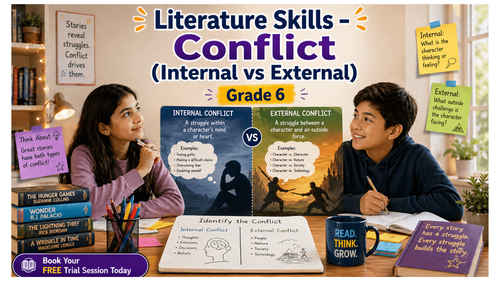

Understanding Story Struggles: Grade 6 English Worksheet on Conflict Types Skills
Every great story is built around a struggle. Whether it is a hero fighting a dragon or a student trying to overcome their own fears, this struggle is what we call conflict. This Grade 6 English worksheet on Conflict (Internal vs External) helps students identify the different types of challenges characters face. By learning to distinguish between a character's inner battle and their struggles against outside forces, students can better understand the depth of a narrative. Mastering conflict types is a key step in becoming an expert at story analysis and creative writing.
Download these English grammar worksheets and practice regularly to strengthen your language skills and build a strong foundation. You can also book a free trial to get expert guidance and improve your reading, writing, and comprehension abilities. The worksheets are designed in a simple and structured way to help K–8 students learn grammar concepts easily and use them confidently in everyday communication.
What Is the Topic?
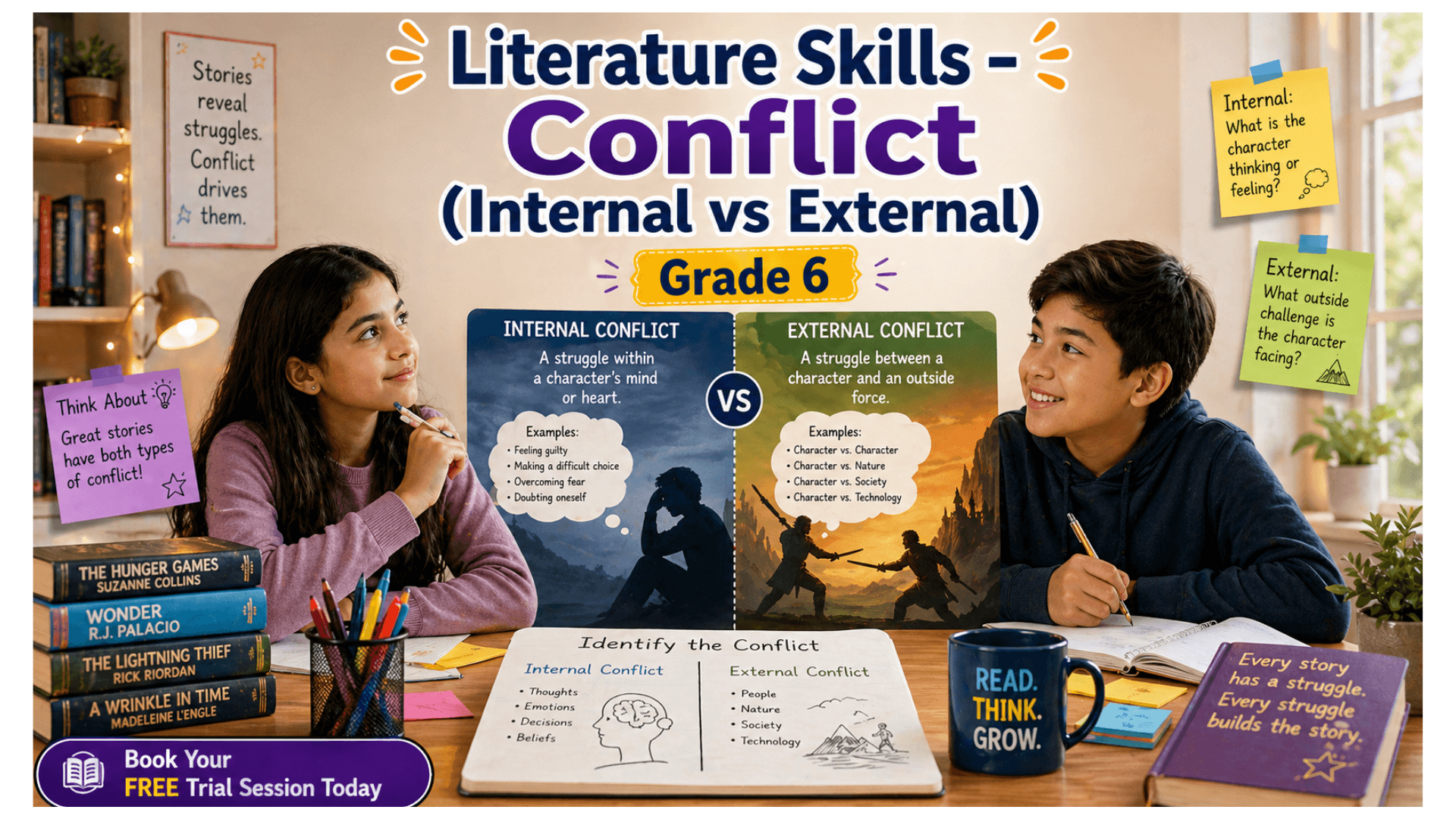
Conflict is the central problem or struggle that drives a story's plot. This worksheet focuses on two main types: Internal Conflict and External Conflict. Students are expected to learn that Internal Conflict happens inside a character’s mind, such as dealing with fear, doubt, or a difficult decision. External Conflict involves a character struggling against an outside force, such as another person, a storm, or a societal rule. Understanding these concepts helps students identify the "why" behind a character's actions and the obstacles they must overcome to succeed.
What’s in This Worksheet?
1. Multiple Choice Questions: Students identify whether the conflict is internal, external, or no conflict.
2. Fill in the Blanks: Students complete sentences using suitable words related to internal and external conflict.
3. True or False: Learners evaluate statements about types of conflict and their role in stories.
4. Underline the Conflict: Students identify and underline the words that show conflict and label its type.
5. Paragraph Writing: Students write a short paragraph explaining internal and external conflict through a real-life situation
Definitions, Examples, Techniques, and Tips
The worksheet provides clear examples to help students differentiate between the two types of conflict. For instance, "She feels scared inside before the competition" is identified as Internal Conflict because the struggle is an emotion within the character. On the other hand, "A storm destroys the village houses" is an External Conflict because the problem comes from nature, which is outside of the character. Students practice these techniques by looking for emotional keywords like "doubts," "confused," or "guilty" for internal struggles, and action keywords like "argues," "fights," or "competes" for external struggles.
Why Is It Important to Learn This?
Learning about conflict types is important because it helps students analyze the "meat" of a story. Without conflict, there is no plot. By recognizing internal and external struggles, students can better appreciate character development and the themes of the books they read. It also improves writing skills, as it teaches students how to create tension and stakes in their own stories, making them more relatable and exciting for the reader. You can Download the worksheet for practicing, For better understanding of Topic you can Book Free Trials.
Where Will This Knowledge Help You?
This knowledge is a core part of Grade 6 literature and will appear in school exams, especially in reading comprehension and character analysis sections. Beyond school, understanding conflict helps in real-life problem solving and communication. Being able to identify whether a problem is personal (internal) or situational (external) is a valuable critical thinking skill. It also sets the stage for learning more advanced literary concepts like "Person vs. Nature" or "Person vs. Society" in higher grades.
How to Use This Worksheet?
1. Start with the matching and general knowledge sections to get your brain ready.
2. Read the sentences in Exercise No. 4 carefully to find the words that show a problem or struggle.
3. Ask yourself: "Is this struggle happening inside the person's head or against something outside?"
4. For the writing task, focus on a specific choice you had to make and how it made you feel.
5. Use the answer key to check your identification skills and learn from any mistakes.
The solutions follow the exact worksheet order, so students should compare their answers carefully.
Important Tips and Tricks
1. Internal conflict usually involves feelings, thoughts, and choices.
2. External conflict involves actions like fighting, arguing, or surviving nature.
3. Look for "emotion" verbs like "feels," "doubts," or "guilty" to find internal conflicts.
4. Look for "action" verbs like "argues," "destroys," or "fights" for external conflicts.
5. A character can face both types of conflict at the same time; look for the primary struggle in the sentence.
✅ Answer Key (For Parents & Educators)
Exercise 1 – Multiple Choice (Internal vs External Conflict)
1.a) Internal conflict
2.a) Internal conflict
3.b) External conflict
4.c) Internal conflict
5.b) External conflict
6.b) External conflict
7.c) External conflict
8.a) Internal conflict
9.b) External conflict
10.c) No conflict
Exercise 2 – Fill in the Blanks
1. internal conflict 2. external conflict 3. mind 4. outside forces 5. feelings
6. people 7. thoughts emotions 8. environment 9. feelings 10. actions
Exercise 3 – True or False
1. True 2. False 3. False 4. False 5. True
6. True 7. True 8. True 9. False 10. True
Exercise 4 – Underline the Conflict
1. feels scared inside (Internal)
2. cannot decide (Internal)
3. barks at a stranger (External)
4. competes against another team (External)
5. storm destroys (External)
6. argues with his friend (External)
7. fights with her brother (External)
8. doubts himself (Internal)
9. feels confused (Internal)
10. feels guilty (Internal)
Exercise 5 – Paragraph Writing-A Time I Faced a Difficult Decision(Sample Answer)
One day, I had to choose between studying for my test and going out with my friends. I felt confused and worried inside, which was my internal conflict. At the same time, my friends insisted that I join them, creating an external conflict. I thought carefully about my priorities and decided to stay home and study. Although it was a difficult choice, I felt satisfied with my decision. This experience taught me how both internal and external conflicts can affect our actions and decisions.
Practicing this worksheet on conflict types helps students gain confidence in understanding the problems that make stories interesting. With regular practice, learners can improve their literature skills and learn to identify both inner and outer struggles in any narrative.
Help your child master story conflicts and build deeper thinking skills with expert guidance today.
🔖Book a free trial!